The CompTIA certification roadmap starts with A+ for complete beginners, branches into Network+, for networking roles, Security+, for cybersecurity roles, Cloud+, for cloud infrastructure, and Linux+, for systems administration, then advances through CySA+, PenTest+, and SecurityX depending on your specialization. CompTIA certifications are organized into clear career tracks and offer stackable certifications that grow with your career from help desk to cybersecurity architect. The most important decision in the CompTIA roadmap is not which certification to eventually earn, it is which one to start with based on where you are right now.
This guide does not just list certifications in order. It maps every active CompTIA certification to the exact career stage, salary range, and job titles it unlocks, and it tells you the truth about where CompTIA certs add value and where vendor-specific alternatives outperform them.
Every Active CompTIA Certification in 2026: The Complete List
Before building your roadmap, understand exactly what exists. CompTIA has 12 active certifications right now, and the certification path through them is more deliberate than most career-change blogs make it sound. These certs are designed to stack. You do not grab them randomly — you climb them.
Core Certifications (The Foundation Stack)
| Certification | Exam Code | Cost | Level | Primary Domain |
| Tech+ | FC0-U71 | $127 | Pre-entry | IT concepts for absolute beginners |
| A+ | 220-1201 and 220-1202 | $253 each | Entry | Hardware, OS, troubleshooting, networking |
| Network+ | N10-009 | $358 | Entry-intermediate | Networking infrastructure and protocols |
| Security+ | SY0-701 | $404 | Entry-intermediate | Cybersecurity fundamentals |
| Cloud+ | CV0-004 | $358 | Intermediate | Cloud infrastructure and deployment |
| Linux+ | XK0-005 | $358 | Intermediate | Linux administration |
| Server+ | SK0-005 | $358 | Intermediate | Server hardware and software |
Advanced Cybersecurity Certifications
| Certification | Exam Code | Cost | Level | Primary Domain |
| CySA+ | CS0-003 | $425 | Intermediate | Threat detection and SOC analysis |
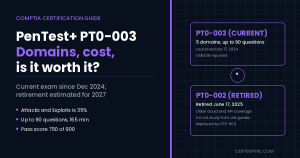
| PenTest+ | PT0-003 | $404 | Intermediate | Penetration testing |
| SecurityX (formerly CASP+) | CAS-005 | $509 | Advanced | Security architecture |
Emerging Technology Certifications
| Certification | Exam Code | Cost | Level | Primary Domain |
| DataSys+ | DS0-001 | $358 | Intermediate | Database administration |
| DataX | Coming 2026 | TBD | Intermediate | Data analytics and AI |
The CompTIA Stackable Certification System: How It Works
One of CompTIA’s biggest advantages is its stackable certification program which combines multiple certifications into recognized career credentials. Stackable certifications help employers quickly identify validated skill sets.
When you hold two or more active CompTIA certifications simultaneously, you automatically earn a stackable credential without any additional exam. Here is every active stackable combination:
| Stackable Credential | Certifications Required | Career Signal |
| CIOS (IT Operations Specialist) | A+ and Network+ | Broad IT operations competency |
| CSIS (Secure Infrastructure Specialist) | A+, Network+, Security+ | Infrastructure with security foundation |
| CNSP (Network Security Professional) | Network+ and Security+ | Network security focus |
| CSAP (Security Analytics Professional) | CySA+ and SecurityX | Advanced security analytics |
| CPENTEST (Penetration Testing Professional) | Security+, CySA+, PenTest+ | Complete offensive security portfolio |
| CIPM (Infrastructure and Penetration Management) | A+, Network+, Security+, CySA+ | Broad security management |
| CLNP (Linux Network Professional) | Network+ and Linux+ | Linux networking focus |
The practical implication: If you plan to eventually hold Security+ and Network+, you automatically earn CNSP. Planning your sequence to accumulate stackables is a smarter strategy than treating each certification as an isolated credential. Our CompTIA stackable certifications guide covers every combination and which stacks are most valued by employers.
The Core CompTIA Roadmap: Where to Start
The first question is not which CompTIA certification is best. It is where you are right now.
Starting Point Decision Tree
| Your Situation | Start Here |
| Zero IT experience, no technical background | Tech+ or A+ |
| Some general IT experience (1 to 2 years help desk) | A+ or skip to Network+ |
| Networking background from any role | Network+ directly |
| IT professional transitioning to cybersecurity | Security+ directly |
| Student in IT or computer science program | A+ to establish formal credential |
| Military or government IT background | Security+ — DoD compliance path |
| Career changer from non-technical field | Tech+ first, then A+ |
The most expensive mistake in CompTIA certification planning is getting the wrong cert first. A+ when you should have started with Network+. If you are considering Network+ as your entry point, try these free Network+ N10-009 practice questions to determine whether your current networking knowledge is strong enough. Security+ before you had the networking foundation. That is months of study time and $265 to $530 in exam fees pointed at the wrong target.
Path 1: IT Support and Infrastructure Track
This is the foundational path for anyone entering IT in a support, operations, or infrastructure role. It builds the broadest possible foundation before specialization.
The Infrastructure Path
| Stage | Certification | Cost | Avg US Salary Unlocked | Time to Prepare |
| 1 | A+ (Core 1 + Core 2) | $506 (2 exams) | $40,000 to $62,000 | 6 to 12 weeks |
| 2 | Network+ | $358 | $60,000 to $80,000 | 8 to 12 weeks |
| 3 | Server+ or Linux+ | $358 | $65,000 to $85,000 | 6 to 10 weeks |
| Stackable earned | CIOS (A+ and Network+) | $0 additional | — | Automatic |
Total exam investment: $1,222 for all three certifications
Who this path is for: Help desk technicians, IT support specialists, desktop support engineers, junior system administrators, and anyone building a foundation before specializing in cybersecurity or cloud.
The honest truth about A+: A+ is a $506 two-exam investment that opens help desk and IT support roles. If you are new to these responsibilities, working through free CompTIA A+ 220-1201 Core 1 practice questions can help you assess your understanding of hardware, networking, mobile devices, virtualization, and troubleshooting. If you already have 2 or more years of hands-on IT support experience, skip A+ and go directly to Network+. Your real-world experience covers what A+ validates. Spending 12 weeks on A+ when you already do the job is not the best use of your certification investment. For the complete comparison of A+ and Network+ to decide which to take first, our CompTIA A+ vs Network+ guide covers every difference in detail.
Path 2: Cybersecurity Track
This is the most searched CompTIA path in 2026 because cybersecurity roles have the highest salary potential in the CompTIA ecosystem and the largest number of unfilled positions globally.
The Cybersecurity Path
| Stage | Certification | Cost | Avg US Salary | Time to Prepare |
| 1 | A+ (optional for career changers) | $506 | $40,000 to $62,000 | 6 to 12 weeks |
| 2 | Network+ | $358 | $60,000 to $80,000 | 8 to 12 weeks |
| 3 | Security+ | $404 | $75,000 to $105,000 | 6 to 12 weeks |
| 4 | CySA+ | $425 | $85,000 to $115,000 | 6 to 10 weeks |
| 5 | SecurityX | $509 | $100,000 to $145,000 | 10 to 14 weeks |
| Stackable earned | CSIS, CNSP, CSAP | $0 additional | — | Automatic |
Total exam investment (full path): $2,202
Who this path is for: Security analysts, SOC analysts, security engineers, threat hunters, incident responders, and professionals targeting government or DoD cybersecurity positions.
Security+ is the most important CompTIA certification. It is the entry credential for the entire cybersecurity job market and meets DoD 8570/8140 IAT Level II requirements. Security+ remains one of the most in-demand cybersecurity certifications, required for many DoD positions and widely accepted in private sector roles. Candidates preparing for this stage can use these free Security+ SY0-701 practice questions to evaluate their knowledge across the current exam objectives. Its vendor-neutral approach ensures broad applicability.
The Network+ before Security+ rule: You can take Security+ without Network+ — it has no formal prerequisites. But skipping ahead without prerequisite knowledge can make certification exams significantly harder. Candidates who take Security+ without Network+ consistently struggle with the networking security domain which represents 15 to 20 percent of the Security+ exam. For the complete comparison, our Network+ vs Security+ guide covers exactly when Network+ first makes sense.
Path 3: Offensive Security and Penetration Testing Track
This is the most technically demanding CompTIA path and the one that connects directly to the broader offensive security certification ecosystem.
The Offensive Security Path
| Stage | Certification | Cost | Avg US Salary | Time to Prepare |
| 1 | Network+ | $358 | $60,000 to $80,000 | 8 to 12 weeks |
| 2 | Security+ | $404 | $75,000 to $105,000 | 6 to 12 weeks |
| 3 | PenTest+ | $404 | $90,000 to $130,000 | 8 to 14 weeks |
| 4 | CySA+ (recommended alongside) | $425 | $85,000 to $115,000 | 6 to 10 weeks |
| Stackable earned | CNSP, CPENTEST | $0 additional | — | Automatic |
Total exam investment (full path): $1,591
PenTest+ vs OSCP — the honest comparison: CompTIA PenTest+ is a multiple choice and performance-based exam covering penetration testing methodology. OSCP (OffSec Certified Professional) is a 24-hour live exploitation exam. PenTest+ is vendor-neutral which sounds great in theory but means it does not carry the weight of OSCP in actual penetration testing hiring. PenTest+ is the right choice for DoD compliance, government roles, and structured career entry. OSCP is the right choice for dedicated penetration testing firms and red team roles where technical credibility matters more than vendor-neutral coverage.
Path 4: Cloud and Infrastructure Track
Cloud+ is vendor-neutral which sounds great in theory but means it does not carry the weight of AWS Solutions Architect or Azure Administrator in actual cloud hiring. If you are building a cloud career, get a vendor-specific cert first.
This is the honest reality that most CompTIA roadmap guides will not tell you. Cloud+ exists and it has value — but it is not the primary cloud certification for landing cloud engineering roles. Here is how to use it correctly:
The Cloud Infrastructure Path
| Stage | Certification | Cost | Context |
| 1 | A+ | $506 | Foundation for hardware and OS |
| 2 | Network+ | $358 | Networking foundation for cloud |
| 3 | Cloud+ | $358 | Vendor-neutral cloud foundations |
| 4 | AWS Solutions Architect or AZ-104 | $300 or $165 | Vendor-specific — this is where cloud jobs come from |
The CompTIA Cloud+ role: Use Cloud+ as a vendor-neutral supplement that proves general cloud knowledge while you prepare for AWS or Azure certifications. On its own without a vendor-specific credential, Cloud+ has limited job market impact. Combined with AWS or Azure, it demonstrates both platform knowledge and vendor-neutral principles.
For the complete comparison of AWS versus Azure certifications including which pays more and which opens more jobs, our AWS vs Azure certification guide covers every dimension.
Path 5: Linux and Systems Administration Track
Linux+ in particular has become more relevant as Linux skills get baked into more job descriptions. A+ → Network+ → Linux+ is a reasonable infrastructure-focused trifecta variant if you are not chasing security roles.
The Linux Path
| Stage | Certification | Cost | Avg US Salary | Notes |
| 1 | A+ | $506 | $40,000 to $62,000 | Optional with IT background |
| 2 | Network+ | $358 | $60,000 to $80,000 | Essential before Linux+ |
| 3 | Linux+ | $358 | $65,000 to $90,000 | Validates practical Linux skills |
| Stackable earned | CLNP (Network+ and Linux+) | $0 additional | — | Automatic |
Linux+ vs RHCSA: Linux+ is vendor-neutral and multiple choice based. RHCSA (Red Hat Certified System Administrator) is a hands-on performance exam testing real command-line skills on a live RHEL system. In enterprise Linux environments — particularly those running Red Hat — RHCSA carries more weight than Linux+. Use Linux+ as your vendor-neutral credential for job market breadth. Pursue RHCSA if your career is specifically in enterprise Linux administration.
Path 6: Data and AI Track (New in 2026)
DataSys+ and DataX are CompTIA’s newest additions and frankly still earning their reputation in the market. If your employer specifically asks for them, get them. If they do not, vendor certs — Snowflake, Databricks, AWS data — probably move the needle more right now.
The Data Track
| Stage | Certification | Cost | Notes |
| 1 | DataSys+ | $358 | Database administration foundations |
| 2 | DataX | TBD | Data analytics and AI — launching 2026 |
The honest assessment of DataSys+ and DataX: These certifications are new and still establishing market recognition. They are valid credentials for candidates whose employers specifically require them. For independent career advancement in data, AWS data certifications, Databricks certifications, and Microsoft Azure data certifications currently have stronger employer recognition. Watch these credentials over the next 12 to 18 months as they build market presence.
CompTIA Certifications and DoD 8570/8140 Compliance
This section is one of the most important for candidates targeting government and defense contractor roles — and the section that most competitors barely mention.
The US Department of Defense requires specific certifications for personnel with privileged access to DoD information systems under DoD 8570 and its successor DoD 8140. CompTIA certifications satisfy multiple categories.
| CompTIA Certification | DoD 8570/8140 Category | Impact |
| Security+ | IAT Level II, IAM Level I | Required for most DoD IT and cybersecurity positions |
| CySA+ | IAT Level III, CSSP Analyst | Advanced analyst roles |
| PenTest+ | CSSP Analyst, CSSP Infrastructure | Penetration testing roles |
| SecurityX (CASP+) | IAT Level III, IAM Level II, IASAE I and II | Senior security engineering and architecture |
| A+ | IAT Level I | Entry-level IT support roles |
| Network+ | IAT Level II | Network and IT positions |
The government contractor advantage: Defense contractors including Booz Allen Hamilton, Raytheon, SAIC, CACI, and Leidos pay certification premiums because DoD compliance is mandatory for billing. Entry-level Security+ holders start at $75,000 to $90,000 in the Washington DC metro area — significantly above equivalent private sector roles. For active clearance holders with Security+, starting salaries of $90,000 to $110,000 are common for Tier 1 roles.
The Complete CompTIA Roadmap: Three Career Trajectories Visualized
Trajectory 1: IT Support to Cybersecurity Management (5 to 7 Years)
| Year | Certification | Role Available | Salary Range |
| 0 to 6 months | A+ | Help desk, IT support | $40,000 to $60,000 |
| 6 to 12 months | Network+ | Junior network admin | $60,000 to $80,000 |
| 12 to 18 months | Security+ | Security analyst, SOC Tier 1 | $75,000 to $100,000 |
| 18 to 24 months | CySA+ | SOC Tier 2, threat analyst | $85,000 to $115,000 |
| 2 to 3 years | SecurityX | Security architect, lead analyst | $100,000 to $145,000 |
| 5 to 7 years (add CISSP) | CISSP | Security manager, CISO track | $120,000 to $175,000 |
Trajectory 2: IT Support to Cloud Engineering (3 to 5 Years)
| Year | Certification | Role Available | Salary Range |
| 0 to 6 months | A+ | Help desk | $40,000 to $60,000 |
| 6 to 12 months | Network+ | Junior sysadmin | $60,000 to $80,000 |
| 12 to 18 months | Cloud+ | Cloud support | $70,000 to $90,000 |
| 12 to 18 months | AZ-104 or AWS SAA | Cloud engineer | $88,000 to $161,000 |
| 2 to 3 years | AZ-305 or AWS SAP | Cloud architect | $120,000 to $180,000 |
Trajectory 3: Direct Entry Cybersecurity (2 to 4 Years for experienced IT pros)
| Year | Certification | Role Available | Salary Range |
| 0 to 3 months | Security+ | Security analyst, SOC | $75,000 to $100,000 |
| 3 to 9 months | CySA+ | Threat analyst, SOC Tier 2 | $85,000 to $115,000 |
| 9 to 18 months | PenTest+ | Penetration tester entry | $90,000 to $130,000 |
| 18 to 30 months | SecurityX | Security architect | $100,000 to $145,000 |
CompTIA Roadmap: Salary Benchmarks by Certification
| Certification | Entry US Salary | Mid-Career US Salary | Top US Salary |
| A+ | $40,000 | $55,000 | $70,000 |
| Network+ | $60,000 | $75,000 | $90,000 |
| Security+ | $70,000 | $90,000 | $115,000 |
| Cloud+ | $70,000 | $88,000 | $110,000 |
| Linux+ | $65,000 | $85,000 | $105,000 |
| CySA+ | $80,000 | $100,000 | $120,000 |
| PenTest+ | $85,000 | $110,000 | $135,000 |
| SecurityX | $95,000 | $120,000 | $150,000 |
CompTIA Exam Cost Summary and Total Path Investment
| Certification | Exam Cost | Number of Exams | Total |
| Tech+ | $127 | 1 | $127 |
| A+ | $253 | 2 | $506 |
| Network+ | $358 | 1 | $358 |
| Security+ | $404 | 1 | $404 |
| CySA+ | $425 | 1 | $425 |
| PenTest+ | $404 | 1 | $404 |
| Cloud+ | $358 | 1 | $358 |
| Linux+ | $358 | 1 | $358 |
| Server+ | $358 | 1 | $358 |
| SecurityX | $509 | 1 | $509 |
Full cybersecurity path (A+ through SecurityX): $2,606 in exam fees over 3 to 4 years
Exam voucher discount strategy: CompTIA offers discounts through its academic partners and authorized training centers. Students can use academic pricing for 20 to 30 percent off standard exam fees. Retake bundles at approximately 50 percent of the exam fee are available through the Certmaster Learn platform. Our CompTIA exam preparation materials cover every active CompTIA certification with current practice questions.
What the CompTIA Roadmap Gets You That Vendor Certs Do Not
This is the angle every competitor misses completely — the honest comparison between CompTIA’s vendor-neutral path and vendor-specific alternatives.
| Factor | CompTIA Path | Vendor-Specific Path |
| Employer recognition | Universal — any employer in any industry | Strong in shops using that vendor |
| DoD compliance | Yes — multiple CompTIA certs meet DoD requirements | Only specific vendor certs meet DoD requirements |
| Platform independence | Applies to any environment | Locked to one vendor’s ecosystem |
| Cost per cert | $127 to $509 | $100 to $400 (varies by vendor) |
| Job posting frequency | Very high — listed across all sectors | High in vendor-specific environments |
| Best combined with | Vendor certs — CompTIA plus AWS or Azure or Cisco is the strongest profile | CompTIA for the foundation, vendor cert for the specialization |
The strongest career strategy in 2026: CompTIA fundamentals plus one vendor specialization. A+ and Network+ from CompTIA, then AWS Solutions Architect or AZ-104 for cloud — or Security+ from CompTIA, then AWS Security Specialty or SC-500 for cloud security. The vendor-neutral foundation plus vendor-specific depth is the profile that commands premium salaries across the widest range of employers. For the complete picture of how CompTIA fits alongside Microsoft Azure certifications, our IT certification roadmap covers every combination.
FAQS
What is the CompTIA certification roadmap?
The CompTIA certification roadmap is the recommended sequence of CompTIA certifications from foundational to advanced. The core path is A+ for IT support, Network+ for networking, Security+ for cybersecurity, then CySA+ or PenTest+ for specialization, and SecurityX for advanced security architecture. The recommended order is A+ then Network+ then Security+ then CySA+ or PenTest+, which ensures foundational knowledge before tackling advanced topics.
Which CompTIA certification should I get first?
Get A+ first if you have zero IT experience. Candidates choosing A+ must pass both exams, and these 220-1202 Core 2 practice test questions can help assess readiness for operating systems, security, software troubleshooting, and operational procedures. Get Network+ first if you have 1 to 2 years of IT experience. Get Security+ first if you have networking experience and are transitioning to cybersecurity. The correct starting point depends on your current experience level. Starting with the wrong certification wastes $265 to $530 in exam fees and months of study time.
How long does the CompTIA roadmap take to complete?
The complete cybersecurity path from A+ through SecurityX takes approximately 3 to 4 years studying part-time while working. Individual certifications take 6 to 14 weeks of preparation each depending on your background. Security+ alone takes 6 to 12 weeks. CySA+ takes 6 to 10 weeks. SecurityX takes 10 to 14 weeks.
What is the difference between CySA+ and PenTest+ on the roadmap?
CySA+ specializes in defensive security — threat detection, log analysis, vulnerability management, and incident response. PenTest+ specializes in offensive security — penetration testing methodology, planning, and reporting. Both build on Security+. Choose CySA+ if you want SOC analyst and defensive security roles. Choose PenTest+ if you want penetration tester and red team roles.
Does CompTIA have a cloud certification?
Yes — CompTIA Cloud+ (CV0-004) covers vendor-neutral cloud infrastructure. However most cloud engineering hiring managers prefer vendor-specific credentials like AWS Solutions Architect or AZ-104. Use Cloud+ as a foundation credential while pursuing a vendor-specific cloud certification alongside it.
How much does the full CompTIA roadmap cost?
The complete cybersecurity roadmap from A+ through SecurityX costs approximately $2,606 in exam fees. The networking path (A+ and Network+) costs $864. The security entry path (Network+ and Security+) costs $762. Individual exam costs range from $127 for Tech+ to $509 for SecurityX.
Do CompTIA certifications expire?
Yes. All CompTIA certifications except Tech+ are valid for 3 years and require renewal through 20 to 30 Continuing Education Units. Passing a higher-level CompTIA certification automatically renews lower-level certs. Passing CySA+ renews Security+ automatically. Passing SecurityX renews all lower-level CompTIA certifications.
Is the CompTIA roadmap recognized by the DoD?
Yes. Security+, CySA+, PenTest+, SecurityX, A+, and Network+ all meet DoD 8570/8140 requirements for various access levels and work roles. Security+ is the most widely required — it meets IAT Level II which is required for most DoD IT and cybersecurity positions.
What comes after SecurityX on the CompTIA roadmap?
After SecurityX, most professionals pursue vendor-specific or non-CompTIA credentials. CISSP for security management and CISO-track roles. CCSP for cloud security specialization. OSCP or GPEN for penetration testing depth. AWS or Azure security specializations for cloud security engineering.
Should I follow the CompTIA roadmap or go directly to CISSP?
Do not go directly to CISSP. CISSP requires 5 years of professional security experience in at least 2 of its 8 domains. Use the CompTIA roadmap to build foundational knowledge and your first 2 to 3 years of experience. Add CISSP when you have the experience requirement and are targeting senior security management or architect roles.