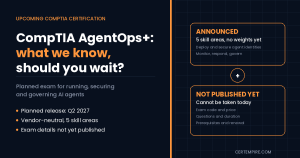
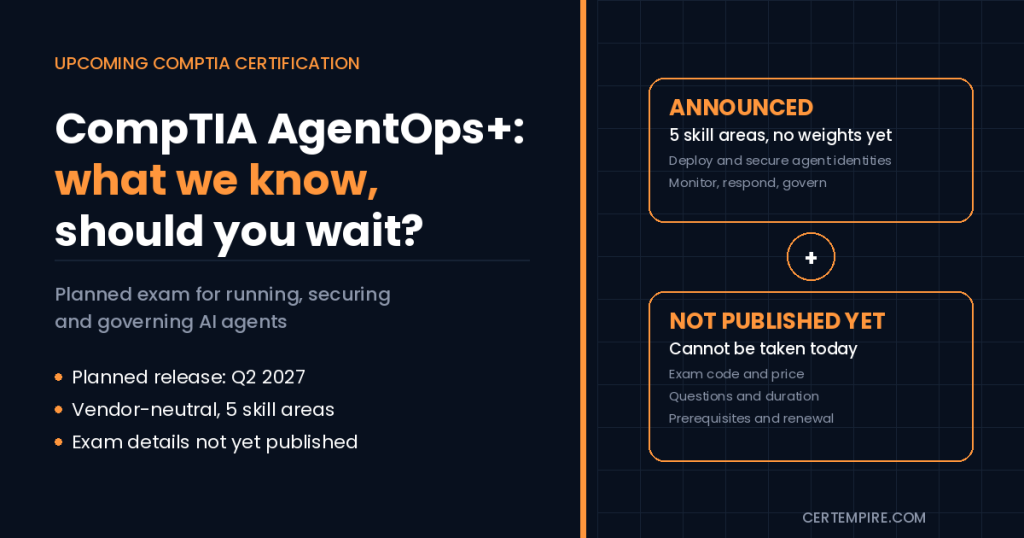
TL;DR: CompTIA has announced AgentOps+, a planned vendor-neutral certification for people who deploy, secure, monitor and govern AI agents. CompTIA is targeting Q2 2027 for the exam and a suite of learning products, so nobody can sit it today. What is public so far: five skill areas (deploying and integrating agents, securing agent identities and permissions, monitoring performance and behavior, responding to agent risks and incidents, and supporting governance and human oversight), an intended audience of DevOps, cloud, platform, sysadmin and security professionals, and a job task analysis workshop CompTIA ran in July 2026 to build the exam. What is not public: the exam code, number of questions, duration, passing score, price, prerequisites and retirement or renewal terms. If you work in operations or security and AI agents are coming into your environment, you should plan for this. It is not a reason to pause everything else you are doing, because you can build the skills now, and the credential will not exist for months.
New certifications are most useful to you early, when you can prepare before the crowd, and most dangerous to you early, when people write confident guides about exams that have not been published. This post separates what CompTIA has said from what we are inferring, so you can plan without guessing.
Quick Facts
| Item | Status |
| Name | CompTIA AgentOps+ |
| Type | Vendor-neutral certification (planned) |
| Announced | October 2026 |
| Planned release | Q2 2027, together with related learning products |
| Available to sit now | No |
| Intended audience | DevOps, cloud operations, platform engineering, systems administration and cybersecurity professionals |
| Announced skill areas | Five (listed below) |
| Exam code | Not published |
| Questions and duration | Not published |
| Passing score | Not published |
| Price | Not published |
| Prerequisites | Not published |
| Renewal terms | Not published |
| Job task analysis workshop | July 27 to 31, 2026, at CompTIA headquarters in Downers Grove, Illinois |
If you see a site giving a precise exam code, price or question count for AgentOps+, treat it as a guess. CompTIA has not released those details.
Why CompTIA Is Building This
CompTIA’s announcement frames the problem in one question: once organizations have AI agents running, who secures them, who governs them and who is accountable for what they do? The release points to survey data to show how fast this is moving. A KPMG survey from the first quarter of 2026 found that 54% of organizations are actively deploying AI agents, while a Deloitte finding cited in the release says only 21% of surveyed companies have a mature governance model for autonomous agents.
Read those two numbers together and the opening for a certification is obvious. Deployment is ahead of control. Someone has to run these systems the way operations teams run any production service: with identity and access management, monitoring, incident response, change control and audit trails. That is the gap AgentOps+ is meant to fill.
The name follows a pattern. Operations disciplines tend to get a suffix of their own once they mature: DevOps, SecOps, MLOps. AgentOps is the version for agentic systems, and CompTIA’s choice of the “Plus” brand puts it in the family of its professional-level credentials, though CompTIA has not said where it sits in the stack.
The Five Announced Skill Areas
CompTIA has published five skill areas but no weights. Our “what this likely means” column is our reading of each phrase based on how those tasks work in production. It is not a list of exam objectives.
| Skill area | What CompTIA says | What this likely means in practice |
| Deploying and integrating AI agents | Getting agents into real environments and connecting them to systems | Packaging and deploying agent workloads, connecting agents to APIs, tools and data sources, environment configuration, orchestration and rollout |
| Securing agent identities, permissions and data access | Treating agents as identities with limited rights | Service identities for agents, least privilege, secrets management, scoped tool access, data access boundaries, preventing agents from reaching what they should not |
| Monitoring performance, behavior and operational health | Watching agents the way you watch any production service, plus behavior | Logging and tracing agent actions, performance and cost metrics, drift in behavior, alerting, dashboards, capacity |
| Identifying and responding to agent-related risks and incidents | Knowing what can go wrong and what to do | Failure modes such as unintended actions, prompt injection, data leakage and runaway loops, incident response runbooks, rollback and containment |
| Supporting governance, accountability, auditability and human oversight | Making agent activity explainable and reviewable | Audit trails, approval steps, human-in-the-loop controls, policy alignment, evidence for auditors |
What stands out
Notice what is missing. The list says nothing about building agents, fine-tuning models or writing prompts. It is an operations credential. A person who builds an agent for a living and has never run a production service will find this exam closer to “what happens after launch” than to anything in their daily work.
Also notice that three of the five areas (identities and permissions, monitoring, incident response) are classic infrastructure and security topics applied to a new kind of workload. If you already do that work for conventional systems, you are closer to ready than you may think.
Who It Is For: What the Exam-Development Workshop Reveals
CompTIA does not publish prerequisites yet, but it did publish the profile it was looking for when it recruited subject matter experts to help build the exam. The job task analysis workshop ran July 27 to 31, 2026, and its requirements give a useful picture of the target candidate. These are the requirements for workshop participants, not for exam candidates, so read them as a signal and not as a rule.
| Profile element | What CompTIA asked for |
| Experience | 2 to 3 or more years in a hands-on production operations role |
| Containers | Practical experience with containerized workloads (Docker) on Kubernetes or a managed platform |
| Automation | Infrastructure as Code and automation, for example Terraform and Helm |
| Access control | Working knowledge of IAM, RBAC and secrets management |
| Troubleshooting | Proven use of logs, metrics, traces and runbooks |
| Preferred | Exposure to LLM applications, retrieval-augmented generation pipelines or agent frameworks, agent orchestration and tool integration, observability for AI systems, governance and compliance, and CI/CD for ML and AI workloads |
That list reads like a description of a platform engineer or site reliability engineer who has started working with AI. If that is you, the credential is aimed at you. If you are a help desk technician or a developer with no operations experience, the exam will probably be a stretch in its first year, and it is worth building the underlying skills first.
Roles that look like a fit
| Role | Why it fits |
| Platform engineer | You own the runtime where agents will run |
| Site reliability or DevOps engineer | Monitoring, deployment and incident response are your daily work |
| Cloud operations engineer | You manage the infrastructure and identities agents use |
| Systems administrator moving into cloud and AI | The operations discipline carries over |
| Security engineer or analyst | Agent identities, access and risk are security questions |
| Governance, risk and compliance specialist with technical depth | Auditability and oversight are central |
What We Do Not Know Yet
This is the list that matters if you are deciding whether to wait.
| Open question | Why it matters |
| Exam code and objective document | Until the objectives are published, nobody can map the exam precisely |
| Weighting of the five areas | Tells you where the marks are |
| Question count, duration, format | Affects pacing and whether there are performance-based items |
| Price | Affects budget and employer approval |
| Prerequisites or recommended experience | Decides whether you can sit it |
| Renewal and validity | Decides the long-term cost |
| Whether other credentials count toward it | Decides whether you can use what you already hold |
| Exact release date inside Q2 2027 | A Q2 target can mean April or June |
| Beta availability | Early access can come before the general release |
Plan around these gaps. Do not buy a “complete AgentOps+ study guide” from a seller who claims to know the answers, because none of them can.
How It Fits Into CompTIA’s Other Credentials
CompTIA has been building an AI portfolio in layers for some time. In March 2024 it announced a roadmap with a foundational series and an advanced series that builds on existing certifications: security-focused products tied to Security+, CySA+ and PenTest+, plus planned products for data analysts, systems operations, tech support, AI architects and prompt engineers. More recently it launched AI Agent Essentials, a course with a CompCert assessment aimed at non-technical and lightly technical professionals.
Where AgentOps+ will sit relative to those is not stated. CompTIA’s announcement of AgentOps+ does not mention AI Agent Essentials, so we cannot say whether it is a stepping stone. Our reading is that AI Agent Essentials is for people who work with agents (product, operations, analytics) and AgentOps+ is for people who run them, but treat that as inference.
AI Agent Essentials in brief
CompTIA’s page describes AI Agent Essentials as a course plus a CompCert assessment taking roughly 4 to 5 hours. It lists six learning areas:
- Identifying where agents add value compared with chatbots or simple automation
- Breaking real tasks into steps that agents can execute and checking each step
- Guiding agent behavior through context, instructions, tool access and autonomy levels
- Deciding what agents should store, retrieve or discard across short-term and long-term memory
- Applying guardrails, least-privilege tool access and human review at critical points
- Evaluating outputs, monitoring performance and communicating failures, with hands-on practice in an agent simulator
The page does not state a price, exam code or prerequisites. It is a practical way to learn the vocabulary if agents are new to you, but it is not the same thing as AgentOps+.
For the established CompTIA ladder that this will join, see our CompTIA certification roadmap and our guide to CompTIA stackable certifications.
Should You Wait for AgentOps+?
It depends on where you are today.
| Your situation | What to do | Why |
| Already running production workloads and starting to host agents | Prepare now, plan to sit it in the first half of 2027 | You already have the base skills, and the exam will validate them |
| Security professional with Security+ or similar | Keep building security depth, and add agent-specific skills | The identity and incident areas map to your work. See our Security+ SY0-701 exam page |
| Network or systems admin with Network+ or Linux+ | Strengthen cloud, containers and automation first | Those are the likely foundations. See our Network+ N10-009 exam page and the Linux+ XK0-006 guide |
| Pentester or offensive security professional | Learn how agents expand the attack surface | Risk and incident response overlap with your skills. See our PenTest+ PT0-003 exam page |
| Experienced security architect | Watch the objectives when they appear | Your existing architecture credentials already cover most of the governance and risk themes |
| IT beginner | Do not wait for this. Build fundamentals first | It targets people with operations experience |
| Developer building agents, no operations background | Learn deployment, identity and monitoring, then revisit | The exam is about running agents, not writing them |
| Manager or governance lead | Follow the governance and oversight area | You may be better served by a governance-focused credential |
The practical rule is simple. If you would be a candidate for AgentOps+ in six months, start doing the work now. If you would not, the announcement does not change your plan.
How to Prepare Before the Objectives Appear
You cannot study to an objective list that does not exist, but you can build the skills the five areas imply. This eight-week plan assumes 5 to 6 hours a week and a hands-on lab, not a classroom.
| Week | Focus | Output |
| 1 | Pick one agent framework or hosted agent service and build a small agent that calls two tools | A working agent in a sandbox |
| 2 | Containerize it and deploy it to Kubernetes or a managed container platform | A deployed agent with a repeatable deployment file |
| 3 | Put the deployment under Infrastructure as Code | A Terraform or Helm definition you can rebuild from scratch |
| 4 | Give the agent its own identity and least-privilege access to one data source | A written access policy and a test that proves it cannot reach anything else |
| 5 | Add logging, tracing and a simple dashboard for agent actions, latency and cost | A dashboard with at least three useful signals |
| 6 | Break it on purpose: unexpected tool input, runaway loops, a malicious prompt | A short incident note with cause, containment and prevention |
| 7 | Add an approval step for high-risk actions and an audit log | A reviewable trail of what the agent did and who approved it |
| 8 | Review CompTIA’s published objectives if available, and fill gaps | A gap list against the real exam outline |
Doing this once, end to end, teaches you more about the five areas than any reading list. It also gives you something concrete to talk about in an interview.
Common Mistakes to Avoid
- Buying prep material before objectives exist. Anything sold now as an AgentOps+ study guide is guesswork.
- Assuming it is a prompt engineering credential. The announced skills are about operations, security and governance.
- Confusing it with AI Agent Essentials. One is a course and assessment for non-technical roles. The other is a planned professional certification.
- Skipping the fundamentals. The workshop profile points to containers, Infrastructure as Code and IAM. Weak foundations will hurt more than weak agent knowledge.
- Waiting passively. Six months is enough time to build the skills. It is not enough time to catch up if you start the week the exam opens.
- Treating agent identity as an afterthought. Of the five areas, access and permissions are the ones most likely to be tested in scenario form.
- Ignoring governance. Auditability and human oversight are a full skill area, not a footnote.
Is It Worth Waiting For?
We cannot judge the exam yet, so here is what we can say about the credential’s likely value.
In its favor. CompTIA is vendor-neutral, widely recognized in IT operations and security, and its credentials are commonly referenced in job requirements and government and enterprise training programs. The topic is also timely. The survey figures in CompTIA’s release suggest that organizations are deploying agents faster than they can govern them, which is the kind of gap that creates demand for a standard.
Against it, for now. The exam does not exist. Price, format and prerequisites are unknown. New credentials take time to appear in job postings, and the first version of any exam tends to change as feedback comes in.
Our view. The preparation is worth doing regardless, because the skills (agent deployment, identity, monitoring, incident response and governance) are useful in any operations or security role that touches AI. The exam itself is worth a decision once CompTIA publishes the objectives, the price and the format. Until then, build the skills and keep your budget flexible. We have left salary figures out because no source separates people who hold a credential that has not launched from the wider operations market.
The official announcement is on CompTIA’s site: CompTIA launches effort to define workforce skills for AI agents. For the wider picture of how vendors are building agentic AI into their programs, see our post on Oracle’s agentic AI certification track, our Artificial Intelligence certification hub and the CompTIA certifications hub.
FAQs
1. What is CompTIA AgentOps+?
It is a planned vendor-neutral CompTIA certification for professionals who deploy, secure, monitor and govern AI agents. It covers AI, cybersecurity, cloud infrastructure and IT operations.
2. When will AgentOps+ be released?
CompTIA is targeting Q2 2027 for the certification and related learning products. No exact date has been published.
3. Can I take the exam now?
No. It has been announced, but it is not available.
4. What are the exam domains?
CompTIA has named five skill areas: deploying and integrating AI agents, securing agent identities, permissions and data access, monitoring performance, behavior and operational health, identifying and responding to agent-related risks and incidents, and supporting governance, accountability, auditability and human oversight. Weights and formal objectives have not been published.
5. How much will it cost?
CompTIA has not announced a price. Any figure you see is a guess.
6. How many questions will it have and how long will it be?
Not announced. The same is true of the passing score and question types.
7. Are there prerequisites?
None have been announced. The profile CompTIA used to recruit exam developers (2 to 3 or more years in a hands-on production operations role, with containers, Infrastructure as Code, IAM and troubleshooting skills) suggests who the exam is aimed at, but it is not an official prerequisite list.
8. Who should take it?
DevOps, cloud operations, platform engineering, systems administration and cybersecurity professionals who deploy, run or secure AI agents.
9. Is AgentOps+ the same as AI Agent Essentials?
No. AI Agent Essentials is a course with a CompTIA assessment for non-technical and lightly technical professionals, taking roughly 4 to 5 hours. AgentOps+ is a planned professional certification for operations and security staff.
10. Is it a beginner certification?
It does not look like one. The target audience and the recruitment profile point to people with hands-on operations experience.
11. Should I wait for it or take another CompTIA exam now?
Do not pause your plans. If you would be a candidate in six months, start building the skills now. If you are earlier in your career, a fundamentals or Security+ path is a better first step.
12. What can I do to prepare today?
Build and deploy a small agent, put it under Infrastructure as Code, give it a least-privilege identity, add monitoring and an audit trail, and practice responding when it fails. The eight-week plan above walks through it.
13. Will it replace any existing CompTIA certification?
Nothing in the announcement says so. It is described as a new certification, not a replacement.