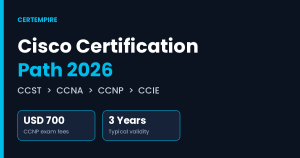
TL;DR: The Cisco certification path has five levels: Entry (CCST), Associate (CCNA), Professional (CCNP), Expert (CCIE and CCDE) and Specialist exams that you earn along the way. There are no formal prerequisites at any level, so you can start anywhere, but the sensible order for most people is CCNA first, then one CCNP track, then CCIE if you want the expert level. The big change is the February 3, 2026 restructuring: DevNet became CCNA, CCNP and CCIE Automation, and CyberOps became CCNA and CCNP Cybersecurity, with CCNP and CCIE Wireless also back as their own track. Every CCNP works the same way: one core exam (USD 400) plus one concentration exam of your choice (USD 300), so a CCNP costs USD 700 in exam fees. CCNA 200-301 costs USD 300 (120 minutes), CCST exams cost USD 125 (50 minutes) and CCIE labs cost USD 1,600 (8 hours). Most certifications are valid for three years, renewable through continuing education credits (30 for Associate, 80 for Professional, 120 for CCIE) or by passing another exam. One date matters right now: the current CCNA (v1.1) can be taken until February 2, 2027, and the refreshed CCNA v2.0 launches on February 3, 2027 with the same exam code, 200-301. Our recommendation: if you are starting from zero, go CCNA, then CCNP Enterprise, then specialize (security, data center, wireless, automation or cybersecurity) based on the jobs you actually want.
Key Takeaways
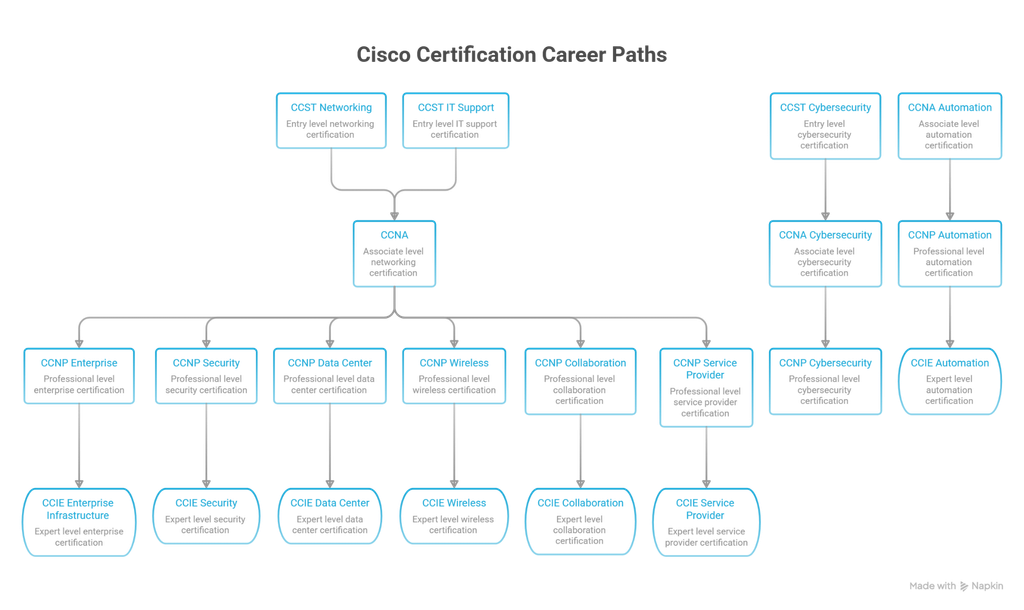
- The path is levels plus tracks. Levels: CCST, CCNA, CCNP, CCIE. Tracks: Enterprise, Security, Cybersecurity, Data Center, Automation, Collaboration, Wireless, Service Provider.
- No prerequisites. Cisco’s CCST page says “CCST certifications have no prerequisites and are available to anyone,” and the CCNP exams list “Prerequisites: None.”
- CCNP = core plus concentration. Pass the core exam and one concentration exam. Each exam you pass also earns a Specialist certification, so you collect credentials along the way.
- The core exam does double duty. The CCNP core exam (for example, ENCOR 350-401) is also the written exam for the matching CCIE, so you take it once.
- Renewal is every three years for most certifications, with no extensions. CCST certifications earned on or after July 15, 2025 are valid for five years.
- The 2026 changes matter. DevNet is now Automation, CyberOps is now Cybersecurity, wireless is back and the CCNA is being refreshed in February 2027.
- BLS pay is strong at the top of the ladder. Computer network architects had a median wage of USD 134,050 (May 2025). Network and computer systems administrators were at USD 99,130, and computer support specialists at USD 62,890.
Cisco Certification Levels, Exams and Fees
| Level | Certification | Exam (code) | Duration | Fee (USD) | Source |
| Entry | CCST Networking | 100-150 | 50 minutes | 125 | Cisco exam page |
| Entry | CCST Cybersecurity | 100-160 | 50 minutes | 125 | Cisco exam page |
| Entry | CCST IT Support | 100-140 | Not read | 125 | Cisco CCST FAQ |
| Associate | CCNA | 200-301 | 120 minutes | 300 | Cisco exam page |
| Associate | CCNA Automation | 200-901 CCNAAUTO v1.1 | 120 minutes | 300 | Cisco exam page |
| Associate | CCNA Cybersecurity | 200-201 CCNACBR v1.2 | 120 minutes | 300 | Cisco exam page |
| Professional | Any CCNP, core exam | 350-xxx | 120 minutes | 400 | Cisco track pages |
| Professional | Any CCNP, concentration exam | 300-xxx | 90 minutes | 300 | Cisco track pages |
| Expert | CCIE written (the core exam) | 350-xxx | 120 minutes | 400 | Cisco CCIE pages |
| Expert | CCIE lab | Track-specific | 8 hours | 1,600 | Cisco CCIE pages |
| Specialist | Meraki Solutions Specialist | 500-220 ECMS | 90 minutes | 300 | Cisco exam page |
Fees can be paid with Cisco Learning Credits. Prices are in USD as shown on Cisco’s pages and can change or vary by country because of taxes.
What the exam fees add up to (our arithmetic)
| Goal | Exams | Exam fees only (USD) |
| CCNA | 200-301 | 300 |
| CCNP (one track) | Core 400 + concentration 300 | 700 |
| CCNA then CCNP | 300 + 700 | 1,000 |
| CCIE (one track) | Core 400 + lab 1,600 | 2,000 |
| CCNA, then CCNP, then CCIE in the same track | 300 + 700 + 1,600 (the core exam is reused as the CCIE written) | 2,600 |
These numbers exclude training, practice labs, retakes, travel for the lab and tax. They are a floor, not a budget.
Step 1: Entry Level, CCST (Cisco Certified Support Technician)
CCST is Cisco’s entry credential for people with little or no IT background.
- Three exams: CCST Networking (100-150), CCST Cybersecurity (100-160) and CCST IT Support (100-140).
- Fee: USD 125 each. Cisco’s pages show 50-minute exams for Networking and Cybersecurity.
- Prerequisites: none. Cisco says CCST certifications “are not prerequisites for the CCNA” but “provide a solid foundation.”
- Validity: certifications earned on or after July 15, 2025 are valid for 5 years. Earlier CCST certifications remain valid for life. CE credits do not apply to CCST renewal. You renew by passing a CCST, Associate, Professional or Expert exam.
- Jobs it points to (per Cisco): CCST Networking leads to network technician and customer support technician roles. CCST Cybersecurity leads to cybersecurity technician, analyst and Tier 1 help desk roles. CCST IT Support leads to help desk and computer support specialist roles.
Do you need it? No. If you already have some networking exposure, go straight to CCNA. CCST makes sense if you are changing careers and want a low-cost first credential and a structured study path (ours). Compare it with other starting points in our guide to the best networking certifications.
Step 2: Associate Level, CCNA (And Its Siblings)
CCNA 200-301 (the standard)
- Exam: Implementing and Administering Cisco Solutions (200-301 CCNA).
- Duration and fee: 120 minutes, USD 300 (or Cisco Learning Credits).
- Topics (Cisco’s page): network fundamentals, network access, IP connectivity, IP services, security fundamentals, and automation and programmability.
- Languages: English and Japanese.
- Validity: most Cisco certifications last three years from the date you earn them.
The version you need to know about (dates from Cisco’s blog, May and later 2026):
| Date | What happens |
| May 20, 2026 | Cisco publishes the refreshed CCNA exam topics (the first major CCNA blueprint change since 2019) |
| February 2, 2027 | Last day to test on CCNA v1.1 |
| February 3, 2027 | CCNA v2.0 goes live. The exam code stays 200-301 |
Cisco’s advice is to keep studying for the current exam rather than wait, because the skills carry over. A third-party analysis reports the v2.0 revision reorganizes topics into five domains, adds troubleshooting emphasis and adds topics such as Ansible and agentic AI for network operations, and says Cisco had not announced a fee or format change. We treat those details as unofficial until you check Cisco’s v2.0 topic list. For the full breakdown, read our CCNA 200-301 v2.0 update and our look at whether a new CCNA exam is coming. To judge the value, see is CCNA worth it, and practice with our free CCNA 200-301 practice test.
Ours: if you can pass before February 2, 2027, v1.1 has more study material available today. If you are starting now with six months or more, either version works, and you should check the topic list for the version you will actually sit.
CCNA Automation (formerly DevNet Associate)
- Exam: 200-901 CCNAAUTO v1.1, “Automating Networks Using Cisco Platforms.”
- Duration and fee: 120 minutes, USD 300.
- Covers (Cisco’s page): understanding and using APIs, application deployment and security, and infrastructure and automation on Cisco platforms.
- Rename: Cisco’s May 2025 announcement says the DevNet track is rebranded as CCNA, CCNP and CCIE Automation, effective February 3, 2026, and that active DevNet Associate, Professional and Expert holders become CCNA, CCNP and CCIE Automation certified. See DevNet vs CCNA Automation and our rename map, and practice with the 200-901 practice test.
CCNA Cybersecurity (formerly CyberOps Associate)
- Exam: 200-201 CCNACBR v1.2, “Understanding Cisco Cybersecurity Operations Fundamentals.”
- Duration and fee: 120 minutes, USD 300.
- Validity: Cisco’s exam page does not state a validity period and says the exam can be used toward recertification.
- Rename: Cisco’s announcement says active CyberOps holders are recognized as CCNA or CCNP Cybersecurity at their current level. Our CyberOps vs CCNA Cybersecurity comparison explains what changed. Practice with the 200-201 practice test.
Step 3: Professional Level, the CCNP Tracks
Every CCNP follows the same rule from Cisco’s pages: “To earn your certification, you’ll take a core exam and a concentration exam of your choice.” Both exams are valid for three years, and each one you pass also earns a Specialist certification.
CCNP track summary
| Track | Core exam (USD 400) | Concentration exams (USD 300 each, pick one) |
| Enterprise | 350-401 ENCOR | 300-410 ENARSI, 300-415 ENSDWI, 300-420 ENSLD, 300-435 ENAUTO, 300-440 ENCC, 300-445 ENNA |
| Security | 350-701 SCOR | 300-710 SNCF, 300-715 SISE, 300-740 SSCA, 300-745 SDSI |
| Cybersecurity | 350-201 CBRCOR | 300-215 CBRFIR, 300-220 CBRTHD |
| Data Center | 350-601 DCCOR | 300-610 DCID, 300-615 DCIT, 300-620 DCACI, 300-635 DCNAUTO, 300-640 DCAI |
| Automation | 350-901 AUTOCOR | 300-435 ENAUTO, 300-635 DCNAUTO |
| Wireless | 350-101 WLCOR | 300-110 WLSD, 300-120 WLSI |
| Collaboration | 350-801 CLCOR | 300-815 CLACC, 300-820 CLHCT, 300-830 CLCCE |
| Service Provider | 350-501 SPCOR | 300-510 SPRI, 300-515 SPVI, 300-540 SPCNI |
All concentration exams are 90 minutes. Core exams are 120 minutes. Cisco’s page for the Enterprise track no longer lists wireless concentration exams, because wireless now has its own track.
CCNP Enterprise (the default professional path)
- Core: 350-401 ENCOR, “Implementing Cisco Enterprise Network Core Technologies.”
- Concentrations: ENARSI (advanced routing and services), ENSDWI (Catalyst SD-WAN), ENSLD (design), ENAUTO (automation), ENCC (secure cloud connectivity) and ENNA (network assurance, English only).
- Best for: network engineers, most enterprise infrastructure roles.
- Guides: our ENCOR 350-401 study guide, and CCNA vs CCNP to decide whether you are ready. A third-party source says the ENCOR exam moved to version 2.0 and added SD-WAN multi-cloud and newer Wi-Fi content, which we have not confirmed on Cisco’s page.
CCNP Security
- Core: 350-701 SCOR, “Implementing and Operating Cisco Security Core Technologies,” 120 minutes. A third-party source says SCOR moved to v2.0 in August 2026 with added Zero Trust and AI security topics. Confirm which version your study material matches.
- Concentrations: SNCF (firewalls), SISE (Identity Services Engine), SSCA (secure cloud access for users and endpoints) and SDSI (designing security infrastructure).
- Best for: firewall, identity and secure access engineers.
- Guides: CCNP Security SCOR study guide, and practice with the 350-701 practice test, 300-710 practice test, 300-715 practice test and 300-745 practice test.
CCNP Cybersecurity
- Core: 350-201 CBRCOR, “Performing Cybersecurity Using Cisco Security Technologies,” 120 minutes.
- Concentrations: 300-215 CBRFIR (forensic analysis and incident response) and 300-220 CBRTHD (threat hunting and defending).
- Best for: SOC analysts, incident responders and threat hunters.
CCNP Security vs CCNP Cybersecurity (ours): Security is about building and operating security infrastructure (firewalls, identity, cloud access). Cybersecurity is about detecting and responding (investigation, forensics, hunting). If your job title says “security engineer,” start with Security. If it says “SOC analyst” or “incident responder,” start with Cybersecurity. For a wider view across vendors, see our cybersecurity certification roadmap.
CCNP Data Center
- Core: 350-601 DCCOR, “Implementing and Operating Cisco Data Center Core Technologies.”
- Concentrations: DCID (design), DCIT (troubleshooting), DCACI (Application Centric Infrastructure), DCNAUTO (automation) and DCAI (Data Center AI Infrastructure, newer).
- CCIE Data Center: lab exam v3.1, USD 1,600, 8 hours. Cisco’s May 2026 blog says CCIE Data Center exam topics with an AI module are planned for Cisco Live Melbourne (November 2026), with practice labs at Cisco Live London (February 2027).
- Practice: 300-620 DCACI, 300-615 DCIT and 300-635 DCNAUTO.
CCNP Automation
- Core: 350-901 AUTOCOR, “Designing, Deploying and Managing Network Automation Systems.”
- Concentrations: ENAUTO (enterprise automation) or DCNAUTO (data center automation). Cisco’s page shows “Prerequisites: None.”
- Best for: network automation engineers, NetDevOps and developers moving into networking.
- Where DevNet went: the old DevNet Associate, Professional and Expert names are retired in favor of CCNA, CCNP and CCIE Automation. Our DevNet vs CCNA Automation guide covers the mapping.
- Practice: 300-435 ENAUTO.
CCNP Wireless
- Core: 350-101 WLCOR, “Implementing and Operating Cisco Wireless Core Technologies” (USD 400, 120 minutes, no prerequisites).
- Concentrations: 300-110 WLSD (designing wireless networks) and 300-120 WLSI (implementing advanced wireless solutions).
- CCIE Wireless: WLCOR plus the CCIE Wireless Lab Exam v1.1 (USD 1,600, 8 hours).
- Relaunch: third-party sources report the dedicated wireless track relaunched on March 19, 2026. Cisco’s track pages we read did not state the date, so treat it as unofficial.
- Guides: CCNP Wireless complete guide, CCNP Wireless: is it worth it and the 350-101 practice test.
CCNP Collaboration
- Core: 350-801 CLCOR, “Implementing and Operating Cisco Collaboration Core Technologies” (v2.0 per Cisco’s announcement).
- Concentrations: 300-815 CLACC (advanced call control, on-premises), 300-820 CLHCT (hybrid and cloud technologies) and 300-830 CLCCE (cloud customer experience, new).
- How it works: pick the concentration that matches your environment: on-premises, hybrid or cloud-only. Cisco’s announcement says the CLCCE exam is the only certification focused solely on the cloud.
- Practice: 300-830 practice test.
- Note: six older specialist exams (including CLAUTO and CLICA) retired on February 2, 2026, according to our Cisco certification changes analysis (not independently verified by us).
CCNP Service Provider
- Core: 350-501 SPCOR.
- Concentrations: 300-510 SPRI (advanced routing), 300-515 SPVI (VPN services) and 300-540 SPCNI (cloud network infrastructure).
- Best for: carrier and ISP engineers. Cisco’s page lists no separate SD-WAN concentration for this track.
CCNP Enterprise concentration for SD-WAN
Cisco’s SD-WAN exam sits inside the Enterprise track: 300-415 ENSDWI, “Implementing Cisco Catalyst SD-WAN Solutions” (USD 300, 90 minutes). The route is CCNA, then ENCOR plus ENSDWI. Passing ENSDWI earns a Specialist certification on its own, which is a useful milestone if you only need SD-WAN skills. We found no dedicated associate-level or expert-level SD-WAN certification on Cisco’s pages.
Step 4: Expert Level, CCIE and CCDE
CCIE (Cisco Certified Internetwork Expert)
CCIE has two parts: a written (core) exam and an 8-hour hands-on lab. Cisco’s pages show the same structure across tracks:
| CCIE track | Written / core exam | Lab exam | Lab fee (USD) |
| Enterprise Infrastructure | 350-401 ENCOR | CCIE Enterprise Infrastructure Lab Exam v1.1 | 1,600 |
| Security | 350-701 SCOR | CCIE Security Lab Exam v6.1 | 1,600 |
| Data Center | 350-601 DCCOR | CCIE Data Center Lab Exam v3.1 | 1,600 |
| Automation | 350-901 AUTOCOR | CCIE Automation practical exam v1.1 | 1,600 |
| Wireless | 350-101 WLCOR | CCIE Wireless Lab Exam v1.1 | 1,600 |
Written exams are USD 400 and 120 minutes. Passing the written exam also earns a Specialist certification. CCIE Collaboration and CCIE Service Provider are listed on Cisco’s site, but we did not read their lab details, so we do not publish those here.
Key facts:
- No prerequisites. You do not need CCNP before CCIE, but the CCNP core exam is the CCIE written exam, so a CCNP path gives you a head start.
- Recertification: CCIE needs 120 CE credits (or passing another qualifying exam) every three years. The recertification page says Cisco does not provide extensions.
- Retakes: the page lists a 30-calendar-day wait after a failed lab attempt and says you cannot retake an expert lab after passing unless your status becomes inactive.
- AI changes: Cisco’s May 20, 2026 blog describes a new one-hour CCIE AI Deploy, Operate, and Optimize Module, a shorter Design Module (three hours down to two), and an AI assistant inside the lab. The rollout order is Data Center first, with the AI-module exam planned for Cisco Live US 2027. Third-party sources add that Enterprise Infrastructure and Security labs added Crosswork Automation and Secure Firewall tasks from April 2026, which we could not confirm on Cisco’s pages.
Ours: CCIE preparation is commonly described by training providers as 12 to 18 months after CCNP-level knowledge. Cisco does not publish this, so treat it as a planning estimate. For the security side, weigh the lab fee and the preparation time against the roles you are targeting before you commit.
CCDE (Cisco Certified Design Expert)
CCDE is the design-focused expert credential. Cisco’s recertification page lists 120 CE credits for CCDE as for CCIE. A third-party source says CCDE now has elective specialist recognitions (such as Large Scale Networks and AI Infrastructure). Cisco’s pages we read do not detail them, so check Cisco before planning around that.
Cisco Meraki Certification Path
Cisco’s Meraki credential is the Cisco Meraki Solutions Specialist certification.
- Exam: 500-220 ECMS, “Engineering Cisco Meraki Solutions,” 90 minutes, USD 300 (or Learning Credits).
- Prerequisites: none formally. Cisco says candidates “should have familiarity with Cisco Meraki solutions.”
- What it covers: Meraki Dashboard and analytics, architecture and design, deployment and integration, cloud management, wireless, switching, security and SD-WAN, Meraki Insight, smart cameras and mobile device management.
- Validity: three years, renewable with Continuing Education credits or by retaking the exam.
- Training: Meraki’s page lists ECMS1 (a one-day introduction) and ECMS2 (a three-day advanced course).
- Caveat: Cisco’s Meraki certification page we read carries a July 2024 date, and we could not confirm any 2026 change to the exam. Check Cisco’s site for the current exam version.
Suggested Meraki path (ours): CCNA (or CCST Networking if you are brand new), then Meraki Solutions Specialist. Meraki is a specialty on top of networking basics, so it works well beside CCNP Enterprise instead of replacing it.
Cisco Network Certification Path
If your goal is a general network engineering career, the path is the Enterprise route:
- CCST Networking (optional)
- CCNA
- CCNP Enterprise (ENCOR plus one concentration)
- CCIE Enterprise Infrastructure (ENCOR plus the lab)
Sample timelines from a third-party roadmap: CCNA 3 to 6 months for a newcomer, CCNP a further 4 to 8 months, and CCIE lab preparation 12 to 18 months, about 2 to 3 years from a standing start. Cisco does not publish these, so they are planning ranges only.
What Is the Best Cisco Certification Path? (Our Recommendations)
There is no single best path. The right one depends on your starting point and the job you want. These recommendations are ours, built from Cisco’s structure and the BLS data below.
| If you are… | Recommended path | Why |
| New to IT | CCST Networking, then CCNA | Low-cost start with no prerequisites |
| Already doing networking, want a pay jump | CCNA, then CCNP Enterprise | The most widely recognized Cisco professional path |
| Interested in security engineering | CCNA, then CCNP Security (SCOR plus SNCF, SISE, SSCA or SDSI) | Matches firewall, identity and cloud access roles |
| Interested in SOC or incident response | CCST Cybersecurity or CCNA Cybersecurity, then CCNP Cybersecurity | Covers detection, forensics and hunting |
| A developer or DevOps person | CCNA Automation, then CCNP Automation | Builds on code skills with network platforms |
| Working in a data center or AI infrastructure team | CCNA, then CCNP Data Center (including DCAI) | Matches ACI, automation and AI infrastructure |
| A wireless engineer | CCNA, then CCNP Wireless | The dedicated track is back |
| Using Meraki | CCNA, then Meraki Solutions Specialist | Product-focused credential |
| Targeting senior or architect roles | CCNP, then CCIE in the same track | Written exam is shared, so the lab is the extra step |
The default path we suggest for most people: CCNA, then CCNP Enterprise, then add one specialty (security, automation or data center) based on the job postings in your region. That sequence builds breadth first and depth second.
Cisco vs other starting points: if you are choosing between Cisco and CompTIA, read CCNA vs Network+ and the Network+ N10-009 vs CCNA 200-301 comparison.
Cisco Certification Path PDF
Many people search for a printable Cisco certification path. Here is how to get one:
- Cisco’s own PDFs: Cisco publishes “at a glance” PDF summaries for individual tracks (the cybersecurity professional track has one), and an entry-level comparison PDF. These are hosted on Cisco’s site and update when the portfolio changes.
- Print this page: the diagram, level table and CCNP track table above are designed to fit on one or two printed pages. Use your browser’s print-to-PDF option and select “Save as PDF.”
- Check the date: a PDF from before February 3, 2026 will still show DevNet and CyberOps names and may list retired exams. If your PDF says “DevNet Associate” or “CyberOps Professional,” it is outdated. Use the rename table in this guide to translate it.
What Is New in the Cisco Certification Path
| Change | What happened | Source |
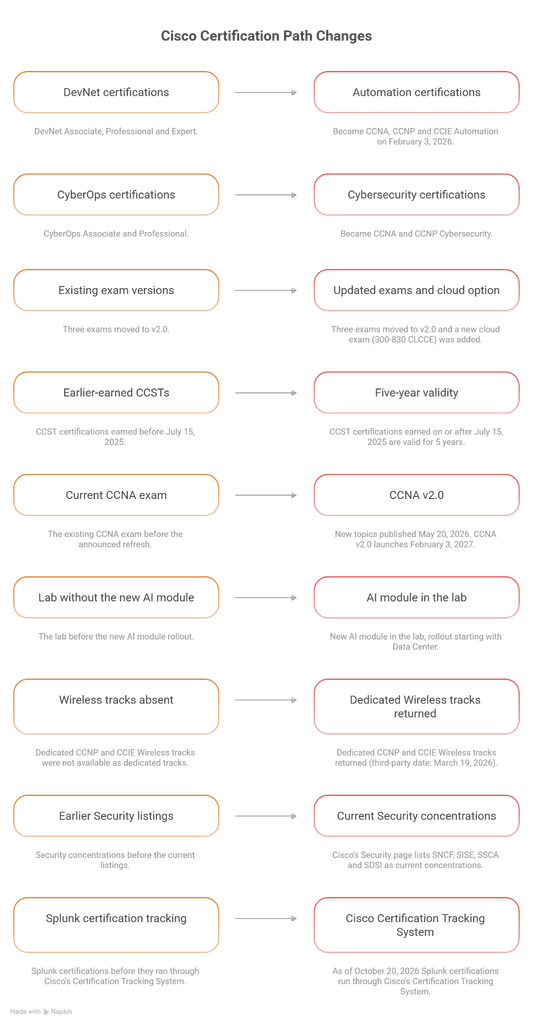
| DevNet became Automation | DevNet Associate, Professional and Expert became CCNA, CCNP and CCIE Automation on February 3, 2026 | Cisco blog (May 27, 2025) |
| CyberOps became Cybersecurity | CyberOps Associate and Professional became CCNA and CCNP Cybersecurity | Cisco blog |
| Collaboration updated | Three exams moved to v2.0 and a new cloud exam (300-830 CLCCE) was added | Cisco blog |
| Entry credentials renewed | CCST certifications earned on or after July 15, 2025 are valid for 5 years | Cisco CCST FAQ |
| CCNA refresh | New topics published May 20, 2026. CCNA v2.0 launches February 3, 2027 | Cisco blog |
| CCIE AI module | New AI module in the lab, rollout starting with Data Center | Cisco blog (May 20, 2026) |
| Wireless relaunched | Dedicated CCNP and CCIE Wireless tracks returned (third-party date: March 19, 2026) | Third-party and Cisco track pages |
| Security updates | Cisco’s Security page lists SNCF, SISE, SSCA and SDSI as current concentrations | Cisco track page |
| Splunk moved to Cisco | As of October 20, 2026 Splunk certifications run through Cisco’s Certification Tracking System | Splunk notices |
For the full list of retired exams and renaming details, read our Cisco certification changes 2026 guide.
How Cisco Recertification Works
From Cisco’s recertification page:
- Validity: most Cisco certifications are active for three years. CCST follows a five-year cycle for certifications earned on or after July 15, 2025.
- Ways to renew: retake your certification’s exam, advance to the next level, or earn Continuing Education credits.
- CE credits needed: Practitioner 15, Associate 30, Specialist 40, Professional 80, CCIE and CCDE 120.
- CE credits are valid for three years from the activity date and apply automatically, and excess credits roll over.
- No extensions: “Cisco does not provide extensions.” If a certification expires, you must complete the full exam process again.
- Reminders: emails are sent two years, one year, 90, 60 and 30 days before expiration.
- Retake waits: 5 calendar days after a failed written exam, 30 calendar days after a failed expert lab or practical exam, and 180 days before retaking a passed exam with the same exam number.
Ours: the efficient strategy is to renew a lower certification by passing a higher-level exam. For example, passing a CCNP concentration can renew a CCNA, because Cisco says you can recertify by advancing to the next level. Use Cisco’s official recertification policy to see which exams count for your certification.
Salary and Job Outlook
BLS does not report pay by certification, so these figures show the occupations Cisco certifications point to, not what a certificate guarantees.
| Occupation (BLS) | Median pay, May 2025 (USD) | Outlook 2025 to 2035 | Typical entry education |
| Computer network architects | 134,050 | +8% | Bachelor’s degree in a computer-related field, 5+ years in a related occupation |
| Network and computer systems administrators | 99,130 | -4% | Bachelor’s degree, though some employers accept a certificate or associate’s degree |
| Computer support specialists | 62,890 | -3% | Associate’s degree for network support, some college for user support, or high school plus certifications |
What this tells you (ours): the high-paying role (network architect) asks for years of experience, and BLS says employers may require or prefer vendor certifications. Entry-level support roles are plentiful (about 48,700 openings a year) but pay less, and administrator openings are mostly replacement hiring. A Cisco path helps you move up the ladder, from support to administrator to architect, but experience still drives the jump.
Common Mistakes on the Cisco Certification Path
- Using an old PDF or roadmap. Anything that mentions DevNet or CyberOps by the old names predates February 2026.
- Skipping the CCNA because “there is no prerequisite.” Cisco lists no prerequisite, but CCNP content builds on CCNA-level knowledge (ours), so skipping it often means struggling later.
- Waiting for CCNA v2.0 out of fear. Cisco’s advice is to keep studying for the current exam. The last v1.1 test date is February 2, 2027.
- Paying for a second written exam for CCIE. The CCNP core exam is the CCIE written exam in the same track, so you only take it once.
- Forgetting the renewal date. Cisco does not grant extensions, and an expired certification means retaking the full exam process.
- Choosing a concentration by exam difficulty. Choose it by the job you want.
- Treating CCIE as a requirement for good jobs. BLS-level roles such as network architect ask for experience and education, with certifications as employer-specific preferences.
- Relying on unofficial “exam dumps.” Memorized questions do not build the hands-on skill CCNP and CCIE roles require, and using unauthorized materials can violate Cisco’s exam policies. Use official training and legitimate practice tests.
FAQS
What is the Cisco certification path?
It is the sequence of Cisco credentials from entry level (CCST) to Associate (CCNA), Professional (CCNP) and Expert (CCIE and CCDE), with technology tracks such as Enterprise, Security, Cybersecurity, Data Center, Automation, Wireless, Collaboration and Service Provider.
What is the best Cisco certification path?
For most people, CCNA then CCNP Enterprise, then a specialty. If you want security, start with CCNA then CCNP Security or CCNP Cybersecurity. If you code, use CCNA Automation then CCNP Automation. The right choice depends on your target job.
What is the new Cisco certification path in 2026?
On February 3, 2026, DevNet became CCNA, CCNP and CCIE Automation and CyberOps became CCNA and CCNP Cybersecurity. Wireless also has its own CCNP and CCIE track again, and the CCNA is being refreshed on February 3, 2027.
Do I need CCNA before CCNP?
No. Cisco lists no formal prerequisites for the CCNP exams. Training providers generally treat CCNA-level knowledge as the base for CCNP, so most people take CCNA first.
Do I need CCNP before CCIE?
No. There are no prerequisites. But the CCNP core exam is the CCIE written exam in the same track, so CCNP gives you the written part.
Is there a Cisco certification path PDF?
Cisco publishes track-level “at a glance” PDFs, and you can print the diagram and tables in this guide to PDF. Make sure any PDF you use is dated after February 3, 2026.
Is there a Cisco certification path diagram?
Yes. The text diagram near the top of this guide shows how CCST, CCNA, CCNP and CCIE connect across tracks.
What is the Cisco CCNP certification path?
Pick a track, pass its core exam (USD 400) and pass one concentration exam (USD 300). For example, CCNP Enterprise is ENCOR 350-401 plus one of ENARSI, ENSDWI, ENSLD, ENAUTO, ENCC or ENNA.
What is the CCIE Cisco certification path?
Pass the track’s written core exam (USD 400) and its 8-hour lab (USD 1,600). CCIE tracks include Enterprise Infrastructure, Security, Data Center, Automation and Wireless, with Collaboration and Service Provider also listed by Cisco.
What is the Cisco security certification path?
CCNA, then CCNP Security (350-701 SCOR plus SNCF, SISE, SSCA or SDSI), then CCIE Security (SCOR plus the lab). For a SOC route, use CCNA Cybersecurity and CCNP Cybersecurity.
What is the Cisco cybersecurity certification path?
CCST Cybersecurity (optional), CCNA Cybersecurity (200-201), then CCNP Cybersecurity (350-201 CBRCOR plus 300-215 CBRFIR or 300-220 CBRTHD).
What is the Cisco data center certification path?
CCNA, then CCNP Data Center (350-601 DCCOR plus DCID, DCIT, DCACI, DCNAUTO or DCAI), then CCIE Data Center.
What is the Cisco wireless certification path?
CCNA, then CCNP Wireless (350-101 WLCOR plus 300-110 WLSD or 300-120 WLSI), then CCIE Wireless (WLCOR plus the lab).
What is the Cisco collaboration certification path?
CCNA, then CCNP Collaboration (350-801 CLCOR plus CLACC, CLHCT or CLCCE), with CCIE Collaboration as the expert level.
What is the Cisco DevNet certification path now?
DevNet is now Automation: CCNA Automation (200-901), CCNP Automation (350-901 plus ENAUTO or DCNAUTO) and CCIE Automation (350-901 plus the practical exam).
What is the Cisco SD-WAN certification path?
CCNA, then CCNP Enterprise with the ENSDWI 300-415 concentration (plus the ENCOR core). Cisco lists no stand-alone SD-WAN associate or expert certification.
What is the Cisco Meraki certification path?
CCNA or CCST Networking, then the Cisco Meraki Solutions Specialist certification (500-220 ECMS, USD 300, 90 minutes, valid for three years). Check Cisco for the current exam version.
What is the Cisco network certification path?
CCST Networking (optional), CCNA, CCNP Enterprise, then CCIE Enterprise Infrastructure.
How much does it cost to complete the Cisco certification path?
Exam fees only: CCNA USD 300, CCNP USD 700, CCIE USD 2,000 (written plus lab). CCNA then CCNP then CCIE in one track is about USD 2,600 because the core exam is reused. Training, retakes and travel are extra.
How long does the Cisco certification path take?
A third-party roadmap estimates 3 to 6 months for CCNA, 4 to 8 more for CCNP and 12 to 18 for CCIE lab preparation. Cisco does not publish official timelines, so treat these as planning estimates.
How long are Cisco certifications valid?
Most are valid for three years. CCST certifications earned on or after July 15, 2025 are valid for five years.
How do I renew a Cisco certification?
Retake the exam, advance to the next level or earn CE credits: 30 for Associate, 80 for Professional and 120 for CCIE. Cisco does not provide extensions.
Is Cisco certification worth it in 2026?
BLS ties higher pay to roles such as network architect (median USD 134,050) that require experience, and says employers may require or prefer certifications for the products they use. The certification helps you qualify and move up, but it does not replace experience. Read our is-CCNA-worth-it analysis for the entry-level view.
Final Thoughts
The Cisco certification path is simpler than it looks once you see the pattern: entry, associate, professional, expert, with the professional level always built from one core exam plus one concentration. For most people, the right route is CCNA, then CCNP Enterprise, then one specialty that matches the job postings you actually see. Security people should compare CCNP Security with CCNP Cybersecurity; developers should look at Automation; and data center, wireless, and collaboration engineers each have a dedicated track. Watch the dates: the current CCNA closes on February 2, 2027; certifications expire after three years with no extensions; and any roadmap that still says DevNet or CyberOps is out of date.