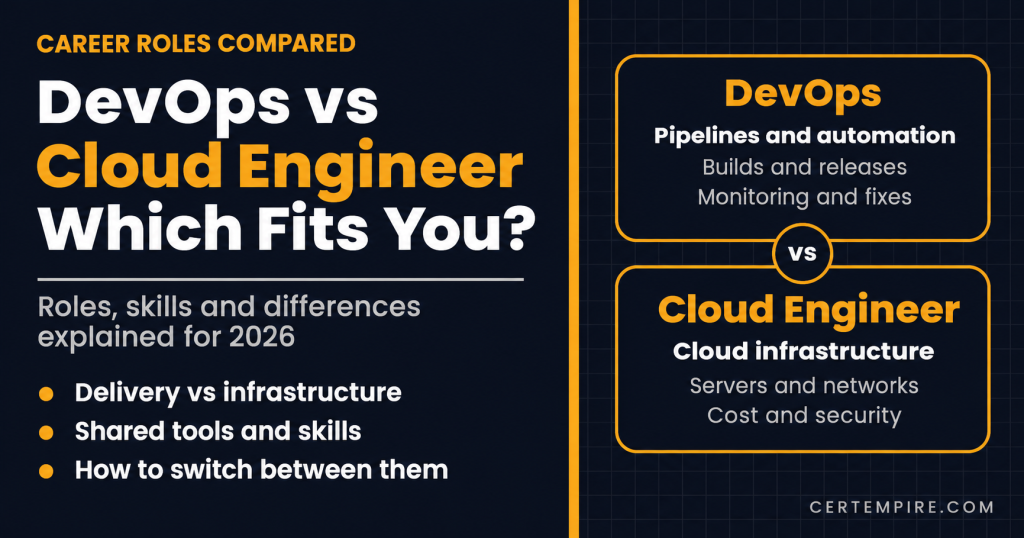
DevOps vs cloud engineer: what is the difference? A DevOps engineer automates how software is built, tested and released. A cloud engineer designs and runs the cloud platform that software lives on.
Open any job board and the two titles often list the same tools: AWS, Terraform, Docker and Kubernetes. That is why so many people pick the wrong one, or apply to both without knowing why.
This guide shows what each role owns, where the skills overlap, and how to read a job post. If you also want pay and long-term direction, our AWS vs DevOps career path guide covers that.
DevOps vs Cloud Engineer: What Each Role Does
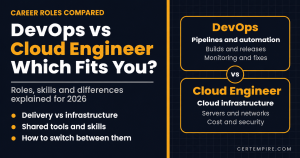
A DevOps engineer owns the path from code to production. A cloud engineer owns the platform that path runs on. Both work with infrastructure, but they start from different questions.
The DevOps engineer
AWS describes DevOps as a mix of culture, working methods and tools that help teams ship software fast. It lists continuous integration, continuous delivery, infrastructure as code, monitoring and strong team communication as core practices. A DevOps engineer turns those ideas into daily work:
- Building and fixing CI/CD pipelines.
- Automating tests, builds and releases.
- Watching applications after release and speeding up recovery.
- Helping developers and operations teams work from one process.
The starting question is: how do we ship changes safely and often?
The cloud engineer
Microsoft’s Azure Administrator page gives a good picture of the platform side. It describes managing and monitoring an Azure environment, covering virtual networks, storage, compute, identity, security and governance. AWS has a similar role-based exam, the CloudOps Engineer Associate, which it describes as proving you can deploy, manage and operate workloads on AWS. A cloud engineer’s daily work looks like this:
- Setting up accounts, networks, storage and access rules.
- Moving systems from data centers into the cloud.
- Keeping the platform secure, available and affordable.
The starting question is: is the foundation safe, reliable and sized right?
Notice that Microsoft’s own role description says administrators coordinate with DevOps teams. The two jobs are built to meet in the middle.
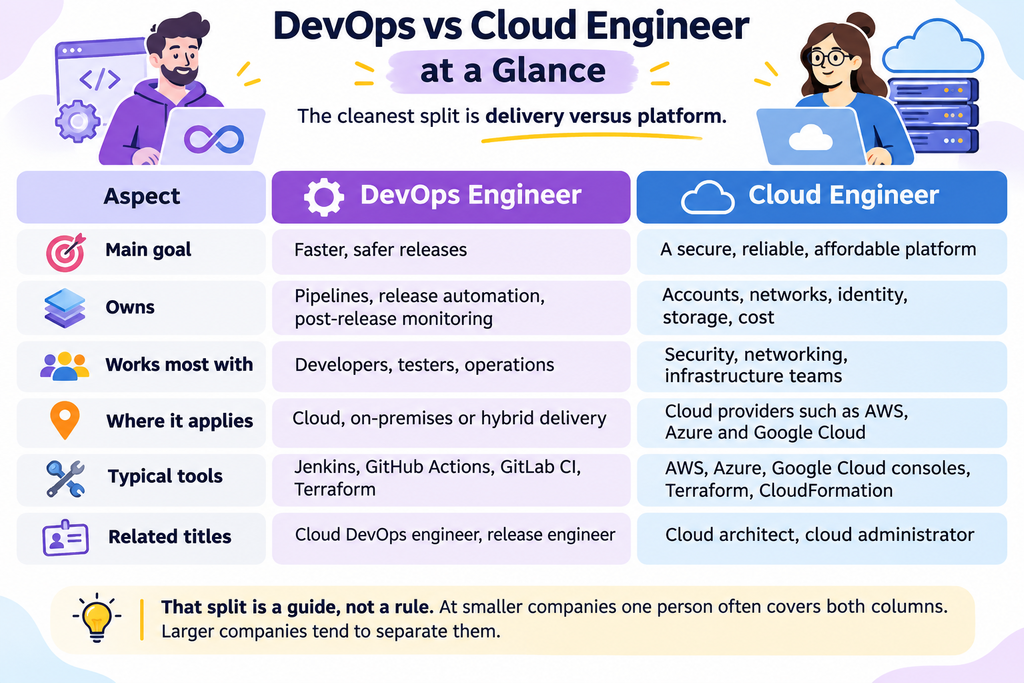
DevOps vs Cloud Engineer at a Glance
The cleanest split is delivery versus platform. This table puts the two roles side by side.
| DevOps engineer | Cloud engineer | |
| Main goal | Faster, safer releases | A secure, reliable, affordable platform |
| Owns | Pipelines, release automation, post-release monitoring | Accounts, networks, identity, storage, cost |
| Works most with | Developers, testers, operations | Security, networking, infrastructure teams |
| Where it applies | Cloud, on-premises or hybrid delivery | Cloud providers such as AWS, Azure and Google Cloud |
| Typical tools | Jenkins, GitHub Actions, GitLab CI, Terraform | AWS, Azure, Google Cloud consoles, Terraform, CloudFormation |
| Related titles | Cloud DevOps engineer, release engineer | Cloud architect, cloud administrator |
That split is a guide, not a rule. At smaller companies one person often covers both columns. Larger companies tend to separate them.
Who Fixes What? Six Everyday Problems
A quick way to feel the difference is to ask who usually leads when something breaks. This table is my reading of a typical split, so expect your team to vary.
| Problem | Usually leads | Why |
| A deployment fails in the pipeline | DevOps engineer | The pipeline is their product |
| A database subnet is unreachable | Cloud engineer | It is a network and platform issue |
| A new service gets “access denied” | Cloud engineer | Identity and permissions sit with the platform |
| Releases take two weeks instead of two days | DevOps engineer | It is a process and automation gap |
| The monthly cloud bill jumps | Cloud engineer | Cost and sizing belong to the platform |
| A container crashes after a release | DevOps engineer | They own the release and its monitoring |
In practice, most real incidents pull in both roles. The leader is just the person who owns the first suspect.
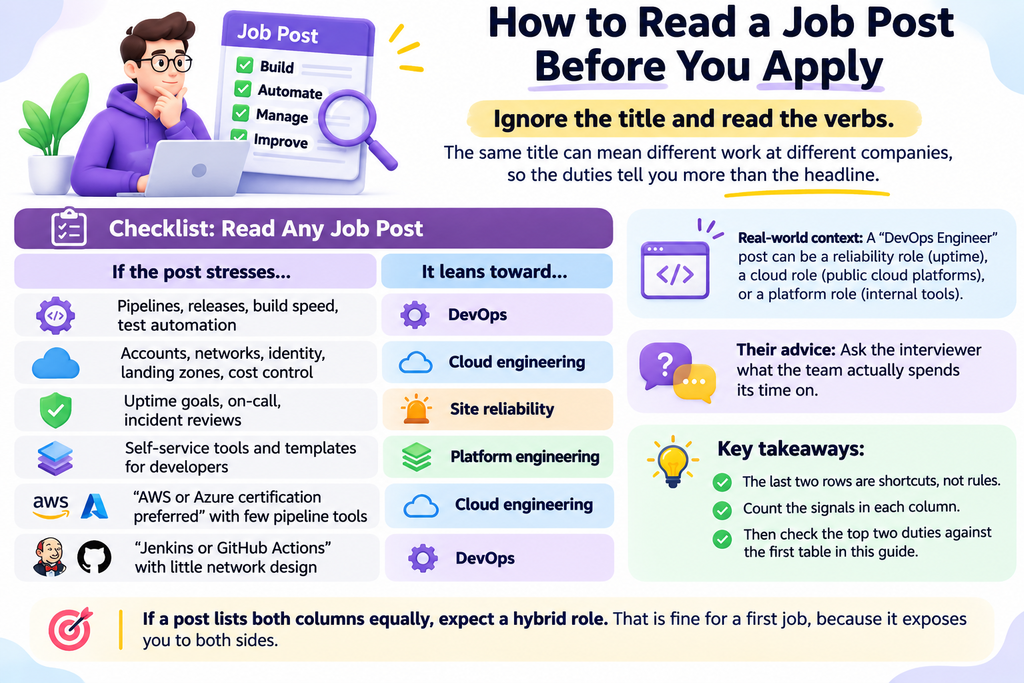
How to Read a Job Post Before You Apply
Ignore the title and read the verbs. The same title can mean different work at different companies, so the duties tell you more than the headline.
One engineer writing on a developer blog in late 2025 made the same point. A “DevOps Engineer” post that stresses uptime and incident reduction is probably a reliability role. One that stresses public cloud platforms is probably a cloud role. One about internal tools for developers is closer to platform engineering. Their advice: ask the interviewer what the team actually spends its time on.
Use this checklist to read any post:
| If the post stresses… | It leans toward… |
| Pipelines, releases, build speed, test automation | DevOps |
| Accounts, networks, identity, landing zones, cost control | Cloud engineering |
| Uptime goals, on-call, incident reviews | Site reliability |
| Self-service tools and templates for developers | Platform engineering |
| “AWS or Azure certification preferred” with few pipeline tools | Cloud engineering |
| “Jenkins or GitHub Actions” with little network design | DevOps |
The last two rows are my own shortcuts, not rules. Count the signals in each column, then check the top two duties against the first table in this guide.
If a post lists both columns equally, expect a hybrid role. That is fine for a first job, because it exposes you to both sides.
Shared and Distinct Skills
Most of the toolbox is shared, so learn that part first. The differences show up in depth, not in the tool names.
Skills both roles need
- Linux and scripting. Bash and Python come up in nearly every automation task.
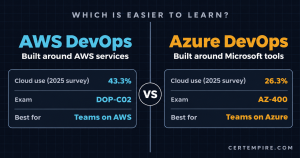
- A major cloud. In the 2025 Stack Overflow Developer Survey, 43.3% of respondents used AWS, 26.3% used Azure and 24.6% used Google Cloud.
- Containers. The same survey shows 71.1% using Docker and 28.5% using Kubernetes.
- Infrastructure as code. Terraform was used by 17.8% of respondents, and CloudFormation covers AWS only.
- Monitoring and basic security. Both roles read logs, set alerts and apply least-privilege access.
Most of these also appear in the duty lists above, which is why the two roles blur so easily.
Skills that lean DevOps
- CI/CD design in tools such as Jenkins, GitHub Actions or GitLab CI.
- Release strategies like blue/green and canary deployments.
- Test automation and working with developers on code review flow.
- Incident response and release rollbacks.
Skills that lean cloud engineering
- Virtual networks, subnets, load balancers and DNS.
- Identity and access management across many accounts.
- Storage, backup and disaster recovery design.
- Cost tracking, migration planning and governance rules.
If you are new, build the shared list first. Then pick the lean that matches the jobs you keep clicking on. Our AWS DevOps vs Azure DevOps guide shows how to choose the first platform to practice on.
Moving From One Role to the Other
You can move either way, and you only need to add a few new skills. The shared base does most of the work for you.
One engineer who spent three years as a cloud engineer described the move to DevOps this way. Cloud work had been mostly provisioning, monitoring and light automation. DevOps added a culture of closing the gap between developers and operations, and cutting manual hand-offs. To get there, they added CI/CD tools, Docker and then Kubernetes, deeper Terraform and Ansible, Prometheus and Grafana for monitoring, Git branching habits, and stronger Python and Bash. Another engineer, who moved from application development into DevOps, said the job felt different day to day even though the developer mindset stayed useful.
Cloud engineer to DevOps
Add these, in this order:
- A CI/CD tool, built into a real pipeline.
- Docker, then Kubernetes basics.
- Release methods like blue/green and rollback.
- Monitoring and alerting after release.
DevOps to cloud engineer
Add these, in this order:
- Networking: subnets, routing, load balancers and DNS.
- Identity and access management across accounts.
- Storage, backup and recovery design.
- Cost and governance habits.
To prove the move, build one small project in the new area and put it in your public portfolio. A working pipeline or a documented network design shows more than a course badge. For help picking what to build first, see our guide to AWS DevOps vs Azure DevOps.
Where Each Role Is Heading
Neither role is going away, but the DevOps title is splitting into sharper specialties. The work is staying; the labels are changing.
Writers who follow the field say many companies now hire for platform engineering and site reliability instead of a general “DevOps engineer.” The duties often look the same. Data points the same way. Google’s 2025 DORA report, based on nearly 5,000 technology professionals, found that 90% of organizations have adopted at least one internal platform. Building and running those platforms uses the same skills this guide covers.
AWS also says DevOps removes the walls between development and operations, with teams owning the whole lifecycle. That is a way of working, not one job title. A way of working does not disappear when the title changes.
So what does that mean for you?
- If you lean DevOps, your skills carry into platform engineering, site reliability and cloud roles. That makes it a launch point, not a dead end. This is my reading of the trend, not a guarantee.
- If you lean cloud, vendors still build role exams around operating cloud workloads. AWS lists a CloudOps Engineer Associate certification, for example.
- If you stay broad, you can move between all of these as the market shifts.
The safest plan is to learn the shared base well and treat the title as a label that may change.
Certifications That Match Each Role
Start with an associate-level cloud exam, then add a role-specific one. Certifications do not replace hands-on work, but they give hiring managers a clear signal.
| Path | Start here | Then add |
| Cloud engineer, AWS | Cloud Practitioner, then Solutions Architect Associate | CloudOps Engineer Associate |
| Cloud engineer, Azure | Azure Administrator Associate (AZ-104) | A security or networking specialty |
| DevOps engineer, AWS | Developer Associate or CloudOps Engineer Associate | DevOps Engineer Professional |
| DevOps engineer, Azure | AZ-104 or the developer associate exam | DevOps Engineer Expert |
AWS’s certification page lists these exams by level and notes that the professional tier expects two or more years of AWS experience. The AWS Certified DevOps Engineer – Professional exam is the DevOps-focused credential on that side. We cover its domains and value in our guide to the AWS DevOps Engineer Professional exam.
On the Microsoft side, check dates before you book. Microsoft’s AZ-400 exam page says that exam retires on February 1, 2027, so read the current notice on Microsoft Learn first. Our Azure DevOps comparison explains the timing in more detail.
Practice before paying for an attempt. The free practice tests at Cert Empire show you which topics need more work.
Frequently Asked Questions
Which is better, a cloud engineer or a DevOps engineer?
Neither is better overall. Cloud engineering suits people who like networks, identity and platform design. DevOps suits people who like automation, code and release flow. Pay for the two roles is close, so let your interest decide.
Can I learn DevOps in 3 months?
You can learn the core basics in 3 months, but job-ready usually takes longer. Public roadmaps range from about three months for people who already code or run servers to close to a year for complete beginners. Cover Linux, Git, Docker, one CI/CD tool and one cloud, then build projects.
Do DevOps and cloud engineers earn the same?
Almost. Glassdoor data from September 2026 shows median total pay of about $145,000 for DevOps engineers and $152,000 for cloud engineers. City, level and company change those numbers, so use them as a rough guide.
What should I learn first, cloud or DevOps?
Learn the shared base first: Linux, Git, scripting and one major cloud. After that, add a pipeline project if you lean DevOps, or a network and identity project if you lean cloud.
Is a cloud DevOps engineer the same as a cloud engineer?
Not quite. A cloud DevOps engineer is a hybrid title, usually meaning pipelines and releases on one specific cloud. Check the top duties in the post, using the job-post checklist above.
Is DevOps a dead-end job?
No. The title is shifting toward platform engineering and site reliability, but the skills carry over. Google’s 2025 DORA report found 90% of organizations have adopted at least one internal platform, so the work remains in demand.
Conclusion: Pick the Role by the Problem You Like
In the DevOps vs cloud engineer choice, DevOps owns the path to production and cloud engineering owns the platform underneath. The skills overlap heavily, and titles blur, so judge a role by its duties, not its name.
Learn the shared base first, then lean toward the side that matches the problems you enjoy solving. For pay and long-term direction, read our career path guide. When you are ready to test your skills, try the free practice tests at Cert Empire, and find more guides on the Cert Empire blog.