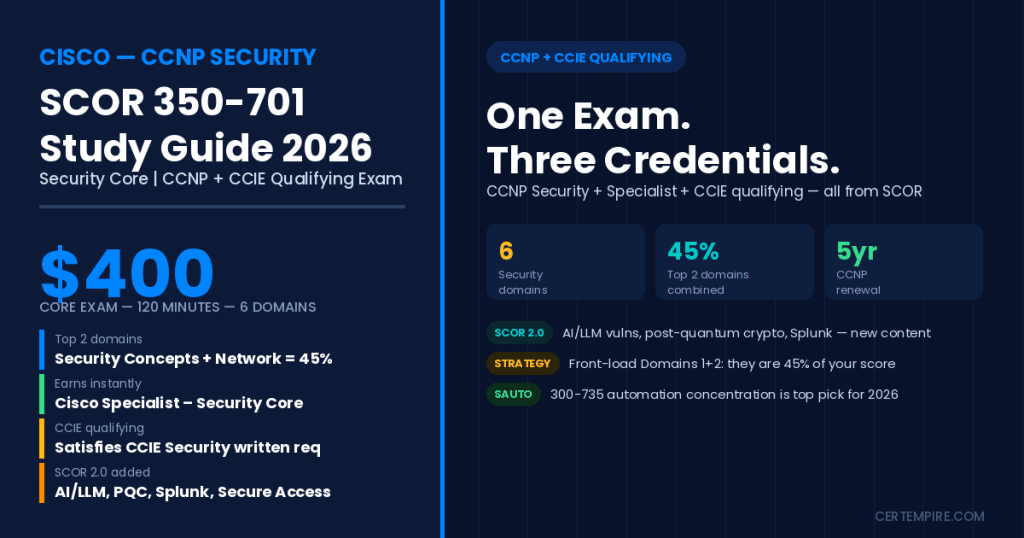
The CCNP Security SCOR 350-701 (Implementing and Operating Cisco Security Core Technologies) is the mandatory core exam for every CCNP Security concentration, runs 120 minutes, costs $400, and covers six domains across network security, cloud security, content security, endpoint protection, secure network access, and security concepts. Passing SCOR alone earns the Cisco Certified Specialist – Security Core credential immediately, satisfies the qualifying exam requirement for CCIE Security, and is the foundation for every CCNP Security concentration without needing a separate written exam.
Quick Facts Table
| Detail | Specification |
| Exam code | 350-701 SCOR |
| Full name | Implementing and Operating Cisco Security Core Technologies |
| Duration | 120 minutes |
| Cost | $400 USD |
| Passing score | Not published (approximately 750-850/1000, scaled) |
| Prerequisites enforced | None (CCNA-level knowledge recommended) |
| Recommended experience | 3-5 years IT and cybersecurity |
| Current version | SCOR 2.0 |
| Delivered via | Pearson VUE (test center or online proctored) |
| Specialist credential earned | Cisco Certified Specialist – Security Core (on passing alone) |
| Qualifies for | CCNP Security (core exam) + CCIE Security (qualifying exam) |
| Renewal | 3 years (Continuing Education or retake) |
The Most Important Thing to Understand About SCOR
Passing SCOR does three things simultaneously that no other single Cisco exam achieves:
First, it earns you the Cisco Certified Specialist – Security Core credential, which appears on your Cisco transcript immediately without needing a concentration exam. Many job postings already accept this Specialist credential as a qualifying requirement.
Second, it satisfies the core exam requirement for CCNP Security. Pair it with any one concentration exam and you have the full CCNP Security certification.
Third, and most importantly for engineers targeting the expert tier, passing SCOR satisfies the CCIE Security qualifying exam requirement. This means you can pass SCOR and proceed directly to preparing for the CCIE Security lab exam without sitting a separate written exam. This is a significant time and cost advantage that many candidates do not realize.
Exam Domain Breakdown
SCOR tests across six domains. Security Concepts and Network Security together account for 45% of the exam — the single most important fact to know when allocating your study time.
| Domain | Weight | What it covers |
| 1. Security Concepts | 25% | Cryptography, PKI, common vulnerabilities, IoT security, incident response frameworks |
| 2. Network Security | 20% | Next-gen firewalls, IPS, segmentation, VPN, network telemetry, Zero Trust |
| 3. Cloud Security | 15% | Cloud access security, posture management, workload protection, API security |
| 4. Content Security | 15% | Cisco Umbrella, Email Security Appliance (ESA), Web Security Appliance (WSA), DLP |
| 5. Endpoint Protection and Detection | 15% | Cisco Secure Endpoint (formerly AMP), malware analysis, endpoint telemetry |
| 6. Secure Network Access, Visibility, and Enforcement | 10% | Cisco ISE, 802.1X, TrustSec, network access control, DNAC security policies |
The practical implication: if you front-load your study time on Domains 1 and 2, you cover nearly half the exam before touching the remaining four domains. This is the most efficient study strategy for candidates who are time-constrained.
What Is New in SCOR 2.0
The current SCOR exam is version 2.0, which added several content areas reflecting how enterprise security has changed since the original SCOR launch in 2020. Candidates who studied from pre-2024 materials may be missing this content.
| New SCOR 2.0 Content | Domain |
| AI/LLM vulnerabilities | Security Concepts |
| Post-quantum cryptography | Security Concepts |
| Splunk for SIEM/SOAR workflows | Security Concepts + Endpoint |
| Cisco Secure Access (formerly Duo) | Secure Network Access |
| Secure Service Edge (SSE/SASE) | Content Security + Cloud |
| Updated Zero Trust frameworks | Network Security |
The AI/LLM vulnerability section is the most distinctive new content area. It covers prompt injection, model poisoning, data exfiltration through LLM interfaces, and governance controls for AI-integrated enterprise environments. Candidates from traditional network security backgrounds who have not kept up with AI threat modeling will find this section genuinely unfamiliar.
Concentration Exams: Choosing Your Specialization
After passing SCOR, one concentration exam earns the full CCNP Security credential. The right concentration depends entirely on what your day job involves.
| Concentration | Exam Code | Focus | Best for |
| Securing Networks with Cisco Firepower | SNCF 300-710 | Cisco Secure Firewall (FTD), Firepower policies, HA | Firewall engineers working with FTD daily |
| Implementing and Configuring Cisco Identity Services Engine | SISE 300-715 | Cisco ISE, 802.1X, profiling, posturing, TrustSec | IAM and network access control engineers |
| Implementing Secure Solutions with Virtual Private Networks | SVPN 300-730 | Site-to-site VPNs, remote access VPNs, DMVPN, FlexVPN | Engineers managing VPN infrastructure |
| Securing Email with Cisco Email Security Appliance | SESA 300-720 | ESA configuration, spam filtering, DLP, email encryption | Email security and messaging engineers |
| Automating and Programming Cisco Security Solutions | SAUTO 300-735 | Security API automation, Python for security, pxGrid | Engineers moving toward security automation |
| Securing the Web with Cisco Web Security Appliance | SWSA 300-725 | WSA configuration, HTTPS inspection, URL filtering | Web proxy and content security engineers |
SAUTO (300-735) is the strategic concentration for 2026. Security automation is the fastest-growing skillset in enterprise security, and SAUTO is the only CCNP Security concentration that explicitly validates it. If you work in a SOC or security engineering role and your organization is moving toward automated threat response, SAUTO pairs with SCOR to produce the most differentiated CCNP Security credential available.
Who Is SCOR For
SCOR is not an entry-level exam. Cisco’s recommended profile is 3 to 5 years of experience in IT and cybersecurity. The scenario-based questions on SCOR assume you have worked with real security products — configuring Cisco Secure Firewall, implementing ISE policies, analyzing threat telemetry in Cisco Secure Endpoint — not just studied about them.
| Profile | Is SCOR appropriate now? |
| CCNA holder with 2+ years security experience | Yes, SCOR is the natural next step |
| Network engineer moving into security | Yes, begin SCOR prep while gaining security tool exposure |
| CCNP Enterprise holder targeting security | Yes, SCOR domain knowledge builds on CCNP Enterprise fundamentals |
| CCIE candidate needing qualifying exam | Yes, SCOR satisfies this requirement |
| Entry-level candidate with no Cisco experience | No, start with CCNA or CCNA Cybersecurity |
Preparation Strategy
Start with Domains 1 and 2. They are 45% of the exam and the most foundational. Security Concepts covers cryptography, PKI, and the threat landscape that every other domain references. Network Security covers the firewall and IPS architecture that Domains 3 through 6 build on top of. Time spent here compounds.
Get hands-on with Cisco products. SCOR scenario questions are written from the perspective of someone who works with Cisco Secure Firewall, Cisco ISE, and Cisco Umbrella regularly. Candidates who have only read about these products consistently underperform on scenario questions compared to candidates who have configured them in production or lab environments.
Cover the SCOR 2.0 additions specifically. If your study materials predate 2024, verify they include AI/LLM vulnerabilities, post-quantum cryptography, Splunk integration, and Cisco Secure Access. These are live exam topics that older materials miss.
Use a lab environment. GNS3 and EVE-NG support Cisco virtual appliances for practice. The Cisco DevNet Sandbox provides free access to Cisco ISE and other security platform labs. Time spent configuring and troubleshooting real scenarios produces better exam outcomes than additional reading.
| Preparation resource | What it provides |
| Cisco Official Cert Guide (2nd Ed, Omar Santos) | Primary study reference, Cisco Press approved |
| Cisco U. SCOR learning path | Official structured learning with labs |
| Cisco DevNet Sandbox | Free lab access to ISE and other platforms |
| CertEmpire SCOR 350-701 exam questions | Exam-style practice under timed conditions |
| GNS3 or EVE-NG | Virtual lab for FTD and network security configuration |
Career and Salary
CCNP Security consistently positions candidates in the upper tier of network security compensation. The credential validates expertise across the full Cisco security stack that enterprise organizations rely on.
| Role | Typical US Salary Range |
| Network Security Engineer | $100,000-$135,000 |
| Senior Security Engineer | $120,000-$155,000 |
| Security Architect | $140,000-$175,000 |
| CCIE Security (after lab exam) | $160,000-$200,000+ |
Government, defense, and federal contracting roles frequently pay a premium above these ranges for Cisco-certified professionals with SCOR-level Zero Trust and federal compliance knowledge, since SCOR’s Zero Trust content aligns directly with NIST SP 800-207 requirements that federal contracts mandate.
SCOR vs CCNP Enterprise (ENCOR): What Is Different
Many candidates considering CCNP Security start by asking how SCOR compares to ENCOR. They are structurally similar exams at the same level, but they test different specializations and lead to different career tracks.
| Factor | SCOR 350-701 | ENCOR 350-401 |
| Duration | 120 minutes | 120 minutes |
| Cost | $400 | $400 |
| Focus | Security across all vectors | Enterprise networking breadth |
| Wireless content | Minimal | Removed in March 2026 (went to WLCOR) |
| Automation content | Security-specific (pxGrid, APIs) | General (15% domain) |
| Leads to | CCNP Security, CCIE Security | CCNP Enterprise, CCIE Enterprise Infrastructure |
| CCIE qualifying exam? | Yes (CCIE Security) | Yes (CCIE Enterprise Infrastructure) |
If your job is network security across Cisco’s security product stack, SCOR is your exam. If your job is enterprise networking infrastructure with routing, switching, and SD-WAN, ENCOR is your exam. They are not interchangeable. See our CCNP Enterprise vs CCNP Security guide for the full career-level comparison.
FAQs
Does passing SCOR alone earn a certification?
Yes. Passing SCOR alone earns the Cisco Certified Specialist – Security Core credential, which appears immediately on your Cisco transcript. You need one additional concentration exam to earn the full CCNP Security certification.
Is SCOR the same as the CCIE Security qualifying exam?
Yes. Passing 350-701 SCOR satisfies the qualifying exam requirement for CCIE Security. You can then proceed directly to the CCIE Security lab exam without sitting a separate written exam.
How many questions are on the SCOR exam?
Cisco does not publish exact question counts, but the exam runs 120 minutes and covers 6 domains. Candidates typically report 90 to 110 questions, with a mix of multiple choice and multiple-select formats plus lab simulations.
What Cisco products does SCOR test?
The exam covers Cisco Secure Firewall (FTD/ASA), Cisco ISE, Cisco Umbrella, Cisco Secure Endpoint (AMP), Cisco Email Security Appliance (ESA), Cisco Secure Access, Cisco Catalyst Center (security policies), Splunk, and the core protocols and frameworks underlying each platform.
Is CCNA required before SCOR?
No mandatory prerequisite is enforced. Cisco recommends CCNA-level knowledge as practical preparation, and 3 to 5 years of security experience is the recommended profile. Most successful SCOR candidates hold CCNA or have equivalent networking and security knowledge from experience.
What changed in SCOR 2.0?
SCOR 2.0 added AI/LLM vulnerabilities, post-quantum cryptography, Splunk, Cisco Secure Access (formerly Duo), and Secure Service Edge (SSE/SASE) content. Candidates using pre-2024 study materials should verify these topics are covered before sitting.
How long should I study for SCOR?
Candidates with 2 or more years of Cisco security product experience typically need 3 to 4 months of focused preparation. Candidates transitioning from networking without deep security product exposure typically need 5 to 6 months including hands-on lab time.
What is the strategic concentration for SCOR in 2026?
SAUTO (300-735, Automating and Programming Cisco Security Solutions) for engineers moving toward security automation and API-driven security operations. SNCF (300-710, Firepower) for engineers whose daily work centers on Cisco Secure Firewall. Choose based on your job, not on perceived difficulty.
Does SCOR expire?
Yes, after 3 years. Renewal options include Continuing Education credits through Cisco’s CE program, or passing any CCNP Security concentration exam, any CCIE lab exam, or any qualifying exam, all of which recertify SCOR and any associated credentials.
Is SCOR worth it compared to vendor-neutral certifications?
SCOR is the right credential for engineers working in Cisco-centric enterprise security environments. If your organization runs Cisco Secure Firewall, ISE, Umbrella, and Secure Endpoint, SCOR validates exactly what you do. Vendor-neutral credentials like CISSP or CASP+ validate broader security governance and architecture knowledge at the expense of Cisco-specific depth.