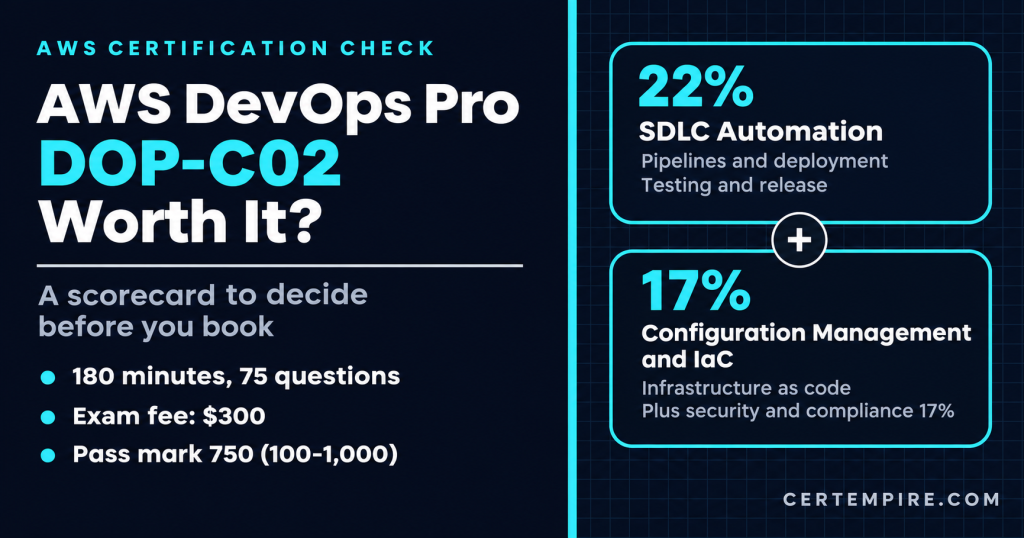
Is the AWS Certified DevOps Engineer Professional worth it? Yes, if you already have about two years of hands-on AWS work and want senior DevOps, SRE or platform roles. No, if you are new to cloud or hope the badge alone will land a job.
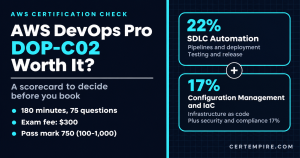
The exam costs $300, runs 180 minutes and has 75 questions, so a wrong call is expensive. This guide gives you a scorecard to decide, a cost worked example, and what the exam really tests. If you are still choosing a direction, start with our AWS vs DevOps career path guide.
What the DOP-C02 Exam Is, in Numbers
DOP-C02 is AWS’s top DevOps exam, and it is built for people who already run AWS in production. Here are the facts from AWS’s own certification page and exam guide.
| Detail | What AWS says |
| Length | 180 minutes |
| Questions | 75: 65 scored and 10 unscored |
| Format | Multiple choice and multiple response |
| Passing score | 750 on a scale of 100 to 1,000 |
| Fee | $300 |
| Recommended experience | 2 or more years provisioning, operating and managing AWS |
| Validity | 3 years |
| Delivery | Testing center or online proctored |
A few details matter more than they look. The scoring is compensatory, so you pass the exam overall, not each section. Unanswered questions count as wrong, and there is no penalty for guessing. Also, the 10 unscored questions are not marked, so treat every question as real.
Do the math on time: 180 minutes across 75 questions leaves about 2.4 minutes each. Long scenario questions can eat that quickly, so pacing is part of the exam.
AWS also notes that the credential validates advanced skill in running distributed applications on AWS, including automating testing and deployment. It does not say the badge guarantees a job.
What the Exam Tests: Six Domains in Plain English
Pipelines and infrastructure as code carry the most points, so start there. AWS weights SDLC Automation at 22% and Configuration Management and IaC at 17%. Together that is 39% of the scored questions.
This table turns each domain into daily work and a practice idea. The weights come from AWS’s exam guide. The “real work” and “practice” columns are my own plain-English reading.
| Domain | Weight | In real work, this looks like | Practice idea |
| SDLC Automation | 22% | Building pipelines that test and deploy code | Build a pipeline with CodePipeline, CodeBuild and CodeDeploy |
| Configuration Management and IaC | 17% | Defining servers and networks as code | Deploy a stack with CloudFormation, then update it safely |
| Security and Compliance | 17% | Automating access rules and compliance checks | Add automated policy checks across more than one account |
| Resilient Cloud Solutions | 15% | Keeping apps available and self-healing | Break a service on purpose and watch it recover |
| Monitoring and Logging | 15% | Alarms, metrics and central logs | Build alarms and a log search for a sample app |
| Incident and Event Response | 14% | Automating the reaction to failures | Trigger an automatic fix from an alarm |
Notice the pattern. Every domain says automate, define or implement. The exam rewards people who have built these things, not people who have only read about them.
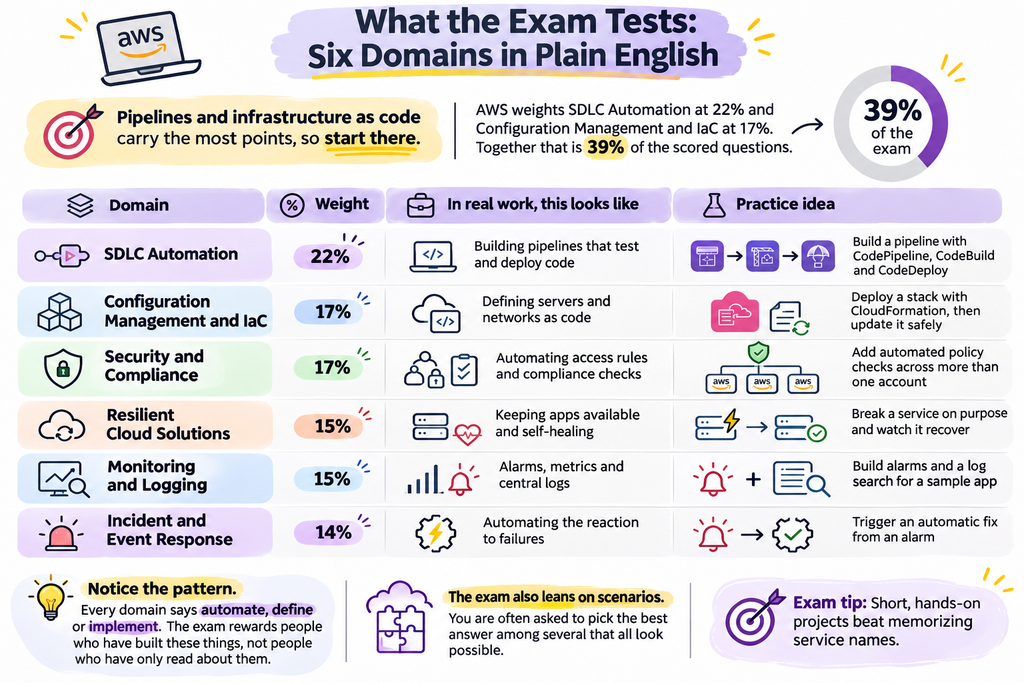
The exam also leans on scenarios. You are often asked to pick the best answer among several that all look possible. That is why short hands-on projects beat memorizing service names.
Is It Worth It for You? A Six-Question Scorecard
Score yourself first, because the answer depends on your situation, not on the exam. Give each question 0, 1 or 2 points.
| Question | 0 points | 1 point | 2 points |
| How much hands-on AWS work do you have? | Under 1 year | 1 to 2 years | 2 or more years |
| Do you build pipelines or infrastructure as code at work? | Never | Sometimes | Weekly |
| Do your target job posts mention this certification? | None do | A few do | Most do |
| Who pays the fee? | Me, and money is tight | Me, but I can afford a retake | My employer, or I hold a discount voucher |
| Do you want a senior DevOps, SRE or platform role? | No | Maybe | Yes |
| Can you study on a steady weekly schedule for several months? | No | Sometimes | Yes |
Add up your points, then use this guide:
| Total | What it suggests |
| 0 to 4 | Wait. Build experience and take an associate-level exam first. |
| 5 to 8 | Nearly there. Fix the questions where you scored 0, then book a date. |
| 9 to 12 | Worth it. The exam should confirm skills you already use. |
The score bands are my own rule of thumb, not an AWS standard. Use them to start a decision, not to end it.
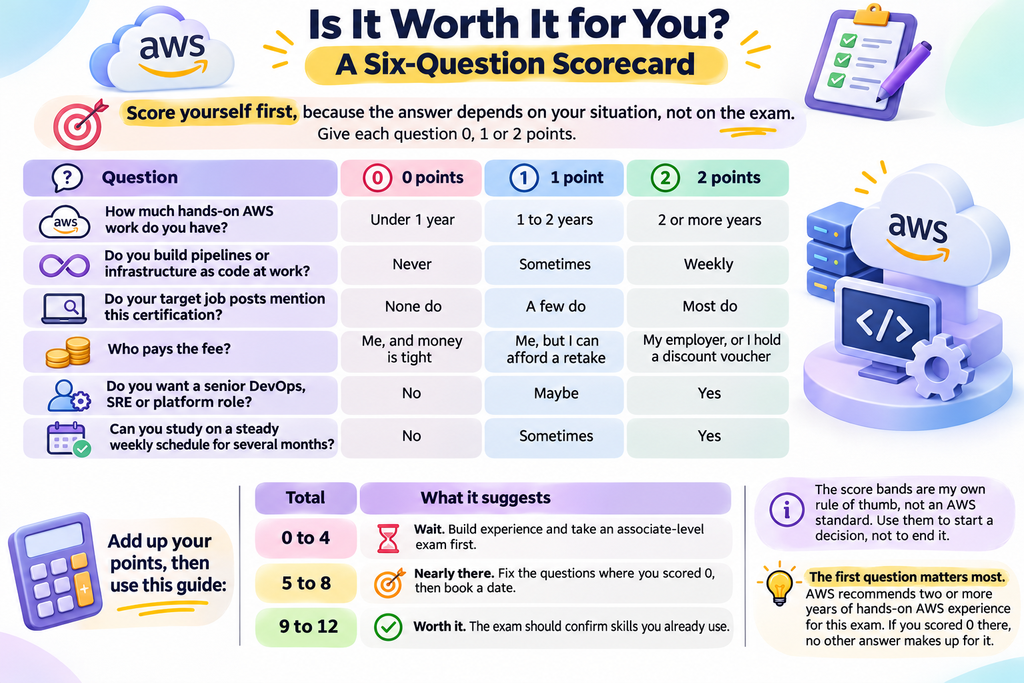
The first question matters most. AWS recommends two or more years of hands-on AWS experience for this exam. If you scored 0 there, no other answer makes up for it.
The Real Cost: Fees, Retakes and Time
The fee is $300, but your real cost is the fee times your number of attempts, plus study time. AWS’s after-testing policy says you must wait 14 calendar days after a fail, there is no limit on attempts, and you pay the full registration fee each time.
Here is a simple worked example using only the exam fee:
| Scenario | Exam fees | Earliest finish |
| Pass on the first try | $300 | Exam day |
| Fail once, then pass | $600 | At least 14 days later |
| Fail twice, then pass | $900 | At least 28 days later |
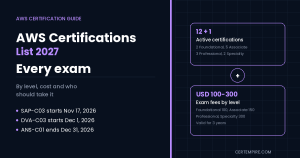
AWS’s benefits page also lists a 50% discount voucher for certified people, usable on recertification or any other AWS exam. If you already hold an AWS certification, check your account before you pay full price. The page does not say when the voucher expires, so do not wait too long.
Three more costs are easy to forget:
- Local taxes and currency. AWS keeps exchange-rate details on a separate pricing policy page.
- Renewal. The certification lasts 3 years, so you pass the latest version again to recertify.
- Your time. The exam is 180 minutes, and months of study come before it.
So the honest question is not “is $300 worth it?” It is “am I ready enough that I will only pay once?” That is why the scorecard above leads with hands-on experience.
What Candidates Say About Preparing and Sitting the Exam
Both public accounts below call the exam hard, and both stress hands-on practice. Here is what each author said.
A 2026 account from an engineer who already held several AWS certifications said the exam was challenging but fair. Many questions asked for the best answer among options that all looked plausible. Their prep mixed a video course, AWS whitepapers, practice exams and labs that deployed pipelines, fixed failures and worked through permissions. They reviewed the explanation for every practice question, even the ones they got right. Security scenarios slowed them most, and they went back to review GuardDuty. They finished in about two hours and still had time to revisit flagged questions.
An older account, written before the current DOP-C02 version, adds two lessons that still apply. The author spent about a year preparing after passing Cloud Practitioner and the three associate exams. They said practice exams were a weak gauge of readiness, since a 65% score the day before did not predict how the real exam would feel. They also split the exam into three blocks of 25 questions with short breaks, yet still ran out of time to review a stack of flagged items.
Online forums are less clear on career impact. Opinions on Reddit lean positive, with many saying recruiters read the badge as a sign of both AWS and DevOps skill. Quora answers are more mixed on how much it directly helps with recruiters. Treat forum views as opinion, not data.
From these accounts, plan for four things:
- Build real pipelines, not just read about them.
- Practice security and incident scenarios, which many people find slow.
- Use practice exams to find gaps, not to predict your score.
- Rehearse pacing so you leave time to review flagged questions.
What the Badge Does for Your Career, and What It Does Not
The badge is a signal that opens conversations. It is not proof that you can run production. Treat it as one piece of evidence next to your projects.
What AWS lists as benefits is modest and clear: a digital badge you can show online, a 50% discount voucher for another exam, access to certified-only events, and a chance to join its exam-writing program. Those are real, but none of them is a pay raise.
As for pay, I did not find an independent study that measures the effect of this one certification. Some articles quote premiums of 12% to 20% without naming a source, so this guide leaves them out. For sourced pay ranges, see our AWS vs DevOps career path guide.
A better test is local. Open ten job posts for the role you want and count how many list this certification. If most do, the badge will likely help you pass a first screen. If few do, spend that study time on projects.
There is also a newer factor. AWS made its DevOps Agent generally available on March 31, 2026. AWS describes it as an always-on assistant that helps triage and resolve incidents and works across AWS, multicloud and on-premises setups. Tools like this take over routine investigation. They raise the value of people who can design pipelines, judge risk and review what automation does. That is exactly what the professional-level exam tests. This is my reading of the trend, not a forecast.
What to Take First, and What to Take Instead
If you scored under 9 on the scorecard, take an associate-level exam first. AWS’s certification page groups its exams by level and notes that the professional tier expects two or more years of AWS experience. This table matches common situations to a next step:
| Your situation | Good next step |
| New to cloud | Cloud Practitioner, then an associate exam |
| Operating AWS workloads day to day | CloudOps Engineer Associate |
| Building and shipping applications | Developer Associate |
| Designing systems and networks | Solutions Architect Associate |
| Two or more years on AWS, with pipelines and IaC at work | DevOps Engineer Professional |
None of these paths is wasted. Associate-level study builds the base that the professional exam assumes, and passing one earns you the 50% voucher for a later attempt.
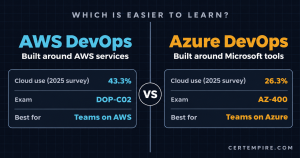
If your employer runs Azure, the Microsoft route may fit better. Microsoft’s AZ-400 exam page says that exam retires on February 1, 2027, so read the current notice before you plan. Our guide to AWS DevOps vs Azure DevOps compares the two paths for beginners.
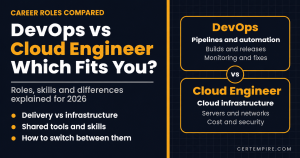
And if you are still unsure which job you want, read our DevOps vs cloud engineer guide first. Picking the role before the exam saves you from studying for the wrong target.
Frequently Asked Questions
Are AWS certifications still worth it in 2026?
Yes, when you pair them with hands-on skills. AWS still lists role-based exams from foundational to professional level, plus benefits like a badge and a discount voucher. They are not worth much as a shortcut, because a badge alone does not show what you can build.
Which AWS certification is best for DevOps engineers?
The DevOps Engineer Professional (DOP-C02) is the DevOps-focused exam. It is a goal for people with two or more years on AWS, not a first step. Most people should earn an associate exam, such as CloudOps Engineer or Developer, before it.
Is DevOps a dead-end job?
No. Google’s 2025 DORA report found 90% of organizations have adopted at least one internal platform, and the same pipeline, infrastructure and monitoring skills build those platforms. Titles are shifting toward platform engineering and site reliability, so the skills matter more than the label.
Does the AWS DevOps Agent replace DevOps engineers?
Not based on how AWS describes it. AWS says the agent helps triage and resolve incidents and connects to your observability tools, runbooks and pipelines. Someone still has to design those systems, set the rules and review its findings.
Is the AWS DevOps Professional exam hard?
Yes, and candidates say so. It runs 180 minutes for 75 questions, and many questions are long scenarios with several plausible answers. One 2026 passer called it hard but fair and credited hands-on labs.
Is the AWS DevOps Professional better than Azure AZ-400?
Neither is better overall. They belong to different platforms, so choose the one your target employers use. Microsoft’s AZ-400 page says that exam retires on February 1, 2027, so check Microsoft Learn before you book.
Conclusion: Take It When You Are Ready, Not When You Are Curious
So, is the AWS Certified DevOps Engineer Professional worth it? It is worth it when you already run AWS in production, build pipelines and infrastructure as code, and want senior DevOps, SRE or platform work. It is not worth rushing into as a first certification.
Score yourself, close your gaps with short hands-on projects, and book the exam only when one attempt looks likely. For the bigger career picture, read our hub guide. When you are ready to test yourself, try the free practice tests at Cert Empire, and find more guides on the Cert Empire blog.