Free 200-901 Practice Test Questions and Answers (2026)

View Mode
Q: 1

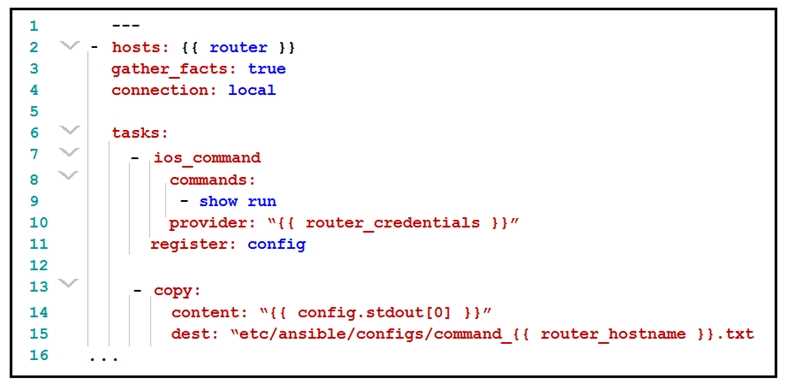
Refer to the exhibit. 200-901 question What is the effect of this Ansible playbook on an IOS router?
Options
12 comments in the community discussion
1
Looks like B, unless the playbook had used show startup-config or referenced the startup config somewhere. Here it's just grabbing the running config and saving it locally. Let me know if you see something different in the modules.
1
B , the playbook just grabs the running config with "show run" and saves it on your local Ansible control node. No config changes on the router, just a backup. Makes sense given the tasks shown if you look close.
Q: 2
What are two benefits of model-driven programmability?
Options
15 comments in the community discussion
2
A/E, not C. Trap is thinking human-friendly means model-driven, but that's more about structure than abstraction or decoupling.
1
C or D could fit too. Model-driven programmability definitely makes APIs a bit easier and more human-friendly, which both C and D hint at. Not totally sold those are the main "architectural" benefits Cisco's after, but they're both plausible in real-world situations. Maybe missing the abstraction piece but still makes
Q: 3

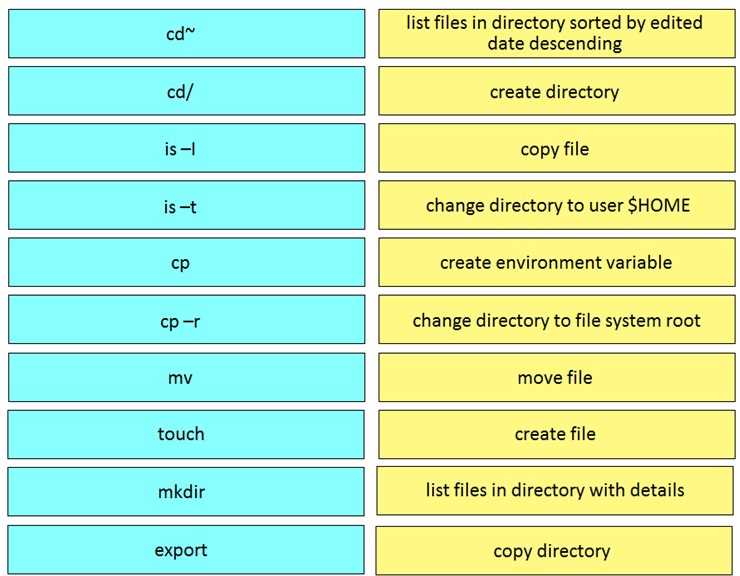
DRAG DROP Drag and Drop the Bash commands from the left onto the correct actions on the right. 200-901 question

Drag & Drop
15 comments in the community discussion
6
Saw a similar mapping on practice. Pretty sure this is correct: ls-t sorts by edited date, mkdir for making a dir, cp handles files, cp -r is used for directories, cd~ jumps to $HOME, cd/ to root, export sets env variables, mv moves files, touch creates files, and ls-l shows details. Let me know if someone disagrees
6
Nice, this mapping tracks with bash basics. cp for files, cp -r for directories, ls -t sorts by modified date (descending by default), and ls -l gives detail view. cd~ is a shortcut to $HOME and cd/ is root. Mkdir, touch
Q: 4

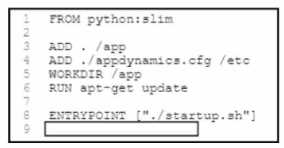
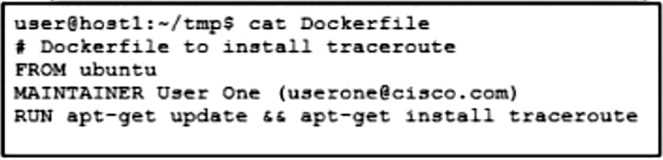
Refer to the exhibit. 200-901 question A developer needs to create a Docker image that listens on port 5000. Which code snippet must be placed onto the blank in the code?
Options
12 comments in the community discussion
3
Option C makes sense here. In a Dockerfile, EXPOSE 5000 tells Docker that the container will listen on port 5000. The other options aren't valid Dockerfile instructions, so not really applicable. Pretty sure it's C but open to corrections if I'm missing something.
1
Its C
Q: 5
A company deploys an application via containers in its local data center. As soon as the application goes into production, it starts to crash at specific hours of the day. After investigation, it is concluded that the crashes are due to too many users accessing the application simultaneously. The spikes must be addressed and allow for future growth without discarding the investment already made. Which deployment model must be used?
Options
13 comments in the community discussion
2
Option A
I’d say it'd be D. Public cloud handles those spikes best and is built for fast scaling.
Q: 6

Fill in the blanks to complete the statement. Cisco DNA provide the capability to send an HTTP _______________ request to the API endpoint https://DNA-c_API_ADDRESS/api/vi/network-device/ and receive the network __________ list in __________ format.

Your Answer
13 comments in the community discussion
6
Pretty sure the blanks are GET, device, JSON. You use GET for fetching stuff from a REST API like this and the DNA Center spits out device lists in JSON. Let me know if I missed something here.
3
GET, device, JSON is the combo here. GET is for retrieving info from an API, and with Cisco DNA that endpoint gives you devices back in JSON format. Only thing to watch out for is not mixing up GET and POST here.
Q: 7
A developer has created a new image to use in a Docker build and has added a tag for the image by using the command: $ docker tag 84fe411926287 local/app:0.4 Which command must be executed next to build the Docker image using the tag?
Options
13 comments in the community discussion
1
B Saw a similar question in a practice exam, and it suggested docker run after tagging the image. Official guide examples might help clear this up.
Makes sense to use D, since docker build -t creates a new image with a tag. The other options are for running containers or use the wrong parameter. Pretty confident but open to corrections.
Q: 8

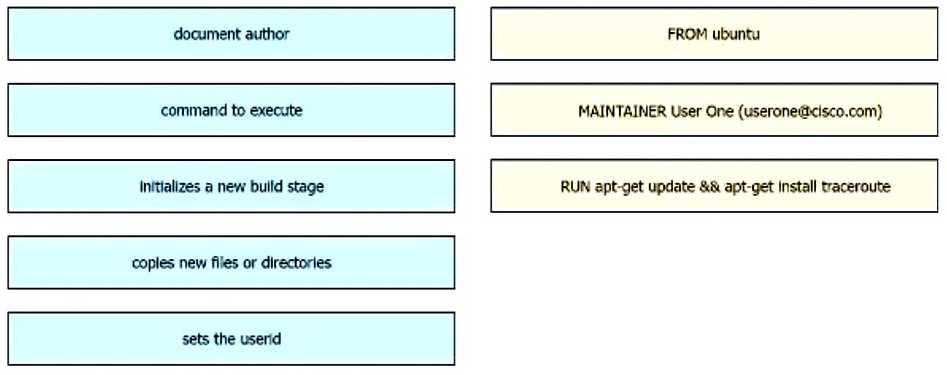
DRAG DROP 200-901 question Refer to the exhibit. Drag and drop the Dockerfile contents from the left onto the functions on the right that create a container image to run traceroute to track network path to specific targets. Not all options are used. 200-901 question
Drag & Drop
18 comments in the community discussion
6
Yeah, FROM ubuntu is just for starting the build stage, not copying files. MAINTAINER sets who wrote the Dockerfile and RUN handles installing traceroute. That’s how I mapped it, pretty sure this lines up with container basics.
4
FROM ubuntu maps to Initializes a new build stage, MAINTAINER is document author, RUN apt-get update && apt-get install traceroute is command to execute. The COPY/USER choices are there as trap distractors since they're not used. Seen similar on past practice.
Q: 9

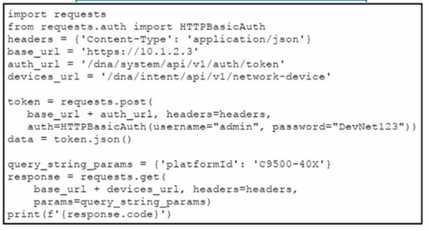
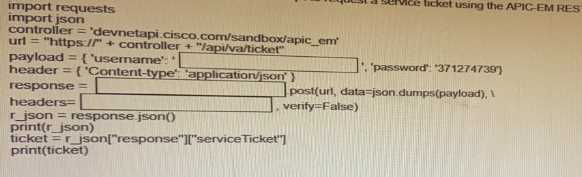
Refer to the exhibit. 200-901 question A network engineer must manage the network devices. The engineer prepares a Python scripts to authenticate to the Cisco to DNA Center API and request a device list. The device request fails and returns errors code 401. Which action solves the problem?
Options
16 comments in the community discussion
1
C or D? Both relate to auth, but from similar practice questions, C looks right since a 401 usually means the token wasn’t sent in the header. Official doc and exam refs stress adding the auth header. Anyone seen differently?
C tbh, because a 401 from DNA Center API usually means you forgot to include the token in the headers. Not really a credentials problem, more like the header is missing. Makes sense to me, agree?
Q: 10
Which two elements are foundational principles of DevOps? (Choose two.)
Options
12 comments in the community discussion
1
Option C and E. I get why some pick A for microservices, but that's more architecture than core DevOps. Pretty sure silos (C) and automation (E) are the foundational parts, not infrastructure cost (D).
1
C and E imo, those are classic DevOps principles. Cross-functional collaboration and lots of automation always show up in the official Cisco guide and exam reports.
Q: 11

Fill in the blanks to complete the python script to request a service ticket using the APIC-EM rest API for the user “devnetuser”. 200-901 question

Your Answer
2 comments in the community discussion
5
devnetuser, requests, header. Not "headers" with an s-tricky typo trap I saw on a similar practice set.
1
Is the script supposed to use just the default "devnetuser" or could a different username be required in some cases? That would change what goes into the payload.
Q: 12

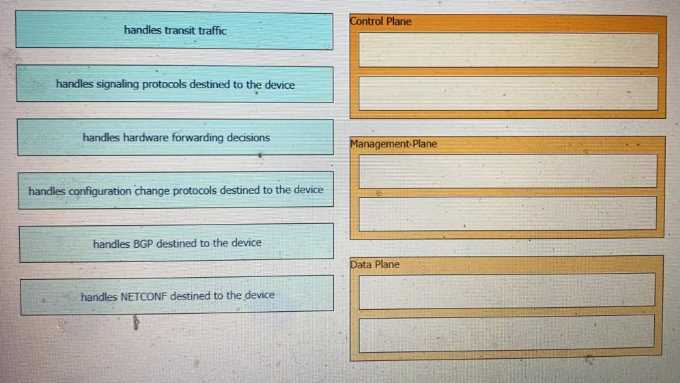
DRAG DROP Drag and drop the function on the left onto the type of plane that handles the function on the right. 200-901 question

Drag & Drop
2 comments in the community discussion
6
Control: signaling protocols and BGP. Management: config change protocols and NETCONF. Data: transit traffic and hardware forwarding decisions.
4
Control: handles signaling protocols dest to device, handles BGP dest to device. Management: handles config change protocols, handles NETCONF. Data: handles transit traffic, handles hardware forwarding decisions. Nice clear mapping.
Q: 13

Fill in the blanks to complete the statement. Given a username of “devnet” And a password “Cisco123”, applications must create a base64 encoding of the string” ____________ ” when sanding HTTP requests to an API that uses _______________ authentication.

Your Answer
5 comments in the community discussion
4
devnet:Cisco123, Basic
1
Looks like the phrase should be devnet:Cisco123 and the authentication type is Digest. Pretty sure about the username:password format, but I thought a lot of APIs nowadays default to Digest over Basic. Correct me if that's off.
Q: 14

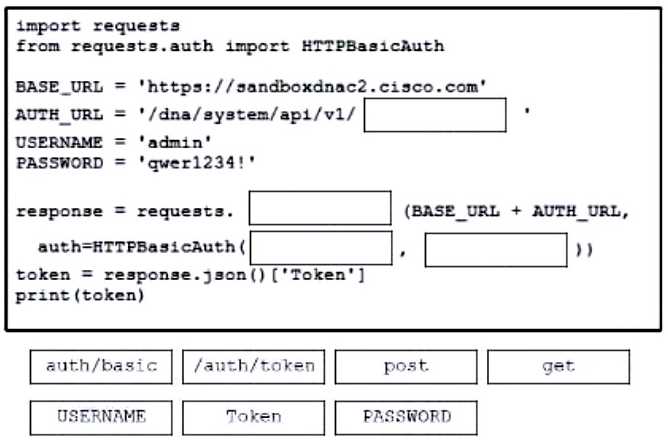
DRAG DROP Drag and drop the code from the bottom onto the box where the code is missing to authenticate with the Cisco DNA Center REST API by using basic authentication. Then generate a token for later use. Not all options are used. 200-901 question

Drag & Drop
4 comments in the community discussion
2
Bucket 1: /auth/token, Bucket 2: post., Bucket 3: USERNAME, Bucket 4: PASSWORD. Pretty sure that's right since POST is standard for token generation with DNAC. The official API guide and practice lab examples show exactly this sequence.
1
Nah, it's Bucket 1: /auth/token, Bucket 2: post., Bucket 3: USERNAME, Bucket 4: PASSWORD. Token endpoint needs POST not GET, easy trap.
Q: 15

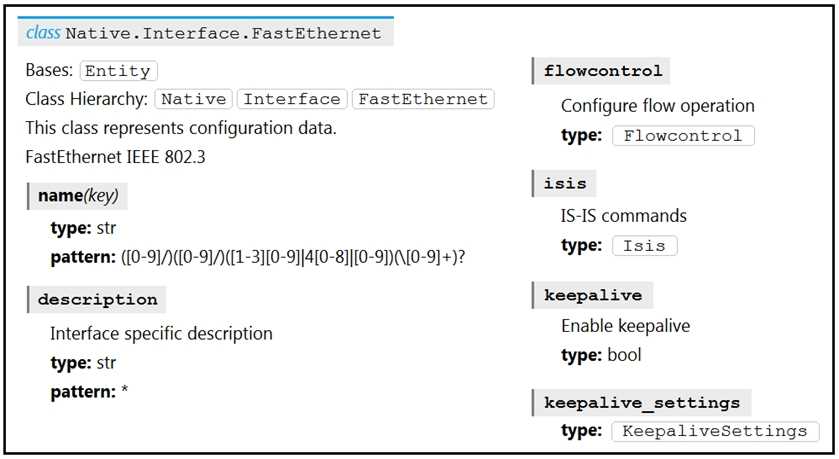
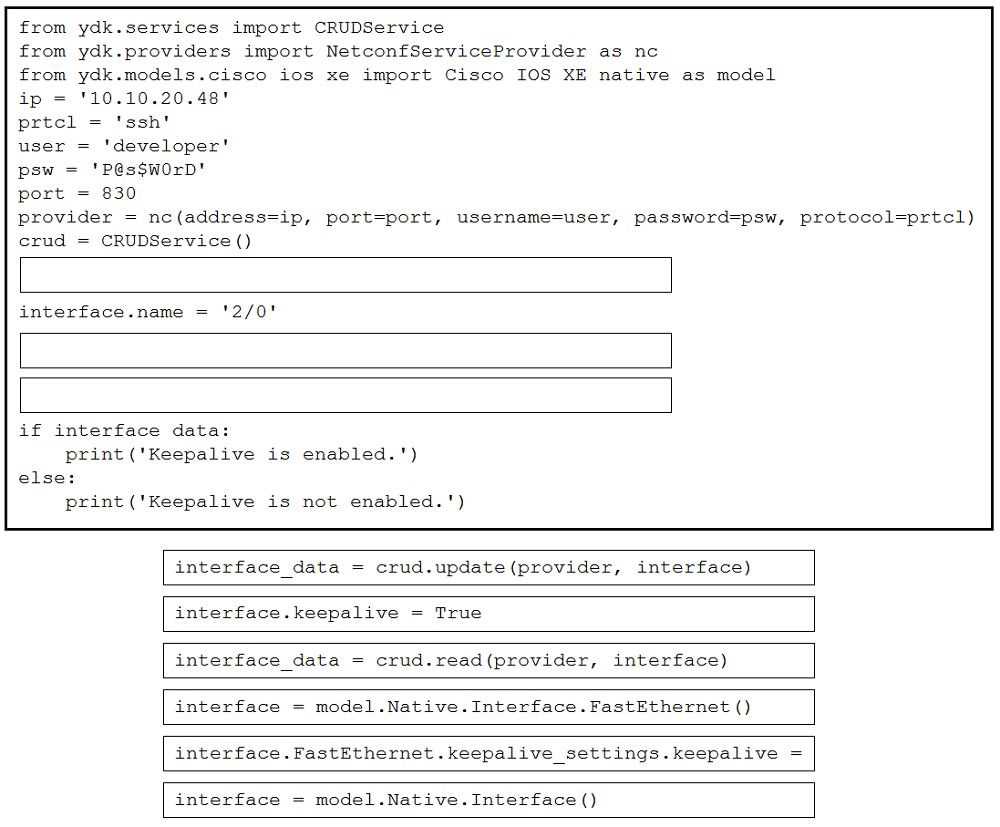
DRAG DROP 200-901 question Refer to the exhibit. Drag and drop the code snippets from the bottom to the blanks in the code to enable keepalive for the FastEthernet 2/0 interface. Not all options are used. 200-901 question
Drag & Drop
3 comments in the community discussion
2
Yeah, for this one you start by creating the FastEthernet obj, then set keepalive to True, then use crud.read since the code is just reading back config. So mapping is:interface = model.Native.Interface.FastEthernet(),interface.keepalive = True,inter
For the mapping: FastEthernet instantiation -> keepalive set True -> read with crud. If the question asked for applying changes instead of just enabling, would we swap out crud.read for crud.update at the end?
Q: 16

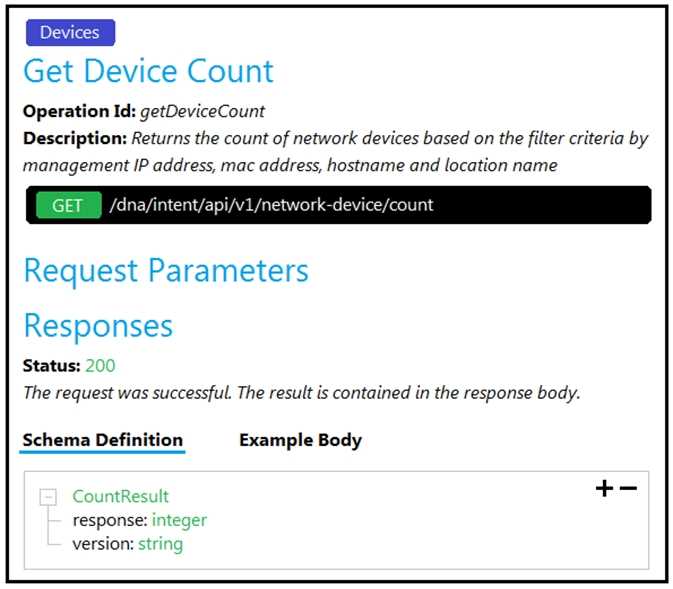
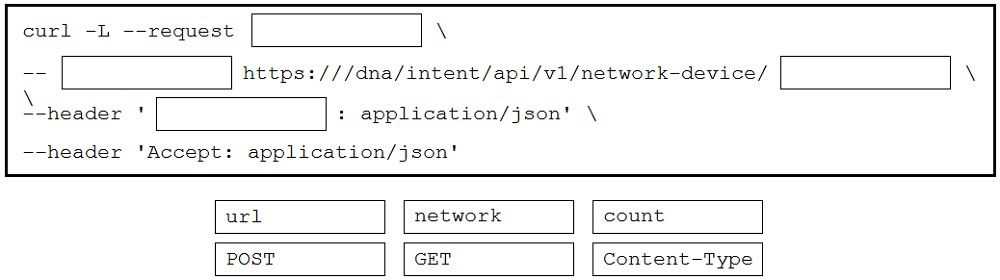
DRAG DROP 200-901 question Refer to the exhibit. Drag and drop the code snippets from the bottom onto the blanks in the code to construct a request to find the Cisco DNA Center switch count. Not all options are used. 200-901 question
Drag & Drop
1 comment in the community discussion
1
Makes sense to me: GET, url, count, Content-Type is the order I’d use here.
Q: 17

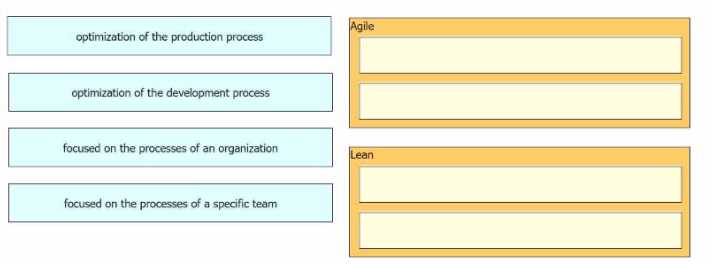
DRAG DROP Drag and drop the characteristics from the left onto the software development methodologies on the right. 200-901 question

Drag & Drop
6 comments in the community discussion
4
Agile = optimization of the development process, focused on the processes of a specific team. Lean = optimization of the production process, focused on org processes.Had something like this in a mock. Both map pretty clear, just watch for "team" (Agile) vs "organization" (Lean). Pretty sure that's what exam e
2
Agile: optimization of the development process, focused on the processes of a specific team. Lean: optimization of the production process, focused on the processes of an organization.
Q: 18
A developer creates a program in which an object maintains a list of classes based on the observer pattern. The classes are dependent on the object. Whenever the state of the object changes, it notifies the dependent classes directly through callbacks. Which advantage of the observer pattern offers minimum dependencies and maximum flexibility between dependent objects or classes?
Options
2 comments in the community discussion
D imo, loose coupling is exactly what the observer pattern is for. A is a trap, since observer reduces tight coupling. Pretty sure about this from practice questions.
Is the question asking for the main benefit or just any feature? That would affect if D is right.
Q: 19
Users cannot access a webserver and after the traffic is captured, the capture tool snows an ICMP packet that reports "time exceeded in-transit". What is the cause of this webserver access issue?
Options
3 comments in the community discussion
6
Option B
1
Looks like B, since ICMP time exceeded usually points to a routing loop or misrouting. Seen similar in practice labs.
Q: 20

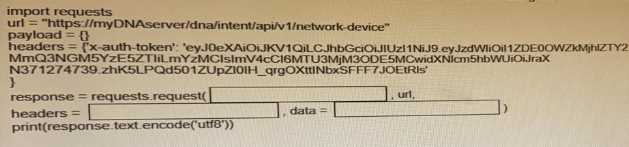
Fill in the blanks to complete the python script to retrieve a list of network devices using the Cisco DNA center API. 200-901 question

Your Answer
3 comments in the community discussion
5
Looks like it needs GET, headers, payload
1
Had something like this in a mock and it was “GET”, headers, payload. Method comes first for requests, then headers with the token, then payload (usually empty for GET). Pretty sure that’s what they want here.
Question 1 of 20

What's covered in this practice questions set

5: Infrastructure and Automation · 4 questions

📖 About this Domain

This domain covers the fundamental concepts of network device architecture, including the control, data, and management planes. It also introduces network programmability and automation using APIs like RESTCONF and NETCONF, and explores the features of Cisco platforms such as IOS XE, DNA Center, and Meraki.

🎓 What You Will Learn

  • You will learn to interpret the results of RESTCONF and NETCONF requests, focusing on data encoding, headers, and return codes.
  • You will learn to differentiate the roles and functions of the management, control, and data planes within a network device.
  • You will learn to interpret the output of Python scripts that utilize Cisco SDKs for device configuration and data retrieval.
  • You will learn to describe the programmability features of key Cisco platforms, including Cisco IOS XE, DNA Center, SD-WAN, and Meraki.

🛠️ Skills You Will Build

  • You will build the skill to analyze API responses from network devices to troubleshoot automation scripts.
  • You will build the skill to identify which device plane is responsible for specific network functions like routing protocol updates or packet forwarding.
  • You will build the skill to recognize the appropriate Cisco platform and its specific APIs for a given automation task.

💡 Top Tips to Prepare

  • Focus on understanding the distinct functions of the control plane (e.g., OSPF, BGP), data plane (e.g., CEF), and management plane (e.g., SSH, SNMP).
  • Practice interpreting JSON and XML data structures, as they are fundamental to RESTCONF and NETCONF operations.
  • Familiarize yourself with common HTTP status codes and NETCONF RPC error messages to quickly diagnose API request failures.
  • Review the key programmability features and API endpoints for Cisco DNA Center and Meraki dashboards, as these are common automation targets.

2: Understanding and Using APIs · 4 questions

📖 About this Domain

This domain focuses on Application Programming Interfaces (APIs) for software development and automation. It covers REST API fundamentals, including request construction and HTTP response interpretation. You will explore API styles, usage patterns, and programmatic interaction.

🎓 What You Will Learn

  • Learn to construct REST API requests with correct HTTP methods, headers, and body based on API documentation.
  • Learn to parse HTTP responses by identifying status codes, headers, and the JSON or XML body.
  • Learn to identify common API patterns like data retrieval, data updates, and event-driven webhooks.
  • Learn to compare API styles such as REST and RPC, and communication patterns like synchronous and asynchronous.

🛠️ Skills You Will Build

  • Build the ability to read API documentation and translate requirements into functional API calls.
  • Build the skill to write a Python script using the requests library to consume a REST API.
  • Build the skill to debug API communication issues by analyzing HTTP response codes and payloads.
  • Build the ability to differentiate between API architectural styles for specific use cases.

💡 Top Tips to Prepare

  • Utilize Postman or a similar API client to practice sending requests and inspecting responses from public APIs.
  • Memorize the meaning of common HTTP status code families like 2xx for success, 4xx for client errors, and 5xx for server errors.
  • Gain hands-on experience with the Python requests library, focusing on methods like requests.get() and requests.post().
  • Understand the key characteristics that differentiate REST from other API styles, particularly its stateless nature.

1: Software Development and Design · 4 questions

📖 About this Domain

This domain covers foundational software development and design principles for network automation. It focuses on data formats, development lifecycles, code organization, and version control with Git.

🎓 What You Will Learn

  • Compare and parse data formats like JSON, XML, and YAML into native Python data structures.
  • Differentiate software development methods such as agile, lean, and waterfall.
  • Understand the benefits of organizing code into methods, functions, classes, and modules.
  • Utilize common Git operations including clone, commit, push, pull, branch, and merge.

🛠️ Skills You Will Build

  • Manipulate structured data from APIs and configuration files using Python.
  • Apply concepts of software development lifecycles to automation projects.
  • Structure Python code for modularity, reusability, and maintainability.
  • Manage code versions and collaboration using Git for infrastructure as code.

💡 Top Tips to Prepare

  • Practice parsing sample JSON, XML, and YAML data with Python libraries like json, xml.etree.ElementTree, and pyyaml.
  • Initialize a local Git repository and execute all core commands: add, commit, branch, merge, and resolve a merge conflict.
  • Compare the iterative nature of agile against the sequential flow of waterfall for different project scenarios.
  • Refactor a monolithic script into separate functions and modules to understand code organization principles.

4: Application Deployment and Security · 3 questions

📖 About this Domain

This domain covers application deployment and security fundamentals. It focuses on CI/CD pipelines, containerization using Docker, and various deployment models like cloud and edge. Key topics include handling API authentication and identifying common security vulnerabilities.

🎓 What You Will Learn

  • Differentiate between application deployment models such as private cloud, public cloud, hybrid cloud, and edge computing.
  • Describe the components of a CI/CD pipeline including source control, build, artifact, package, test, and deployment.
  • Utilize Docker commands to manage the lifecycle of images and containers and understand the components of a Dockerfile.
  • Identify common application security risks based on the OWASP Top 10 and describe the use of secrets in scripts.

🛠️ Skills You Will Build

  • Construct a Python script that calls a REST API requiring an authentication token or credentials.
  • Manage container lifecycles using core Docker commands for building, running, and inspecting containers.
  • Use application-level security tools like Bandit to perform static analysis and check for common vulnerabilities in code.
  • Analyze and select appropriate deployment types, including virtual machines, bare metal, and containers, for specific use cases.

💡 Top Tips to Prepare

  • Get hands-on practice with Docker commands; build images from a Dockerfile and manage running containers.
  • Write and debug Python scripts that interact with authenticated REST APIs to understand secret management.
  • Memorize the stages of a CI/CD pipeline and the purpose of each component, from code commit to deployment.
  • Familiarize yourself with the OWASP Top 10 to quickly identify common application security flaws.

3: Cisco Platforms and Development · 3 questions

📖 About this Domain

This domain covers Cisco's intent-based networking architectures and platforms. It focuses on the functions of Cisco DNA Center, SD-Access, and SD-WAN for network automation and management.

🎓 What You Will Learn

  • Learn the core functions of Cisco DNA Center, including device discovery, inventory, topology, and Software Image Management (SWIM).
  • Understand the concepts of Cisco SD-Access, including the underlay, overlay, and fabric architecture.
  • Identify the architectural planes of Cisco SD-WAN: orchestration (vBond), management (vManage), control (vSmart), and data (vEdge).
  • Describe the use of APIs for programmability and automation within Cisco DNA Center and vManage.

🛠️ Skills You Will Build

  • Ability to differentiate the operational planes and components within a Cisco SD-WAN deployment.
  • Skill to explain the function of the underlay and overlay in a Cisco SD-Access fabric.
  • Competency in identifying the primary automation and assurance capabilities of Cisco DNA Center.
  • Understanding of how REST APIs are utilized in Cisco's software-defined networking solutions.

💡 Top Tips to Prepare

  • Memorize the specific roles of vManage, vSmart, vBond, and vEdge in the SD-WAN architecture.
  • Focus on the key assurance and automation features of DNA Center, like SWIM and device provisioning.
  • Understand the integration points between SD-Access, DNA Center, and ISE for policy and identity.
  • Clearly distinguish between the management, control, data, and orchestration planes for both SD-Access and SD-WAN.

6: Network Fundamentals · 2 questions

📖 About this Domain

This domain covers the foundational building blocks of modern networks. You will explore network components, architectures, and the core protocols that enable communication. It establishes the essential knowledge for understanding IP connectivity and Ethernet operations.

🎓 What You Will Learn

  • You will learn to identify the roles of core network devices like routers, L3 switches, and access points in different network topologies.
  • You will learn to compare TCP and UDP transport layer protocols and their operational characteristics.
  • You will learn to implement IPv4 and IPv6 addressing schemes, including subnetting and address type identification.
  • You will learn fundamental switching concepts such as MAC learning, frame switching, and virtualization basics with virtual machines.

🛠️ Skills You Will Build

  • You will build the skill to configure and verify IPv4 and IPv6 addressing on network devices and client operating systems.
  • You will build the skill to differentiate between network architectures like 3-tier, spine-leaf, and SOHO.
  • You will build the skill to identify physical layer issues related to cabling, collisions, interface errors, and duplex mismatches.
  • You will build the skill to explain the operation of a switch's MAC address table and the process of frame flooding.

💡 Top Tips to Prepare

  • Master binary math for efficient IPv4 subnetting and variable-length subnet mask (VLSM) calculations.
  • Use command-line tools like ipconfig, ifconfig, and ping to verify IP parameters and connectivity on client OS.
  • Practice identifying IPv6 address types, including global unicast, unique local, link-local, and Modified EUI-64.
  • Create diagrams of different network topologies like spine-leaf and 3-tier to visually understand data flow and device roles.

Premium Access Includes

  • Quiz Simulator
  • Exam Mode
  • Progress Tracking
  • Question Saving
  • Flash Cards
  • Drag & Drops
  • 3 Months Access
  • PDF Downloads
Get Premium Access
Scroll to Top

FLASH OFFER

Days
Hours
Minutes
Seconds

avail $6 DISCOUNT on YOUR PURCHASE