
Picking between the CCNA vs Network+ certification decides what your first year in networking looks like. Network+ gives you vendor-neutral fundamentals and fits help desk and support roles. The CCNA gives you Cisco configuration skills and fits network administrator and engineer roles. Choose wrong and you either burn three months on lab-heavy Cisco material you were not ready for, or you sit a broad exam that adds little to a Cisco-focused resume. This guide compares both exams on content, difficulty, cost, pay and renewal, then gives you a checklist that ends in one clear pick. Read the quick answer first, then jump to the section that matches your situation.
Quick answer: which one should you take first?
Bottom line: Take Network+ first if you are new to IT or aim at support and operations roles. Take the CCNA first if you already work with networks and want network administrator or network engineer jobs.
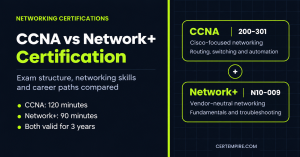
| Factor | CompTIA Network+ (N10-009) | Cisco CCNA (200-301) |
| Vendor focus | Vendor-neutral | Cisco-specific |
| Level | Foundational | Associate |
| Exam length | 90 minutes | 120 minutes |
| Questions | Up to 90 | Cisco does not publish a count |
| Passing score | 720 on a 100–900 scale | Cisco does not publish a score |
| Question types | Multiple-choice and performance-based | Includes Cisco configuration simulations |
| Exam fee | 369–399 in current guides | $300 |
| Validity | 3 years | 3 years |
| Renewal | 30 CEUs, retake, or a higher certification | Pass a current or higher exam, or earn 30 CE credits |
| Best fit | Help desk, technical support, network operations, system administration | Network administrator, network engineer, Cisco environments |
| Plan for | 6–10 weeks | 3–6 months |
Neither exam has a formal prerequisite. CompTIA recommends A+ and 9–12 months of hands-on networking experience before Network+, and Cisco sets no requirement for the CCNA. If you plan to earn both, earn Network+ first: it builds the vocabulary the CCNA assumes. You can test yourself on either exam with the free N10-009 practice questions and the free 200-301 practice questions before you commit to one.
What each exam covers
Bottom line: Network+ tests how networks work and how to fix them on any vendor’s gear. The CCNA tests whether you can configure and troubleshoot a Cisco network from the command line.
The CompTIA Network+ N10-009 exam, launched on June 20, 2024, splits into five domains:
- Networking concepts: 23%
- Network implementation: 20%
- Network operations: 19%
- Network security: 14%
- Network troubleshooting: 24%
Troubleshooting is the heaviest domain, and the exam adds business topics such as change management, incident management and disaster recovery. CompTIA maps the certification to three job roles: technical support specialist, network operations specialist and system administrator.
The Cisco CCNA 200-301 exam covers six areas: network fundamentals, network access, IP connectivity, IP services, security fundamentals, and automation and programmability. The questions push you toward doing: reading routing tables, building VLANs and trunks, writing access control lists and configuring OSPF.
The two exams overlap on IP addressing, subnetting, switching, basic routing, wireless and network services such as DHCP and DNS. They separate on depth. Network+ asks you to recognise a problem and pick the right tool or fix. The CCNA asks you to type the configuration that makes the network work. If you want exam-style questions for either side of that gap, the Network+ N10-009 exam questions and CCNA 200-301 exam questions pages show the format, and the CompTIA and Cisco vendor pages list every related exam.
Is CCNA harder than Network+?
Bottom line: Yes. The CCNA is harder for almost everyone because it demands Cisco command-line configuration, goes deeper on routing and switching, and runs 30 minutes longer.
Three things make the gap real:
- Hands-on skill. You cannot pass the CCNA on reading alone. You need lab time in Packet Tracer or on real or virtual Cisco devices.
- Depth. OSPF, VLAN trunking, access control lists and IP services get configuration-level treatment.
- Length and secrecy. The exam runs 120 minutes, and Cisco publishes neither the question count nor the passing score.
That last point answers the fail-rate question. Cisco publishes no pass rate, so any exact CCNA fail-rate percentage you see online is a guess. Network+ publishes its passing score (720 on a 100–900 scale) but no pass rate either.
Network+ is still not easy. Subnetting, port numbers, cabling standards and the performance-based questions catch people who only read. One learner who documented a Network+ attempt wrote that the first full practice test showed they knew commands but not when to use each one, and that subnetting was the hardest topic early on. That matches the exam design: troubleshooting is 24% of the objectives.
Is the CCNA really entry-level? Cisco classifies it as an associate-level certification and offers the CCST Networking exam ($125, 50 minutes) as the step below it. Hiring managers read the CCNA as an entry-to-junior network engineer credential. It is entry-level for network engineering and a stretch as a first IT credential.
Prep time follows the difficulty. Plan 6–10 weeks for Network+. CompTIA’s own CertMaster estimates put the Learn product at 25–40 hours and labs at 15–25 hours. Plan 3–6 months for the CCNA, with a lab in every study session. Coursera’s guide puts a part-time learner with minimal background at three to four months.
Cost, validity and renewal
Bottom line: The CCNA costs less to sit, both certifications last three years, and renewal rules differ in ways that matter if you hold both.
Exam fees. Cisco charges $300 for the CCNA 200-301, payable in cash or Cisco Learning Credits. CompTIA’s Network+ page shows vouchers only inside bundles, and current study guides list the Network+ voucher between $369 and $399. Budget up to $399 and add the cost of practice material for either exam. Our CompTIA voucher discount guide shows routes that can lower the Network+ bill.
Validity. Both certifications stay active for three years.
Network+ renewal. CompTIA offers five routes: complete CertMaster CE, earn a higher CompTIA certification, earn a relevant non-CompTIA certification, retake the latest Network+ exam, or collect 30 CEUs through multiple activities. CompTIA charges a continuing-education fee of $150 on most of these routes.
CCNA renewal. You pass the current CCNA exam or a higher-level Cisco exam, or you earn 30 Cisco Continuing Education credits. Cisco does not grant extensions, so recertify before the expiry date. The full rules sit on Cisco’s recertification page.
Holding both. CompTIA’s renewal table credits the CCNA with 20 CEUs toward Network+ renewal. If you earn Network+ first and the CCNA later, the CCNA does two-thirds of the Network+ renewal work for you.
Salary and jobs: what each certification leads to
Bottom line: Pay follows the job title, not the badge. Network+ points at support and operations roles, and the CCNA points at higher-paid network roles.
No official source publishes a Network+-only salary. What you can measure is the pay of the jobs each certification targets, using U.S. Bureau of Labor Statistics median wages and one survey of Cisco-certified professionals:
| Role or group | Median or average pay | Source |
| Computer user support specialists | $61,860 | BLS, May 2025 |
| Computer network support specialists | $73,340 | BLS, May 2024 |
| Network and computer systems administrators | $99,130 | BLS, May 2025 |
| Computer network architects | $134,050 | BLS, May 2025 |
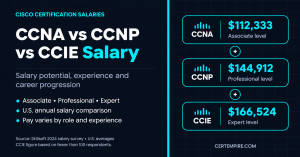
| CCNA holders | $112,333 average | Survey of 863 Cisco-certified professionals, fielded May–September 2024 |
Read the table this way. Network+ roles land in the first two or three rows. The CCNA survey average sits above the support rows because the respondents include experienced engineers, so a CCNA with no experience starts below $112,333. The CCNA also feeds the path to CCNP and CCIE, where pay climbs further: the same survey puts CCNP Enterprise holders at $144,912. Our CCNA vs CCNP vs CCIE salary breakdown covers every figure, and the CCNA vs CCNP comparison shows when the jump is worth it.
Can you get a job with just a CCNA? Yes, but the first job is usually a network operations center seat, a junior network technician role or an upgrade inside your current IT job, not a senior engineer title. BLS projects employment of computer support specialists to decline 3% from 2025 to 2035 across about 903,100 jobs, and network and computer systems administrators to decline 4% across about 323,600 jobs. Certifications do not override that. Experience does, so pair either certificate with a help desk seat, a lab you can show, or a project you ran.
CCNA or Network+ for cybersecurity?
Bottom line: For a cybersecurity career, start with Network+ and move to Security+. Choose the CCNA only if you want to secure Cisco networks as a network-security engineer.
Network+ gives security work the layer underneath it: ports, protocols, segmentation and troubleshooting, with network security as a 14% domain. It also sits in the same CompTIA family as Security+, so your study habits and exam format carry over. Our Security+ SY0-801 guide shows what that next step looks like.
Cisco’s own security route skips both exams for the first step: the CCST Cybersecurity certification leads to the CyberOps Associate exam, and the 200-201 exam questions page shows that format. The CCNA includes a security fundamentals domain, but it is one of six and it is taught on Cisco gear.
Two related questions come up constantly:
- Can I skip A+ and do Network+? Yes. CompTIA recommends A+ but does not require it. Skip it if you already do IT support work or have studied networking. Take it first if you have never worked on a PC and want a help desk job; the A+ 220-1201 vs 220-1202 guide explains which core exam to sit.
- Do I need Network+ if I have the CCNA? No. The CCNA covers the networking ground, and it earns 20 CEUs toward Network+ renewal if you ever hold both. Add Network+ only when an employer or a DoD 8140 work role names it in a requirement.
Is Network+ equivalent to the CCNA? No. Network+ is foundational and vendor-neutral. The CCNA is associate-level and Cisco-specific. Employers treat the CCNA as the stronger signal for network engineering and Network+ as the cleaner signal for support and operations.
Decision checklist and worked examples
Bottom line: Answer six questions, count your answers, and the higher column is your first exam.
| # | Question | Yes points to |
| 1 | Have you never configured a router or switch? | Network+ |
| 2 | Is your target job in help desk, field support or desktop support? | Network+ |
| 3 | Are you undecided between networking and cybersecurity? | Network+ |
| 4 | Do your target job posts name Cisco equipment? | CCNA |
| 5 | Can you subnet an IPv4 address on paper without a calculator? | CCNA |
| 6 | Can you commit to lab time in most study sessions? | CCNA |
Count the yes answers in each column. Three or more for Network+ means take Network+ first. Four or more for the CCNA means go straight to it. A tie means start with Network+ and book the CCNA for six to nine months later.
Scenario 1: career changer with no IT background. Take Network+ in about eight weeks, apply for help desk and support roles, and start CCNA study while you work.
Scenario 2: help desk technician with 18 months at a managed service provider that supports Cisco switches. Go straight to the CCNA. You already know the vocabulary, and the CCNA is the credential that moves you toward network administrator work.
Scenario 3: student aiming at cybersecurity. Take Network+, then Security+. Add the CCNA later if you land a network-security role on Cisco equipment.
Scenario 4: system administrator who manages Windows servers and wants network responsibility. Take the CCNA. Your server experience covers the foundations, and the configuration practice is what you lack.
What learners say
Bottom line: Shared accounts agree on three things: the CCNA carries more weight on a network engineering resume, Network+ is the easier ramp, and certificates alone do not get you hired.
- In a CCNA community thread, a learner halfway through CCNA study asked whether to switch to Network+. The top reply, with more than 170 upvotes, told them to stay with the CCNA and said Network+ does not carry the CCNA’s prestige.
- In a security careers thread, a commenter said they would hire a CCNA holder over a cybersecurity degree graduate, because real networking knowledge is rare among graduates.
- On a certification forum, a learner who held the CCNA passed Network+ first try with an 820 score. They also pointed out the catch: two certificates and zero IT experience, because employers want experience first.
- Another forum poster advised Network+ before the CCNA because Network+ is easier, while the CCNA expects you to know Cisco commands and configuration at a practical level.
- A different poster said the first semester of CCNA coursework already covered nearly everything needed for Network+.
- Cisco published a CCNA success story of a network and security product owner who moved into a full-time network engineering role after passing the CCNA, crediting the certification for the switch.
The pattern is consistent. People who want network engineering work pick the CCNA. People who need a ramp pick Network+. Nobody in these accounts landed a job on the certificate alone.
Study roadmap and exam-version timing
Bottom line: Study the current versions and time the CCNA around Cisco’s February 2027 switch to v2.0.
CCNA timing. Version 1.1 of the 200-301 stays available through February 2, 2027. Version 2.0 goes live on February 3, 2027 with the same exam code, the same $300 fee and the same 120-minute length. If you can be exam-ready by February 2, book v1.1. If you cannot, study to the v2.0 topics Cisco publishes in its v2.0 exam topics PDF. Our CCNA 200-301 v2.0 update guide lists what changes.
Network+ timing. CompTIA estimates N10-009 retires around 2027, usually three years after launch. Study N10-009 now. Waiting for the next version only delays your first credential.
| Phase | Network+ plan (8 weeks) | CCNA plan (16 weeks) |
| Weeks 1–2 | Networking concepts, OSI model, ports and protocols | Fundamentals, IPv4 and IPv6 addressing, subnetting drills |
| Weeks 3–4 | Subnetting, switching, routing basics | Switching, VLANs, trunking, spanning tree |
| Weeks 5–6 | Network operations and security | Routing, static routes, OSPF |
| Weeks 7–8 | Troubleshooting methodology, full practice tests | IP services: NAT, DHCP, DNS, NTP |
| Weeks 9–12 | Not needed | Security fundamentals, wireless, ACLs |
| Weeks 13–16 | Not needed | Automation, then three full timed practice exams |
Where does each credential sit in the full ladder? The networking path runs CCST Networking, then Network+, then CCNA, then CCNP Enterprise, then CCIE Enterprise Infrastructure. Skip the rungs you already stand above. Our Cisco certification path guide maps every Cisco step, and the CCNP Enterprise ENCOR 350-401 guide covers what comes right after the CCNA.
Frequently asked questions
Is CCNA harder than Network+?
Yes. The CCNA requires Cisco command-line configuration, goes deeper on routing and switching, and runs 120 minutes against 90 for Network+. Network+ still takes real study, especially subnetting and the performance-based questions.
Is CCNA still worth it in 2026?
Yes, if you want network administrator or network engineer work. Cisco keeps the exam code, the $300 fee and the length unchanged for v2.0 in February 2027, and the CCNA remains the entry point to CCNP and CCIE. It is a poor first pick only if your target is help desk or general IT support.
Do I need Network+ if I have CCNA?
No. The CCNA covers the networking foundation, and CompTIA credits it with 20 CEUs toward Network+ renewal. Earn Network+ only if an employer or a DoD 8140 work role asks for it by name.
Is CompTIA Network+ equivalent to CCNA?
No. Network+ is foundational and vendor-neutral, and the CCNA is associate-level and Cisco-specific. The CCNA is the deeper, more hands-on credential.
Can I pass the CCNA in 2 weeks or 1 month?
Two weeks works only if you configure Cisco devices every day at work and already subnet without a calculator. One month works at three to four hours a day with a lab in every session. Everyone else should plan 3–6 months.
What is the CCNA salary?
A survey of 863 Cisco-certified professionals, fielded May–September 2024, put the CCNA average at $112,333. That average includes experienced engineers, so entry-level CCNA roles start lower. The CCNA salary breakdown shows the full ladder.
What is the fail rate for the CCNA?
No public number exists. Cisco publishes neither a pass rate nor the passing score, so any exact fail-rate percentage is a guess. Judge readiness by timed practice exams and lab work instead.
Can I get a job with just a CCNA certification?
Yes, in roles such as network operations center technician, junior network technician or an upgrade inside your current IT job. Senior engineer roles need experience on top of the certificate, so pair the CCNA with a help desk seat or a lab project.
Can I skip A+ and do Network+?
Yes. CompTIA recommends A+ and 9–12 months of hands-on experience for Network+ but does not require either. Skip A+ if you already work in IT support or have studied networking.
Conclusion: pick one and book the exam
The CCNA vs Network+ certification choice comes down to your starting point. Take Network+ first if you are new to IT, aim at support and operations roles, or have not chosen between networking and cybersecurity. Take the CCNA first if you already work with networks, want network administrator or engineer jobs, and can commit to lab time. If you plan to earn both, Network+ then CCNA is the smoother order.
Start with a free practice test for the exam you chose, compare your score against the CompTIA or Cisco exam pages, and browse more comparisons on the Cert Empire blog. Explore Cert Empire for the full exam library.