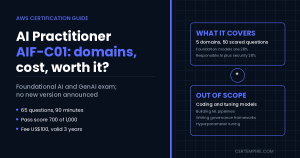
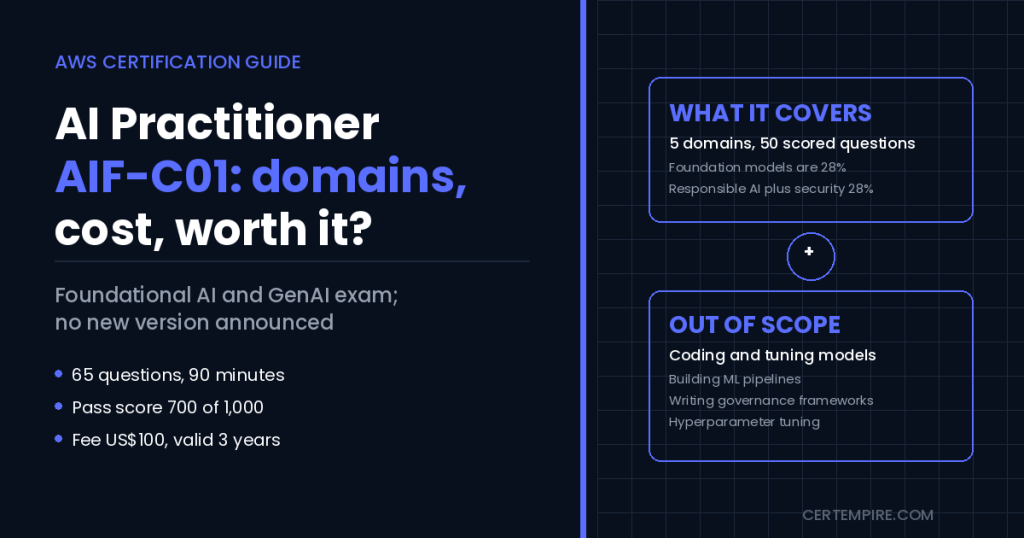
TL;DR: AWS Certified AI Practitioner (AIF-C01) is AWS’s foundational exam on AI, machine learning and generative AI. You get 65 questions in 90 minutes (50 scored, 15 unscored), the fee is US$100, you need 700 out of 1,000 to pass, and the certificate is valid for three years. There are five domains, and the biggest is Applications of Foundation Models at 28%, followed by Fundamentals of GenAI at 24%. The exam guide is now at version 1.1, dated April 30, 2026, and the outline names agentic AI, Model Context Protocol (MCP), Amazon Bedrock AgentCore, Kiro and Strands Agents, so anything you study from before 2026 needs a second look. No prerequisite is required, and the exam is aimed at people who use AI on AWS rather than build it. This guide covers every task statement, the in-scope and out-of-scope services, a 5-week study plan and a realistic view of whether it is worth taking.
Quick Facts
| Item | Detail |
| Exam code | AIF-C01 |
| Level | Foundational |
| Questions | 65 total: 50 scored and 15 unscored |
| Time | 90 minutes |
| Fee | US$100 (exchange rates and local costs may apply) |
| Passing score | 700 on a scale of 100 to 1,000 |
| Scoring | Compensatory: you pass overall, not section by section |
| Question types | Multiple choice, multiple response, ordering, matching |
| Delivery | Pearson VUE test center or online proctored |
| Validity | 3 years |
| Prerequisites | None |
| Target candidate | Up to 6 months of exposure to AI/ML on AWS; uses AI solutions but does not necessarily build them |
| Languages | 12, including English, Arabic, French, German, Italian, Japanese, Korean, Portuguese, Chinese and Spanish |
| Exam guide version | 1.1, April 30, 2026 |
| Language change | Italian and German versions retire after October 15, 2026 |
Where AIF-C01 Stands Today
The exam code has not changed, and AWS has not announced a new version. What has changed is the exam guide. The current guide is version 1.1, dated April 30, 2026, which is 175 days ago, and it lists updates to objectives and services.
That matters because the outline now spells out topics that older AI Practitioner material may not cover: agentic AI, Model Context Protocol (MCP), Amazon Bedrock AgentCore, Kiro, Strands Agents and Amazon Nova. If you bought a course or practice set in 2024 or 2025, compare it against the current outline before you trust it.
Also note that AWS says the Italian and German versions of the exam retire after October 15, 2026. That date passed a week ago. If you were planning to test in either language, check with AWS or Pearson VUE what is still available.
Renewal is simple: pass the latest version of the exam, or earn the AWS Certified Machine Learning Engineer – Associate, which also renews it.
How the Exam Works
Questions
There are 65 questions. Fifty count toward your score and 15 are unscored items AWS uses to test new content. You will not know which are which, so treat every question as live.
The four question types
| Type | How it works |
| Multiple choice | One correct answer and three distractors |
| Multiple response | Two or more correct answers out of five or more options. You must select all of them to get credit |
| Ordering | Place 3 to 5 steps in the right order |
| Matching | Match a list of responses to 3 to 7 prompts. Every pair must be right |
Ordering and matching are all-or-nothing, so do not rush them.
Scoring rules
- Unanswered questions count as wrong, and there is no penalty for guessing. Answer everything.
- Your score is scaled from 100 to 1,000, and 700 is the minimum to pass.
- The scoring is compensatory, so a strong domain can make up for a weak one. You only need to pass the exam as a whole.
Timing
65 questions in 90 minutes works out to about 83 seconds each. That is comfortable for single-answer questions and tight for ordering and matching. Aim for about a minute on quick ones, and flag anything that takes more than two minutes so you can come back.
The Five Domains
| Domain | Weight | Task statements |
| 1. Fundamentals of AI and ML | 20% | 1.1, 1.2, 1.3 |
| 2. Fundamentals of GenAI | 24% | 2.1, 2.2, 2.3 |
| 3. Applications of Foundation Models | 28% | 3.1, 3.2, 3.3, 3.4 |
| 4. Guidelines for Responsible AI | 14% | 4.1, 4.2 |
| 5. Security, Compliance, and Governance for AI Solutions | 14% | 5.1, 5.2 |
The weights add to 100%, spread across 14 task statements. Domains 2 and 3 together make up 52% of the exam, so generative AI is the center of gravity. Domains 4 and 5 together are 28%, which is more than people expect. Do not treat responsible AI and security as filler because they are not technical.
Domain 1: Fundamentals of AI and ML (20%)
Task 1.1: Basic AI concepts and terminology
You need clear definitions for AI, ML, deep learning, neural networks, computer vision, natural language processing, models, algorithms, training and inferencing, bias, fairness, fit, large language models, generative AI and agentic AI, and you need to know how they relate. A simple way to hold it together: AI is the broad field, ML is a way of doing AI by learning from data, deep learning is ML with neural networks, GenAI creates new content, and agentic AI uses models to plan and act across steps.
Also in this task: the types of inferencing (batch, real-time, asynchronous and serverless), the types of data (labeled and unlabeled, tabular, time-series, image, text, structured and unstructured) and the types of learning (supervised, unsupervised and reinforcement).
Task 1.2: Practical use cases for AI
The outline wants you to spot where AI adds value (assisting decisions, scaling, automation) and where it does not, such as when a specific outcome is needed instead of a prediction or when the cost-benefit does not work. You should match techniques to problems: regression for numbers, classification for categories, clustering for grouping. You also need to recognize real-world applications like computer vision, speech recognition, recommendation systems, fraud detection, forecasting, knowledge bases and agentic AI.
On the AWS side, know what the managed services do. Transcribe turns speech into text, Translate translates, Comprehend analyzes text, Lex builds conversational interfaces, Polly turns text into speech and SageMaker AI is the broader platform for building and deploying models. Finally, be able to say when a traditional ML model is the better choice than a foundation model, for example because of regulatory concerns, explainability needs or operational limits.
Task 1.3: The AI/ML development lifecycle
Know the stages of a pipeline, where foundation models come from (open source pre-trained models or custom training), and how a model reaches production (a managed API service or a self-hosted API). The outline maps AWS services to stages, naming Amazon Bedrock, Amazon Quick, Kiro and SageMaker AI. It also covers MLOps basics: experimentation, repeatable processes, scalable systems, managing technical debt, production readiness, monitoring and retraining.
Metrics show up here as well. Technical ones: accuracy, precision, recall and F1. Business ones: cost per user, development cost, customer feedback and ROI.
Study tip: Learn the metrics in plain words. Accuracy is overall correctness. Precision asks how many flagged items were actually positive. Recall asks how many real positives you caught. F1 balances the two.
Domain 2: Fundamentals of GenAI (24%)
Task 2.1: Basic GenAI concepts
This task is the vocabulary of the whole second half of the exam: tokens, chunking, embeddings, vectors, prompt engineering, transformer-based LLMs, foundation models, multi-modal models and diffusion models. It also covers GenAI use cases (image, video and audio generation, summarization, assistants, translation, code generation, customer service agents, search and recommendations) and the foundation model lifecycle: data selection, model selection, pre-training, fine-tuning, evaluation, deployment and feedback.
Two newer items are worth special attention. First, token-based pricing: you need to understand why longer prompts and longer outputs cost more. Second, agentic AI: the outline names multi-agent patterns, MCP and its role in connecting agents to external systems, multi-agent communication, memory management, tool usage and workflow orchestration, along with the role of context engineering in applications.
Task 2.2: Capabilities and limits of GenAI for business problems
The upside: adaptability, responsiveness, conversational ability and content generation. The downside: hallucinations, limited interpretability, inaccuracy and nondeterminism. You also need to weigh model selection factors (model type, performance, capabilities, constraints, compliance, cost, latency, complexity) and tie GenAI to business metrics such as ROI, efficiency, conversion rate, average revenue per user, accuracy and customer lifetime value.
Task 2.3: AWS infrastructure and technologies for GenAI
Know the services and features used to build GenAI applications: Amazon Bedrock, SageMaker AI, SageMaker JumpStart, Amazon Quick, Kiro, Strands Agents and Amazon Bedrock AgentCore. Know why managed services help (accessibility, a lower barrier to entry, efficiency, cost-effectiveness, speed to market), what AWS infrastructure offers (security, compliance, responsibility, safety), and the cost trade-offs: responsiveness, availability, redundancy, performance, regional coverage, token-based pricing, provisioned throughput and custom models.
Domain 3: Applications of Foundation Models (28%)
This is the biggest domain, and it has four task statements.
Task 3.1: Design considerations for FM applications
- Choosing a model: cost, modality, latency, multi-lingual support, size, complexity, customization, input and output length and prompt caching.
- Inference parameters: how settings like temperature and output length change responses. Temperature controls how random the output is.
- RAG (Retrieval Augmented Generation): what it is, why businesses use it and how Amazon Bedrock Knowledge Bases supports it.
- Vector storage: AWS services that can hold embeddings, including Amazon OpenSearch Service, Aurora, Neptune and RDS for PostgreSQL.
- Customization trade-offs: pre-training, fine-tuning, in-context learning, RAG and model distillation, ranked by cost and effort.
- AI agents: their role and business applications.
Task 3.2: Prompt engineering
Concepts: context, instruction and negative prompts. Techniques: chain-of-thought, zero-shot, single-shot, few-shot and prompt templates. Best practices: improving response quality, experimenting, using guardrails and keeping prompts specific and concise. Risks: exposure, poisoning, hijacking and jailbreaking. The outline also names Amazon Bedrock Prompt Management for versioning and managing prompts.
Task 3.3: Training and fine-tuning
The key elements are pre-training, fine-tuning, continuous pre-training and distillation. Fine-tuning methods include instruction tuning, adapting models to a domain, transfer learning and continuous pre-training. For data preparation, know about curation, governance, size, labeling, representativeness and reinforcement learning from human feedback (RLHF).
Task 3.4: Evaluating FM performance
Approaches include human-in-the-loop evaluation, benchmark datasets and Amazon Bedrock Model Evaluation. Metrics include ROUGE, BLEU, BERTScore and LLM-as-a-judge. You also need to judge whether a model meets business goals, evaluate applications built on FMs (RAG, agents and workflows), and use business alignment metrics such as task completion rate, user satisfaction and cost per interaction.
Study tips for Domain 3: Think of prompting, RAG and fine-tuning as a ladder of effort and cost, from cheapest to most expensive. Know the evaluation metrics by purpose: ROUGE and BLEU compare generated text to reference text, BERTScore uses embeddings, and LLM-as-a-judge uses another model to grade outputs.
Domain 4: Guidelines for Responsible AI (14%)
Task 4.1: Developing responsible AI systems
Know the features of responsible AI: bias, fairness, inclusivity, robustness, safety and veracity. Know that Amazon Bedrock Guardrails is the named tool for controlling what a model will accept and produce. Be ready for responsible model selection (including environmental impact and sustainability), the legal risks of GenAI (intellectual property claims, biased outputs, loss of customer trust, end-user risk and hallucinations), what makes a good dataset (inclusive, diverse, curated and balanced), the effects of bias and variance (including overfitting and underfitting) and ways to detect problems such as label quality analysis, human audits and subgroup analysis.
Task 4.2: Transparent and explainable models
Understand the difference between models you can explain and models you cannot, and the tools that help: Amazon SageMaker Model Cards, Amazon Bedrock Model Evaluations, and open source models with their data and licensing. Know the trade-off between safety and transparency, and the principles of human-centered design for explainable AI, such as user feedback mechanisms and decision transparency.
Questions in this domain are usually scenarios. A model treats a group unfairly, a model makes things up, a dataset is unbalanced. Practice naming the issue and the right mitigation.
Domain 5: Security, Compliance, and Governance for AI Solutions (14%)
Task 5.1: Securing AI systems
The outline names IAM roles, policies and permissions, encryption, Amazon Macie, AWS PrivateLink, the shared responsibility model, Amazon Bedrock AgentCore Identity, policy in AgentCore and Bedrock Guardrails. Beyond services, you need the ideas: source citation and data lineage, secure data engineering (quality, privacy-enhancing technologies, access control and integrity), and AI-specific risks such as prompt injection, data leakage, toxicity, and the need for output filtering, validation, audit trails and logging. Hallucination detection and grounding also appear, with RAG grounding, output validation and confidence scoring as examples.
Task 5.2: Governance and compliance
Know which services help: AWS Config, Amazon Inspector, AWS Artifact, AWS CloudTrail and AWS Trusted Advisor. Know data governance strategies (lifecycles, logging, residency, monitoring and retention), and governance processes such as policies, review cadences, frameworks like the Generative AI Security Scoping Matrix, transparency standards and team training.
Watch the verbs. The outline asks you to explain and recognize, not implement. One line each helps: CloudTrail logs API activity, Config tracks resource configuration, Inspector scans for vulnerabilities, Artifact provides compliance reports and Trusted Advisor gives best-practice checks.
What Is In Scope, and What Is Not
AWS publishes both lists and calls them non-exhaustive.
In scope
| Category | Services |
| Machine Learning | Amazon Bedrock, Bedrock AgentCore, Comprehend, Lex, Nova, Personalize, Polly, Rekognition, SageMaker AI, SageMaker JumpStart, Textract, Transcribe, Translate, AWS Transform |
| Developer tools | Kiro, Strands Agents |
| Analytics | AWS Data Exchange, EMR, Glue, Glue DataBrew, Lake Formation, OpenSearch Service, Amazon Quick, Redshift |
| Compute and containers | EC2, Lambda, ECS, EKS |
| Database | Aurora, DocumentDB, DynamoDB, ElastiCache, Neptune, RDS |
| Security | Artifact, IAM, Inspector, KMS, Macie, Secrets Manager |
| Management and governance | CloudTrail, CloudWatch, Config, Trusted Advisor, Well-Architected Tool |
| Networking | CloudFront, VPC |
| Storage | S3, S3 Glacier |
| Cost management | Budgets, Cost Explorer |
Do not try to memorize every service. Start with Machine Learning, Security and Management rows, then learn one sentence for each remaining service: what it does and when you would use it for an AI workload.
Out of scope
AWS’s out-of-scope list includes things like Clean Rooms, MSK, App Runner, Elastic Beanstalk, Lightsail, GuardDuty, WAF, Shield, Cognito, Security Hub, IAM Identity Center, Organizations, Control Tower, Service Catalog, Route 53, Direct Connect, DMS, DataSync, IoT Core and Elemental Media services. Seeing GuardDuty, WAF and Security Hub on that list is useful. It tells you the security questions focus on the AI-related services above, not every AWS security product.
Out-of-scope job tasks
AWS also lists job tasks you are not expected to do:
- Developing or coding AI/ML models or algorithms
- Implementing data engineering or feature engineering
- Hyperparameter tuning or model optimization
- Building and deploying AI/ML pipelines or infrastructure
- Mathematical or statistical analysis of models
- Implementing security or compliance protocols for AI/ML systems
- Developing governance frameworks and policies
This tells you where to stop studying. If you are learning how to tune a model, you have gone deeper than this exam needs.
Cost, Retakes and Renewal
The fee is US$100, and AWS notes that exchange rates and other costs may apply. The certificate lasts three years. To renew, pass the latest version or earn the Machine Learning Engineer – Associate. AWS’s pages do not spell out a retake policy, so check AWS’s current policy before booking.
If you plan to pair this with Cloud Practitioner (CLF-C02), budget about US200inexamfees,assumingbothareUS100. Check the current CLF-C02 fee on AWS’s site. Training and practice exams are extra, and AWS offers free digital training that is enough for many candidates.
Who Should Take AIF-C01
AWS describes the target candidate as someone familiar with AI/ML technologies on AWS who uses them but does not necessarily build solutions, with up to six months of exposure.
| You are | Fit |
| A business analyst, product manager or project manager working with AI tools | Strong fit |
| A sales or pre-sales professional explaining AWS AI services | Strong fit |
| A new cloud professional adding AI knowledge | Good fit |
| A developer wanting to prove you can build with Bedrock | Weak fit. Look at the Professional-level exam |
| A working ML engineer | Better served by an associate or professional credential |
| Someone with no AWS exposure | Start with an AWS foundations course first |
AWS recommends Cloud Practitioner Essentials or Technical Essentials if you are new to IT and AWS. If you already hold Cloud Practitioner or an Associate-level certification, you can skip those. The guide also recommends familiarity with core services such as EC2, S3, Lambda, Bedrock and SageMaker AI, the shared responsibility model, IAM and AWS pricing models.
AIF-C01 vs CLF-C02
These two exams look alike on paper: reportedly both have 65 questions, 90 minutes, a US$100 fee and a 700 passing score. They test completely different things. CLF-C02 is about cloud fundamentals, and reported domain weights are Cloud Concepts 24%, Security and Compliance 30%, Cloud Technology and Services 34% and Billing, Pricing and Support 12%. AIF-C01 is about AI, ML and generative AI.
A simple rule: if you are new to AWS or cloud, start with CLF-C02. If AI is already part of your work and you have some AWS exposure, go straight to AIF-C01. If you are early in your career or your employer is paying, doing both in sequence is reasonable and takes around two months. Our CLF-C02 exam page covers the Cloud Practitioner side.
Where AIF-C01 Fits in the AWS AI Path
| Credential | Level | Purpose |
| AI Practitioner (AIF-C01) | Foundational | Understanding AI concepts and AWS AI tools |
| Machine Learning Engineer – Associate | Associate | Building and operating ML solutions. Earning it also renews AI Practitioner |
| Generative AI Developer – Professional (AIP-C01) | Professional | Developing generative AI solutions |
For the next steps, see our MLA-C01 vs MLA-C02 comparison, the AIP-C01 exam guide and the Amazon Bedrock certification guide. Practice material is on our AIF-C01 exam page, the MLA-C01 exam page and the AIP-C01 exam page.
Six Practice Scenarios
These are our own study examples, not exam questions.
| Scenario | Task | What to think |
| A bank wants to flag unusual transactions and only needs a risk ranking | 1.2 | Fraud detection is a classic ML use case |
| A team wants answers grounded in its own documents without retraining | 3.1 | RAG, for example with a knowledge base |
| A chatbot sometimes invents facts | 2.2, 5.1 | Hallucination. Use grounding and output validation |
| A team must stop a model producing disallowed content | 4.1 | Guardrails |
| Costs grow as users send longer prompts | 2.1 | Token-based pricing |
| An auditor asks who called model APIs last month | 5.2 | CloudTrail logging |
A 5-Week Study Plan
This assumes about 6 to 8 hours a week and no deep AI background. Most candidates seem to need three to five weeks.
| Week | Focus | Tasks |
| 1 | AI and ML basics, learning and inference types, use cases, managed services, lifecycle, metrics | 1.1 to 1.3 |
| 2 | GenAI concepts, tokens and embeddings, FM lifecycle, limits, AWS GenAI services, agentic AI basics | 2.1 to 2.3 |
| 3 | Model selection, inference parameters, RAG and vector stores, customization trade-offs, prompt techniques | 3.1, 3.2 |
| 4 | Fine-tuning, data prep, evaluation, then responsible AI and explainability | 3.3, 3.4, 4.1, 4.2 |
| 5 | Security, governance services, then two full timed practice runs | 5.1, 5.2 |
Things worth doing along the way:
- Read the exam guide and the in-scope services page and tick off each service you can explain in a sentence.
- Open Amazon Bedrock in the console and browse the models and features, even if you do not run anything.
- Write a one-page summary of the shared responsibility model for an AI workload.
- Write five flashcards per domain in your own words.
- Draw the FM lifecycle and the RAG flow from memory.
- Do two timed runs of 65 questions in 90 minutes.
Key Terms to Know
| Term | Meaning |
| Foundation model | Large model trained on broad data and adapted for many tasks |
| Generative AI | Models that produce text, images or other content |
| Agentic AI | Systems that use models, tools and memory to complete multi-step tasks |
| MCP | Model Context Protocol, a way to connect agents to external systems |
| Token | A unit of text a model processes, and the basis of pricing |
| Embedding, vector | Numeric representations of content |
| RAG | Retrieval Augmented Generation |
| Fine-tuning, distillation | Ways of customizing models |
| Temperature | Inference setting that affects randomness |
| Hallucination | Confident but wrong output |
| ROUGE, BLEU, BERTScore | Text evaluation metrics |
| Guardrails | Controls that filter model inputs and outputs |
| Shared responsibility | Who secures what in AWS |
| Compensatory scoring | Pass overall, not per section |
Mistakes People Make
- Over-studying build skills. Coding, tuning and pipelines are out of scope.
- Using pre-2026 material only. The outline now names agentic AI, MCP, AgentCore, Kiro and Strands Agents.
- Skipping responsible AI and security. They are 28% of the exam together.
- Ignoring question types. Ordering and matching need every item right.
- Leaving questions blank. There is no guessing penalty.
- Memorizing service names without use cases. The exam asks you to pick the right tool.
- Studying out-of-scope services. GuardDuty, WAF and Security Hub are on AWS’s out-of-scope list.
- Assuming foundational means trivial. Many candidates find it harder than Cloud Practitioner because of the GenAI detail.
- Overlooking language availability. Check Italian and German before booking.
Is AIF-C01 Worth It?
I will not quote salary numbers, because I have not seen a reliable figure that isolates AI Practitioner holders from the wider workforce.
Where it helps. The fee is low, there is no prerequisite, and one exam covers AI basics, generative AI, agentic AI concepts, responsible AI and security. That suits non-engineers who need to speak credibly about AI on AWS. It lasts three years and leads naturally into associate and professional credentials.
Where it falls short. It is foundational, so it signals awareness, not the ability to build. AWS says building pipelines and governance frameworks are out of scope. The outline changed in 2026, so you need current study material. And its value to an employer depends on the role.
Bottom line. If your job touches AI on AWS but you do not write the code, AIF-C01 is a sensible first step. If you are an engineer, the Associate or Professional AI credentials say more about you.
FAQS
What is the AWS Certified AI Practitioner exam?
AIF-C01 is a foundational AWS exam on AI, ML and generative AI concepts and AWS AI tools, with a focus on practical business use.
How many questions are on AIF-C01?
65 in total: 50 scored and 15 unscored questions that AWS does not identify.
How long is the exam and what is the passing score?
90 minutes, with a minimum passing score of 700 on a scale of 100 to 1,000.
How much does it cost?
US$100 according to AWS, plus any local costs or exchange rate effects.
What are the domains and weights?
Fundamentals of AI and ML 20%, Fundamentals of GenAI 24%, Applications of Foundation Models 28%, Guidelines for Responsible AI 14%, and Security, Compliance, and Governance for AI Solutions 14%.
Does the exam cover agentic AI?
Yes. The current outline names agentic AI, multi-agent patterns, Model Context Protocol, memory management, tool usage and workflow orchestration, plus Amazon Bedrock AgentCore and Strands Agents.
Are there prerequisites?
No. AWS recommends Cloud Practitioner Essentials or Technical Essentials if you are new to IT and AWS.
How long is the certification valid?
Three years. To recertify, pass the latest version or earn the Machine Learning Engineer – Associate.
Is a new version of AIF-C01 coming?
AWS has not announced one. The exam guide was updated to version 1.1 on April 30, 2026.
What question types appear?
Multiple choice, multiple response, ordering and matching. For the last three you must get every part right.
Is there a penalty for guessing?
No. Unanswered questions count as wrong, so answer every question.
What happens to the Italian and German exams?
AWS says they retire after October 15, 2026. Check availability with AWS or Pearson VUE.
Do I need to code or build models?
No. Coding models, feature engineering, tuning and building pipelines are out of scope.
For the official details, see AWS’s AI Practitioner page. More AWS guides are in our AWS category and on our Amazon vendor page.