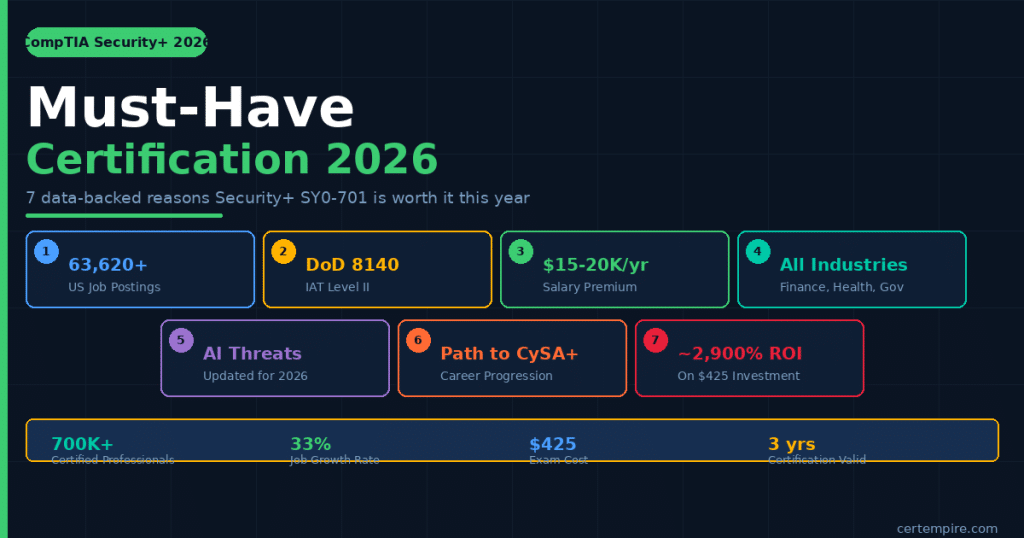
Quick Answer: CompTIA Security+ SY0-701 is the most widely held entry-level cybersecurity certification in the world, with over 700,000 certified professionals and 63,620 active US job postings listing it as a requirement or preference. It is DoD 8140 compliant, vendor-neutral, globally recognized, and delivers an average salary premium of $15,000 to $20,000 per year over non-certified peers. For anyone entering or advancing in cybersecurity in 2026, it remains the single best first certification to earn.
The Case for Security+ in 2026: Seven Reasons Backed by Data
This is not a “certifications are important” article. Every IT career site publishes those. This is a specific, data-backed case for why Security+ SY0-701 is the right certification to prioritize right now, in 2026, over every other entry or intermediate cybersecurity credential available.
Reason 1: The Job Demand Is Concrete and Growing
There are currently over 63,620 active job postings in the United States that explicitly list CompTIA Security+ as a requirement or preferred qualification. That is not estimated demand or projected demand. Those are real positions being actively recruited for right now.
The broader cybersecurity job market context makes this more significant. The ISC2 2024 Cybersecurity Workforce Study identified a global shortfall of 4.8 million cybersecurity professionals. In the US alone, the Bureau of Labor Statistics projects information security analyst roles to grow at 33% over the next decade, nearly five times the average job growth rate across all occupations.
Security+ sits at the intersection of this supply gap and employer demand. It is the certification most frequently cited in entry-to-mid-level cybersecurity job descriptions, which means it is the credential that gets your resume through applicant tracking systems and in front of hiring managers.
For a full breakdown of the specific roles and salary data associated with Security+ certification see our Security+ salary and job roles guide.
Reason 2: The DoD 8140 Compliance Value Is Unique
No other entry-level cybersecurity certification provides DoD 8140 compliance at IAT Level II the way Security+ does. This single factor creates a category of opportunity that is completely inaccessible to candidates without it.
DoD 8140 (formerly 8570) is the US Department of Defense directive that mandates cybersecurity certification for personnel with privileged access to DoD information systems. This applies to both government employees and private sector defense contractors working on DoD programs.
The organizations this affects include: federal agencies (DHS, DoD, NSA, CIA, and dozens of others), defense contractors such as Booz Allen Hamilton, Leidos, SAIC, CACI, Raytheon, Northrop Grumman, and General Dynamics, and any private company with federal IT contracts requiring security clearance.
Entry-level DoD SOC analysts with Security+ and a Secret clearance typically earn $75,000 to $100,000 at the starting level. The same role without Security+ simply does not exist in those organizations. The certification is not preferred, it is required by regulation.
If you are anywhere near the US government, defense, or federal contracting ecosystem, Security+ is not optional.
Reason 3: The Salary Premium Is Measurable
The original version of this blog listed an “$88,000 average salary” with no breakdown. That number is not wrong, but it is also not useful because it blends entry-level and experienced professionals across all roles and regions.
Here is what the 2026 data actually shows by role and experience level:
| Role | Experience Level | Typical US Salary |
| IT Support or Help Desk (Security+ certified) | 0 to 1 year | $50,000 to $65,000 |
| SOC Analyst Tier 1 | 0 to 2 years | $55,000 to $75,000 |
| Security Analyst | 1 to 3 years | $70,000 to $95,000 |
| System Administrator (security focus) | 2 to 4 years | $75,000 to $100,000 |
| DoD/Government SOC Analyst (with clearance) | 1 to 3 years | $75,000 to $110,000 |
| Security Engineer (with Security+ and CySA+) | 3 to 5 years | $95,000 to $130,000 |
The most important data point is not the absolute salary number. It is the differential. Security+ holders earn $15,000 to $20,000 more per year on average compared to non-certified peers in equivalent roles. At a $700 total investment for the certification, that premium pays back in under two weeks of additional earnings and then delivers the full advantage every year after.
Reason 4: It Is Recognized Across Every Industry That Matters
One of Security+’s most underappreciated advantages is its cross-industry relevance. Unlike vendor-specific certifications (Microsoft Azure, AWS, Cisco) that primarily matter in organizations using those specific platforms, Security+ is vendor-neutral and recognized in essentially every regulated industry.
Technology and IT companies: Security+ is often the minimum required credential for security-adjacent roles including system administrator, network administrator, and IT auditor positions.
Healthcare: HIPAA requires organizations to protect patient health information. Healthcare IT teams need staff who understand security controls, risk assessment, and incident response. Security+ satisfies those knowledge requirements and is frequently listed in healthcare IT security job descriptions.
Finance and banking: PCI-DSS compliance, financial fraud prevention, and regulatory IT auditing all require security-competent staff. Security+ is widely recognized in financial sector security roles from analyst to compliance specialist.
Government and public sector: Beyond DoD 8140 compliance, state and local government agencies, federal civilian agencies, and public sector IT organizations consistently include Security+ in role requirements for security positions.
Healthcare technology and medical devices: The convergence of healthcare and connected device security (medical IoT) has created demand for professionals who understand both network security and compliance frameworks. Security+ covers both.
For a detailed look at which specific job titles across these industries list Security+ see our Security+ job roles and industries guide.
Reason 5: SY0-701 Is Updated for the Actual Threats Organizations Face in 2026
Security+ is not a static credential. The SY0-701 version was launched in November 2023 specifically to address gaps in the previous version and align with the threat landscape organizations actually face today.
The key updates in SY0-701 that make it more relevant than its predecessor:
Zero trust architecture receives full coverage in both Domain 1 and Domain 3. Zero trust is no longer a concept organizations are evaluating. It is being actively implemented across enterprise environments, and hiring managers want staff who understand it practically, not just conceptually.
AI-driven threat coverage was added to Domain 2. AI-powered phishing, deepfake voice social engineering, and machine-learning-assisted attacks are documented in real-world breach reports. SY0-701 prepares candidates to recognize and respond to these modern attack vectors.
Supply chain security was significantly expanded. After high-profile supply chain attacks, organizations across every sector are investing in supply chain risk management. SY0-701 covers software bill of materials, vendor risk assessment, and third-party security controls.
Cloud and hybrid environment security has greater depth than in SY0-601. The shared responsibility model, CSPM tools, CASB implementations, and hybrid network security are all part of Domain 3 coverage, reflecting where enterprise infrastructure has shifted.
Security Operations was elevated to 28% of the exam weight, the single largest domain. This reflects employer demand: organizations want security staff who can operate in a SOC, respond to incidents, and work with SIEM and SOAR tools, not just understand security concepts theoretically.
Reason 6: It Positions You for the Most Valuable Next Steps
Security+ does not just open doors to entry-level roles. It is the strategically strongest first credential because of what it enables you to pursue next.
The two most common paths after Security+ in 2026:
Path 1: Blue team and analyst roles. Security+ leads directly to CompTIA CySA+, which builds on Security+’s threat detection and incident response foundations with deeper operational content. CySA+ certified roles average $100,000 to $125,000, a significant step up from Security+-only positions. After CySA+, the path continues to CISSP for senior security engineering and management roles.
Path 2: Government and compliance careers. Security+ satisfies DoD 8140 IAT Level II, which enables the government and defense contractor track described in Reason 2. Many candidates on this path add CISSP or CISM after several years of experience for senior clearance-eligible positions.
In both cases, Security+ is the optimal starting point because it is universally recognized, accessible to candidates with two years of IT experience, and provides the foundational vocabulary that every advanced certification assumes you already have.
For a full map of where Security+ leads, see our cybersecurity certification roadmap.
Reason 7: The ROI Is One of the Best in IT Certifications
When you compare Security+ against every other available entry-level cybersecurity credential, the return on investment is hard to match.
| Certification | Cost | DoD 8140 | Job Postings (US) | Salary Premium |
| CompTIA Security+ SY0-701 | $425 | Yes (IAT II) | 63,620+ | $15K to $20K/yr |
| ISC2 CC | Free (exam waiver) | No | Growing | Moderate |
| CompTIA Network+ | $369 | Partial | High | $5K to $10K/yr |
| CompTIA CySA+ | $404 | Yes (CSSP) | High | $20K to $30K/yr |
| CISSP | $749 | Yes (IAM III) | Very high | $30K to $50K/yr |
Security+ delivers more DoD compliance value than Network+, is more accessible than CySA+ (lower experience requirement), and costs significantly less than CISSP while still generating strong salary premium. For candidates at the start of a cybersecurity career, it is the most efficient use of $425 available.
The math is straightforward. A $425 exam voucher plus $200 to $300 in study materials totals approximately $650. A $15,000 to $20,000 annual salary premium means the investment pays back in 12 to 16 days of additional earnings and then delivers full value every year after. First-year ROI is roughly 2,300% to 3,000%.
For the complete cost breakdown including study materials, academic discounts, and renewal fees, see our Security+ certification cost guide.
Who Benefits Most from Security+ in 2026
Security+ is genuinely valuable for several distinct candidate profiles. Knowing which one you are helps you plan the right preparation approach.
IT professionals transitioning into cybersecurity. If you have one to three years in network support, system administration, or help desk roles, Security+ is the fastest validated path into security-focused positions. The exam assumes IT foundations you likely already have and adds the security layer employers need.
Recent graduates entering the job market. A computer science, information systems, or cybersecurity degree paired with Security+ creates a significantly stronger resume than a degree alone. Many entry-level positions list Security+ as a requirement regardless of educational background.
Career changers with no IT background. Security+ is achievable without prior IT experience but requires more preparation time (typically 16 to 20 weeks from scratch). The investment is worth it given the salary premium at entry level ($55,000 to $70,000) versus most non-IT entry-level positions.
Government and defense contractor employees. If your organization has DoD 8140 compliance requirements or federal IT contracts, Security+ may be a job requirement rather than a voluntary career investment. Many employers in this space offer full exam cost reimbursement.
IT professionals in regulated industries. Healthcare IT, financial services IT, and any organization handling sensitive regulated data benefits from having Security+-certified staff. The certification demonstrates the specific knowledge frameworks those industries require.
For a detailed breakdown of which profile matches your situation, see our guide on whether Security+ is right for you.
Honest Assessment: Who Should Not Prioritize Security+ in 2026
A good case for something should also acknowledge when it is not the right choice.
Experienced security professionals with five or more years of hands-on experience. If you have substantial practical security experience, Security+ adds less value because employers can evaluate your track record directly. CISSP, CISM, or a specialist credential like OSCP is a better investment of your time and money.
Candidates who want offensive security roles. Security+ covers defensive security fundamentals. If your goal is penetration testing or red team work, CompTIA PenTest+ or the Offensive Security OSCP certification aligns better with those specific career paths.
Professionals already holding CISSP or equivalent senior certifications. Security+ does not add meaningful differentiation above senior-level credentials. Investing that study time in a specialist area is more efficient.
How to Get Started
If Security+ is the right next step, the path is straightforward.
Download the official SY0-701 exam objectives from CompTIA.org to understand exactly what is tested. Take the free SY0-701 practice test at CertEmpire to set a baseline score across all five domains before you start studying. Use that baseline to identify which domains need the most preparation time. Follow a structured SY0-701 study plan and use SY0-701 exam questions for domain-level practice throughout your preparation.
For everything you need to know about the exam itself, see our CompTIA Security+ SY0-701 exam guide. For a condensed last-week review reference, use our SY0-701 cheat sheet.
Frequently Asked Questions
Is Security+ still worth it in 2026? Yes for most candidates.
With 63,620 active US job postings, DoD 8140 compliance value, a $15,000 to $20,000 annual salary premium, and a total investment of $500 to $700, Security+ delivers strong ROI for IT professionals entering or advancing in cybersecurity. The one exception is experienced professionals with five or more years of security experience, for whom advanced credentials deliver more value.
How long does it take to earn Security+ in 2026?
Eight to ten weeks for candidates with Network+ and IT experience. Twelve weeks for boot camp graduates or degree holders with no work experience. Sixteen to twenty weeks for career changers starting without IT background. For a detailed timeline see our SY0-701 preparation guide.
What is the Security+ exam cost in 2026?
The exam voucher costs $425 USD through Pearson VUE. Total investment including study materials typically ranges from $500 to $700 for self-study candidates. Academic discounts of 40 to 50 percent are available for eligible students. See our Security+ cost guide for the full breakdown.
Is Security+ enough to get a cybersecurity job?
Security+ is a strong credential that opens doors, but it is most effective combined with hands-on experience, either from a current IT role or documented lab and project work. The certification helps you pass ATS filters and demonstrates baseline knowledge, but interviews still evaluate practical ability. Most candidates use Security+ to make the transition into security from an adjacent IT role.
What is the difference between Security+ and ISC2 CC?
ISC2 CC (Certified in Cybersecurity) is free to sit and growing in recognition. Security+ costs $425 but provides DoD 8140 compliance, significantly higher employer recognition, and a larger body of job postings listing it as a requirement. Many candidates earn both: CC first (free), then Security+ once income supports it. See our ISC2 CC guide for a full comparison.
What should I do after passing Security+?
For analyst and SOC careers the most common next step is CompTIA CySA+. For senior engineering and management roles the path leads to CISSP after several years of experience. See our guide on what to do after Security+ for a full breakdown of options.
How does Security+ compare to other certifications at the same level?
Security+ outperforms Network+ on DoD compliance and salary premium, is more accessible than CySA+ (lower experience requirement), and costs significantly less than CISSP while still delivering strong career value. For a full comparison, see our best cybersecurity certifications guide.
Final Thoughts
The case for CompTIA Security+ SY0-701 in 2026 is built on concrete numbers: 63,620 active job postings, a 33% projected job growth rate for security analyst roles, $15,000 to $20,000 annual salary premium, DoD 8140 IAT Level II compliance, and cross-industry recognition that no other entry-level cybersecurity credential matches.
It is the right first credential for most IT professionals entering cybersecurity because it opens the most doors, satisfies the most compliance requirements, and provides the foundational vocabulary that every advanced certification builds on.
Start with the free SY0-701 practice test at CertEmpire to see where you stand today. Use our SY0-701 exam questions and exam dumps to prepare efficiently. And walk into your exam with the confidence that comes from knowing exactly what you are preparing for and why it matters.
For official exam details and registration visit CompTIA.org. For a complete guide to becoming a cybersecurity analyst see our cybersecurity analyst career guide.