Author Note: This guide is written by a cybersecurity practitioner with hands-on experience in ISC2 certification preparation. All information reflects the current 2026 exam format, pricing, and job market data.
Why ISC2 CC Is Gaining Momentum in 2026
The cybersecurity talent gap is not closing — it is widening. According to ISC2’s 2024 Cybersecurity Workforce Study, the global cybersecurity workforce shortage stands at 4.8 million professionals. Employers are under pressure to hire qualified candidates faster than ever, and entry-level certifications like the ISC2 Certified in Cybersecurity (CC) are increasingly serving as the hiring filter of choice.
The ISC2 CC was purpose-built for people entering cybersecurity for the first time. You do not need a computer science degree, years of IT experience, or a deep technical background to earn it. What you do need is a willingness to learn and a structured study plan.
In 2026, two things have changed that make this certification more valuable than before:
Employer recognition has grown. The ISC2 “One Million Certified in Cybersecurity” initiative has pushed the credential into mainstream HR pipelines. Hiring managers now recognize the CC logo the way they once only recognized CompTIA Security+ or CISSP.
The cost barrier has dropped significantly. The CC exam costs $199 USD — a fraction of what competitors charge. CompTIA Security+ runs $392, and Cisco’s CyberOps Associate costs $330. For career changers and students, this difference is meaningful.
How ISC2 CC Stands Out Among Entry-Level Certifications
There are several entry-level cybersecurity certifications available in 2026. The most commonly compared options are:
- CompTIA Security+ — widely recognized, more technical, costs $392
- EC-Council CEH — focused on ethical hacking, requires experience, costs $950+
- Cisco CyberOps Associate — networking-heavy, costs $330
- ISC2 CC — broadest foundational coverage, beginner-friendly, costs $199
Here is what genuinely separates the ISC2 CC from the rest:
It is designed for zero-experience candidates. Unlike Security+ (which assumes 2 years of IT experience is helpful) or CEH (which requires documented work experience), the ISC2 CC has no prerequisites. A fresh graduate, a finance professional switching careers, or a military veteran transitioning to tech can all sit the exam without meeting experience thresholds.
It is globally portable. ISC2 is recognized in over 170 countries. If you work internationally or plan to, an ISC2 credential travels with you in a way that some regional certifications do not.
It is a legitimate pathway into ISC2’s ecosystem. Once you hold the CC, you are an ISC2 member in good standing. This gives you access to ISC2 resources, communities, and a clear pathway toward SSCP, CCSP, and eventually CISSP — the most respected cybersecurity certification in the world.
It maps directly to real job tasks. The five exam domains were developed by practicing cybersecurity professionals, not academics. Every topic tested corresponds to something an entry-level analyst or security operations center (SOC) team member actually does on the job.
For a detailed comparison of ISC2 CC vs. CompTIA Security+, see our CC vs Security+ guide to understand which certification fits your specific career goals.
Who Should Get the ISC2 CC?
The ISC2 CC is not just for college students. Here is an honest breakdown of who gets the most value from it in 2026:
Career changers from unrelated fields. If you are coming from finance, healthcare, education, or retail and want to move into cybersecurity, the CC is your most credible starting point. It validates that you understand the fundamentals — and for employers, that validation matters more than a list of self-taught skills on a resume.
IT professionals who want to specialize in security. System administrators, help desk technicians, and network engineers who interact with security tools daily but lack a formal security credential use the CC to formalize their knowledge and open doors to SOC analyst or junior security engineer roles.
Recent graduates. A cybersecurity or computer science degree gets you through HR screening. The CC on top of that tells the hiring manager you have validated, standardized knowledge — not just classroom theory.
Non-technical professionals who manage security decisions. Project managers, compliance officers, and business analysts increasingly need to understand cybersecurity to work effectively with security teams. The CC gives them that vocabulary and framework without requiring them to become technical specialists.
One group that should consider going directly to CompTIA Security+ instead: experienced IT professionals with 3+ years in networking or systems administration who are ready for a more technical credential immediately.
The Five Exam Domains Explained
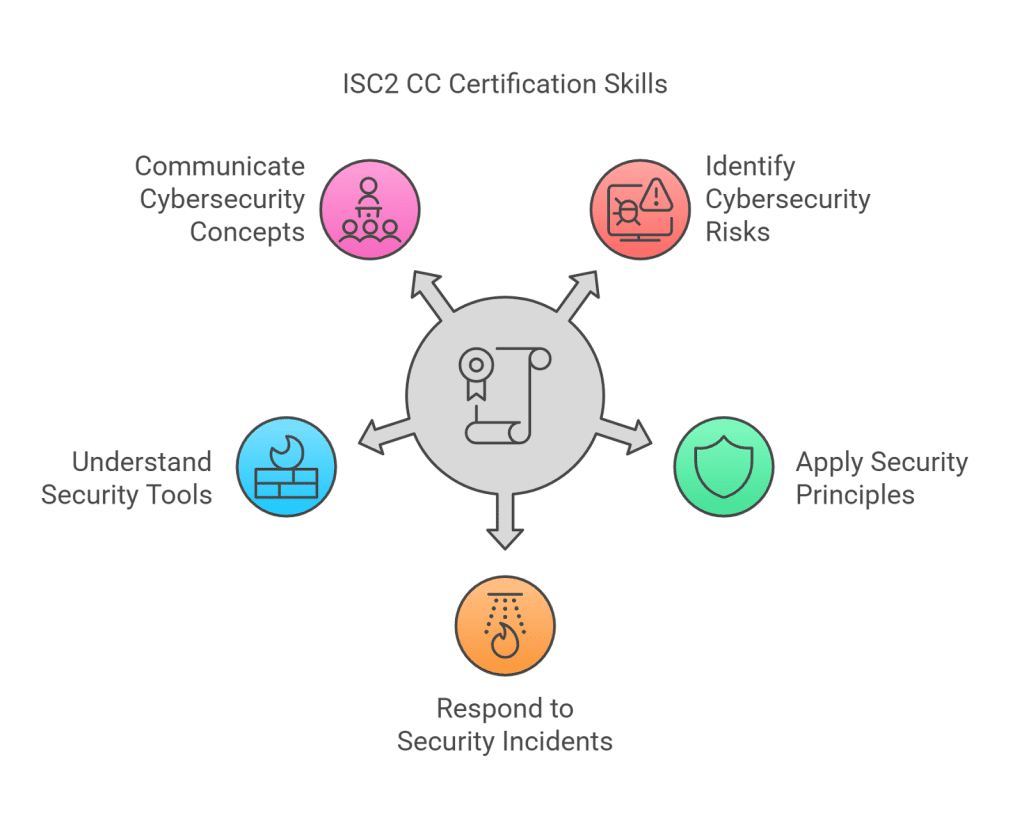
The ISC2 CC exam tests across five domains. Here is what each one actually covers and why it matters for real-world work:
Domain 1: Security Principles (26% of exam)
This is the conceptual foundation of the entire certification. You will learn the CIA triad (Confidentiality, Integrity, Availability) — the three-part framework that underlies every security decision made in any organization. You will also cover access control models, authentication methods (passwords, MFA, biometrics), and the principle of least privilege.
In practice, this domain teaches you to think like a security professional: before you can protect a system, you need to understand what you are protecting and why.
Domain 2: Business Continuity, Disaster Recovery & Incident Response (10% of exam)
What happens when something goes wrong? This domain covers how organizations prepare for disruptions (business continuity planning), recover from them (disaster recovery), and respond to active security incidents (incident response). You will learn the phases of an incident response plan and understand the difference between a disaster recovery plan and a business continuity plan — a distinction that trips up many beginners.
Domain 3: Access Controls Concepts (22% of exam)
Access control is one of the most practical domains on the exam. You will learn how organizations control who can access what — covering physical controls (locks, badges, security guards), logical controls (firewalls, ACLs, role-based access control), and administrative controls (policies, training, background checks). This domain directly applies to day-one SOC analyst responsibilities.
Domain 4: Network Security (24% of exam)
Networks are the most common attack surface in any organization. This domain covers TCP/IP fundamentals, how firewalls and VPNs work, common network threats (man-in-the-middle attacks, DDoS, packet sniffing), and basic network hardening techniques. You do not need to be a network engineer to pass this — but you do need to understand how attackers target networks and how defenders respond.
Domain 5: Security Operations (18% of exam)
The final domain covers the day-to-day work of a security operations team: monitoring systems for anomalies, using SIEM tools, understanding logging and log analysis, and applying data security concepts like encryption and data classification. This is the domain most directly tied to entry-level SOC analyst job descriptions.
ISC2 CC Exam Format, Questions & Passing Score
Here are the key facts about the 2026 exam format:
| Detail | Information |
| Number of Questions | 100 multiple-choice questions |
| Time Limit | 120 minutes (2 hours) |
| Passing Score | 700 out of 1,000 (scaled scoring) |
| Exam Fee | $199 USD |
| Delivery | Online proctored or Pearson VUE test center |
| Retake Policy | 30-day wait; max 3 attempts per 12-month period |
| Maintenance | 45 CPE credits required every 3 years |
About the question format: The exam does not test memorization. Every question is scenario-based — meaning you are given a situation and asked to choose the best response. This is deliberately designed to match real job conditions, where security professionals make judgment calls under pressure.
About the scaled scoring: Not all questions are worth the same number of points. Complex scenario questions carry more weight than basic concept questions. This means you should never leave a question blank — an educated guess on a hard question is always worth attempting.
A practical tip from experience: If you consistently score above 80% on practice exams, you are well-positioned to pass. Most candidates who fail do so because they underestimate the scenario-based nature of the questions and over-focus on memorizing definitions.
How to Prepare: Study Resources That Actually Work
The average preparation time for the ISC2 CC is 4 to 8 weeks for most candidates, depending on your background. Here is what genuinely works in 2026:
1. ISC2 Official Self-Paced Training (Free)
ISC2 offers free official self-paced training for the CC exam through their website. This is your baseline — cover it completely before anything else. It is structured around the five exam domains and takes approximately 14 hours to complete. The fact that it is free and official makes it the most important starting resource.
2. ISC2 Certified in Cybersecurity Official Study Guide (Wiley)
The official study guide published by Wiley is the most comprehensive written resource available. It covers all five domains in depth, includes practice questions at the end of each chapter, and reflects the current exam objectives. If you are someone who learns by reading and taking notes, this is your primary tool.
3. Practice Exams
Practice exams are how you actually prepare for the format of the test — not just the content. Aim to complete at least 3 to 4 full-length practice exams before sitting the real one. Recommended platforms:
- Official ISC2 Practice Exams — closest to the actual test format
- Boson — known for high-quality, scenario-based questions
- Cert Empire — good for timed ISC2 CC practice under exam conditions
Do not just check whether you got a question right or wrong. Use free ISC2 CC practice questions to test your understanding, then analyze why each wrong answer was wrong. That understanding is what the real exam tests.
4. Hands-On Practice Labs
Theory alone will not prepare you for scenario questions. Platforms like TryHackMe (especially their “Pre-Security” and “SOC Level 1” learning paths) give you practical exposure to the tools and tasks the exam references — firewalls, log analysis, network scanning, and more. Even 30 minutes per day on a hands-on platform makes a significant difference.
5. Study Groups and Community
The ISC2 community forum and subreddits like r/cybersecurity and r/isc2 are active in 2026 with exam takers sharing recent experiences, study tips, and domain-specific advice. Connecting with others going through the same process keeps you accountable and surfaces gaps in your knowledge you might not notice studying alone.
Is the ISC2 CC Worth It in 2026?
The short answer: yes, for the right candidate.
The CC is not a shortcut to a six-figure salary. It is a legitimate entry point into a field that is genuinely short of qualified workers. Here is the realistic picture:
Entry-level roles the CC helps you qualify for include SOC Analyst (Tier 1), IT Security Analyst, Junior Penetration Tester (combined with labs experience), Compliance Analyst, and Help Desk with Security Focus. According to 2025 Glassdoor and LinkedIn salary data, these roles in the US typically range from $55,000 to $80,000 annually at entry level.
The CC is most valuable when combined with hands-on experience. A candidate with the CC plus 6 months of documented lab work or a personal security project on GitHub is significantly more competitive than a candidate with the CC alone.
It is the right first certification if: you are new to cybersecurity, you want ISC2 membership access, or you are building toward CISSP in the long run.
It is not the right first certification if: you already have 3+ years in IT and want to jump directly into a mid-level security role — in that case, consider CompTIA Security+ or CySA+ instead.
For a detailed look at salary ranges by job title and industry for CC-certified professionals, see our ISC2 CC Job Roles and Salary Insights guide.
Frequently Asked Questions
How long does it take to prepare for the ISC2 CC?
Most candidates with no prior IT background need 6 to 8 weeks of consistent study (1 to 2 hours per day). Candidates with existing IT experience typically need 3 to 4 weeks. The key variable is how comfortable you are with the scenario-based question format, which requires practice regardless of your background.
Can you pass the ISC2 CC without any IT experience?
Yes. The CC was specifically designed for candidates with no prior experience. Thousands of career changers, fresh graduates, and non-technical professionals have passed it. The official free ISC2 training plus the Wiley study guide is sufficient for most zero-experience candidates.
What happens if you fail the ISC2 CC exam?
You must wait 30 days before retaking the exam. ISC2 allows a maximum of three attempts within any 12-month period. Use the time between attempts to identify which domains you underperformed in (ISC2 provides a domain-level score breakdown) and focus your re-study there.
Is the ISC2 CC harder than CompTIA Security+?
They test different things. The CC is broader and more conceptual — it covers five domains at a foundational level. Security+ is slightly more technical in areas like cryptography and network protocols. Most candidates who have passed both report the CC as slightly less technically demanding, but the scenario-based format makes it harder to “cram” for than people expect.
How much does the ISC2 CC exam cost in 2026?
The exam fee is $199 USD. The official self-paced training is free. The Wiley study guide costs approximately $50 to $60. Total investment for quality preparation runs roughly $250 to $300, making it one of the most affordable professionally recognized cybersecurity certifications available.
Does the ISC2 CC expire?
Yes. You must earn 45 Continuing Professional Education (CPE) credits every three years to maintain the certification. This is a low bar — attending webinars, reading security publications, and completing online courses all count toward CPEs.
Is the ISC2 CC recognized by employers in 2026?
Yes, and recognition is growing. The ISC2 brand carries significant credibility with enterprise employers, government agencies, and multinational companies. Smaller companies may be less familiar with the CC specifically (compared to Security+), but ISC2’s reputation makes the credential trustworthy across most hiring contexts.
For more resources on ISC2 CC preparation, explore our full ISC2 CC Study Guide and Practice Exam collection at CertEmpire.