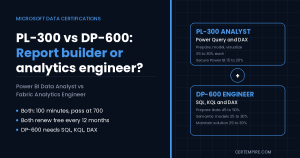
TL;DR: Take PL-300 (Power BI Data Analyst) if your job is building reports and dashboards from data someone else prepared. Take DP-600 (Fabric Analytics Engineer) if you also build the data layer under those reports: lakehouses, warehouses, SQL, KQL and large semantic models. PL-300 is the easier and more common first step. DP-600 is the bigger step up and rewards people who want to move from “report builder” to “analytics engineer”. Neither is retiring according to Microsoft’s current pages, and both cost the same, so the decision is about the work you want to do, not the exam fee.
Quick Facts
| Item | PL-300 | DP-600 |
| Full exam name | Microsoft Power BI Data Analyst | Implementing Analytics Solutions Using Microsoft Fabric |
| Certification earned | Power BI Data Analyst Associate | Fabric Analytics Engineer Associate |
| Core role | Report and dashboard builder, self-service analytics | Builds and manages analytics assets: semantic models, warehouses, lakehouses |
| Exam length | 100 minutes | 100 minutes |
| Passing score | 700 or higher | 700 or higher |
| Question count | Not published by Microsoft | Not published by Microsoft |
| Languages | 10, including English, Japanese, Chinese, Korean, German, French, Spanish, Portuguese (Brazil) and Italian | 7, including English, Japanese, Chinese (Simplified), German, French, Spanish and Portuguese (Brazil) |
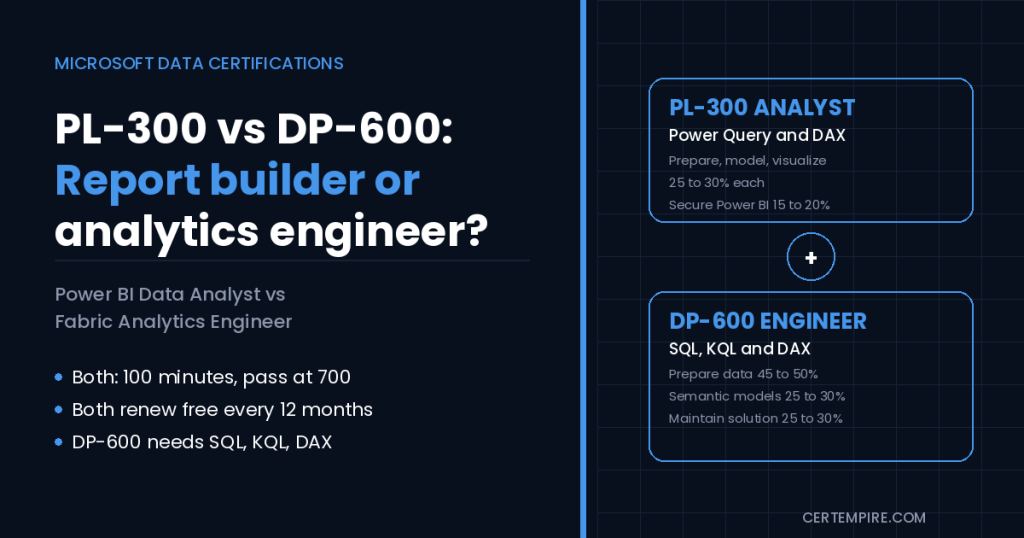
| Languages you need to know | Power Query and DAX | SQL, KQL and DAX |
| Biggest skill area | Prepare, model and visualize, each 25 to 30% | Prepare data, 45 to 50% |
| Security and governance | 15 to 20% (Power BI workspaces, RLS, labels) | Part of the 25 to 30% maintenance domain |
| Exam price | Varies by country, typically USD 165 in the US (check the Microsoft page) | Same, typically USD 165 in the US (check the Microsoft page) |
| Validity | 12 months, free online renewal | 12 months, free online renewal |
| Retirement notice | None shown | None shown |
| Skills outline version | April 20, 2026 | October 19, 2026 |
| Typical US pay (job-title data, not certification-specific) | Power BI developer roles average about USD 89,000 to 93,000 | Analytics engineer roles are reported higher, but no reliable survey exists |
| Best for | Analysts, BI developers, finance and operations reporting staff | Analytics engineers, senior BI developers, Fabric project owners |
| Typical next step | DP-600 or a Fabric certification | DP-700 (Fabric Data Engineer) or deeper specialisation |
The Short Answer
Think of the two exams as two different jobs on the same data team.
- PL-300 is the report builder’s exam. You connect to data, clean it in Power Query, model it, write DAX measures, design visuals and publish securely. Microsoft describes the candidate as someone who delivers insights through visualizations and enables self-service analytics.
- DP-600 is the analytics engineer’s exam. Almost half of it is data preparation in Fabric: getting data into OneLake, choosing between a lakehouse and a warehouse, transforming with SQL and KQL, and then building and optimising large semantic models on top.
If you only build reports, PL-300 covers what you do every day. If you are the person who decides how data lands in Fabric and how the model is designed so that fifty reports can share it, DP-600 is closer to your work.
Why This Comparison Matters Now
Microsoft Fabric has blurred the line between “Power BI person” and “data person”. Even the PL-300 outline now mentions Direct Lake, shared semantic models and Copilot features, and the DP-600 outline asks for Direct Lake configuration and fallback behaviour, deployment pipelines and the XMLA endpoint. The two exams now touch the same platform from different heights.
Two dates are worth knowing:
- The PL-300 skills outline is effective as of April 20, 2026.
- The DP-600 skills outline is effective as of October 19, 2026, with a minor change in the “query and analyze data” area.
Neither page shows a retirement notice. If you were holding off on DP-600 because of the new outline, the change Microsoft lists is minor, and the audience profile and the prepare-data section are unchanged.
What PL-300 Covers
Microsoft lists four skill areas. Weights are given as ranges, so treat them as approximate.
| Skill area | Weight |
| Prepare the data | 25 to 30% |
| Model the data | 25 to 30% |
| Visualize and analyze the data | 25 to 30% |
| Manage and secure Power BI | 15 to 20% |
In practice that means:
- Prepare the data: connecting to sources and shared semantic models, choosing between Import, DirectQuery and Direct Lake, profiling data, and transforming it in Power Query (merge, append, pivot, unpivot, reference versus duplicate queries).
- Model the data: star schemas, cardinality, cross-filter direction, date tables, DAX with CALCULATE and time intelligence, calculation groups, and performance tuning with Performance Analyzer.
- Visualize and analyze: choosing visuals, conditional formatting, bookmarks, drillthrough, tooltips, paginated reports, accessibility, AI visuals, forecasting and anomaly detection.
- Manage and secure: workspaces, apps, gateways, scheduled refresh, row-level security, sensitivity labels, certifying or promoting content.
This is a wide exam, but not a deep one in any single area. A person with six months of real Power BI use can pass it with focused preparation.
What DP-600 Covers
DP-600 is weighted very differently.
| Skill area | Weight |
| Prepare data | 45 to 50% |
| Implement and manage semantic models | 25 to 30% |
| Maintain a data analytics solution | 25 to 30% |
Details Microsoft lists:
- Prepare data (45 to 50%): connecting to data, using the OneLake catalog and Real-Time hub, choosing data stores, transforming with views, functions and stored procedures, building star schemas, and querying with the visual query editor, SQL, KQL and DAX.
- Semantic models (25 to 30%): storage modes, bridge tables and many-to-many relationships, DAX variables, calculation groups, dynamic format strings, field parameters, composite models, query and DAX performance, Direct Lake configuration and incremental refresh.
- Maintain the solution (25 to 30%): workspace and item-level access, row, column, object and file-level security, sensitivity labels, version control, .pbip projects, deployment pipelines, impact analysis and XMLA-based deployment.
The study guide asks for SQL, KQL and DAX. It does not mention PySpark, which surprises some candidates who assume Fabric always means notebooks. That is the territory of DP-700, the Fabric Data Engineer exam.
Where the Two Overlap
Roughly, the overlap is the semantic-model and DAX layer.
- DAX measures, calculation groups, time intelligence and performance tuning appear in both.
- Row-level security and sensitivity labels appear in both, with DP-600 going further (column, object and file level).
- Direct Lake appears in both, but DP-600 expects you to configure and troubleshoot it.
The difference is what surrounds that shared core. PL-300 adds visual design and report distribution. DP-600 adds data stores, SQL and KQL querying, lifecycle management and enterprise-scale model design.
Difficulty: Which Is Harder?
DP-600 is the harder exam for most people, for three reasons.
- More languages. You need SQL, KQL and DAX, not just DAX and Power Query.
- More architecture. You are expected to choose between a lakehouse, warehouse and eventhouse and justify it.
- Heavier weighting on preparation. Nearly half the exam is about getting and shaping data, which is where people without data engineering exposure struggle.
PL-300 is more forgiving if you have used Power BI Desktop, because the exam matches the tool’s workflow closely. The two areas that catch people out are DAX context (CALCULATE and filter behaviour) and row-level security.
If you can already write joins and aggregations in SQL and know basic star-schema modelling, DP-600 becomes much more approachable.
Who Should Take Which
Take PL-300 if:
- You build dashboards for a business team and want a recognised credential for that work.
- You are early in your analytics career, or moving into it from finance, operations or marketing.
- You use Power BI Desktop weekly but do not touch the data platform behind it.
- You want a lower-risk first Microsoft data certification.
Take DP-600 if:
- You already build semantic models for multiple reports and want to own the platform side.
- Your company is adopting Fabric and you will be the one deciding on lakehouses, warehouses and pipelines.
- You are comfortable in SQL and want to add KQL.
- You want a stepping stone toward DP-700 (Fabric Data Engineer).
Take both, in order, if:
- You are building from analyst toward analytics engineer. PL-300 first gives you the modelling and DAX foundation, and DP-600 then adds the engineering layer.
Six Realistic Scenarios
- Finance analyst using Power BI daily, no SQL. PL-300. DP-600 would force SQL and KQL study before you can use the credential in your role.
- BI developer with three years of Power BI and good SQL, company moving to Fabric. DP-600 directly. PL-300 would be a repeat of what you already do.
- Graduate with a statistics degree, no Microsoft experience. PL-300. It is the cleaner entry point, and you can build up to DP-600 later.
- Data engineer asked to “support the reporting team”. DP-600 is closer to your knowledge, and DP-700 is the better fit if your work is pipelines and notebooks.
- Freelance Power BI consultant. PL-300 is the credential clients recognise most. Add DP-600 when you start taking Fabric implementation projects.
- Team lead choosing one certification for the whole reporting team. PL-300 for report builders, DP-600 for the one or two people responsible for the shared models and workspace.
Does One Pay Off More? Salary and Career Impact
Here is what the data can and cannot say. I could not find a survey that separates PL-300 holders from DP-600 holders, so every figure below is by job title, not by certification.
Report-building side (PL-300 territory). A US salary roundup updated in September 2026 compiled Power BI developer averages from Payscale (about USD 88,700), ZipRecruiter (about USD 91,700) and Zippia (about USD 92,600). Glassdoor’s median total pay, which includes bonuses, was higher at about USD 133,000. The spread between sources is large, so treat it as a range of roughly USD 89,000 to 133,000 depending on how pay is counted and where you work. The same roundup shows pay rising with experience, from roughly USD 81,000 to 130,000 at 0 to 1 years on Glassdoor, to well above that at 15 or more years.
Engineering side (DP-600 territory). No independent survey for Fabric Analytics Engineer titles turned up. One exam-prep publisher estimates USD 95,000 to 150,000 for Fabric or analytics engineer roles in the US, but it names no data source or method, so I would treat that as a rough claim, not a benchmark. What is safe to say is that engineering-oriented roles that need SQL and platform skills tend to sit higher than pure reporting roles at the same experience level.
| Layer | Typical roles | Pay evidence |
| Report building | Power BI developer, BI analyst, reporting analyst | About USD 89,000 to 93,000 average (Payscale, ZipRecruiter, Zippia), about USD 133,000 median total pay on Glassdoor |
| Data layer and models | Analytics engineer, senior BI developer, Fabric specialist | No reliable survey, one unsourced estimate of USD 95,000 to 150,000 |
What this means for the decision:
- The roles differ more than the certificates do. The pay step usually comes from moving into a job that needs SQL, KQL and platform design, not from the exam itself.
- The exam is a signal. Employers read it as proof you can do the work, which helps most when you are changing role or employer.
- The cost to find out is low. Each exam typically costs USD 165 in the US, and renewal is free every year.
For your own market, search job postings for “Power BI developer” and “analytics engineer”, compare ranges, and note how many name Fabric or the certification.
Cost and Renewal
- Exam fee: Microsoft’s pages say the price depends on country or region. In the US, associate-level Microsoft exams have typically been USD 165, so confirm yours at checkout.
- Validity: both certifications expire after 12 months unless renewed.
- Renewal: free, done through an online assessment on Microsoft Learn.
- Retakes: after a first failed attempt you can retake after 24 hours. Later waiting periods are longer.
- Free practice: Microsoft offers a free practice assessment and exam sandbox for PL-300, and practice assessments for its certifications on Microsoft Learn.
Budget more for study materials and a Fabric trial or capacity if you are preparing for DP-600, since hands-on practice matters.
How to Prepare for PL-300
- Read the official study guide and mark each bullet as “do daily”, “have seen” or “never touched”.
- Build one complete report from a messy dataset: Power Query cleaning, a star schema, ten DAX measures, and a published report with row-level security.
- Spend extra time on CALCULATE, filter context and time intelligence. They are the most common stumbling blocks.
- Practise workspace, app, gateway and refresh topics, since they are easy marks that people skip.
- Take timed practice tests and review every wrong answer. Our free PL-300 practice questions, the PL-300 exam page and the PL-300 exam overview are good places to start.
Plan on 4 to 8 weeks with regular Power BI use, or longer if you are new to the tool.
How to Prepare for DP-600
- Confirm your SQL basics: joins, aggregations, views and stored procedures.
- Learn KQL at least to the level of reading and writing simple queries over eventhouse data.
- Create a Fabric trial workspace, build a lakehouse and a warehouse, and load the same dataset into both so you can see the differences.
- Build a semantic model with Direct Lake, then practise relationships, calculation groups, field parameters and incremental refresh.
- Walk through deployment pipelines and Git integration, because the maintenance domain is a quarter or more of the exam.
- Use timed practice to find weak areas. Our DP-600 exam page and free DP-600 practice questions cover the format.
Plan on 8 to 12 weeks if you already know SQL and Power BI, and longer if you do not.
A Simple Decision Framework
Answer these four questions:
- Do I mostly build reports, or do I also decide how data is stored and shaped? Reports points to PL-300. Both points to DP-600.
- Can I write SQL joins and aggregations comfortably? No means PL-300 first or time to learn SQL.
- Is my company adopting or already using Fabric? Yes raises the value of DP-600.
- Am I planning to move toward data engineering later? If so, DP-600 then DP-700 is a natural path.
If you are unsure, start with PL-300. It is faster to finish, it overlaps with a large part of DP-600, and what you learn carries over.
Related Reading
If you are mapping a wider route, our Azure certification path guide and the top Microsoft certifications roadmap show where each exam fits. If you are weighing DP-600 against the data engineering exam, read DP-600 vs DP-700, and for the newer Azure data exams see DP-750 vs DP-800. For a closer look at PL-300 on its own, see Is PL-300 worth it?.
FAQS
Do I need PL-300 before DP-600?
No. Microsoft does not list PL-300 as a prerequisite for DP-600. Many people take PL-300 first because it builds the modelling and DAX foundation, but you can go straight to DP-600 if you have the SQL and Power BI experience.
Which exam is harder, PL-300 or DP-600?
DP-600 is usually harder because it expects SQL, KQL and DAX, and puts 45 to 50% of the weight on data preparation. PL-300 expects Power Query and DAX and is closer to day-to-day Power BI work.
How much do the exams cost?
Microsoft says the price depends on country or region. Associate-level Microsoft exams in the US have typically been USD 165, but check the Microsoft page for your location before booking.
How long are the exams?
Both are listed at 100 minutes. Microsoft does not publish the number of questions for either.
What is the passing score?
700 or greater for both exams, on Microsoft’s scaled score.
Do these certifications expire?
Yes, both are valid for 12 months. Renewal is free and done by passing an online assessment on Microsoft Learn.
Is DP-600 about PySpark and notebooks?
No. The current study guide lists SQL, KQL and DAX and does not mention PySpark. Notebook and pipeline work sits mainly in DP-700, the Fabric Data Engineer exam.
Did the DP-600 exam just change?
The skills outline is effective as of October 19, 2026, and Microsoft lists a minor change in the query and analyze data area. The audience profile and the prepare-data section are unchanged. Always check the study guide for the current version before booking.
Is PL-300 retiring?
Microsoft’s PL-300 pages show no retirement notice. The skills outline was updated as of April 20, 2026, and now includes items such as Direct Lake and Copilot features.
Which certification pays more?
No reliable source compares PL-300 and DP-600 holders directly. US Power BI developer pay averages roughly USD 89,000 to 93,000 on three salary sites, and engineering-oriented roles that DP-600 maps to generally pay more, but that comes from the skills and the job, not the certificate alone. Check job postings in your own market.
Should I take PL-300 or DP-600 if I want to become a data engineer?
Neither is the data engineering exam. Start with whichever matches your current skills, then look at DP-700 (Fabric Data Engineer). DP-600 is the closer stepping stone because it already covers SQL, KQL and Fabric data stores.
Final Thoughts
PL-300 is the right call if your work is reports and dashboards, and it is the safer first step for most people. DP-600 pays off when your role is shifting toward owning the data layer, especially if your company is moving to Fabric. Read the current study guides on Microsoft’s Fabric Analytics Engineer Associate page before you book, since outlines and prices can change.