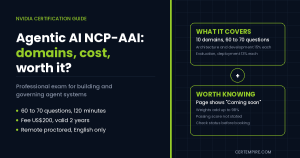
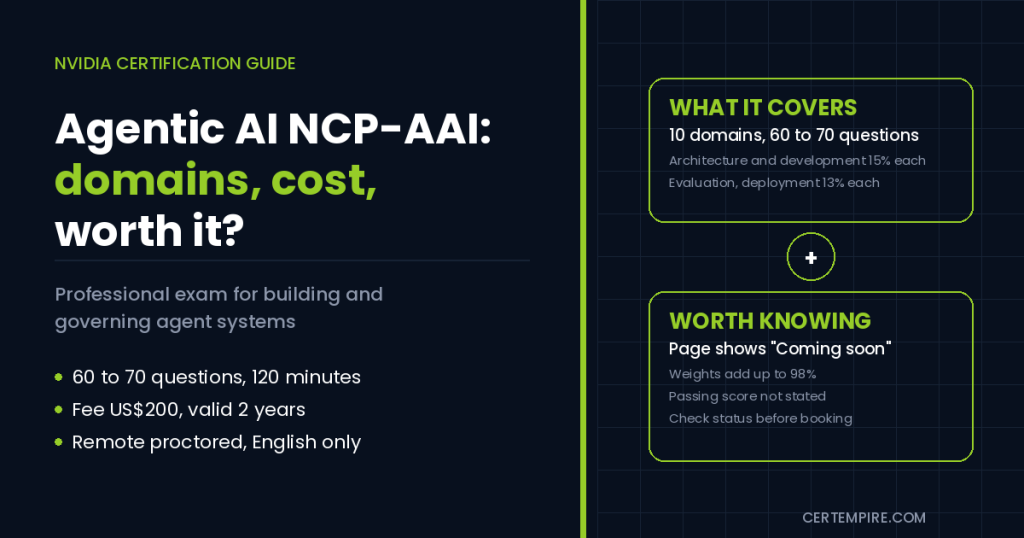
TL;DR: The NVIDIA-Certified Professional: Agentic AI (NCP-AAI) is a professional-level exam that tests whether you can design, build, deploy, and govern agentic AI systems, meaning applications where language models plan, call tools, remember context, and work alongside other agents. NVIDIA’s page lists 60 to 70 questions, 120 minutes, a US$200 exam fee, online remote proctoring, English only, and a two-year validity period. The blueprint has ten domains, led by Agent Architecture and Design (15%) and Agent Development (15%), with Evaluation and Tuning and Deployment and Scaling at 13% each. The exam is aimed at people with 1 to 2 years of AI or ML experience who have already shipped something agentic. It is a good fit if you build or deploy agent systems on NVIDIA infrastructure. It is a weaker fit if you are brand new to AI, in which case an entry-level credential makes a better first step. One practical note: the NVIDIA page still shows “Coming soon” beside the exam title while also offering a registration button, so confirm availability on the page before you plan a date.
Agentic AI is the part of the AI job market that is changing fastest, and certifications in it are new enough that nobody has a settled opinion on their value yet. This guide goes through what the exam covers, how it is run, what it costs, who it suits and how to prepare, so you can decide with real information.
Quick Facts
| Item | Details |
| Exam name | NVIDIA-Certified Professional: Agentic AI (listed on NVIDIA’s site as “Agentic AI LLMs Certification for Professionals”) |
| Exam code | NCP-AAI |
| Level | Professional (NVIDIA describes it as intermediate) |
| Questions | 60 to 70 |
| Duration | 120 minutes |
| Exam fee | US$200 |
| Delivery | Online, remotely proctored |
| Language | English |
| Account needed | A Certiverse account to access the exam |
| Recommended experience | 1 to 2 years of AI/ML experience, including hands-on work on production-level agentic AI projects |
| Domains | 10 (see the blueprint below) |
| Validity | Two years from issuance |
| Recertification | Retake the exam |
| Credential | Digital badge, plus an optional certificate showing level and topic |
| Passing score | Not stated on the exam page |
| Status on NVIDIA’s page | “Coming soon” shown beside the title, with a registration button present |
Two details on the NVIDIA page are worth knowing before you plan. First, the ten domain weights add up to 98%, not 100%, so treat the percentages as a guide to emphasis, not as exact question counts. Second, NVIDIA does not state a passing score or a retake policy on the exam page itself, so check the certification FAQs and exam policies it links to.
What the Certification Is Testing
NVIDIA frames the credential as validating your ability to design, build, deploy and govern advanced agentic AI systems, with attention to multi-agent interaction, distributed reasoning, scalability and ethical safeguards. In plain terms, the exam is not asking whether you can write a prompt. It is asking whether you can build a system where a model makes a sequence of decisions, uses tools and data, gets evaluated, runs in production and stays within safe limits.
That is a different skill set from the one most generative AI certifications measure. A typical foundation-level AI exam checks that you know what a large language model is, what hallucination means and which cloud service does what. The NCP-AAI sits a level above. It assumes you have already built an agent, and it asks about the decisions you faced while doing it: how to structure the agents, how to give them memory, how to measure whether they are any good, how to scale them and how to keep a human in the loop.
If you want the broader landscape of AI credentials before committing, our AWS Certified AI Practitioner guide covers the foundation level, and the Claude certification comparison shows how the model-vendor credentials differ.
The Ten Domains and What Each One Means
The blueprint is below. The “what to expect” column is our reading of what each domain implies in practice, based on NVIDIA’s one-line descriptions, so use NVIDIA’s own study guide as the final word on scope.
| Domain | Weight | What it covers | What to expect |
| Agent Architecture and Design | 15% | Structuring agentic systems, and how agents interact, reason and communicate | Single-agent vs multi-agent designs, orchestration patterns, hand-offs between agents, when a workflow is better than an autonomous agent |
| Agent Development | 15% | Building, integrating and improving agents | Tool and function calling, framework use, prompt and tool design, integrating external services, iterating on behavior |
| Evaluation and Tuning | 13% | Measuring, comparing and optimizing agent performance | Test sets for agent behavior, task success metrics, trajectory evaluation, comparing configurations, tuning prompts and models |
| Deployment and Scaling | 13% | Putting agentic systems into production and scaling them | Serving models, containerized deployment, concurrency, latency and cost trade-offs, scaling multi-agent workloads |
| Cognition, Planning and Memory | 10% | Reasoning strategies, decision-making and memory management | Planning and reasoning patterns, short-term vs long-term memory, context handling, reflection and self-correction |
| Knowledge Integration and Data Handling | 10% | Bringing in external knowledge and handling diverse data types | Retrieval-augmented generation, vector search, chunking and indexing choices, structured and unstructured data |
| NVIDIA Platform Implementation | 7% | Using NVIDIA hardware and software for agentic systems | NVIDIA’s inference and agent tooling, microservices for models, GPU-aware deployment choices |
| Run, Monitor and Maintain | 5% | Operating and monitoring systems after deployment | Observability, logging, tracing, alerting, drift and regression detection |
| Safety, Ethics and Compliance | 5% | Responsible operation and adherence to legal and regulatory requirements | Guardrails, content and action limits, privacy, auditability, policy alignment |
| Human-AI Interaction and Oversight | 5% | Designing for effective human oversight and interaction | Approval steps, escalation, transparency to users, interface design for agent systems |
How to read the weights
The top four domains (Architecture, Development, Evaluation, Deployment) make up 56% of the blueprint. If you are short on time, those are where most of your marks are. The three smallest domains (Run and Monitor, Safety, Human-AI Oversight) are 5% each, but do not skip them: with 60 to 70 questions, 5% is only three or four questions, yet those are often the easiest marks to collect because the concepts are lighter than the engineering domains.
The NVIDIA Platform Implementation domain is only 7%, which tells you the exam is not mainly a product quiz. You should know NVIDIA’s tooling well enough to answer practical questions, but a strong grounding in agent design carries more weight than product trivia.
Exam Format and Logistics
The exam is 60 to 70 questions in 120 minutes, which gives you roughly one and a half to two minutes per question. NVIDIA does not say on the exam page which question types appear, so prepare for scenario-style multiple choice and be ready for anything that needs you to reason about a design rather than recall a fact.
Delivery is online with remote proctoring, so you need a quiet room, a working webcam and a stable connection. You also need a Certiverse account to access the exam. The language is English only.
The credential is valid for two years from the date it is issued, and NVIDIA’s route to recertify is to retake the exam. That matters for your budget, because the credential has a recurring cost, and for your study plan, because the agentic AI field changes quickly enough that the exam you retake in two years will likely look different from the one you sit now.
Availability: the “Coming soon” label
On the NVIDIA page, the words “Coming soon” appear next to the exam title, yet a registration button is present. NVIDIA’s Generative AI LLMs professional page shows the same label. We cannot tell you which way that resolves. Check the page on the day you intend to book, and if registration is open, you can proceed. If it is not, the study guide and recommended courses are still worth working through, because the skills transfer to any agent engineering role regardless of the exam date.
Cost: What You Will Actually Spend
| Item | Cost |
| Exam fee | US$200 |
| Recommended course: Building RAG Agents With LLMs | US$90 (8 hours) |
| Recommended course: Building Agentic AI Applications With LLMs | US$90 (8 hours) |
| Recommended course: Evaluating RAG and Semantic Search Systems | US$30 (3 hours) |
| Recommended course: Introduction to Deploying RAG Pipelines for Production at Scale | US$90 (8 hours) |
| Recommended course: Adding New Knowledge to LLMs | US$500 (8 hours, instructor-led) |
NVIDIA lists these courses as recommended training on the exam page. None is required.
Three realistic budgets
| Approach | What you buy | Approximate total |
| Lean | Exam only, study from the guide and your own project work | US$200 |
| Sensible | Exam plus the two core agent courses and the evaluation course | US$410 |
| Full | Exam plus all five recommended courses | US$1,000 |
Most people who already build agents professionally can go with the lean or sensible route. If you are strong on application development but new to evaluation or production RAG, the sensible route is a better use of money than the US$500 instructor-led course, which is aimed at a narrower skill (adding new knowledge to models).
Because the credential lasts two years and recertification means a retake, plan for the exam fee to recur. We could not find a retake price or waiting period on the exam page, so check NVIDIA’s FAQs before you book if there is any chance you will need a second attempt.
Who Should Take It
NVIDIA lists the target audience as software developers and engineers, solutions architects, machine learning engineers, data scientists, AI strategists and AI specialists. Beyond that list, here is how we would sort people:
| Your situation | Should you take it? | Why |
| Engineer who has built and deployed an LLM-based agent | Yes | The exam maps to work you have done and will give it a recognized label |
| ML engineer moving from classic models to agent systems | Yes, after building a project | The architecture and evaluation domains fill a real gap |
| Solutions architect designing agent platforms for clients | Yes | Architecture, deployment and governance are central |
| Developer with only chatbot or prompt experience | Not yet | Build a tool-using agent and a retrieval pipeline first |
| Beginner to AI | No, start with a foundation credential | The exam assumes 1 to 2 years of experience |
| Manager or strategist with no hands-on build experience | Probably not | The questions are technical, so a strategy-level credential fits better |
| Team using NVIDIA GPUs and microservices in production | Yes | The platform domain and the infrastructure context line up with your daily work |
| Team deploying only on a hyperscaler’s managed AI service | Maybe | Consider the cloud provider’s own AI developer certification first |
A useful test: can you explain, without notes, how your last agent decided which tool to call, how you knew it worked and what you would change to run it at ten times the volume? If yes, you are ready to study for this exam. If not, build something first.
How It Compares With Other AI Certifications
Against NVIDIA’s other professional exams
NVIDIA’s Generative AI LLMs professional exam (NCP-GENL) uses the same overall format: 60 to 70 questions, 120 minutes, US$200, two-year validity. The difference is the subject. NCP-GENL is about the model itself: optimization, GPU acceleration, prompt engineering, fine-tuning and data preparation. NCP-AAI is about the system around the model: architecture, planning, memory, tools, evaluation and oversight. If you build the applications, NCP-AAI fits. If you train, tune and optimize the models, NCP-GENL fits. Our pages for NCA-GENL and NCP-AII show the neighboring NVIDIA credentials.
Against cloud-provider AI developer certifications
Cloud-provider credentials test you on that provider’s managed services. The NCP-AAI is built around agent design principles plus NVIDIA’s own stack. If your employer is committed to a single cloud, the provider’s credential may carry more weight with your manager. If your work is hardware-aware or multi-environment, the NVIDIA credential is more portable. Our AWS Generative AI Developer practice material and the AWS certification path guide cover the AWS side if you want to compare directly.
Against other vendors adding agentic tracks
Agentic AI has started to appear as its own track in vendor programs. Oracle, for example, has restructured part of its certification line around it, which we covered in our Oracle OCI certification changes post. The trend is clear: expect more credentials in this area over the next year, and expect the content to move quickly.
Study Plan: Six to Eight Weeks
This plan assumes you already work in AI or software and can give 6 to 8 hours a week.
| Week | Focus | Output |
| 1 | Read NVIDIA’s study guide end to end and map it to the ten domains. Note where you are strongest and weakest | A one-page gap list |
| 2 | Agent architecture and design: single vs multi-agent, orchestration, hand-offs | A diagram of an agent system you could defend in an interview |
| 3 | Agent development: tool calling, framework use, integration | A small working agent with two or three tools |
| 4 | Knowledge integration and memory: retrieval pipeline, chunking, indexing, short- and long-term memory | A retrieval-backed version of your agent |
| 5 | Evaluation and tuning: build a test set, measure task success, compare two configurations | A short evaluation report with numbers |
| 6 | Deployment, scaling, monitoring: serve it, load test it, add tracing | A deployed version with logs and basic alerts |
| 7 | Safety, oversight and the NVIDIA platform: guardrails, approval steps, NVIDIA’s tooling | A guardrail layer and an approval step in your agent |
| 8 | Timed practice, error log review, weak-domain revision | A second pass through your gap list |
The point of the plan is that every week ends with something you built. Exams in this area reward people who have run into the problems before, because the questions describe situations and ask for the best decision.
Common Mistakes
- Treating it as a prompt engineering exam. Prompting is a small part of one domain. The weight is on systems.
- Skipping evaluation. Evaluation and Tuning is 13%, and many builders have only ever eyeballed agent outputs. Learn to measure.
- Over-studying product names. The NVIDIA platform domain is 7%. Know the tooling at a practical level, but do not let it eat your whole plan.
- Ignoring the small domains. Safety, monitoring and human oversight together are 15%. They are quick to learn and easy to lose marks on if you skip them.
- Relying on one framework. The exam covers multi-agent frameworks and integration across platforms, so avoid learning only one tool’s way of doing things.
- Booking before checking availability. Confirm the exam is open for registration on the day you plan to book.
- Using unofficial practice material as your only guide. The blueprint and NVIDIA’s study guide are the source of truth. Third-party practice questions can help you test recall, but they should follow the official domains.
Is It Worth It?
It depends on where you are in your career, and for a very new credential the plain answer is that its market value is still being established. Here is how we would weigh it.
Reasons to take it. The fee is modest at US$200. The skills it covers are in demand and hard to evidence on a CV without a project portfolio. It comes from the company whose hardware and software sit under much of the industry’s AI infrastructure, so the name carries weight with teams that run on NVIDIA. And the preparation itself, if you follow a build-as-you-go plan, makes you better at your job whether or not the badge ever matters.
Reasons to wait. The credential is new, hiring managers are still learning what it signals, and the “Coming soon” label means the program may still be settling. It lasts only two years and recertifies by retake, so the cost recurs. If you have no hands-on agent experience, the exam will be a hard first step and you will likely learn more from building than from studying for a test.
Our verdict. If you build or deploy agent systems today, take it once you have confirmed the exam is open: it is cheap enough to be a low-risk way to put a recognized label on skills you already use. If you are earlier in your AI journey, build an agent project and take a foundation-level credential first, then return to this one in six months. We have left salary figures out of this guide because no source we could find separates people who hold this credential from the wider AI engineering market.
The authoritative details, including the current status, study guide and FAQs, are on NVIDIA’s Agentic AI certification page.
FAQs
1. What is the NVIDIA NCP-AAI certification?
It is NVIDIA’s professional-level credential for agentic AI. It validates your ability to design, build, deploy and govern agent systems, including multi-agent designs, planning, memory, evaluation and oversight.
2. How many questions are on the exam and how long is it?
NVIDIA lists 60 to 70 questions and 120 minutes. The exam is delivered online with remote proctoring.
3. What are the domains and weights?
There are ten: Agent Architecture and Design (15%), Agent Development (15%), Evaluation and Tuning (13%), Deployment and Scaling (13%), Cognition, Planning and Memory (10%), Knowledge Integration and Data Handling (10%), NVIDIA Platform Implementation (7%), Run, Monitor and Maintain (5%), Safety, Ethics and Compliance (5%) and Human-AI Interaction and Oversight (5%). The listed weights add up to 98%, so use them as a guide to emphasis.
4. Is there a prerequisite?
There is no formal prerequisite listed, but NVIDIA recommends 1 to 2 years of AI or ML experience including hands-on work on production-level agentic AI projects.
5. What is the passing score?
It is not stated on the exam page. Check NVIDIA’s certification FAQs and exam policies.
6. How long is the certification valid?
Two years from issuance. NVIDIA’s recertification route is to retake the exam.
7. Is the exam available now?
The page shows “Coming soon” beside the title while also offering a registration button. Check the page on the day you plan to book to see whether registration is open.
8. In which languages is it offered?
English only.
9. What is the difference between NCP-AAI and NCP-GENL?
Both are professional-level, 120-minute NVIDIA exams at US$200. NCP-GENL focuses on the model (optimization, fine-tuning, GPU acceleration), while NCP-AAI focuses on the agent system around the model (architecture, planning, memory, evaluation and oversight).
10. Which NVIDIA courses are recommended?
NVIDIA lists Building RAG Agents With LLMs, Building Agentic AI Applications With LLMs, Evaluating RAG and Semantic Search Systems, Introduction to Deploying RAG Pipelines for Production at Scale and Adding New Knowledge to LLMs. None is mandatory.
11. How long should I study?
For someone already working in AI, six to eight weeks at 6 to 8 hours a week is a reasonable plan, built around creating a small working agent, an evaluation set and a deployed version.
12. Is it worth taking if I am a beginner in AI?
Probably not yet. The exam assumes hands-on agent experience. A foundation-level AI credential and a project of your own are better first steps.