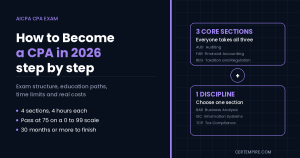
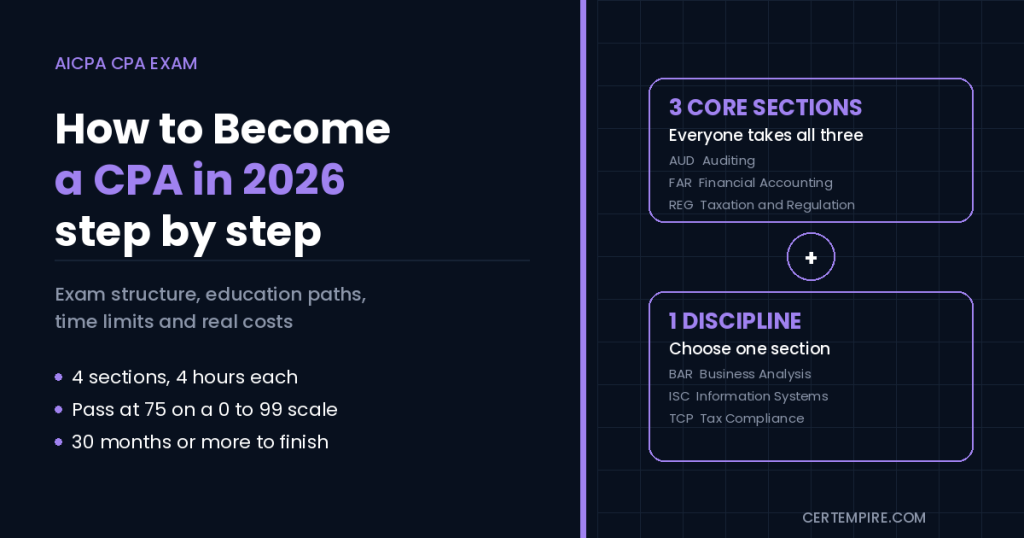
TL;DR: Becoming a CPA means meeting three requirements: education, the Uniform CPA Examination, and supervised experience. Your state or jurisdiction’s Board of Accountancy sets the details, so start by choosing where you want to be licensed. The exam is 16 hours in total: three four-hour Core sections (AUD, FAR and REG) plus one four-hour Discipline section that you pick from BAR, ISC or TCP. You take one section at a time and need a score of 75 on a 0 to 99 scale on each. Most jurisdictions now give you at least 30 months to pass all four sections, not the old 18. The traditional education route is 150 credit hours, but newer pathways such as a bachelor’s degree plus two years of experience are being adopted state by state. Exam fees depend on your jurisdiction, so budget from your own board’s page, not from a national figure.
Quick Facts
| Item | CPA |
| Exam name | Uniform CPA Examination |
| Total length | 16 hours across four sections |
| Core sections (all required) | AUD (Auditing and Attestation), FAR (Financial Accounting and Reporting), REG (Taxation and Regulation) |
| Discipline sections (choose one) | BAR (Business Analysis and Reporting), ISC (Information Systems and Controls), TCP (Tax Compliance and Planning) |
| Time per section | 4 hours |
| Structure of each section | 5 testlets: 2 multiple-choice, then 3 task-based simulations |
| Passing score | 75 on a 0 to 99 scale, per section, not curved |
| Scoring weights | AUD, FAR, REG, BAR and TCP: 50% multiple-choice and 50% simulations. ISC: 60% and 40% |
| Time to pass all four sections | At least 30 months in most jurisdictions, up to 36 in some |
| Order of sections | Any order, one section at a time |
| Language and format | English only, computer-based, at Prometric centers |
| Who sets requirements | Board of Accountancy in each of the 55 jurisdictions |
| Education | Several pathways, including 150 credit hours, master’s degree, and in some states a bachelor’s degree plus two years of experience |
| Experience | 1 to 2 years of supervised work, depending on pathway and state |
| Application fee | Varies by jurisdiction, AICPA describes a typical range of USD 20 to 150 |
| Exam section fee | Varies by jurisdiction (one example in the cost section) |
| License upkeep | Continuing professional education (CPE) and good standing |
| Latest cumulative pass rates (Q1 to Q3 2026) | AUD 50.03%, FAR 43.54%, REG 66.32%, BAR 43.88%, ISC 68.56%, TCP 79.75% |
The Short Answer
There are six steps, and the order is more flexible than people expect.
- Choose the jurisdiction where you want to be licensed.
- Check its education requirement and plan how to meet it.
- Apply to sit the exam through your jurisdiction (applications run through NASBA’s CPA Central).
- Pass the four exam sections within your jurisdiction’s time limit.
- Complete your supervised experience.
- Apply for the license, then maintain it with continuing professional education.
The exam is the same for everyone. Everything else depends on where you apply. That is why a general guide can only tell you what to ask your board, and why this one keeps pointing you back to it.
What the CPA Exam Looks Like Today
The exam changed structure in recent years, and a lot of older advice still describes the previous version. The current design is built on a Core and Discipline model.
Core sections: everyone takes all three.
- AUD: Auditing and Attestation
- FAR: Financial Accounting and Reporting
- REG: Taxation and Regulation
Discipline section: choose one.
- BAR: Business Analysis and Reporting
- ISC: Information Systems and Controls
- TCP: Tax Compliance and Planning
That makes four sections, each four hours long, 16 hours in total. A common mistake is to think you must sit all six lettered sections. You do not. You sit the three Core sections and one Discipline section.
Each section has five testlets. The first two are multiple-choice questions and the last three are task-based simulations, which are small case studies. You can move around inside a testlet before you submit it, but once you submit a testlet you cannot return to it, and you cannot move on until the previous one is submitted.
Breaks. The clock keeps running after testlets one, two and four. After testlet three, if you choose to take a break, the clock stops for 15 minutes.
Calculators. You can do financial calculations using a spreadsheet application or a four-function online calculator.
Format. The exam is computer-based and in English only. You can sit one section at a time, in any order.
How the CPA Exam Is Scored
The passing score is 75 on a scale of 0 to 99, for each section. The AICPA states that scores are not curved and that a score does not represent a percentage of questions answered correctly. A 75 is not “75 percent right.”
Some facts that help you plan:
- Scoring is automated and uses Item Response Theory. Scaled scores take into account whether each question was answered correctly and how difficult it was.
- Pretest questions are included for data collection and do not affect your score.
- Weights. For AUD, FAR, REG, BAR and TCP, the multiple-choice and simulation parts count 50% each. For ISC the split is 60% multiple-choice and 40% simulations.
- Simulations are half the score for five of the six sections. Practising task-based simulations is therefore not optional.
- Results timing. Scores are released on a rolling basis, with release dates posted twice a year. The AICPA page does not give a fixed number of days, so check the current release schedule.
- Score review. A review only checks that the approved answer keys were applied correctly. Requests go through your Board of Accountancy and can take up to eight weeks. Appeals exist only in some jurisdictions, with a separate fee for each item challenged.
- No score adjustments are made for testing difficulties. In rare cases of serious technical problems, NASBA may offer a free retest.
Pass Rates by Section
The AICPA publishes cumulative pass rates for each section.
| Section | Q1 to Q3 2026 | Full year 2025 |
| AUD | 50.03% | 48.21% |
| FAR | 43.54% | 42.12% |
| REG | 66.32% | 63.12% |
| BAR | 43.88% | 41.94% |
| ISC | 68.56% | 67.79% |
| TCP | 79.75% | 77.65% |
Reading these numbers:
- FAR and BAR are the hardest by pass rate, both below 45%.
- TCP has the highest pass rate, near 80%, and ISC and REG are in the high 60s.
- Do not choose a Discipline section only because the pass rate is high. The AICPA’s own guidance advises against picking the section that seems easiest. Choose based on your coursework, work experience and interests.
- Comparisons with earlier years are not like-for-like. The AICPA notes that transitional policies, changed candidate behaviour and the new Discipline choice all affect the figures.
- Pass rates are per section, not per person. They tell you how often a sitting passes, not how many candidates eventually qualify.
Choosing Your Discipline Section
The AICPA’s guidance describes the three options like this.
- BAR suits candidates interested in corporate accounting, financial analysis or applied research.
- ISC suits candidates interested in technology, IT audit, advisory work or where accounting meets information systems.
- TCP suits candidates interested in tax, personal financial planning or wealth advisory.
Two points make the decision less stressful.
- Your license does not name your Discipline. The AICPA states that a CPA license simply says CPA. It does not specify whether you passed BAR, ISC or TCP, and the choice does not restrict your career.
- Pick on fit, not on difficulty. Think about your coursework, internships and the work you want to do. If you are drawn to IT audit, ISC is the natural choice, and our CISA certification cost guide shows a related credential path.
The Time Limit: It Is No Longer 18 Months
This is the most common outdated claim online. The AICPA states that the window to pass all sections was previously 18 months and is now at least 30 months, and three years in some states. A national education site for candidates says the same: most jurisdictions allow 30 months after the first section is passed, and some allow up to 36.
How the clock works varies by jurisdiction. The AICPA describes it as starting when you pass your first section. One state board example, Ohio, says candidates must pass all four sections within a rolling 30-month period that starts on the date of the score release, and that credit for any section passed outside that window expires. Check your own jurisdiction’s wording before you plan, because the start point and any exceptions are set locally.
Practical consequences:
- Plan your sections as a sequence. The sections can be taken in any order, so start with the one you are best prepared for, or the one that links to your current coursework.
- Pace yourself. The AICPA article for candidates suggests a few months of preparation per section as an ideal. With 30 months, four sections and a job, that is realistic for most people.
- Do not let credit expire. If a section passed early falls outside the window, you must retake it.
Education Requirements and the New Pathways
Education requirements are set by each Board of Accountancy, and this is where the rules are changing fastest.
The traditional route is 150 semester hours of college coursework, which usually means a bachelor’s degree plus additional credits, or a master’s degree. The AICPA’s road map for candidates describes it as 150 credit hours plus one year of experience plus passing the exam.
Newer pathways are being adopted state by state. The AICPA’s candidate site describes these:
| Pathway | Education | Experience | Exam |
| Master’s route | Master’s degree with an accounting concentration | 1 year | Yes |
| Bachelor’s plus 30 | Bachelor’s with an accounting concentration plus 30 additional credits | 1 year | Yes |
| Bachelor’s route (newer) | Bachelor’s with an accounting concentration | 2 years | Yes |
Points to know:
- The bachelor’s plus two years route is an additional option. It does not replace the existing ones.
- It is not available everywhere. Each state must pass legislation or change its rules. The AICPA says many states have adopted it, and that effective dates differ, with some starting in 2026 or 2027. The AICPA points to NASBA for the current list, so check it before you plan.
- The master’s route and the bachelor’s plus 30 route are described as recognised in all states.
- All pathways lead to the same CPA license.
- An accounting concentration often means about 24 to 30 accounting credit hours and about 24 business credit hours, but this varies by state. One state board example, Ohio, requires 30 semester hours in accounting (including auditing, financial accounting and taxation) plus 24 semester hours in business courses other than accounting, with business law counting as a business course.
Before you spend on courses, ask your board three questions: which pathway will you accept, which accounting and business courses count, and whether a credential evaluation is required.
Experience and Ethics
You need supervised experience, usually 1 to 2 years depending on your pathway and jurisdiction. The work must be supervised by a licensed CPA, and each board defines what qualifies. Some states also require an ethics requirement, sometimes called the “E.” The AICPA describes it only briefly, so check your board for details.
How to Apply for the Exam
- Choose your jurisdiction first. Applications go through the Board of Accountancy of the state or territory where you want to be licensed.
- Get the application materials and submit them as your jurisdiction directs, through NASBA’s CPA Central.
- Provide transcripts and identification and pay the application fee.
- Receive your Notice to Schedule. This authorises you to book a section at a testing center.
- Schedule and sit the exam within your Notice to Schedule period.
Rules worth knowing:
- No withdrawal or extension of a Notice to Schedule is described as a standard option, and fees are not refundable. If your notice expires or you miss an appointment, you must reapply and pay again. An Ohio example says candidates may request an extension or partial refund in extreme circumstances through an exception form.
- Test from any state. Candidates can test in the US from any state, not only the one where they are licensed.
- Non-participating jurisdictions limit testing to approved centers in the US, Guam, Puerto Rico and the Virgin Islands.
Testing Outside the US
The exam is offered at Prometric centers in the US and in these countries: Bahrain, Brazil, Egypt, England, Germany, India, Ireland, Israel, Japan, Jordan, Kuwait, Lebanon, Nepal, Saudi Arabia, Scotland, South Korea and the UAE. International testing is offered continuously.
- An international Notice to Schedule cannot be used at a US center. If you need to switch back, you must notify NASBA.
- Bring a passport. It is the primary ID for international testing, including for US citizens living abroad.
- The exam is in English only.
How Much Does the CPA Cost?
There is no single national price, because fees are set by the jurisdiction and testing providers. The AICPA’s road map says exam application fees are typically USD 20 to 150, and the section fee is listed separately.
As one worked example, NASBA’s Ohio page lists:
| Item | Amount (USD) |
| Education evaluation application fee | 96.00 |
| Exam application fee | 101.00 |
| Exam section fee | 268.59 per section |
For four sections in that jurisdiction the section fees alone come to 1,074.36 (4 x 268.59), before the application and evaluation fees and before any retakes. Your own state will differ, so use this as an illustration of the shape of the cost, not as a quote.
Other costs to add up:
- Review course and practice materials. This is often the largest item and varies by provider.
- Retakes. Each retake of a section pays the section fee again.
- Additional courses if you need credits to meet your jurisdiction’s education rules.
- Licensing fees after you pass, set by your board.
- CPE to keep the license active.
How Long Does It Take?
Plan on years, not months. The education requirement often takes the longest. The exam itself can be done in as little as a few sittings if you pass everything first time, but with four sections and a job most candidates spread it across one to two and a half years. The AICPA suggests a few months of preparation per section as an ideal, which puts a steady pace at around a year to a year and a half for the exam. Experience requirements of one to two years can run alongside the exam in many jurisdictions, but check whether yours allows that.
Salary and Career Outlook
Salary depends heavily on role, location and experience, and I did not find a reliable source that isolates CPA license holders from other accountants. The best public benchmark is the US Bureau of Labor Statistics figure for accountants and auditors, which includes people without a CPA.
| Measure | BLS figure |
| Median annual wage, May 2025 | USD 83,680 (USD 40.23 per hour) |
| Finance and insurance | USD 93,290 |
| Management of companies and enterprises | USD 91,940 |
| Government (excluding state and local education and hospitals) | USD 83,350 |
| Accounting, tax preparation, bookkeeping and payroll services | USD 81,490 |
| Projected growth, 2025 to 2035 | 5%, faster than the 3% average |
| Jobs in 2025 | About 1,595,200 |
What the data does and does not say:
- A CPA is not required for every accounting job. BLS says accountants who file reports with the SEC must be licensed CPAs, and that others may pursue licensure to improve their job prospects.
- Industry matters as much as the credential. Medians range from about USD 81,000 to USD 93,000 across the top industries listed.
- Very wide salary ranges are not useful. A range that spans tens of thousands to hundreds of thousands tells you nothing about what you are likely to earn. Look at the median for your region and specialism.
For a wider view of finance credentials, see our guides to CFA vs FMVA and the FMVA certification.
How to Prepare for the CPA Exam
These suggestions come from how the exam is built, not from any AICPA rule.
- Read the exam blueprints. The AICPA publishes blueprints for each section that outline the content and the skill level at which it can be tested. They are your syllabus.
- Pick your first section strategically. Start with the one closest to your current coursework or job, so the first pass builds confidence and starts the clock on your terms.
- Treat simulations as half the exam. Task-based simulations carry 50% of the score on five of six sections, so practise them from the first week, not the last.
- Practise under exam conditions. Do full-length four-hour practice sessions, including the testlet rules, because you cannot return to a submitted testlet.
- Plan your breaks. Only the break after testlet three stops the clock. Practise your pacing around that.
- Review failed sections properly. The AICPA’s guidance suggests reviewing your approach, including simulation practice and blueprint use, before a retake.
- Track your window. Write down the date your 30-month period started and the date each section’s credit expires.
- Use quality practice questions. Our exam pages for Auditing, Financial and Business show the style of practice questions we publish.
Common Mistakes to Avoid
- Using the old structure. There are four sections, three Core and one Discipline, not six.
- Believing the 18-month limit. It is now at least 30 months in most jurisdictions, and the start point is set locally.
- Applying to the wrong jurisdiction. Education and experience rules differ, so choose first.
- Assuming 150 hours is the only route. Newer pathways exist, but only where your state has adopted them.
- Reading 75 as 75 percent. The score is on a 0 to 99 scale and is not a percentage.
- Ignoring simulations. They are half the score on most sections.
- Letting a Notice to Schedule expire. Fees are not refundable and you must reapply.
- Choosing a Discipline section only on pass rate. Fit with your career matters more.
- Budgeting from a single national fee. Fees are set locally, so use your own board’s figures.
A Simple Decision Framework
- Which jurisdiction do I want? Start there, because every other answer depends on it.
- Which education pathway does it accept? Master’s, 150 hours, bachelor’s plus 30, or bachelor’s plus two years.
- Which Discipline section fits my career? BAR for corporate and analysis, ISC for IT and controls, TCP for tax and planning.
- Which section should I start with? The one nearest my coursework or current work.
- What is my deadline? Note the date the time limit starts and the date credit expires.
Related Reading
If you work in or want to move into IT audit or controls, the ISC section pairs well with the credentials in our CISA certification cost guide. If your interest is finance and valuation rather than licensure, compare CFA vs FMVA and read the FMVA certification guide.
FAQS
How do I become a CPA?
Meet your jurisdiction’s education, exam and experience requirements, then apply for the license. Choose the state or territory first, check which education pathway it accepts, apply to sit the Uniform CPA Examination through NASBA’s CPA Central, pass all four sections, complete 1 to 2 years of supervised experience, and maintain the license with continuing professional education.
What are the sections of the CPA exam?
Three Core sections (AUD, FAR and REG) and one Discipline section that you choose from BAR, ISC or TCP. Each is four hours, for 16 hours in total.
Do I have to take all six CPA sections?
No. You take the three Core sections and only one Discipline section. The Discipline options are BAR, ISC and TCP.
What is the passing score for the CPA exam?
75 on a scale of 0 to 99 for each section. The score is not a percentage and is not curved.
How long do I have to pass all CPA sections?
At least 30 months in most jurisdictions, and up to 36 in some. The old limit was 18 months. The exact start point of the clock and any exceptions are set by your jurisdiction, so check your board.
How hard is the CPA exam?
Pass rates vary a lot by section. For Q1 to Q3 2026 the AICPA’s cumulative rates were about 50% for AUD, 44% for FAR, 66% for REG, 44% for BAR, 69% for ISC and 80% for TCP. FAR and BAR are the hardest by pass rate.
How many credit hours do I need to be a CPA?
The traditional route is 150 credit hours. Other pathways, such as a master’s degree, a bachelor’s plus 30 credits, or in some states a bachelor’s degree plus two years of experience, are also described by the AICPA. Requirements are set by each Board of Accountancy.
Can I become a CPA with a bachelor’s degree and no extra credits?
In some states, yes. A newer pathway lets you qualify with a bachelor’s degree with an accounting concentration, two years of supervised experience and the exam. It is not available in every state, so check your board and NASBA’s list.
How much does the CPA exam cost?
It depends on your jurisdiction. The AICPA describes typical application fees of USD 20 to 150, with exam section fees on top. As one example, NASBA’s Ohio page lists USD 101 for the exam application, USD 96 for the education evaluation and USD 268.59 per section. Check your own board’s page.
Can I take the CPA exam outside the US?
Yes. The exam is offered at Prometric centers in several countries, including India, Brazil, Germany, Japan, the UAE and others, in English only. You need a passport as your primary ID, and an international Notice to Schedule cannot be used at a US center.
Can I take the CPA sections in any order?
Yes. You take one section at a time and can choose the order. Many candidates start with the section closest to their coursework or current work.
Which CPA Discipline section should I choose?
Choose the one that fits your career. BAR suits corporate accounting and analysis, ISC suits IT audit and controls, and TCP suits tax and planning. Your license does not name your Discipline, so the choice does not limit your career.
How much do CPAs earn?
No reliable source isolates CPA license holders. The US Bureau of Labor Statistics reports a median of USD 83,680 for accountants and auditors in May 2025, with higher medians in finance and insurance (USD 93,290). That figure includes accountants without a CPA, so check job postings in your region.
Final Thoughts
The CPA path is clear once you split it into the parts that are national and the parts that are local. The exam structure, the 75 passing score, the 0 to 99 scale and the 16-hour format are the same everywhere. Education pathways, fees, experience rules and time limits are set by your Board of Accountancy, so choose your jurisdiction first and read its page before you spend money. For the exam itself, plan around simulations, because they are half the score on most sections. Read the current structure and requirements on the AICPA’s CPA Exam page before you start, since rules and fees change.