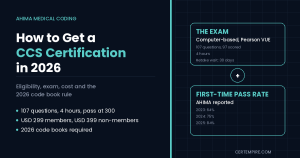
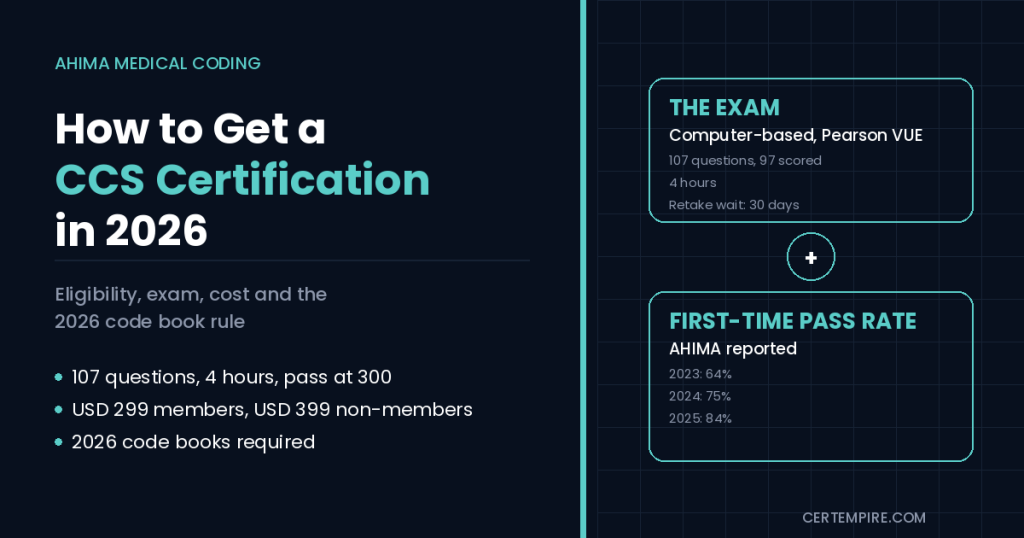
TL;DR: The Certified Coding Specialist (CCS) credential from AHIMA is earned by passing one 4-hour, 107-question computer-based exam at a Pearson VUE testing center. The pass mark is 300. The fee is USD 299 for AHIMA members and USD 399 for non-members. AHIMA does not make a degree or course mandatory, but it recommends one of several backgrounds, such as two years of applied coding experience or coursework plus one year of experience. You have 120 days to schedule once you are approved, and from May 1, 2026 you must bring the 2026 code books from AHIMA’s list or you cannot test and lose your fee. The credential renews every two years with continuing education units and a recertification fee. First-time pass rates have risen from 64% in 2023 to 75% in 2024 and 84% in 2025.
Quick Facts
| Item | CCS |
| Issuing body | AHIMA (American Health Information Management Association) |
| Exam format | Computer-based, multiple choice |
| Total questions | 107 (97 scored and 10 pretest, pretest items do not affect your score) |
| Time allowed | 4 hours |
| Passing score | 300 |
| Where you test | Pearson VUE testing center, in the US and internationally |
| Exam fee (USD) | 299 members, 399 non-members |
| Retake | New application and the full exam fee again, minimum 30-day wait |
| Scheduling window | 120 days from approval (extendable, see below) |
| Required code books | 2026 editions from AHIMA’s required list, for exams on or after May 1, 2026 |
| Eligibility | Recommended backgrounds, none strictly mandatory |
| Domains | 5 (Coding Knowledge and Skills 39 to 41%, Coding Documentation 18 to 22%, Provider Queries 9 to 11%, Regulatory Compliance 18 to 22%, Information Technologies 9 to 11%) |
| Case settings | Inpatient, outpatient and emergency department, 33.3% each |
| Recertification cycle | 2 years |
| Recertification fee (USD) | 100 members, 249 non-members (see the note in the renewal section) |
| First-time pass rate | 84% in 2025 (6,331 testers), 75% in 2024 (4,031), 64% in 2023 (3,287) |
| Best for | Hospital and facility coders, inpatient coding, record review and audit roles |
The Short Answer
Getting the CCS has six steps.
- Check that your background matches one of AHIMA’s recommended paths.
- Prepare for the five exam domains and get the 2026 code books.
- Apply online through MyAHIMA and pay the exam fee.
- Wait for the Authorization to Test email from Pearson VUE.
- Schedule and take the exam within your eligibility window.
- Earn continuing education units and pay the recertification fee every two years.
That sounds simple, and it is. The parts that catch people out are small rules: the code book requirement, the eligibility window, the cancellation rules and the retake delay. This guide walks through each of them.
What the CCS Is and Who It Is For
The CCS shows that you can assign accurate diagnosis and procedure codes from health records, apply the rules for sequencing and reimbursement, query providers when documentation is unclear, and follow compliance requirements. It is widely associated with hospital and facility coding, where records are long and the coding is detailed.
The exam outline describes the work through five domains, and its case scenarios are split evenly between inpatient, outpatient and emergency department settings. That means the credential is not limited to one kind of encounter, but the depth of the inpatient content is what many coders associate with it.
The CCS is a good fit if you:
- Work in or want to work in a hospital or health system coding department.
- Already code and want a recognised credential to show it.
- Want to move toward auditing, quality review or coding education.
- Prefer facility-side work over physician-office coding.
If your work is in physician offices and you think you may prefer professional-fee coding, compare it against the other major coding credential in our CPC vs CCS salary guide.
Do You Need a Degree or Course to Take the CCS?
No. AHIMA states that its eligibility paths are recommended, not required. The CCS page advises candidates to have one of the following:
- Coursework in anatomy and physiology, pathophysiology, pharmacology, medical terminology, reimbursement methodology, ICD diagnostic coding and CPT and HCPCS coding, plus one year of applied coding experience.
- Two years of related applied coding experience.
- A CCA credential plus one year of applied coding experience.
- A coding credential from another certifying organisation plus one year of applied coding experience.
- A CCS-P, RHIT or RHIA credential.
Two points are worth stating clearly.
“Recommended” does not mean “optional to prepare”. The exam is a 4-hour test of coding judgment. A person with no coding experience and no coursework would find it very hard to pass, even though AHIMA does not block them from applying.
The CCA is a path to the CCS, not something the CCS replaces. AHIMA lists the CCA with one year of applied coding experience as one of the recommended routes. After passing the CCS you keep your other credentials, and each one has its own renewal requirement.
If you are choosing between the entry-level credential and the CCS, our medical coding salary guide helps you place each in a career path.
The CCS Exam Format
- Questions: 107 in total, of which 97 are scored and 10 are pretest items. You will not know which are which, and the pretest items do not affect your result.
- Time: 4 hours.
- Delivery: computer-based at a Pearson VUE testing center. AHIMA says it is offered both domestically and internationally.
- Navigation: you can move between questions and flag items for review.
- Passing score: 300.
The exam is built around medical record scenarios. The outline says inpatient, outpatient and emergency department cases are weighted equally at 33.3% each, so you cannot afford to prepare for only one setting.
What the Five Domains Cover
AHIMA’s current content outline took effect on May 1, 2024. It gives these domains and weights.
| Domain | Weight |
| Coding Knowledge and Skills | 39 to 41% |
| Coding Documentation | 18 to 22% |
| Provider Queries | 9 to 11% |
| Regulatory Compliance | 18 to 22% |
| Information Technologies | 9 to 11% |
Coding Knowledge and Skills (39 to 41%). This is the core of the exam. The outline lists assigning diagnosis and procedure codes, sequencing, present-on-admission rules, coding edits, reimbursement methods and abstracting data from the health record. Almost four in ten scored questions come from here, so accuracy in the basics matters more than any other single skill.
Coding Documentation (18 to 22%). Reading a record critically. You are expected to resolve conflicting documentation, confirm that required documentation is present and verify what a record actually says before coding it.
Provider Queries (9 to 11%). Writing and evaluating compliant queries and recognising when a query is needed. This is a small domain, but the questions are specific and usually easy to answer if you have studied compliant query practice.
Regulatory Compliance (18 to 22%). Record completeness, payer rules, patient safety indicators and hospital-acquired conditions, HIPAA, AHIMA’s code of ethics and the Uniform Hospital Discharge Data Set.
Information Technologies (9 to 11%). Electronic health record types, encoder and grouper software, computer-assisted coding and HITECH compliance. Candidates with a purely paper or physician-office background often underestimate this domain.
The outline names CPT and HCPCS explicitly in its modifier task and refers more generally to diagnosis and procedure codes elsewhere. Do not read that as a reason to skip any code set. Prepare for everything on AHIMA’s required code book list.
The 2026 Code Book Rule
Starting May 1, 2026, the CCS exam requires the 2026 editions of the code books on AHIMA’s required list. AHIMA states that candidates without the correct code books cannot test and forfeit their fees.
Practical steps:
- Check AHIMA’s current required code book list before you buy anything.
- Buy the 2026 editions, not last year’s, and not an edition that is merely similar.
- Practise with the same books you will use on test day, including tabbing and annotation rules that the test center allows. Confirm the allowed materials with the test center and AHIMA before the day.
- Do not apply for a date that falls before you have the books in hand.
This rule is the most expensive mistake on the list, because it costs the full exam fee and the booking.
How to Apply: Step by Step
AHIMA’s application page lays out the process.
- Read the candidate guide and confirm your eligibility before applying. If you apply and are found ineligible, AHIMA refunds the fee minus a USD 75 processing fee.
- Apply online through MyAHIMA and pay by credit card.
- Use the exact name on your ID. The name you register with must match your identification exactly.
- Apply for accommodations if you need them. You must notify AHIMA in writing each time. Send the ADA application and supporting documentation to the address AHIMA lists, by the normal application closing date. Documentation must come from a properly credentialed professional with no family relationship to you.
- Wait for the Authorization to Test email from Pearson VUE. Read the whole email and verify your details.
- Schedule with Pearson VUE within your eligibility window.
On the day of the test, bring valid, unexpired identification that matches your registered name and the required code books. Confirm the full list of allowed materials with the test center.
The 120-Day Eligibility Window
AHIMA states that the exam eligibility period is 120 calendar days from the application approval date, and it also notes that the window starts the day the Authorization to Test letter is created. In practice, treat the day your approval email arrives as the start and schedule early.
- If you do not schedule and test within the window, your eligibility expires and you must reapply and pay all fees again.
- You can ask for an extension, but you must request it at least 14 days before your exam date or your eligibility end date.
- Each extension is in 30-day steps and costs USD 50, up to 90 days in total.
Do not apply until you are ready to test within about four months. If you are not, the extension fees add up.
How Much Does the CCS Cost?
| Cost | Amount (USD) |
| Exam fee, AHIMA member | 299 |
| Exam fee, non-member | 399 |
| Retake | Same as the exam fee, plus a new application |
| Eligibility extension | 50 per 30 days, up to 90 days |
| Cancel 15 or more business days before | Free |
| Cancel between 14 days and 24 hours before | 30 |
| Refund request up to 14 business days before the date | 75 processing fee |
| Reschedule within 24 hours of the exam | Not allowed |
| Code books | Varies by seller, check AHIMA’s list |
| Recertification, per two-year cycle | 100 members, 249 non-members |
Is AHIMA membership worth it for the exam? Membership lowers the CCS fee by USD 100 (USD 399 to USD 299), and the CCA and other exams have member discounts too. The membership dues are billed separately from recertification, and the dues amount was not listed on the pages reviewed for this guide, so check AHIMA’s membership page. If the dues are less than the exam saving plus the recertification saving, membership pays for itself in the first cycle. Compare the numbers yourself before you decide.
Add the cost of code books, preparation material and any time away from work to get your real total.
What Is the CCS Pass Rate?
AHIMA reports first-time pass rates for the CCS.
| Year | First-time pass rate | Testers |
| 2023 | 64% | 3,287 |
| 2024 | 75% | 4,031 |
| 2025 | 84% | 6,331 |
Two cautions when reading these numbers.
- They cover all first-time testers. They are not limited to people who prepared thoroughly. So “84% of well-prepared candidates passed” is not what the figure says.
- The rise has not been explained by AHIMA. The pass rate moved from 64% to 84% in two years while the number of testers nearly doubled. Several things could explain that, such as a changed content outline in 2024 or more experienced candidates, but the data on the pages reviewed does not say which. Do not treat the 84% as a promise that the exam has become easy.
Plan as if the exam is demanding. A 4-hour, scenario-based test with a required code book set is not one to attempt without practice.
How to Prepare
The outline and the pass rates suggest a simple approach. These are suggestions, not AHIMA rules.
- Download the current content outline and rate yourself on every task statement, domain by domain.
- Weight your time like the exam. Spend about two-fifths of your study time on Coding Knowledge and Skills, a fifth each on Coding Documentation and Regulatory Compliance, and the rest on queries and information technologies.
- Code real record scenarios across all three settings. Inpatient, outpatient and emergency department cases carry equal weight. If you only code inpatient records, practise outpatient and ED cases deliberately.
- Learn compliant query practice. It is a small domain, so the questions reward knowing the rules.
- Study the information technology and compliance topics. Encoders, groupers, computer-assisted coding, HIPAA, HITECH, patient safety indicators and hospital-acquired conditions are easy to skip and easy to lose marks on.
- Practise with the 2026 books. Learn where things are in the books you will actually use.
- Do timed full-length practice. A 4-hour exam tests stamina as well as knowledge. Practise sitting for the full time.
- Review every wrong answer and go back to the rule behind it.
A reasonable timeline for someone already coding is four to six weeks of regular study. A career changer who is building coding knowledge from the start should plan for several months. Those ranges are rules of thumb, not figures from AHIMA.
Retaking the CCS
If you do not pass, a retake needs a new application and the full exam fee again. CCS candidates must wait at least 30 days before the new application is approved, and AHIMA cannot waive the retest period. Use the wait to find your weak domains and rebuild your study plan around them. Remember that the 120-day window starts again with the new approval.
How to Maintain Your CCS
Once certified, you renew on a two-year cycle.
- CEU requirement: AHIMA’s recertification guide (August 2025 edition) states 20 continuing education units per two-year cycle for the CCS. Of those, 80% (16 CEUs) must be within the health information domains and 20% (4 CEUs) can be outside the domains if relevant to your job. AHIMA’s recertification page says the number of CEUs is “a specified number” and refers to a 2026 guide, so check the 2026 recertification guide before you plan.
- CEU value: 0.5 CEU per 30 minutes of participation. Sessions under 30 minutes earn nothing.
- Reporting: enter CEUs in AHIMA’s CEU Center as you earn them.
- Cycle start: for credentials earned on or after December 12, 2024, the cycle starts the day you pass the exam.
- Rollover: up to 4 excess CEUs can roll into the next cycle if they come from eligible sources and match the health information domains.
- Records: keep your documentation for two years after the cycle ends, because AHIMA audits recertification records.
- Fee: AHIMA’s recertification page lists USD 100 for members and USD 249 for non-members for one credential. The 2025 guide listed USD 218 for non-members, so the non-member fee has risen. Confirm the current amount when you renew.
If you miss the deadline, the credential goes through stages: inactive for six months, then temporarily revoked for six months, then permanently revoked. Reactivating from inactive needs the original requirements plus a USD 50 extension fee. Reinstating from temporarily revoked needs either the required CEUs plus a USD 368 reinstatement fee, or retaking and passing the exam. Those figures come from the 2025 guide, so confirm them in the current one.
Salary and Career Outlook
AHIMA does not publish CCS-specific pay, and I did not find a reliable survey that separates CCS holders from other coders. The best public benchmark is the US Bureau of Labor Statistics, which tracks medical records specialists, the occupation group that most coding jobs fall into. It is not a CCS-only figure.
| Measure | BLS figure |
| Median annual wage, May 2025 | USD 51,140 (USD 24.59 per hour) |
| Hospitals (median) | USD 59,120 |
| Management of companies and enterprises (median) | USD 60,980 |
| Administrative and support services (median) | USD 49,490 |
| Offices of physicians (median) | USD 47,120 |
| Projected growth, 2025 to 2035 | 8%, about 15,600 new jobs |
| Average annual openings | About 14,000 |
| Jobs in 2025 | About 200,700 |
Three things stand out.
- Setting matters. Hospitals pay a median of about USD 12,000 more than physician offices in this data, which is consistent with the CCS’s facility-side focus. That is a pattern across all medical records specialists, not proof that the credential causes the difference.
- Certification helps with hiring. BLS says employers may prefer certified specialists or expect new hires to certify soon after starting, and that a postsecondary certificate is the typical entry education.
- Demand is steady. Growth of 8% is described by BLS as much faster than the 3% average for all occupations.
For pay by credential and region, see our CPC vs CCS salary guide and medical coding salary overview. For the related health information management route, our RHIA salary guide shows what the degree-based path looks like.
CCS vs CCA vs CPC: Which Should You Choose?
CCS vs CCA. The CCA is the entry-level AHIMA coding credential. It costs USD 199 for members and USD 299 for non-members, against USD 299 and USD 399 for the CCS. The CCA with one year of applied coding experience is one of the recommended routes to the CCS, so many coders take the CCA first and the CCS later. If you have two or more years of applied coding experience already, you can go straight to the CCS.
CCS vs CPC. The CPC is the AAPC credential and is more closely associated with physician and outpatient coding, while the CCS leans toward hospital and facility coding. Pick based on where you want to work. Our CPC vs CCS salary guide compares the two in detail.
Other AHIMA routes. If you want a broader health information management career, the RHIT and RHIA credentials are degree-based paths. A CCS-P, RHIT or RHIA also counts as a recommended path to the CCS. For RHIA preparation, see our RHIA exam page and free RHIA practice questions.
Common Mistakes to Avoid
- Booking before buying the 2026 books. You cannot test without them, and you lose the fee.
- Letting the 120-day window run out. You then reapply and pay again.
- Leaving a name mismatch on your ID. The registered name must match your identification exactly.
- Cancelling late. Cancelling between 14 days and 24 hours before the exam costs USD 30, and you cannot reschedule within 24 hours.
- Preparing for only one setting. Inpatient, outpatient and ED each carry 33.3% of the scenarios.
- Skipping the small domains. Provider queries and information technologies are about a fifth of the exam combined.
- Reading the pass rate as a guarantee. It covers all first-time testers and does not say who prepared.
- Forgetting recertification. A missed cycle leads to inactive status and extra fees.
A Simple Decision Framework
- Do I have two years of coding experience, or coursework plus one year? Yes means you can apply now. No means build that experience first, or consider the CCA.
- Do I want hospital or facility coding? Yes points to the CCS. No, physician office points to the CPC.
- Can I test within four months? Yes means apply. No means wait, because extensions cost USD 50 per 30 days.
- Do I have the 2026 books? No means do not book yet.
FAQSs
How do I get a CCS certification?
Pass the AHIMA CCS exam. Check that your background matches a recommended eligibility path, apply online through MyAHIMA, pay the exam fee, wait for the Authorization to Test email from Pearson VUE, then schedule and take the 4-hour exam within 120 days. You then renew every two years with continuing education units and a fee.
Do I need a degree to take the CCS exam?
No. AHIMA lists recommended backgrounds, not required ones, and none of them is a degree. They include coursework plus one year of applied coding experience, two years of applied coding experience, a CCA plus one year of experience, another coding credential plus one year of experience, or a CCS-P, RHIT or RHIA.
How much does the CCS exam cost?
USD 299 for AHIMA members and USD 399 for non-members. A retake costs the same again. Cancelling between 14 days and 24 hours before the exam costs USD 30, and extending your eligibility costs USD 50 per 30 days.
How many questions are on the CCS exam?
107 questions, of which 97 are scored and 10 are pretest items that do not affect your result. You have 4 hours.
What is the passing score for the CCS exam?
300.
What is the CCS pass rate?
AHIMA reports first-time pass rates of 84% in 2025, 75% in 2024 and 64% in 2023. The figures cover all first-time testers, not only well-prepared ones.
Which code books do I need for the CCS exam in 2026?
The 2026 editions from AHIMA’s required code book list. The requirement applies to exams on or after May 1, 2026, and candidates without the correct books cannot test and forfeit their fees. Always check AHIMA’s current list before buying.
Can I take the CCS exam online from home?
AHIMA describes the exam as computer-based at a Pearson VUE testing center, offered in the US and internationally. The pages reviewed for this guide do not describe a remote option, so plan for a test center and confirm with Pearson VUE when you book.
How long do I have to schedule the CCS exam?
120 calendar days from your approval. If you do not test in that time, your eligibility expires and you must reapply and pay again. You can extend in 30-day steps for USD 50 each, up to 90 days, if you ask at least 14 days before your exam date or your eligibility end date.
How long should I study for the CCS exam?
Someone who already codes every day might need four to six weeks of regular study, while a career changer should plan for several months. These are rules of thumb, not AHIMA figures. Use the content outline to find your weak domains and spend your time there.
How do I renew my CCS certification?
Renew every two years by earning continuing education units and paying the recertification fee. AHIMA’s August 2025 guide states 20 CEUs for the CCS, with 80% in the health information domains. The fee is USD 100 for members and USD 249 for non-members on AHIMA’s current page. Check the 2026 recertification guide before you plan.
Is the CCS better than the CPC?
Neither is better for everyone. The CCS is more closely associated with hospital and facility coding, and the CPC with physician and outpatient coding. Choose based on where you want to work.
Is the CCS worth it?
It can be, if you want facility-side coding work. BLS reports a median of USD 51,140 for medical records specialists in May 2025, with hospitals higher at USD 59,120, and projects 8% growth through 2035. That is occupation data, not CCS-only pay, so check job postings in your area for how many ask for the credential.
Final Thoughts
Getting the CCS is mostly a matter of preparing well and not tripping over the small rules. Check your eligibility path, buy the 2026 books before you book, apply when you can test within 120 days, and plan for the 4-hour exam with practice across inpatient, outpatient and emergency department cases. Read the current requirements, fees and recertification rules on AHIMA’s Certified Coding Specialist page before you apply, since fees and rules can change.