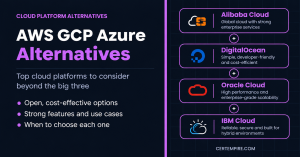
Your list of AWS, GCP and Azure alternatives is probably shorter than the marketing suggests, and more useful than a “top 10” roundup. Most teams do not leave the big three because the platforms are weak. They leave because a bill, a data-residency rule or a lock-in worry changed the maths. This guide compares Oracle Cloud Infrastructure, IBM Cloud, DigitalOcean, Hetzner, OVHcloud and Alibaba Cloud by workload, not by logo. You get a quick-pick table, a seven-point checklist, a service-mapping example and a decision table, all checked against vendor pages on 27 November 2026.
Which AWS, GCP and Azure alternatives fit which workload?
Match the alternative to the reason you are leaving: cost and simplicity point to DigitalOcean or Hetzner, database-heavy enterprise work to Oracle or IBM, and European data control to OVHcloud.
| Provider | Best fit | Watch for |
| Oracle Cloud Infrastructure (OCI) | Database-heavy workloads, high outbound traffic | Service coverage for your stack |
| IBM Cloud | Regulated, hybrid estates | Region and the controls your auditor expects |
| DigitalOcean | Startups and small SaaS with predictable bills | Depth of managed services |
| Hetzner | Lowest-cost compute for teams that run their own platform | Who operates databases and backups |
| OVHcloud | European data control and named certifications | Which product holds which certification |
| Alibaba Cloud | Asia-Pacific reach | Regions, rules and support for your users |
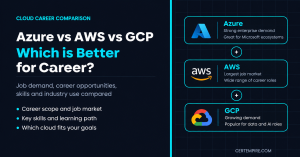
Still choosing among the big three first? Read our Azure vs AWS vs GCP career guide, then compare the exam tracks on the Amazon, Microsoft and Google vendor pages.
Why do teams look beyond AWS, GCP and Azure?
Four reasons recur: outbound-data cost, data-residency rules, lock-in worries and simpler tooling for small teams.
The big three are still growing. Synergy Research Group put global cloud infrastructure spending at about $167.7 billion for Q3 2026, up 55% year on year. Amazon held 26% share, Microsoft 19% and Google 16%, and Oracle ranked among the fastest-growing tier-two providers. So the real question is rarely “are the big three failing?” It is “does a smaller provider fit this workload better?”
Cost comes first for many teams, and outbound data is the line item that surprises them. AWS and Azure each include 100 GB of outbound transfer a month; beyond that you pay per gigabyte.
Residency is the second driver. The EU Data Act generally bans switching charges, including egress tied to switching, from 12 January 2027, which lowers the cost of trying a European provider. Lock-in worry and simplicity complete the list. A ten-person team rarely needs two hundred services.
How do you judge an AWS, GCP or Azure alternative?
Score each candidate on seven checks, using your last three bills instead of a pricing page.
- Outbound data. Take last month’s data-transfer-out line and compare it with what each provider includes.
- Managed services. List the databases, queues, identity and monitoring services you actually use, then confirm each has an equivalent.
- Data location. Confirm the region, and which certification covers which product.
- Exit path. Prefer open formats and S3-compatible storage so a second move is not a rewrite.
- Operations. Name who is paged at 2 a.m. when the provider no longer manages that layer for you.
- Evidence. Check the audit reports and certifications your customers ask for.
- Support. Read the SLA and support channels before you rely on them.
Included outbound data on vendor pages, 27 November 2026:
| Provider | Included outbound data |
| AWS | 100 GB a month, global across Regions |
| Azure | 100 GB a month |
| OCI | First 10 TB a month |
| DigitalOcean $4 Droplet | 500 GiB a month |
| DigitalOcean $24 Droplet | 4,000 GiB a month |
Worked example: a team sending 600 GB outbound in a month has about 500 GB billable on AWS or Azure after the free 100 GB, charged at the rate on each provider’s pricing page. The same traffic fits inside the 4,000 GiB included with a $24 DigitalOcean Droplet and well inside Oracle’s 10 TB allowance. My rule of thumb: if you cannot name an owner for checks 2 and 5, do not move that workload yet.
When do Oracle Cloud and IBM Cloud make sense?
Choose OCI when databases or outbound traffic drive your bill, and IBM Cloud when a regulated, hybrid estate matters more than a wide catalogue.
Oracle’s pricing pages state that the first 10 TB of public-internet egress each month is free, data movement inside a region costs nothing, and prices are identical in every region. Its Free Tier adds a US$300 credit for 30 days plus Always Free resources, including two small AMD virtual machines and an Arm allowance of 1,500 OCPU hours and 9,000 GB hours a month. Oracle’s own comparison, based on published prices from December 2024, shows OCI below AWS, Azure and Google Cloud on virtual machines, block storage and outbound bandwidth. Working toward an Oracle credential? See the Oracle exam preparation page.
IBM Cloud targets regulated industries through IBM Cloud for Financial Services, which IBM describes as hybrid by design and informed by a council of CIOs, CISOs and compliance officers. IBM fits organisations that must evidence controls to regulators. Skip it if you want the widest service catalogue.
Are DigitalOcean and Hetzner the cheap, simple choice?
Yes for small and mid-size apps on virtual machines and containers, provided your team accepts fewer managed services and, with Hetzner, more operations work.
DigitalOcean lists Basic Droplets from $4 a month (1 vCPU, 512 MiB memory, 10 GiB SSD, 500 GiB transfer) and a 2 vCPU, 4 GiB plan at $24 with 4,000 GiB of transfer. Since 1 January 2026 it bills Droplets per second, with a minimum of 60 seconds or $0.01. Spaces object storage starts at $5 a month, is S3-compatible and includes a CDN. Its product list also covers managed databases, Kubernetes, load balancers and App Platform.
Hetzner Cloud offers shared and dedicated vCPU plans, with locations in Germany, Finland, the US (Hillsboro and Ashburn) and Singapore. Its cloud page lists GDPR compliance, ISO/IEC 27001 for its German and Finnish data centres, a 99.9% uptime SLA with credits and 24/7 email support. It also states that extra traffic costs far less than hyperscaler egress.
DigitalOcean is the gentler step down from a hyperscaler. Hetzner has the lowest price floor, but support is by email and teams that moved run their databases themselves.
What do OVHcloud and Alibaba Cloud add for data control and reach?
OVHcloud suits teams that need European control and named certifications, and Alibaba Cloud suits teams whose users are mainly in Asia-Pacific.
OVHcloud lists ISO 27001, ISO 27701, C5 in Germany, ENS in Spain and AGID in Italy. Its Private Cloud solutions hold the French ANSSI SecNumCloud 3.2 qualification across three French data centres (Gravelines, Roubaix and Strasbourg), while it lists its newer SNC Cloud Platform as still in the qualification process. A certification covers named products and sites, not a whole company. OVHcloud states that SecNumCloud-qualified solutions keep data from being accessed, transferred or processed outside the EU, so get the contract terms for your exact product in writing.
Alibaba Cloud reports 109 availability zones in 32 regions. If your users or subsidiaries sit in Asia-Pacific, that footprint can beat what a European host offers. Read the legal and support terms for each region you plan to use.
Sovereignty is a contract and certification question, not a flag question. The EU Data Act’s switching rules also reach non-EU providers that serve EU customers.
How do AWS, Azure and Google Cloud services map to alternatives?
Compute, object storage, Kubernetes and databases map cleanly; identity, analytics and AI services are where migrations stall.
Google Cloud publishes an official table, Compare AWS and Azure services to Google Cloud, that lines up equivalents across the big three. Use it as your starting column, then add your target provider. Its last update was 3 December 2024.
Worked example: a small SaaS app with web servers, a database, file uploads and containers.
| Need | Big-three example | DigitalOcean product |
| Virtual machines | EC2, Azure Virtual Machines, Compute Engine | Droplets |
| Object storage | S3, Blob Storage, Cloud Storage | Spaces (S3-compatible) |
| Managed database | Each provider’s managed database service | Managed Databases |
| Containers | Managed Kubernetes | Kubernetes |
| Load balancing | Cloud load balancers | Load Balancers |
| Message queue, data warehouse | Native services | None on its product list |
The last row is the lesson. The app moves, but anything built on proprietary glue needs a redesign.
What do engineers say after moving off the big three?
Engineers who moved report large savings and one shared trade-off: more operational work.
Public posts from engineers who made the move show one pattern:
- An engineer who led a move from AWS to Hetzner and OVHcloud reported a 90% cost cut, driven by cost plus GDPR and CLOUD Act concerns.
- A developer who moved a Postgres-backed API to one Hetzner instance plus a bare-metal database found it comparable to managed platforms with a deployment tool on top, at a fraction of the cost. The catch: you are now the platform team.
- A fintech engineering team wrote that the move demands Kubernetes skills beyond theory and engineers who can run infrastructure without a managed service underneath.
- A podcast site moved from DigitalOcean to Hetzner’s US data centre and reported saving about $1,500 a year, then noted that Hetzner later changed its limits and pricing.
- In an April 2026 r/Cloud thread about non-cost reasons to leave, a top reply put Azure first on a realistic shortlist, then Oracle, then perhaps IBM, and said most alternatives handle plain VMs fine.
The pattern is simple: the cheaper the platform, the more of the stack you own.
Which alternative should you pick, and how risky is the move?
Pick by the constraint hurting most, and move one low-risk workload first.
| Main constraint | Start with | Migration risk |
| Small team, predictable bills | DigitalOcean | Low for stateless apps and files |
| Lowest compute price | Hetzner | Medium: you run databases and backups |
| Heavy outbound traffic or Oracle databases | OCI | Medium: check service coverage |
| Regulated, hybrid estate | IBM Cloud | Medium to high: controls need evidence |
| EU control and certifications | OVHcloud | Medium: certification is per product |
| Asia-Pacific users | Alibaba Cloud | Medium: regional terms |
A 30-day pilot keeps the risk small. In week one, export last month’s bill and score the seven checks. In week two, stand up one stateless service and its object storage on the candidate. In week three, run both side by side and compare latency, cost and on-call noise. In week four, decide, and write down the exit path before you commit.
Exit terms differ. AWS offers free outbound transfer when you move your data off, after you contact support, with a 60-day window. Azure’s waiver needs advance notice, a 60-day window and cancelling the related subscriptions, and it covers internet transfer, not specialised links such as ExpressRoute. Google’s exit programme requires you to end use of the Google Cloud service you migrate from. From 12 January 2027 the EU Data Act generally bans switching charges, although standard fees and professional services remain.
Terraform, Linux, Kubernetes and networking skills carry over to any provider; cloud-specific exam knowledge does not. For role context, read AWS DevOps vs Azure DevOps, DevOps vs Cloud Engineer and the AWS vs DevOps career path hub. If you are starting on AWS, see AWS certs ranked from easiest to hardest and the AWS DevOps Engineer Professional guide.
Frequently asked questions
What are the big three cloud platforms, and who is the big four?
Amazon Web Services, Microsoft Azure and Google Cloud are the big three by revenue. There is no official fourth. Synergy’s Q3 2026 data ranks Amazon, Microsoft and Google first and names Oracle among the fastest-growing tier-two providers.
Is Azure similar to AWS and GCP, and what are the AWS equivalents of GCP services?
Yes at the core. All three sell virtual machines, object storage, Kubernetes, databases and identity. EC2 maps to Compute Engine, S3 to Cloud Storage and EKS to GKE, and Google’s official comparison table lists the rest, including Azure. Names, pricing models and identity design differ, so run a mapping exercise rather than a lift-and-shift. Our career guide compares the three side by side.
Who is bigger, AWS or Azure, and which is most widely used?
AWS is bigger. In Synergy’s Q3 2026 data, Amazon held 26% of cloud infrastructure spending, ahead of Microsoft at 19% and Google at 16%. Spending share is the standard measure of size.
Which cloud platform is growing the fastest?
Google Cloud. It reported 103% revenue growth in the September 2026 quarter, against 48% for Azure and 39% for AWS. Google’s figure includes Workspace and starts from a smaller base.
Did Jeff Bezos start AWS?
Bezos founded Amazon and backed the project, but Andy Jassy started and led AWS. Bezos appointed him to create it in 2003, and it launched in 2006. Fortune reports that the story of AWS renting out spare capacity is not true.
Are alternatives cheaper than AWS, GCP and Azure?
Often for simple VM workloads, not always overall. DigitalOcean starts at $4 a month and Oracle includes the first 10 TB of egress, but the savings engineers report come with staff time spent running databases and backups. Run your own bill through each provider’s calculator.
Will the EU Data Act make switching free?
From 12 January 2027 it generally bans switching charges, including egress tied to switching, for in-scope services. It does not make migration free: standard service fees, professional services and proportionate early-termination charges can remain.
Conclusion
The best AWS, GCP and Azure alternatives are the ones that fix your specific constraint, not the ones with the lowest headline price. Run the seven checks on your own bills, price one workload on two candidates and move the lowest-risk piece first. To build skills for whichever cloud you pick, practise with Cert Empire’s practice tests, browse the Amazon, Microsoft, Google and Oracle vendor pages, and find more guides on the Cert Empire blog or the Cert Empire home page.