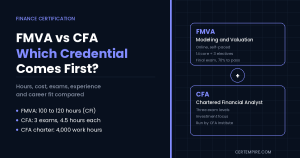
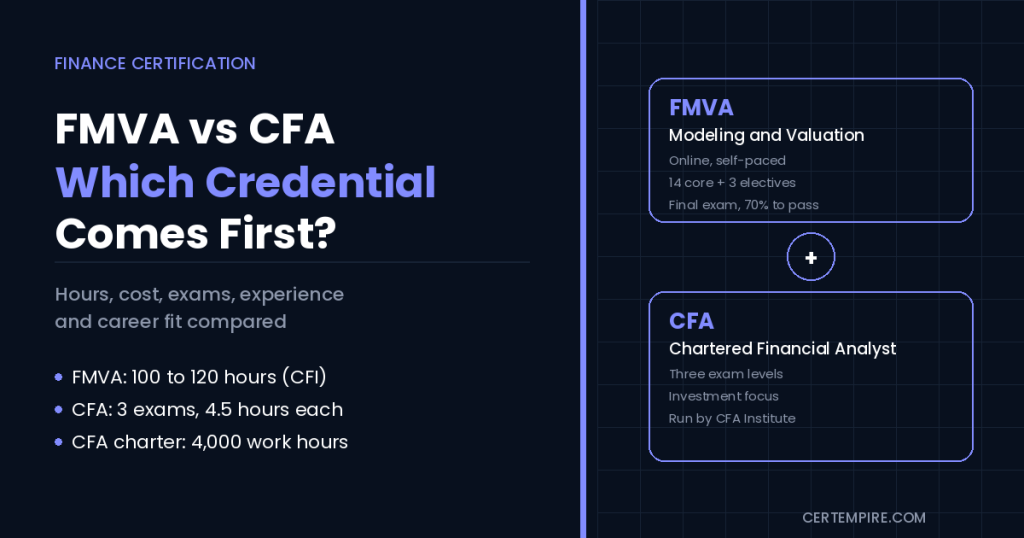
TL;DR: Pick the FMVA (Financial Modeling and Valuation Analyst) from Corporate Finance Institute (CFI) if you want practical Excel modeling, valuation, and FP&A skills you can use in a job within a few months, on a flexible online schedule. Choose the CFA (Chartered Financial Analyst) from CFA Institute if you want a long-term investment management credential and are ready for three exams, 4,000 hours of qualifying work experience, and a multi-year commitment. They are not direct substitutes. FMVA is a self-paced online program with a final exam, built around modeling skills. CFA is a three-level exam program for investment professionals. A common path is to start with FMVA to build modeling skills now and decide on the CFA later if your career moves toward investment analysis or portfolio management. If you work in corporate finance, FP&A, banking support, or analysis and want practical skills first, FMVA is the easier start. If you are aiming at asset management, equity research, or portfolio roles, the CFA is the stronger long-term signal.
Quick Facts
| Item | FMVA (CFI) | CFA (CFA Institute) |
| Full name | Financial Modeling and Valuation Analyst | Chartered Financial Analyst |
| Provider | Corporate Finance Institute | CFA Institute |
| Format | Online, self-paced courses plus a final exam | Three proctored exams (Level I, II, III) |
| Courses or levels | 14 core courses plus 3 electives (you choose from 27) | 3 levels |
| Time estimate | 100 to 120 hours per CFI | 300 hours of study per level per CFA Institute factsheet, over four years on average including work experience |
| Assessment | 80% on each end-of-course assessment, then a 3-hour final exam with 70% to pass | Level I, II and III exams of 4.5 hours each |
| Prerequisites | Active CFI subscription; prep courses optional | Eligibility through education and/or work experience (4,000 hours option) |
| Work experience to earn the credential | Not required | 4,000 hours over at least 36 months for the charter |
| Cost model | Subscription based; check CFI pricing | Exam fee per level (USD 1,140 to 1,590 for 2026 exams, depending on level and registration date) |
| Enrollment fee | None stated | USD 0 from 2026 (previously USD 350) |
| Typical audience | FP&A, corporate finance, banking support, analysts | Investment analysts, portfolio managers, research |
Figures are taken from CFI’s FMVA program page and the CFA Institute’s pricing announcement, exam page, charter page and factsheet, checked in November 2026. CFI and CFA Institute change fees, structure and policies, so confirm on the official pages before you pay.
Key Takeaways
- FMVA is skills-based and self-paced. CFA is exam-based and long-term.
- FMVA is estimated at 100 to 120 hours. CFA lists 300 hours of study per level.
- FMVA needs a CFI subscription. CFA charges per-level exam fees.
- CFA requires 4,000 hours of qualifying work experience over at least 36 months to earn the charter. FMVA has no work experience requirement.
- The two focus on different things: modeling and valuation practice (FMVA) versus investment analysis, ethics, and portfolio management (CFA).
- You don’t need FMVA before CFA, or vice versa. Many people use FMVA for early-career skills and CFA for long-term positioning.
What Is the Difference Between FMVA and CFA?
FMVA: practical modeling and valuation
CFI describes the FMVA as an online program where you complete core courses, choose electives and then pass a final exam. According to CFI’s help page, you complete 14 core courses and choose three electives from 27 to qualify for the final exam. Each end-of-course assessment needs 80%, and the final exam, which must be completed in three hours with no pause, needs 70% to become FMVA certified. CFI estimates 100 to 120 hours to finish.
Older CFI brochures list a different course structure and hours (for example, 12 core courses and a longer study estimate). That shows the program has changed over time, so check CFI’s current program page. The topics typically include financial analysis, accounting, three-statement modeling, DCF valuation, comparable valuation, budgeting and forecasting, scenario analysis, dashboards and professional ethics, with electives such as M&A modeling, LBO modeling, advanced Excel and Power BI.
If you want a full walkthrough of how to enroll and finish, read our FMVA certification guide.
CFA: three levels toward the investment charter
The CFA Program is made up of three exams. The CFA Institute exam page describes them like this:
| Level | Focus | Format |
| Level I | Learn and describe: key terms, concepts and formulas | Multiple-choice questions |
| Level II | Analyze and evaluate | Vignette-supported multiple-choice questions |
| Level III | Integrate and apply | Vignette-supported essay and multiple-choice questions, with a choice of specialised pathways |
Each exam lasts 4.5 hours. The CFA Institute factsheet lists 300 hours of study per exam level plus a mandatory Practical Skills Module, and says the full program takes over four years on average, including the required work experience. Check the CFA Institute site for the current number of questions, since the exam page we reviewed does not state it.
Where they overlap
Both cover valuation and financial analysis. The depth and style differ. FMVA trains you to build the model in Excel. CFA tests whether you can analyze securities, apply ethics standards and make portfolio decisions across a broad curriculum. If you work with models daily, FMVA content feels close to your job. If you work with portfolios and research, CFA content does.
How Do the Exams Compare?
| Feature | FMVA | CFA |
| Delivery | Online, self-paced | Proctored exams on scheduled dates |
| Final test | 3-hour final exam, 70% to pass | Three 4.5-hour exams |
| Per-course passing | 80% on each end-of-course assessment | Not applicable |
| Exam frequency | Take the final once you qualify | Level I is offered four times a year (February, May, August and November), Level II three times, Level III twice, per the CFA Institute factsheet |
| Cannot pause | The final exam has no pause once started | Standard proctored rules |
| Style | Applied modeling and valuation | Broad investment curriculum with ethics |
Be careful with exam dates. The factsheet’s schedule may change, and CFA Institute publishes current dates on its exam schedule page.
How Do Costs Compare?
| Cost item | FMVA | CFA |
| Enrollment | Requires an active CFI Self-Study or Full-Immersion subscription | USD 0 enrollment fee from 2026; it was USD 350 before CFA Institute removed it |
| Exam fees | No additional fees to earn the certification after enrollment, per CFI | Level I and II: USD 1,140 early registration or USD 1,490 standard; Level III: USD 1,240 early or USD 1,590 standard (for exams from February 2026) |
| Study materials | Included in the subscription | Often purchased separately from prep providers or provided via the program; check CFA Institute |
| Retakes | Check CFI | Each attempt needs a new exam registration |
| Membership | Not required | Required to submit your charter application |
For a total CFA budget, multiply exam fees by the number of levels and add any retakes and study materials. For FMVA, the total depends on the CFI subscription price at the time you enroll and how many months you need. CFI sets its pricing on its own page, so check it before you commit. CFA Institute’s 2026 prices apply to exams seated from February 2026, and later pricing may differ.
How Long Does Each Take?
CFI estimates 100 to 120 hours for the FMVA. At 8 hours a week, that is roughly 12 to 15 weeks, though your pace depends on your background. The CFA Institute factsheet lists 300 hours of study per level and says the full program takes over four years on average including work experience. If you pass each level on the first try and study steadily, you can finish faster, but most people plan for years, not months.
What Are the Eligibility and Work Experience Rules?
FMVA
CFI requires an active subscription. Prep courses such as accounting fundamentals, reading financial statements and corporate finance fundamentals are optional. You also sign the CFI Honor Pledge to receive and keep the certification. There is no work experience requirement listed on the help page.
CFA
For the exam program, the CFA Institute factsheet describes entry through qualified work experience (a combination of 4,000 hours of work experience and/or college or university education over at least three sequential years by the date you enroll for Level I) or through a degree path. Check the CFA Institute enrollment page for the current options for your situation.
To earn the charter, the CFA Institute charter page lists three steps: pass all three exams, complete 4,000 hours of relevant experience over at least 36 months that directly involves the investment decision-making process (or supports it), and be a regular member with two to three professional references. Passing the exams alone does not make you a charterholder.
Which Certification Fits Which Career Goal?
| Your goal | Better fit | Why |
| Learn Excel modeling and valuation for a corporate finance or FP&A job | FMVA | Hands-on modeling and a shorter commitment |
| Move into equity research, asset management or portfolio management | CFA | The charter is built for investment roles |
| Build skills while working full time with limited budget | FMVA first | Lower time commitment and flexible pace |
| Strengthen a resume for a banking support or analyst role | FMVA | Practical modeling content |
| Pursue a long-term investment career and can wait several years | CFA | Charter, ethics standards and a global investment curriculum |
| Not sure yet | FMVA first | Lower risk; you can decide on the CFA later |
| Working in accounting and want a different credential | See our how to become a CPA guide | CPA is a separate licensing path |
| Interested in a fraud or forensic angle | See our CTFA pass rate article | Different specialty |
If your job asks for neither, check job postings in your market and note which credential appears more often.
Should You Do Both?
Some professionals do. A common sequence is to complete FMVA early to build modeling skills, then pursue the CFA once they know they want an investment career. Doing both at once is usually too much, since the CFA alone takes hundreds of study hours per level. If your employer pays for one of them, that may decide the order.
Which Is Harder?
CFA Institute does not publish a simple difficulty rating on the pages we reviewed, and we do not quote pass rates here because we could not confirm them from an official source. What the documents show is a difference in load. The CFA involves three 4.5-hour proctored exams, 300 hours of study per level and a work experience requirement for the charter. The FMVA involves a self-paced program with an 80% threshold on each end-of-course assessment and a 3-hour final exam at 70%. For most people, the CFA is the longer and more demanding commitment. The FMVA is shorter, but it still requires you to pass every assessment at 80%, so it is not a formality.
A 12-Week FMVA Plan and a First-Level CFA Plan
These are suggested plans, not requirements. Adjust them to your background.
| Week | FMVA focus | CFA Level I focus (if you chose the CFA) |
| 1 | Check CFI prep courses; rate your accounting and Excel skills | Read the exam outline; set a study calendar |
| 2 to 4 | Core courses: financial analysis, accounting, 3-statement modeling | Ethics and quantitative methods |
| 5 to 7 | Core courses: DCF, comparables, budgeting and forecasting | Economics, financial statement analysis |
| 8 to 9 | Scenario analysis, dashboards, chosen electives | Corporate issuers, equity, fixed income |
| 10 to 11 | Finish end-of-course assessments at 80% | Derivatives, alternatives, portfolio management |
| 12 | Prepare for the 3-hour final exam | Mock exams |
A realistic CFA plan runs much longer than 12 weeks. With 300 hours per level, many candidates study for several months before each exam.
For free practice across vendors, see our list of the best free certification practice tests. If you want to add data skills to your finance profile, our PL-300 vs DP-600 guide compares two Microsoft analytics paths.
Is a Finance Certification Worth It?
It can help if employers in your market value the credential, but the value depends on your role, employer and region. We do not quote salary numbers here. Review recent job listings, note whether they name FMVA, CFA or neither, and weigh the cost and time against what the roles require.
FAQS
What is the difference between FMVA and CFA?
FMVA is a self-paced online program from CFI focused on financial modeling and valuation, with a final exam. CFA is a three-exam program from CFA Institute focused on investment analysis, with a work experience requirement for the charter.
Which is better, FMVA or CFA?
Neither is better overall. FMVA fits corporate finance, FP&A and analyst roles that need modeling skills. CFA fits investment management, research and portfolio roles.
How long does the FMVA take?
CFI estimates 100 to 120 hours to complete the program. Your pace depends on your background and schedule.
How long does the CFA take?
The CFA Institute factsheet lists 300 hours of study per level and says the full program takes over four years on average, including work experience.
Is there an exam for the FMVA?
Yes. After finishing the required courses and passing each end-of-course assessment at 80%, you take a 3-hour final exam and need 70% to become certified, per CFI.
How many exams are in the CFA Program?
Three: Level I, Level II and Level III. Each lasts 4.5 hours.
How much does the CFA cost?
For exams seated from February 2026, CFA Institute lists Level I and II at USD 1,140 (early) or USD 1,490 (standard), and Level III at USD 1,240 (early) or USD 1,590 (standard). The USD 350 enrollment fee was removed. Check the current fee page, since prices can change.
How much does the FMVA cost?
FMVA requires an active CFI subscription. CFI sets the subscription price on its pricing page, so check it before you enroll.
Do I need work experience for the FMVA or CFA?
FMVA has no work experience requirement listed on CFI’s help page. The CFA charter requires 4,000 hours of relevant experience over at least 36 months, plus membership and references.
Can I take the CFA without a finance degree?
CFA Institute describes entry through work experience, education or a combination. Check the CFA Institute enrollment page for the exact options that apply to you.
Should I do FMVA before CFA?
It is optional. FMVA can build modeling skills early, and CFA can follow if you move toward an investment career. You do not need one to start the other.
Can I do both FMVA and CFA?
Yes, but doing both at the same time is demanding. Many people finish FMVA first, then plan CFA study around work.
Are FMVA and CFA worth it?
It depends on your career goal and employer. Review job postings in your market and weigh the cost, study time and ongoing requirements before you decide.
Final Thoughts
FMVA and CFA solve different problems. FMVA gives you modeling and valuation skills in a few months, at your own pace. CFA gives you a long-term investment credential, at the cost of three exams and a work experience requirement. Start with the one that matches your current role and the jobs you want next, then confirm the latest fees, structure and dates on the official CFA Institute charter page and CFI’s pricing page before you commit.