TL;DR
You already have (or are about to earn) SnowPro Core (COF-C03). The question is what comes next. Here is the short version:
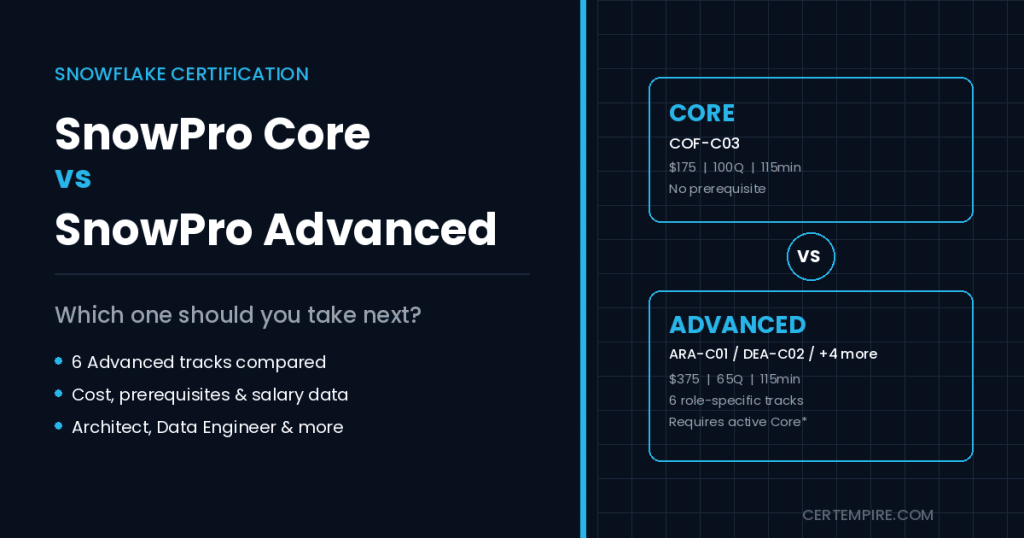
- SnowPro Core ($175, 100 questions, 115 minutes) proves general Snowflake literacy. It has no formal prerequisite and is meant for anyone touching the platform.
- SnowPro Advanced is not one exam. It is six separate, role-specific exams: Architect (ARA-C01), Data Engineer (DEA-C02), Data Scientist (DSA-C03), Administrator, Security Engineer, and Data Analyst. Each costs $375 (Data Engineer is $300 in India), runs 65 questions in 115 minutes, and needs a 750/1000 scaled score to pass.
- Snowflake’s own certification team describes Core as the required starting point for Advanced, saying the Advanced exams “build upon the factual knowledge of the Core exam and assume proficiency with Snowflake.” Some third-party prep vendors soften this to “recommended.” We disclose exactly where that disagreement comes from below so you are not caught off guard at registration.
- Architect (ARA-C01) is widely regarded as the hardest exam in the entire SnowPro program. Data Engineer (DEA-C02) is the most in-demand for people doing pipeline and ELT work day to day.
- Certification alone will not move your salary. Paired with 1-2 years of production experience, recruiters report Advanced Architect adds a $12,000 to $20,000 premium and Advanced Data Engineer adds $8,000 to $14,000, compared to $3,000 to $6,000 for Core alone.
- If you have less than a year of hands-on Snowflake work, stay on Core and build experience before sitting an Advanced exam. If you already own a specific job function (architecture, pipelines, admin, analytics, data science, or security), the matching Advanced track is the direct next step.
Quick Facts: Core vs Advanced at a Glance
| SnowPro Core (COF-C03) | SnowPro Advanced (any track) | |
| Exam codes | COF-C03 | ARA-C01, DEA-C02, DSA-C03, and three others (below) |
| Cost | $175 | 375(300 in India for Data Engineer) |
| Questions | 100 | 65 |
| Time limit | 115 minutes | 115 minutes |
| Passing score | 750/1000 (scaled) | 750/1000 (scaled) |
| Prerequisite | None | Active SnowPro Core (see disagreement below) |
| Question style | Factual, knowledge-recall | Scenario-based, task-driven |
| Validity | 2 years | 2 years |
| Number of tracks | 1 | 6 (role-specific) |
| Launched | February 16, 2026 (COF-C02 retired May 14, 2026) | Varies by track, all currently active |
Sources: Snowflake SnowPro Core Certification page, Snowflake Advanced Certifications blog.
If you have not yet sat Core, start with Cert Empire’s SnowPro Core Certification Guide before coming back here, or browse the full Snowflake certification hub on Cert Empire for every exam code currently covered.
The Prerequisite Question: Required or Recommended? (We Checked Both Sides)
This is the part most comparison articles gloss over, and it genuinely matters because it affects whether you can even register for an Advanced exam.
Snowflake’s own certification blog is direct about it. Describing the path from Core to Advanced, Snowflake writes that the Advanced exams “build upon the factual knowledge of the Core exam and assume proficiency with Snowflake,” and the same post instructs candidates to “Earn your SnowPro Core Certification” as step one before attempting any Advanced track.
Some independent exam-prep sites use softer language. One third-party certification tracker lists Core as merely “recommended” for Advanced, while a separate exam quick-facts resource for both ARA-C01 (Architect) and DEA-C02 (Data Engineer) states plainly that an “Active SnowPro Core Certification” is required to sit those two exams specifically.
Here is the honest reconciliation: the requirement is not identical across all six Advanced tracks, and Snowflake has changed prerequisite enforcement before without much fanfare. Treat Core as a hard requirement for Architect and Data Engineer, and treat it as a strong practical requirement for the other four tracks (Administrator, Data Scientist, Data Analyst, Security Engineer) even where enforcement language is looser, because the exam content genuinely assumes Core-level fluency with Snowflake’s architecture, security model, and SQL layer. Confirm current registration rules on your specific exam’s page in the Snowflake certification portal before you pay, since prerequisite policy is exactly the kind of detail vendors change between exam versions.
Which Advanced Track Should You Take? A 3-Question Framework
Instead of guessing from a generic “best certification” list, answer these three questions in order. Most people land on the right track by question two.
Question 1: What does your actual job title say?
If your day-to-day work is building and maintaining pipelines, transformations, or ELT jobs, skip to Data Engineer. If you are designing account structures, security models, and platform architecture, skip to Architect. If you write queries and build dashboards more than you build pipelines, skip to Data Analyst. If you are the person who gets paged when Snowflake breaks, that is Administrator. If your work is closer to model training, feature pipelines, or applied ML on top of Snowflake, that is Data Scientist. If you own access control, data masking, and compliance posture, that is Security Engineer.
Question 2: How much production experience do you have on Snowflake specifically?
Advanced exams are scenario-based, not factual-recall like Core. Snowflake’s own guidance frames the target candidate as having roughly one to two years of hands-on experience, depending on the track. If you passed Core last month and have not yet touched a production Snowflake account, the honest move is to wait. A scenario exam punishes textbook knowledge without applied context far more than Core does.
Question 3: Which track has the steepest difficulty curve, and are you ready for it?
Architect (ARA-C01) is consistently described by exam-prep resources as the toughest exam in the SnowPro program, testing account and security design, architecture trade-offs, data engineering patterns, and performance optimization across four domains simultaneously. If you are choosing between Architect and another track purely to “prove yourself,” make sure the difficulty matches an actual role you hold or are targeting, not just a badge.
This same “how far do you actually need to go” question comes up constantly outside the Snowflake ecosystem too. We walked through nearly identical reasoning for Databricks’ associate-to-professional jump in Databricks Data Engineer Associate vs Professional: How Far Do You Need to Go? and for the machine learning track in Databricks Machine Learning Associate vs Professional. The core logic (match the harder exam to an actual job function, not a badge-collecting instinct) applies whether you are choosing a Snowflake or a Databricks track.
The Six SnowPro Advanced Tracks, Side by Side
| Track | Exam Code | Domains | Cost | Who It’s For |
| Architect | ARA-C01 | Accounts and Security, Snowflake Architecture, Data Engineering, Performance Optimization (4 domains) | $375 | Solution, database, and system architects |
| Data Engineer | DEA-C02 | Data Movement, Performance Optimization, Storage and Data Protection, Data Governance, Data Transformation (5 domains) | 375(300 in India) | Data engineers building pipelines and ELT |
| Data Scientist | DSA-C03 | Not fully published in third-party trackers at time of writing | $375 | Data scientists and AI/ML engineers working on Snowflake |
| Administrator | Not standardized across sources | Account, security, and platform operations | $375 | Snowflake administrators and DBAs |
| Data Analyst | Not standardized across sources | Query, BI, and reporting-focused | $375 | Data analysts, ELT developers, BI specialists |
| Security Engineer | Not standardized across sources | Access control, governance, data protection | $375 | Security and governance-focused engineers |
All six use the same shell: 65 scored questions, 115 minutes, a 750/1000 scaled passing score, and 2-year validity. Where a source did not publish confirmed domain weightings for a track at the time of this writing, we have said so rather than inventing numbers, because SnowPro Advanced domain blueprints for the newer tracks (Data Scientist, Security Engineer) are less consistently documented across prep vendors than Architect and Data Engineer.
Architect (ARA-C01): The One Everyone Calls the Hardest
Architect tests whether you can make platform-level decisions, not just execute tasks. Its four domains (Accounts and Security, Snowflake Architecture, Data Engineering, Performance Optimization) require you to reason about trade-offs: when to use a bigger warehouse versus better clustering keys, how to structure account and database hierarchies for a multi-team org, and how role-based access control interacts with data sharing. Exam-prep resources that track difficulty across the SnowPro program consistently flag Architect as the most demanding of the six, in part because it draws on all four domains simultaneously in scenario questions rather than testing them in isolation.
Data Engineer (DEA-C02): The Highest-Demand Track Day to Day
Data Engineer’s five domains (Data Movement, Performance Optimization, Storage and Data Protection, Data Governance, Data Transformation) map almost one to one onto what a working Snowflake data engineer does every week: moving data in and out of Snowflake, tuning warehouse and query performance, applying data protection features like masking and row access policies, and building transformation pipelines with Streams, Tasks, or dbt. Its scenario-driven question format tests whether you can pick the right tool for a described pipeline problem, not just define what the tool does. This is the track most engineers building day-to-day production pipelines should target directly after Core.
Career Impact: What Certification Premiums Actually Look Like
Certification does not set your salary; experience does. But recruiters who specialize in Snowflake hiring do report measurable premiums when a certification is paired with real production work, and the numbers scale with exam difficulty.
Base salary bands by experience (Snowflake-focused roles, 2026):
| Experience Level | Salary Range |
| Associate/junior (0-2 years) | $95,000 to $120,000 |
| Mid-level (2-5 years) | $120,000 to $155,000 |
| Senior (5-8 years) | $155,000 to $195,000 |
| Lead/principal/architect (8+ years) | $195,000 to $265,000 |
Certification premiums, when paired with demonstrated production experience:
| Certification | Reported Premium |
| SnowPro Core | $3,000 to $6,000 |
| SnowPro Advanced: Administrator | $6,000 to $10,000 |
| SnowPro Advanced: Data Engineer | $8,000 to $14,000 |
| SnowPro Advanced: Architect | $12,000 to $20,000 |
Source: KORE1 Snowflake Engineer Salary Guide 2026, which explicitly caveats that these premiums apply only when the certification is paired with real production experience, not as a standalone credential fresh out of a bootcamp. Senior architect-track roles at major tech hubs push past $260,000 in the same guide, and separate compensation trackers on platforms like Levels.fyi show individual Snowflake Solution Architect data points as high as the low $300,000s in total compensation at specific companies, though those figures reflect base-plus-equity packages at large tech employers rather than typical market rates.
The practical takeaway: Core protects you from being screened out of a data role. Advanced, especially Architect or Data Engineer, is what actually shows up as a negotiation point once you are already in the interview.
How to Prepare for an Advanced Exam After Core
- Get 6-12 months of hands-on time first. Advanced exams are scenario-based. Studying documentation without touching a production or sandbox account will leave gaps that only show up as wrong answers on test day.
- Read the exam guide for your specific track before you study anything else. Domain weightings differ significantly between Architect and Data Engineer, and studying the wrong emphasis wastes real time.
- Practice with realistic scenario questions, not just flashcards. Core rewards memorizing SQL syntax and object hierarchy. Advanced rewards picking the correct architecture or pipeline design out of several plausible-sounding options.
- Use Cert Empire’s exam question banks for your track to get a feel for the scenario format before exam day, alongside official Snowflake documentation and quickstarts. Cert Empire covers ARA-C01 Architect exam questions and Administrator (ADA-C01) exam questions directly, and if you are still shoring up Core fundamentals first, the free SnowPro Core practice questions are a no-cost way to check readiness before you spend on Advanced.
- Budget more study time than Core took you, even though the question count is lower. Fewer, denser scenario questions generally take longer to reason through per question than Core’s factual questions.
Common Mistakes People Make Choosing Between Core and Advanced
- Chasing Architect as a status symbol without an architecture role. It is the hardest exam for a reason, and its content will not stick if you are not applying it.
- Assuming any Advanced pass will move your salary immediately. Recruiters pair certification with proven experience; a certification with no matching work history rarely converts to a premium on its own.
- Ignoring the prerequisite question until registration day. Confirm your specific track’s current prerequisite policy on Snowflake’s certification portal before paying the $375 fee, since policy has shifted before between exam versions.
- Picking Data Engineer or Data Scientist based on title alone without checking the domain blueprint. The two tracks overlap in places (both touch data transformation and movement), and reading the actual domain list prevents a mismatched study plan.
FAQS
Is SnowPro Core required before SnowPro Advanced?
Snowflake’s own certification team describes it as the required starting point, and third-party quick-facts pages for Architect (ARA-C01) and Data Engineer (DEA-C02) list an active Core certification as required. Some other trackers describe it as merely recommended. Confirm the current policy on your specific track’s registration page, since this is exactly the kind of detail that changes between exam versions.
How many SnowPro Advanced certifications are there?
Six: Architect (ARA-C01), Data Engineer (DEA-C02), Data Scientist (DSA-C03), Administrator, Data Analyst, and Security Engineer.
Which SnowPro Advanced exam is hardest?
Architect (ARA-C01) is the one most consistently flagged as the toughest, because its four domains require reasoning across security, architecture, data engineering, and performance simultaneously rather than testing each in isolation.
How much does SnowPro Advanced cost?
$375 for most tracks and regions. Data Engineer (DEA-C02) is discounted to $300 in India.
How many questions are on a SnowPro Advanced exam, and how long do I get?
65 scored questions in 115 minutes, with a 750/1000 scaled passing score, the same time limit and passing threshold as Core despite the lower question count.
Is SnowPro Advanced worth it if I am not aiming for an architect role?
Yes, if your target track matches your actual job function. Data Engineer, Administrator, Data Analyst, Data Scientist, and Security Engineer each map to distinct day-to-day roles, and the salary premium data suggests employers do value role-specific Advanced credentials, not just Architect.
Do SnowPro Advanced certifications expire?
Yes. Like Core, they carry a 2-year validity period before you need to recertify.
Should I go straight from Core to Advanced, or wait?
Wait until you have real hands-on Snowflake experience, generally 1-2 years depending on the track. Advanced exams are scenario-based and assume applied proficiency, not textbook recall.
Which Advanced track should a data engineer take first if they also do some architecture work?
Start with Data Engineer (DEA-C02) if pipelines and transformations are the bulk of your daily work, then consider Architect later once you are formally responsible for account and platform design decisions, since Architect’s difficulty is best tackled once that is genuinely your job.
Does passing SnowPro Advanced guarantee a raise?
No. Recruiters and salary guides consistently frame certification premiums as conditional on pairing the credential with demonstrated production experience, not as an automatic pay bump.
Where can I find official domain blueprints for each Advanced track?
On Snowflake’s own certification portal for each exam code. Third-party trackers vary in how completely they publish domain weightings, particularly for newer tracks like Data Scientist and Security Engineer.
Can I take multiple SnowPro Advanced tracks?
Yes. Many Snowflake professionals hold more than one Advanced credential over their career as their responsibilities expand, for example adding Data Engineer after starting in an Administrator role.
How does this compare to stacking certifications in other ecosystems, like Terraform or Kubernetes?
The logic is similar. Just as Snowflake professionals weigh Core against six specialized Advanced tracks, DevOps practitioners weigh general-purpose credentials against more specialized ones; see HashiCorp Terraform Associate (004) vs CKA for how that trade-off plays out in infrastructure-as-code roles. Browse every certification path Cert Empire covers if you are mapping out a multi-vendor data or cloud career.
Is there a SnowPro Advanced exam that does not require Core?
Based on currently available prerequisite information, all six tracks are positioned as following Core, though the strictness of enforcement language varies by track and source, as detailed above.