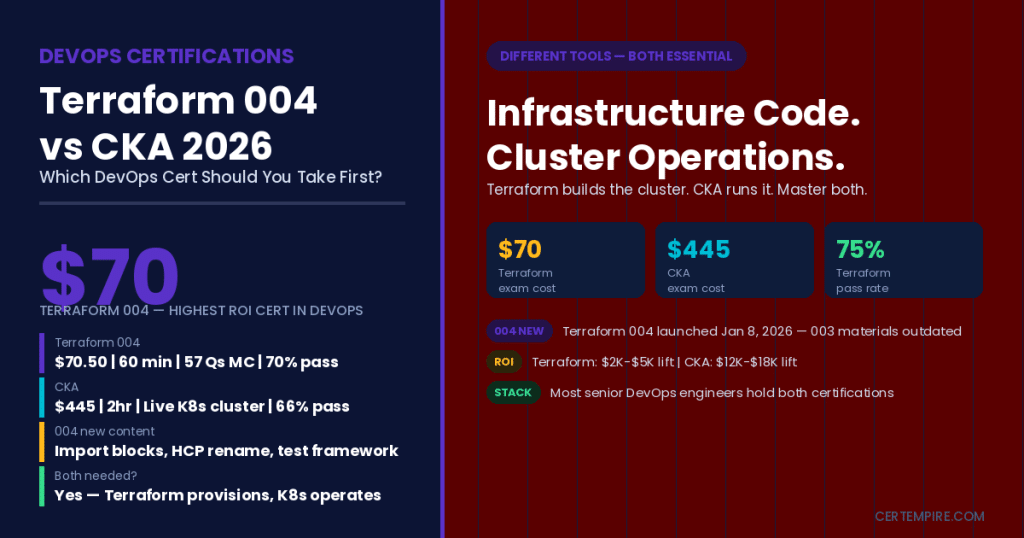
HashiCorp Certified: Terraform Associate (004) is the right first certification if your work involves provisioning and managing cloud infrastructure through code – it costs $70.50, takes 4 to 8 weeks to prepare for, uses a 60-minute multiple-choice format, and is the highest return-on-investment certification in DevOps by cost per career impact. Certified Kubernetes Administrator (CKA) is the right first certification if your work involves operating, managing, and troubleshooting Kubernetes clusters – it costs $445, takes 2 to 4 months to prepare for, uses a 2-hour hands-on live cluster format, and earns a $12,000 to $18,000 salary premium at the associate DevOps level. They are not competing certifications: most senior DevOps engineers and platform engineers ultimately hold both, and the sequence depends entirely on what your current job involves.
Quick Comparison Table
| Factor | Terraform Associate 004 | CKA |
| Full name | HashiCorp Certified: Terraform Associate | Certified Kubernetes Administrator |
| Issued by | HashiCorp | CNCF / Linux Foundation |
| Current version | 004 (launched January 8, 2026) | Current (domain weights updated 2024) |
| Cost | $70.50 USD | $445 USD |
| Questions / Tasks | 57-60 multiple choice | 15-20 performance-based tasks |
| Duration | 60 minutes | 2 hours |
| Passing score | 70% | 66% |
| Format | Multiple choice (closed book) | Live Kubernetes cluster (docs allowed) |
| Prerequisites enforced | None | None |
| Validity | 2 years | 3 years |
| Free retake included | No | Yes (1 included) |
| Recommended experience | Basic Terraform CLI usage | 6-12 months Kubernetes administration |
| Average US salary (role) | $120,000-$140,000 (DevOps/Cloud Eng) | $120,000-$150,000 (Platform/SRE) |
| Salary uplift | $2,000-$5,000 on next job change | $12,000-$18,000 (community survey) |
| First-attempt pass rate | ~75% | ~60-67% |
| Typical prep time | 4-8 weeks | 8-16 weeks |
| Appearance in job postings | Very high (80%+ of cloud engineer roles list Terraform) | Very high (90%+ of platform/SRE roles list Kubernetes) |
The Critical Difference: What Each Certification Validates
Understanding the difference between Infrastructure as Code and container orchestration is the foundation of this decision.
Terraform: What you provision. Terraform is an Infrastructure as Code tool that creates and manages cloud resources – virtual machines, networks, databases, storage, and Kubernetes clusters themselves – through declarative HCL configuration files. When a DevOps engineer writes terraform apply, Terraform reads the desired state from code and creates or modifies cloud resources to match it. Terraform Associate validates your ability to write, manage, and maintain this infrastructure code.
Kubernetes/CKA: What runs on what you provision. Kubernetes is a container orchestration platform that manages the lifecycle of containerized applications running on infrastructure. A Kubernetes Administrator does not typically provision the cloud infrastructure – they manage what runs on top of it: scheduling containers, managing networking between them, handling persistent storage, and keeping the cluster healthy. CKA validates your ability to operate this platform.
| Career dimension | Terraform Associate | CKA |
| Core question it answers | “How do I build and manage cloud infrastructure through code?” | “How do I run and maintain a Kubernetes cluster reliably?” |
| Layer in the stack | Infrastructure provisioning | Container orchestration platform |
| Primary tool | Terraform CLI, HCL | kubectl, kubeadm, etcdctl |
| Cloud provider dependency | Works with any cloud (AWS, Azure, GCP, others) | Runs on any infrastructure |
| Primary role type | DevOps Engineer, Cloud Engineer, Infrastructure Engineer | Platform Engineer, SRE, Kubernetes Administrator |
| They complement each other because | Terraform provisions the Kubernetes cluster | CKA manages what runs inside it |
Terraform Associate 004: What Changed and What the Exam Tests
Terraform Associate 004 launched on January 8, 2026, replacing the 003 version which retired on January 5, 2026. If you are using 003 study materials from 2025, they are now outdated. The 004 exam was updated to align with Terraform 1.12 and includes new content on:
- Import blocks (declarative import, new in Terraform 1.5 and now heavily tested)
- HCP Terraform (the new name for Terraform Cloud – this renaming catches candidates off guard)
- Test framework (terraform test command for writing unit tests for Terraform configurations)
- Updated provider and module management content
The Nine Terraform Associate 004 Exam Objectives
| Objective | Weight | What it covers |
| 1. Understand IaC Concepts | 8% | What Infrastructure as Code is, benefits vs manual provisioning, Terraform’s role |
| 2. Understand Terraform’s Purpose | 9% | When to use Terraform vs other tools, multi-cloud approach, stateful management |
| 3. Understand Terraform Basics | 17% | HCL syntax, providers, resources, data sources, terraform init/plan/apply/destroy |
| 4. Use Terraform Outside Core Workflow | 8% | terraform fmt, validate, import, state commands |
| 5. Interact with Terraform Modules | 12% | Module structure, sourcing from registry, version constraints, input/output variables |
| 6. Use the Core Terraform Workflow | 11% | Plan, apply, destroy workflow, workspace management, dependency management |
| 7. Implement and Maintain State | 15% | Remote state backends, state locking, terraform state commands, sensitive values |
| 8. Read, Generate, and Modify Configuration | 14% | Dynamic blocks, count, for_each, locals, functions, conditional expressions |
| 9. Understand HCP Terraform Capabilities | 6% | HCP Terraform workspaces, Sentinel policies, team access, run triggers |
Objectives 7 and 8 together are 29% of the exam – state management and configuration generation are the two areas where candidates with surface Terraform knowledge most often fail. The ability to use terraform state mv, terraform state rm, terraform import, and write complex for_each expressions on real resources is directly testable.
The Format Difference That Matters
Terraform Associate uses traditional multiple-choice format, closed book, 60 minutes. This is significantly more accessible than CKA’s performance-based format, which is why the pass rate is approximately 75% versus CKA’s 60-67%. A candidate with solid conceptual understanding and study discipline can pass Terraform Associate in 4 weeks. CKA requires genuine hands-on cluster experience that cannot be substituted with study time alone.
CKA: What the Exam Tests (The Performance-Based Difference)
CKA’s five domain breakdown – and why the exam format fundamentally changes how you prepare:
| Domain | Weight | What it covers |
| 1. Cluster Architecture, Installation & Configuration | 25% | kubeadm cluster setup, etcd backup/restore, RBAC, cluster upgrades |
| 2. Workloads & Scheduling | 15% | Deployments, StatefulSets, DaemonSets, resource requests/limits, node affinity |
| 3. Services & Networking | 20% | Services, Ingress, NetworkPolicy, CoreDNS troubleshooting |
| 4. Storage | 10% | PersistentVolumes, PersistentVolumeClaims, StorageClasses |
| 5. Troubleshooting | 30% | Node failures, Pod CrashLoopBackOff, network issues, control plane problems |
Troubleshooting at 30% is the single most important domain. A CKA candidate who cannot diagnose a broken kubelet, identify why a Pod is in Pending state due to resource constraints, or restore etcd from a backup will not pass, regardless of how well they know the deployment and service concepts.
The exam allows access to kubernetes.io/docs but not external tools, AI assistants, or personal notes. Time pressure is the primary challenge – 15-20 tasks in 2 hours requires fluent kubectl usage with aliases and shortcuts, not documentation search for every command.
For a complete breakdown of all three Kubernetes certifications and which to pursue after CKA, see our CKA vs CKAD vs CKS guide.
The ROI Calculation: Which Pays Off Faster
This is the most practical comparison for candidates choosing between the two.
Terraform Associate ROI
| Cost factor | Amount |
| Exam fee | $70.50 |
| Study materials (HashiCorp Learn is free) | $0 |
| Optional Udemy course | $15-$30 |
| Total investment | $85-$100 |
| Typical salary lift on next job change | $2,000-$5,000 |
| Time to positive ROI | Days to weeks after first job change |
| Break-even on exam cost | Less than 1 day of additional salary |
Terraform Associate is the highest ROI certification per dollar spent in the entire DevOps/cloud certification landscape. At $70.50 for the exam, it is 6x cheaper than AWS SAA-C03, 10x cheaper than AZ-104, and 63x cheaper than CISSP. The salary lift is modest in absolute terms but the cost is so low that the ROI ratio is extraordinary.
CKA ROI
| Cost factor | Amount |
| Exam fee (includes 1 free retake) | $445 |
| Study course (Mumshad’s KodeKloud recommended) | $30-$50 |
| Lab environment (killer.sh included with exam) | $0 (2 simulator sessions included) |
| Total investment | $475-$495 |
| Typical salary lift (community surveys) | $12,000-$18,000 |
| Time to positive ROI | First month of next role |
| Break-even on exam cost | Less than 2 weeks of additional salary |
CKA’s absolute ROI is higher than Terraform Associate. The $12,000-$18,000 salary lift documented in CNCF community surveys dwarfs the $445 exam cost. The payback period is measured in weeks, not months.
Which Industries and Roles Prefer Each
| Sector / Role | Terraform priority | CKA priority |
| Cloud infrastructure engineering | Primary credential | Important but secondary |
| Platform engineering / internal developer platforms | Both equally important | Primary credential |
| Site Reliability Engineering (SRE) | Important (IaC for infra) | Primary credential |
| DevOps consulting | Very high (client-facing IaC deliverables) | High (cluster delivery) |
| Fintech and regulated industries | High (compliance-as-code, drift detection) | High (secure workload isolation) |
| Startup / cloud-native companies | High (infrastructure bootstrapping) | Very high (Kubernetes-first deployments) |
| Government and public sector | Growing (automation mandates) | Growing (DoD containerization initiatives) |
How Terraform and Kubernetes Work Together
Understanding how these two tools relate reinforces why holding both certifications is more powerful than either alone.
Terraform provisions infrastructure including the Kubernetes cluster itself. A Terraform configuration can create an EKS cluster on AWS, a GKE cluster on Google Cloud, or an AKS cluster on Azure in a repeatable, version-controlled way. Once the cluster exists, Kubernetes administrators manage what runs inside it.
A platform engineer with both Terraform Associate and CKA can:
- Use Terraform to provision a production-grade Kubernetes cluster with specific node groups, networking, and IAM policies
- Use CKA-level skills to configure RBAC, deploy workloads, set up monitoring, and troubleshoot cluster health
- Manage the entire lifecycle of the platform as code – from day zero provisioning to day two operations
This combined skillset is what senior platform engineering and DevOps leadership roles require, which is why holding both certifications consistently produces the largest salary premiums in the DevOps space.
Decision Guide: Which to Take First
| Your situation | Take first |
| You work primarily with cloud infrastructure provisioning | Terraform Associate |
| You manage or want to manage Kubernetes clusters | CKA |
| You are transitioning into DevOps from sysadmin | Terraform Associate (lower cost, lower risk entry) |
| You are transitioning into DevOps from development | CKA (app deployment background is CKA prep) |
| Budget is a major constraint | Terraform Associate ($70.50 vs $445) |
| You want maximum salary impact soonest | CKA (higher absolute salary lift) |
| You work at a cloud-native startup | CKA first, Terraform Associate second |
| You work at an enterprise with established infrastructure | Terraform Associate first, CKA second |
| You have no DevOps certifications at all | Terraform Associate – cheapest way to prove IaC competency |
| You want both eventually | Terraform Associate first (faster, cheaper), CKA 2-4 months later |
FAQs
Is Terraform Associate harder than CKA?
No. Terraform Associate has a higher first-attempt pass rate (~75% vs ~60-67% for CKA). Terraform Associate uses a closed-book multiple-choice format that tests conceptual understanding and workflow knowledge. CKA uses a live performance-based lab that requires genuine hands-on kubectl fluency under time pressure. CKA is significantly harder by most community accounts.
What changed between Terraform Associate 003 and 004?
Terraform Associate 004 launched January 8, 2026. Key changes include: alignment with Terraform 1.12, new content on import blocks (declarative import), rebranding of Terraform Cloud to HCP Terraform throughout exam content, expanded terraform test framework content, and updates to provider lock file and dependency management topics. Candidates using 003 materials need to supplement with 004-specific content.
Do Terraform and Kubernetes compete for the same job roles?
Partly, but mostly they complement each other. Terraform is primarily used for infrastructure provisioning – creating the cloud resources that applications and platforms run on. Kubernetes manages containerized workloads that run on that infrastructure. Senior platform engineers and DevOps architects typically use both tools in the same workflow: Terraform to create the EKS/GKE/AKS cluster, Kubernetes to operate it.
Is Terraform Associate worth it at $70.50?
Yes – it has the highest return-on-investment ratio of any professional certification in the DevOps space. The exam costs less than most professional books, the study materials (HashiCorp Learn) are free, and Terraform appears in 80%+ of cloud engineer job postings in 2026. Even a failed first attempt costs less than one dinner.
Does CKA count toward any cloud provider certifications?
CKA is a vendor-neutral CNCF certification and does not fulfill any AWS, Azure, or Google Cloud certification requirements. However, AWS EKS, Azure AKS, and GCP GKE all run standard Kubernetes, meaning CKA skills directly apply to managed Kubernetes on any cloud provider.
What comes after Terraform Associate?
HashiCorp launched the Terraform Authoring and Operations Professional, a hands-on lab exam for senior IaC practitioners. The HashiCorp Vault Associate is the natural complement for secrets management. For cloud-specific depth, AWS Developer Associate or Azure AZ-104 pair well with Terraform Associate.
What comes after CKA?
CKS (Certified Kubernetes Security Specialist) is the natural next step for platform security roles. CKAD (Certified Kubernetes Application Developer) is a logical complement for engineers who also write applications. See our CKA vs CKAD vs CKS guide for the full Kubernetes certification path.
How does Terraform relate to Ansible?
Terraform provisions infrastructure (creating cloud resources). Ansible configures that infrastructure (installing software, managing configuration on running systems). They are complementary tools in different layers of the automation stack. Neither replaces the other – many DevOps teams use both. Terraform certification is more broadly requested in modern cloud engineering roles because cloud-provider APIs have largely replaced the OS-configuration use case for Ansible.
Is CKA recognized by the US Department of Defense?
CKA does not appear on the DoD 8570/8140 approved list. For DoD compliance in cybersecurity roles, CompTIA Security+, CCNA Cybersecurity, or CISSP are the relevant credentials. However, DoD and federal agencies are actively adopting Kubernetes for containerized workloads, and CKA is increasingly valued in federal contracting roles even without formal 8570 mapping.
How much does Terraform Associate cost to renew?
$70.50 every 2 years – you retake the current version of the exam. CKA costs $445 every 3 years (or a $445 retake if you let it lapse). Over a 6-year period, Terraform Associate renewal costs $141 total; CKA renewal costs $445 once.