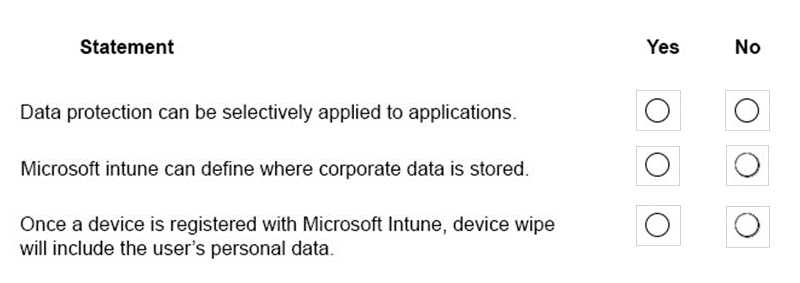
HOTSPOT An organization plans to deploy Microsoft Intune. For each of the following statements, select Yes if the statement is true. Otherwise, select No. 
Free MS-900 Practice Test Questions and Answers (2026)
DRAG DROP A company is evaluating Microsoft 365 collaboration apps. You need to describe the collaboration apps. Match each collaboration app to its description. To answer, move the appropriate collaboration app from the column on the left to its description on the right. You may use each collaboration app once, more than once, or not at all.
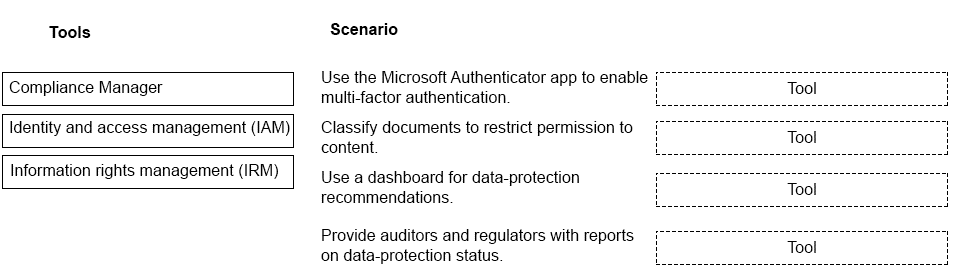
DRAG DROP Your company has aMicrosoft 365 subscription. You need to implement security policies to ensure that sensitive data is protected. Which tools should you use? To answer, drag the appropriate tools to the correct scenarios. Each tool may be used once, more than once, or notat all. You may need to drag the split bar between panes or scroll to view content.
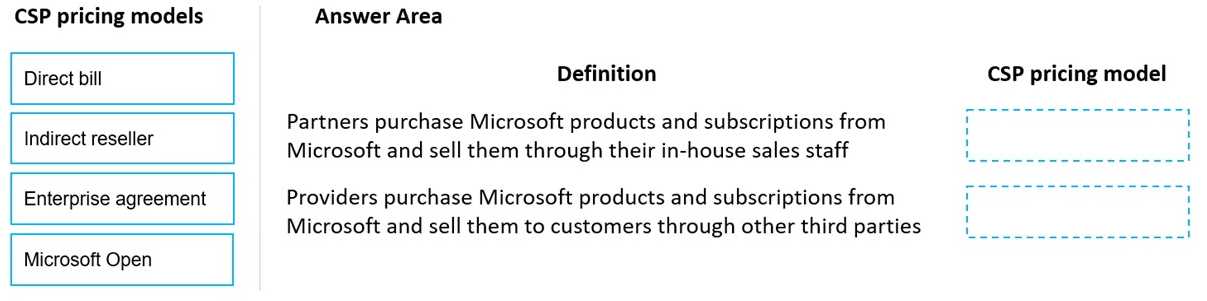
DRAG DROP A company is investigating cloud solution provider (CSP) pricing models for Microsoft cloud services. Match each CSP pricing model to its definition. Instructions: To answer, drag the appropriate CSP pricing model from the column on the left to the definition on the right. Each CSP pricing model might be used once, more than once, or not at all.
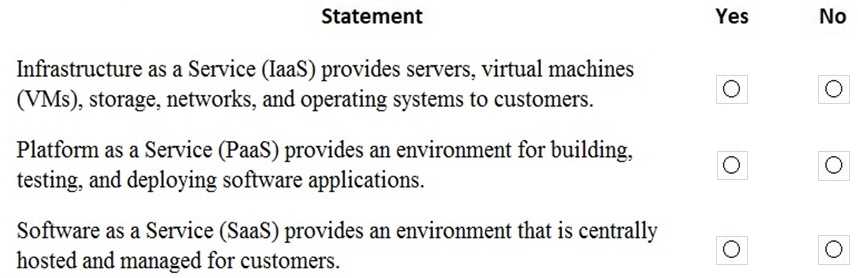
HOTSPOT For each of the following statements, select Yes if the statement is true. Otherwise, select No.
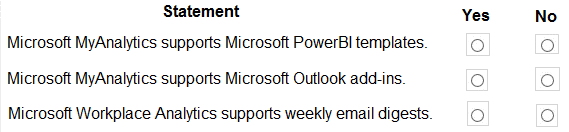
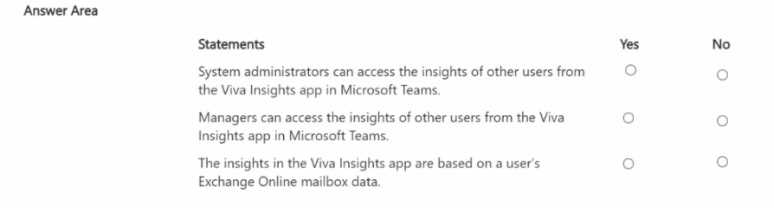
HOTSPOT A company uses Microsoft Viva Insights Instructions: For each of the following statements, select Yes if the statement is true. Otherwise, select No.
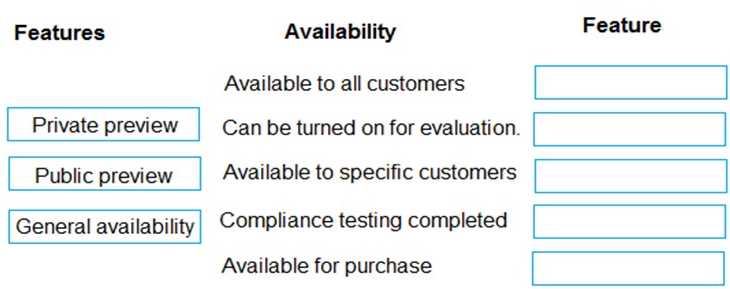
DRAG DROP Match each Microsoft 365 feature to its availability. Instructions: To answer, drag the appropriate feature from the column on the left to its availability on the right. Each feature may be used once, more than once, or not at all.
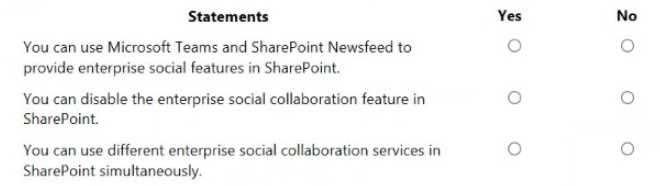
HOTSPOT Instructions: For each of the following statements, select Yes if the statementis true, Otherwise, select No.
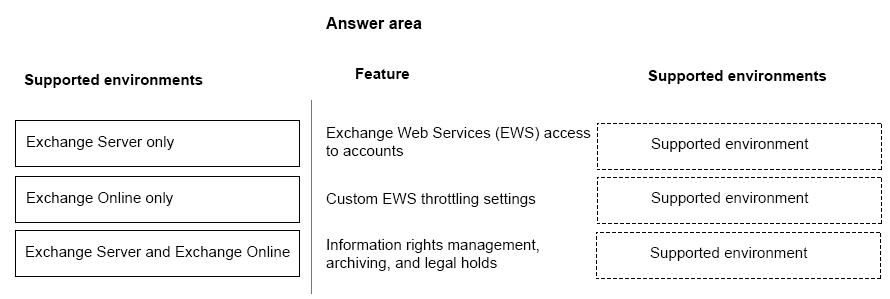
DRAG DROP A company plans to deploy Microsoft 365. You need to identify differences between the features in Exchange Online and Exchange Server. Match the appropriate features to the corresponding supported environments. To answer, drag the appropriate environments to the correct features. Each environment may be used once, more than once, or not at all. You may need to drag the split bar between panes or scroll to view content.
A company plans to deploy automated workflows for managers to approve. You 365 products allow access to personal workflows. Which two products should the managers use? Each correct answerpresents a partial solution.
A company is evaluating the security features in Microsoft 365. You need to recommend the Microsoft 365 apps that help secure data. Which two apps or services should you recommend? Each correct answer presents part of the solution.
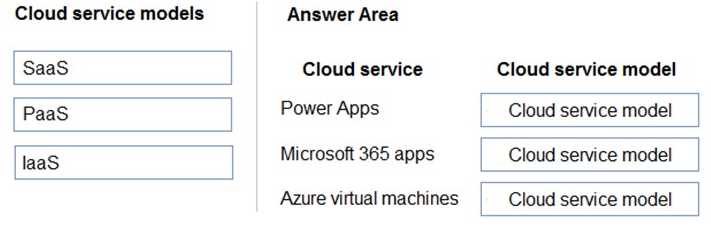
DRAG DROP You need to identify the software as a service (SaaS), platform as a service (PaaS), and infrastructure as a service (IaaS) services provided by Microsoft 365. What type of cloud service model does each cloud service represent? To answer, drag the appropriate cloud service models to the correct cloud services. Each cloud service model may be used once, more than once, or not at all. You may need to drag the split bar between panes or scroll to view content.
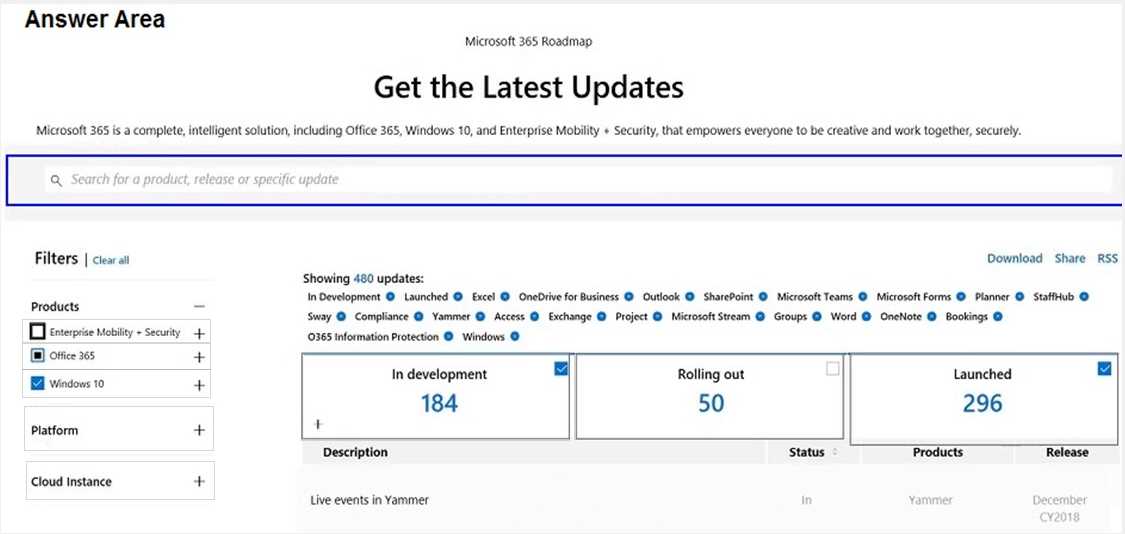
HOTSPOT You are the Microsoft 365 administrator for a company. You need to find all general availability features for SharePointOnline. Which two options should you select on the Microsoft 365 Roadmap page? To answer, select the appropriate options in the answer area.
What's covered in this practice questions set
2: Describe Microsoft 365 apps and services · 15 questions
📖 About this Domain
This domain focuses on the core productivity, collaboration, and business process applications and services available within Microsoft 365. It covers the capabilities of Microsoft 365 Apps and key online services that form the modern workplace. You will understand how these components integrate to provide a comprehensive solution.
🎓 What You Will Learn
- Describe the core productivity capabilities of Microsoft 365, including Microsoft 365 Apps, Exchange Online, SharePoint Online, OneDrive, and Microsoft Teams.
- Understand the collaboration benefits of the Microsoft 365 ecosystem, focusing on how Teams integrates with other services.
- Identify the components of Microsoft Viva and their purpose in enhancing the employee experience.
- Explain the business process automation capabilities of the Power Platform, including Power Apps, Power Automate, and Power BI.
🛠️ Skills You Will Build
- Articulate the function and business value of key Microsoft 365 applications and services.
- Differentiate between the various Microsoft 365 apps and services to match them to specific business requirements.
- Explain the concept of the modern workplace and how Microsoft 365 services enable it.
- Identify use cases for Power Platform components to automate business processes and analyze data.
💡 Top Tips to Prepare
- Focus on the integration between services, such as how Teams leverages SharePoint for file storage and Exchange for calendaring.
- Create a feature matrix to compare and contrast similar services like OneDrive and SharePoint.
- Understand the licensing implications for different apps, especially for Power Platform and Microsoft 365 Apps.
- Review the official Microsoft 365 service descriptions to grasp the core functionality of each component.
3: Describe Microsoft 365 security and compliance · 3 questions
📖 About this Domain
This domain covers the foundational security and compliance concepts within the Microsoft 365 cloud productivity suite. You will explore identity management, threat protection, information protection, and governance features using services like Azure Active Directory and Microsoft Purview.
🎓 What You Will Learn
- Learn about identity and access management concepts, including Azure AD features like multi-factor authentication (MFA) and conditional access.
- Understand how Microsoft 365 Defender provides a unified pre- and post-breach enterprise defense suite for endpoints, identities, and applications.
- Discover the capabilities of Microsoft Purview Information Protection for classifying, labeling, and protecting sensitive data.
- Explore the Service Trust Portal and Microsoft Purview compliance manager to manage regulatory compliance and assess organizational risk.
🛠️ Skills You Will Build
- You will build the skill to describe an organization's security posture using tools like Microsoft Secure Score.
- You will be able to explain core identity services such as Azure AD Identity Protection for mitigating identity-based risks.
- You will build the ability to describe how services like Microsoft Defender for Office 365 protect against phishing and malware threats.
- You will gain the skill to detail compliance solutions like eDiscovery and data loss prevention (DLP) within Microsoft Purview.
💡 Top Tips to Prepare
- Focus on understanding the principles of the Zero Trust security model as it underpins many Microsoft 365 security services.
- Familiarize yourself with the Microsoft Purview compliance portal's layout and key features like Compliance Manager and Information Protection.
- Clearly distinguish between the different Microsoft Defender products, such as Defender for Endpoint, Defender for Identity, and Defender for Cloud Apps.
- Spend time navigating the Service Trust Portal to understand how Microsoft provides transparency on its security and compliance practices.
4: Describe Microsoft 365 pricing and support · 2 questions
📖 About this Domain
This domain covers the commercial aspects of Microsoft 365. It focuses on subscription models, licensing options, billing management, and available support channels. Understanding these concepts is critical for managing the financial and operational lifecycle of Microsoft 365 services.
🎓 What You Will Learn
- You will learn to describe the various licensing and payment models available for Microsoft 365 subscriptions.
- You will learn about the different support offerings, including self-service resources and paid support plans.
- You will learn to explain the concept of Service Level Agreements (SLAs) and how they relate to service credits.
- You will learn about the service lifecycle in Microsoft 365, including public preview and General Availability (GA) releases.
🛠️ Skills You Will Build
- You will build the skill to identify the appropriate Microsoft 365 subscription plan based on business requirements.
- You will gain the ability to navigate the Microsoft 365 admin center to manage billing and subscriptions.
- You will develop the skill to create and manage service requests to resolve technical issues.
- You will learn to interpret the Service Health dashboard to monitor service status and understand SLAs.
💡 Top Tips to Prepare
- Focus on the key differences between Microsoft 365 Business, Enterprise, and Education subscription plans.
- Familiarize yourself with the billing and subscription management blades in the Microsoft 365 admin center.
- Understand the process for creating a service request and the scope of different support plans.
- Review the Microsoft Modern Lifecycle Policy to understand how services are updated and retired.
1: Describe cloud concepts
📖 About this Domain
This domain covers the fundamental principles of cloud computing, establishing the baseline knowledge for understanding Microsoft 365 services. You will explore core cloud characteristics like high availability and scalability, and differentiate between key expenditure models like CapEx and OpEx.
🎓 What You Will Learn
- You will learn to differentiate between cloud service models such as Infrastructure-as-a-Service (IaaS), Platform-as-a-Service (PaaS), and Software-as-a-Service (SaaS).
- You will learn to describe the characteristics of Public, Private, and Hybrid cloud deployment models.
- You will learn to identify the value proposition of Microsoft 365 as a comprehensive cloud service suite.
- You will learn the principles of the shared responsibility model in the context of Microsoft 365 cloud services.
🛠️ Skills You Will Build
- You will build the skill to articulate the business benefits of cloud computing, including high availability, scalability, and agility.
- You will build the skill to differentiate between Capital Expenditure (CapEx) and Operational Expenditure (OpEx) in an IT context.
- You will build the skill to identify the appropriate cloud service model (IaaS, PaaS, SaaS) for specific business requirements.
- You will build the skill to explain the shared responsibility model and its implications for security and management.
💡 Top Tips to Prepare
- Focus on memorizing the definitions and key differentiators of IaaS, PaaS, and SaaS.
- Master the distinction between Capital Expenditure (CapEx) and Operational Expenditure (OpEx) as it is a core cloud financial concept.
- Use the official Microsoft Learn MS-900 learning path to review cloud principles and service models.
- Understand the shared responsibility model to correctly identify customer versus Microsoft responsibilities in different cloud scenarios.