Free AI-900 Practice Test Questions and Answers (2026)
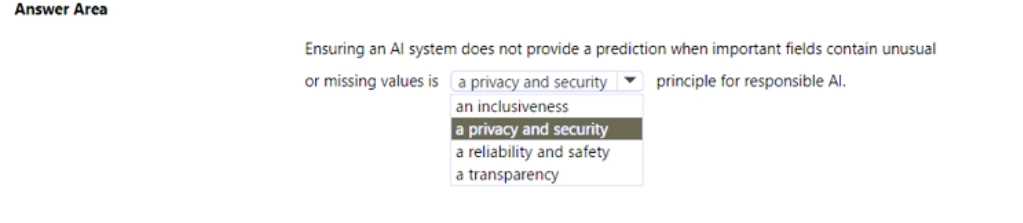
HOTSPOT Select the answer that correctly completes the sentence 
HOTSPOT brectly completes the sentence.
HOTSPOT Select the answer that correctly completes the sentence.
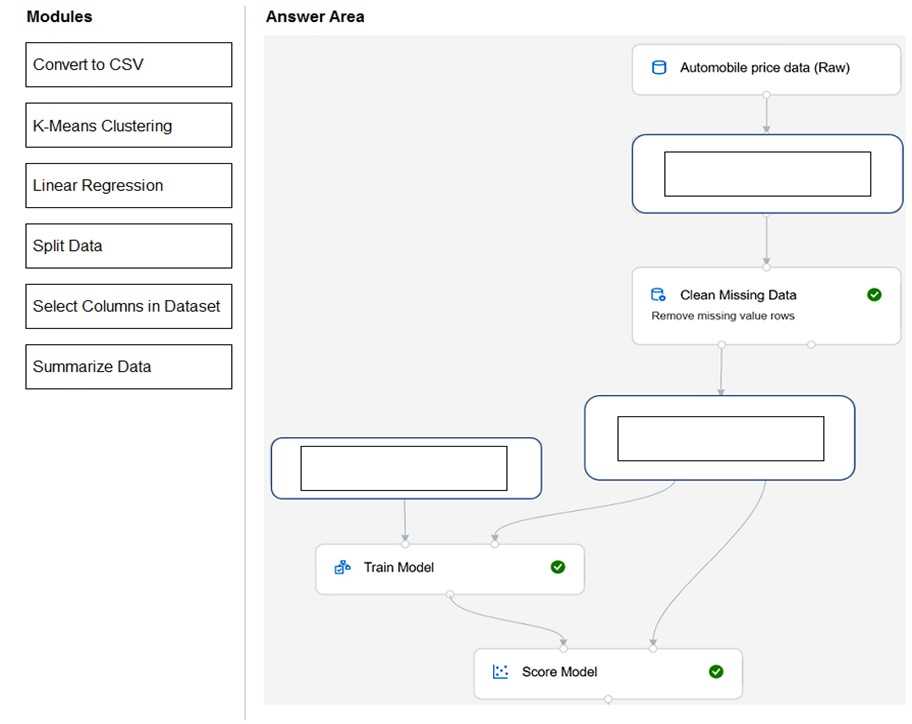
DRAG DROP You need to use Azure Machine Learning designer to build a model that will predict automobile prices. Which type of modules should you use to complete the model? To answer, drag the appropriate modules to the correct locations. Each module may be used once, more than once, or not at all. You may need to drag the split bar between panes or scroll to view content. NOTE: Each correct selection is worth one point.
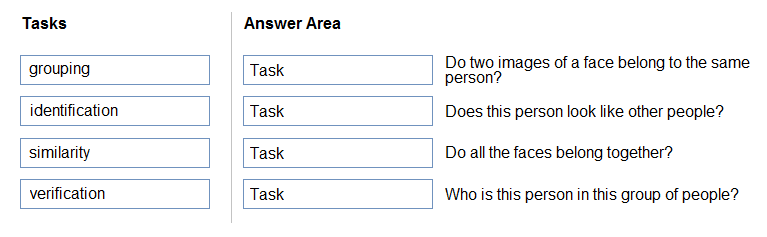
DRAG DROP Match the facial recognition tasks to the appropriate questions. To answer, drag the appropriate task from the column on the left to its question on the right. Each task may be used once, more than once, or not at all. NOTE: Each correct selection is worth one point.
HOTSPOT To complete the sentence, select the appropriate option in the answer area.
HOTSPOT Select the answer that correctly completes the sentence.
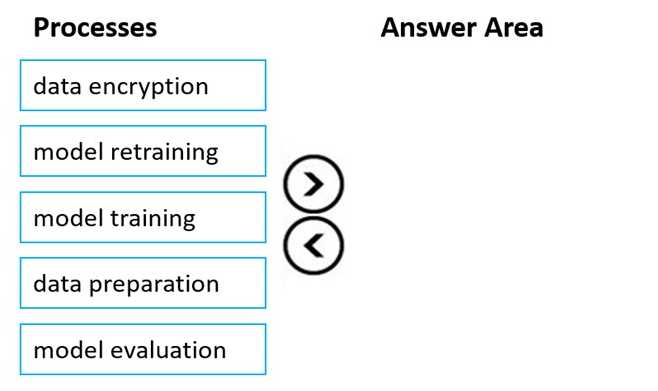
DRAG DROP You plan to deploy an Azure Machine Learning model as a service that will be used by client applications. Which three processes should you perform in sequence before you deploy the model? To answer, move the appropriate processes from the list of processes to the answer area and arrange them in the correct order.
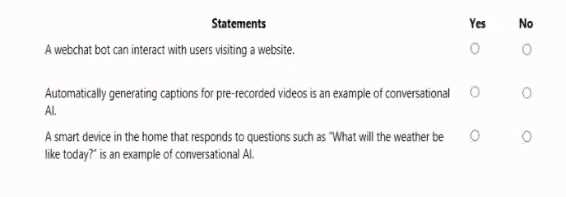
HOTSPOT For each of the following statements, select Yes if the statement is true. Otherwise, select No. NOTE: Each correct selection is worth one point.
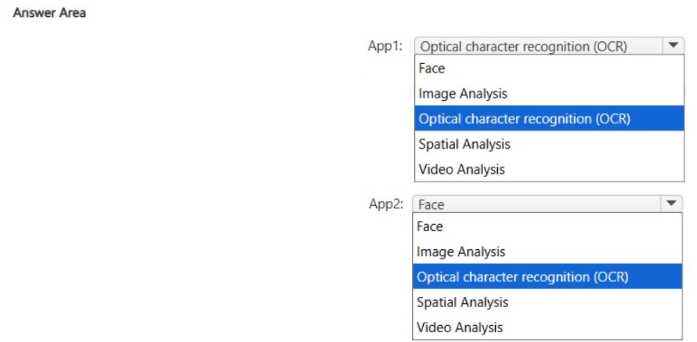
HOTSPOT You have the following apps: • App1: Uses a set of images and photos to extract brand names • App2: Enables touchless access control for buildings Which Azure Al Vision service does each app use? To answer, select the appropriate options in the answer area. NOTE: Each correct selection is worth one point.
DRAG DROP You plan to deploy an Azure Machine Learning model by using the Machine Learning designer Which four actions should you perform in sequence? To answer, move the appropriate actions from the list of actions to the answer area and arrange them in the correct order.
What's covered in this practice questions set
2: Describe fundamental principles of machine learning on Azure · 12 questions
📖 About this Domain
This domain introduces core machine learning concepts and model types like regression, classification, and clustering. It focuses on how these principles are implemented using the Azure Machine Learning service.
🎓 What You Will Learn
- You will learn to identify features and labels in a dataset for supervised machine learning.
- You will learn to differentiate between regression, classification, and clustering machine learning models.
- You will learn the core capabilities of Azure Machine Learning for building end-to-end ML solutions.
- You will learn about automated machine learning (AutoML) and the Azure Machine Learning designer for no-code model development.
🛠️ Skills You Will Build
- You will build the ability to describe the process of training, evaluating, and deploying a machine learning model.
- You will build the skill to map a business problem to the correct machine learning task.
- You will build the skill to identify core assets within the Azure Machine Learning studio, including datasets, experiments, and models.
- You will build the ability to describe the principles of Responsible AI, including fairness and explainability in models.
💡 Top Tips to Prepare
- Focus on the specific use cases that differentiate regression, classification, and clustering.
- Complete the hands-on labs in the official Microsoft Learn path to gain practical experience with Azure Machine Learning studio.
- Understand the key components of an Azure Machine Learning workspace, such as compute targets, datastores, and environments.
- Practice identifying features and labels from sample data scenarios as this is a fundamental concept.
3: Describe features of computer vision workloads on Azure · 4 questions
📖 About this Domain
This domain introduces computer vision workloads on Microsoft Azure. It covers how Azure AI services enable applications to interpret visual media like images and videos. You will explore the fundamental capabilities and services for building computer vision solutions.
🎓 What You Will Learn
- You will learn to identify core computer vision tasks, including image classification, object detection, and optical character recognition (OCR).
- You will learn the features of the Azure AI Vision service for analyzing images to generate tags, captions, and identify objects.
- You will learn the capabilities of the Azure AI Face service for detecting, analyzing, and identifying human faces in images.
- You will learn how Azure AI Video Indexer extracts metadata and insights from video and audio content.
🛠️ Skills You Will Build
- You will build the skill to describe how to provision an Azure AI Vision resource and use it for image analysis.
- You will build the skill to differentiate between face detection, face verification, and face identification use cases.
- You will build the skill to explain how optical character recognition (OCR) extracts text from images using the Read API.
- You will build the skill to identify appropriate Azure services for common computer vision workload scenarios.
💡 Top Tips to Prepare
- Focus on the specific functions of each service: Azure AI Vision for general analysis, Azure AI Face for facial recognition, and Azure AI Video Indexer for video.
- Understand the difference between key concepts like image classification (what is it?) and object detection (what is it, and where is it?).
- Review the common JSON response structures from the Vision service to understand outputs like bounding box coordinates and confidence scores.
- Memorize the specific tasks handled by the Face service, such as detecting attributes like age or emotion, and the principles of Responsible AI associated with it.
4: Describe features of Natural Language Processing (NLP) workloads on Azure · 2 questions
📖 About this Domain
This domain introduces Natural Language Processing (NLP) workloads on the Azure platform. It focuses on the features of Azure AI services that process and understand human language. You will learn about services for text analysis, speech processing, and building conversational AI solutions.
🎓 What You Will Learn
- You will learn to identify features of the Azure AI Language service, including key phrase extraction, entity recognition, and sentiment analysis.
- You will understand the capabilities of Azure AI Speech for speech-to-text (transcription) and text-to-speech (synthesis) workloads.
- You will explore text translation and language detection functionalities available through Azure AI services.
- You will learn the core components of conversational AI, such as intents, utterances, and entities within Conversational Language Understanding (CLU).
🛠️ Skills You Will Build
- You will build the skill to map common NLP business problems to specific Azure AI services like Azure AI Language or Azure AI Speech.
- You will be able to describe the process of analyzing text for insights like sentiment, key phrases, and personally identifiable information (PII).
- You will develop the ability to explain how to create conversational AI experiences using question answering and language understanding models.
- You will gain the skill to identify the correct Azure resource for tasks like real-time speech transcription or multi-language text translation.
💡 Top Tips to Prepare
- Focus on the specific tasks performed by each feature within the Azure AI Language service, such as differentiating entity recognition from key phrase extraction.
- Memorize the distinction between speech-to-text and text-to-speech and the Azure service that provides these capabilities.
- Understand the core concepts of conversational AI, particularly the relationship between an utterance and an intent.
- Use the Microsoft Learn modules to see practical examples of provisioning and consuming these NLP services via their endpoints and keys.
1: Describe Artificial Intelligence workloads and considerations · 2 questions
📖 About this Domain
This domain covers the foundational concepts of artificial intelligence and its common workloads. You will explore machine learning, computer vision, natural language processing, and the core principles for responsible AI development on Microsoft Azure.
🎓 What You Will Learn
- Identify features of common AI workloads, including machine learning, anomaly detection, computer vision, NLP, and conversational AI.
- Understand the six guiding principles for responsible AI: fairness, reliability and safety, privacy and security, inclusiveness, transparency, and accountability.
- Describe fundamental machine learning concepts such as features, labels, training, validation, and model types like regression, classification, and clustering.
- Explore how to create machine learning models using no-code tools like the Azure Machine Learning designer.
🛠️ Skills You Will Build
- The ability to identify and differentiate key AI workloads like computer vision and knowledge mining in business scenarios.
- The skill to apply Microsoft's responsible AI principles to evaluate the ethical implications of AI solutions.
- Competency in recognizing the appropriate machine learning model, such as regression or classification, for a given data problem.
- The ability to map common AI workloads to specific Microsoft Azure AI services.
💡 Top Tips to Prepare
- Master the specific capabilities and use cases for each AI workload as defined in the Microsoft Learn path for AI-900.
- Memorize the six responsible AI principles and practice applying them to different scenarios.
- Clearly differentiate between regression, classification, and clustering algorithms and their typical applications.
- Complete the hands-on labs in the Microsoft Learn module to understand the Azure Machine Learning studio interface.