ITIL Version 5 launched February 12, 2026 and contains 36% entirely new content and 24% modified content, meaning only 40% of what the ITIL 4 Foundation exam tested is retained unchanged. If you hold ITIL 4 Foundation, you do not need to retake the Foundation exam – your credential remains valid as a prerequisite for all advanced ITIL Version 5 modules. If you are starting from scratch in 2026, go directly to ITIL Version 5. There is no reason to begin with ITIL 4 when V5 is the current framework.
Quick Comparison Table
| Factor | ITIL 4 | ITIL 5 (Version 5) |
| Full name | ITIL 4 | ITIL (Version 5) |
| Published by | PeopleCert / Axelos | PeopleCert |
| Foundation launched | February 2019 | February 12, 2026 |
| Framework focus | IT Service Management | Digital Product and Service Management |
| Core model | Service Value Chain (6 activities) | Product and Service Lifecycle Model (8 activities) |
| AI content | Minimal, emerging references | AI-native: AI Capability Model, AI Governance module |
| Management practices | 34 (3 groups) | 34 (2 groups, reorganized) |
| Guiding principles | 7 (unchanged) | 7 (unchanged) |
| Four dimensions | Unchanged | Renamed: Four Dimensions of Product and Service Management |
| Foundation exam questions | 40 | 40 |
| Foundation exam duration | 60 minutes | 60 minutes |
| Foundation pass mark | 65% (26/40) | 65% (26/40) |
| Foundation exam cost | $295-$350 | $690 (standalone) / $263 (Bridge for ITIL 4 holders) |
| Certification validity | 3 years | 3 years |
The Most Important Thing Most Guides Get Wrong
ITIL Version 5 is not a replacement for ITIL 4. PeopleCert has explicitly confirmed that both frameworks run in parallel for a minimum of 12 months from the launch date, with no announced retirement date for ITIL 4. Organizations and professionals do not need to abandon ITIL 4 work immediately. The relevant question is whether to start new candidates on ITIL 4 or V5, and the answer to that question is unambiguous: start on V5.
The content has changed enough that ITIL 4 study materials will not adequately prepare you for the ITIL V5 Foundation exam. A candidate who studies only from ITIL 4 materials and sits the V5 exam will be underprepared for approximately 60% of the content.
The Biggest Exam Change: Weighting Shifted Dramatically
This is where candidates who underestimate the difference between ITIL 4 and ITIL V5 lose the most points on the V5 exam.
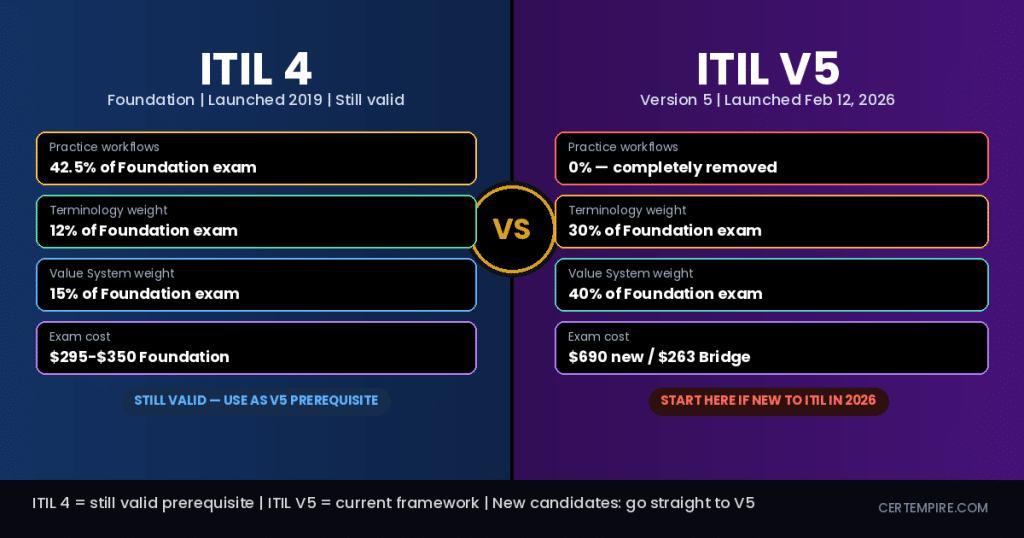
| Exam topic area | ITIL 4 Foundation weight | ITIL V5 Foundation weight | Change |
| Key concepts and terminology | 12% | 30% | +18 percentage points |
| Value System (SVS/PSLM) | 15% | 40% | +25 percentage points |
| Detailed practice workflows | 42.5% | 0% | Removed entirely |
| Guiding principles | 17% | Same territory, redistributed | Restructured |
| Four dimensions | 8% | Incorporated into Value System | Merged |
The single most dramatic change: detailed practice workflows, which made up 42.5% of the ITIL 4 Foundation exam covering incident management, change control, service desk procedures and more, are completely removed from the V5 Foundation exam. Candidates who spent significant study time on step-by-step practice procedures will find that the content simply does not appear on the V5 exam. However, candidates who are still preparing for the older certification can use ITIL 4 Foundation practice questions to assess their understanding of these workflows before exam day.
The trade-off: V5 now tests whether you understand how the entire framework connects (40% of the exam on the Value System) and whether you can speak V5’s new vocabulary (30% on terminology). Conceptual understanding replaces workflow recall.
What Is Actually New in ITIL Version 5
Digital Product and Service Management. The biggest scope shift. ITIL 4 focused on services. ITIL V5 expands to manage digital products and services together as a unified system. Organizations today deliver value through products (apps, platforms) and services simultaneously, and the framework now reflects that reality.
Product and Service Lifecycle Model (PSLM). Replaces ITIL 4’s Service Value Chain. The old model had 6 activities in a chain. PSLM has 8 activities: Discover, Design, Acquire, Build, Transition, Operate, Deliver, and Support. Critically, the PSLM is iterative, not linear. Teams move between activities based on actual work requirements rather than following a prescribed sequence.
AI Governance built in. ITIL 4 barely mentioned AI. ITIL V5 includes a dedicated ITIL AI Governance module and the ITIL AI Capability Model (the 6C model: creation, curation, clarification, cognition, communication, and coordination). AI-specific content including generative AI, agentic AI, and responsible AI adoption appears at Foundation level.
New vocabulary. ITIL V5 introduces terminology that did not exist in ITIL 4, including digital product, digital service, experience level agreement (XLA), value co-creation, and agentic AI. The exam tests precise understanding of these new terms. V4 vocabulary alone is insufficient.
Experience as a core pillar. In ITIL V5, Experience is a standalone framework element for the first time. Managing the user experience and customer journey is now structurally built into the framework, not a side consideration.
What Stayed the Same
Knowing what is unchanged helps ITIL 4 holders estimate how much genuinely new study is needed.
| Component | Status in ITIL V5 |
| 7 Guiding principles | Unchanged |
| 34 management practices (by name) | Unchanged (minor terminology updates expected in H2 2026) |
| Four dimensions of service management | Retained, renamed to Four Dimensions of Product and Service Management |
| Continual improvement | Retained and reinforced |
| ITIL Foundation as entry point | Unchanged, still mandatory for all advanced modules |
| Managing Professional, Strategic Leader, Practice Manager, Master designations | Retained by name |
| Core philosophy of value co-creation | Unchanged |
The ITIL V5 Certification Path
| Certification | Level | What it leads to |
| ITIL Foundation V5 | Entry | Prerequisite for all advanced modules |
| ITIL Product | Advanced | Part of Managing Professional designation |
| ITIL Service | Advanced | Part of Managing Professional designation |
| ITIL Experience | Advanced | Part of Managing Professional designation |
| ITIL Strategy | Advanced | Part of Strategic Leader designation |
| ITIL Transformation | Advanced | Required for all three advanced designations |
| ITIL Monitor, Support and Fulfil (MSF) | Advanced | Part of Practice Manager designation |
| ITIL Plan, Implement and Control (PIC) | Advanced | Part of Practice Manager designation |
| ITIL Collaborate, Assure and Improve (CAI) | Advanced | Part of Practice Manager designation |
| ITIL AI Governance | Extension | Standalone extension module |
| ITIL Master (Version 5) | Highest | Requires all three designations |
Key structural change: Practitioner modules that existed as standalone certifications under ITIL 4 no longer exist independently. They are now bundled within the Practice Manager certification stream, providing a more coherent progression path.
Transition Paths Based on Your Current Situation
| Your current status | What to do |
| No ITIL certification | Go directly to ITIL V5 Foundation. Do not start with ITIL 4. |
| Hold ITIL 4 Foundation only | No need to retake Foundation. Your cert is a valid V5 prerequisite. Optional Bridge ($263) if you want the V5 credential on your resume. |
| Mid-path in ITIL 4 advanced track | Finish your ITIL 4 path. Transition modules from ITIL 4 designations to V5 are available. Stopping mid-path to restart in V5 costs more. |
| Hold ITIL 4 Managing Professional | Move directly to the MP (Version 5) Transition module. |
| Hold ITIL 4 Strategic Leader | Structured transition path available using a designated transition module. |
| Hold ITIL v3 Foundation | Complete ITIL V5 Foundation. V3 cannot be used as a direct V5 prerequisite. |
The Foundation Bridge: The Smart Path for ITIL 4 Holders
If you hold ITIL 4 Foundation and want the V5 Foundation credential on your transcript without restudying 60% of content you already know, the Foundation Bridge is the most efficient path.
| Bridge detail | Specification |
| Cost | $263 (as of April 2026) |
| Format | 20 questions |
| Duration | 30 minutes |
| What it covers | Only the V5-specific updates, not the full Foundation content |
| What it earns | ITIL Foundation (Version 5) credential |
| Prerequisite | Active ITIL 4 Foundation certificate |
| Is it required to progress? | No, ITIL 4 Foundation alone qualifies you for advanced V5 modules |
Salary and Career Impact
ITIL Foundation in both versions targets ITSM roles in the $70,000 to $110,000 salary range in the US. The advanced V5 modules target service delivery management, IT operations management, and organizational transformation roles, typically ranging $100,000 to $145,000 depending on experience and organization size.
The practical career impact of transitioning from ITIL 4 to ITIL V5 is not immediate at the Foundation level, since most employers still recognize either credential equivalently in 2026. Where V5 differentiates is in the advanced modules: the AI Governance module and the Experience-focused advanced certifications give IT leaders credentials that directly address what boards are asking about in 2026.
FAQs
Does ITIL 4 expire now that ITIL Version 5 exists?
No. ITIL 4 certifications have not been retired and no retirement date has been announced. PeopleCert confirmed that ITIL 4 and V5 run in parallel for at least 12 months from the February 2026 launch. Your ITIL 4 credential remains valid and recognized.
Is ITIL 5 harder than ITIL 4?
Different rather than uniformly harder. ITIL V5 tests more terminology and Value System understanding, and less workflow detail. Candidates who memorized ITIL 4 practice procedures may find V5 harder because that approach does not transfer. Candidates who understood ITIL 4 conceptually typically find V5 more intuitive.
Can I use ITIL 4 study materials to prepare for the ITIL V5 exam?
No. ITIL 4 materials will leave you underprepared for approximately 60% of the V5 Foundation exam, which covers new vocabulary, the PSLM model, and AI governance content that does not exist in ITIL 4 publications.
What is the ITIL V5 Foundation exam format?
40 multiple-choice questions in 60 minutes, closed book, with a 65% passing score (26 correct). The format is identical to ITIL 4 Foundation. The content is not.
How much does ITIL Version 5 Foundation cost?
$690 for candidates taking the full Foundation exam. ITIL 4 holders can take the Foundation Bridge for $263 instead.
What replaced the Service Value Chain in ITIL V5?
The Product and Service Lifecycle Model (PSLM), which has 8 activities versus the old chain’s 6, and is iterative rather than linear.
Do the 34 ITIL practices still exist in Version 5?
Yes, all 34 practices are retained by name. They are reorganized into two groups (22 Product and Service Management practices, 12 General Management practices) instead of ITIL 4’s three groups. Updated Official Practice Guides with V5-aligned terminology are expected in the second half of 2026.
What is an Experience Level Agreement (XLA)?
An XLA is a V5-specific concept that measures service performance based on actual user experience outcomes rather than technical SLA metrics. It appears in V5 Foundation terminology and is frequently tested.
What is the ITIL AI Governance module?
A standalone extension module covering responsible AI adoption, AI risk management, governance frameworks for AI, and how to use AI within the ITIL V5 framework. It is separate from Foundation and has no prerequisites.
Should I take ITIL V4 or V5 if I am starting today?
ITIL Version 5. There is no reason to start on ITIL 4 in 2026 if you have not already begun. V5 is the current framework, has the most relevant content for modern IT environments, and is where PeopleCert is directing all new learning investment.