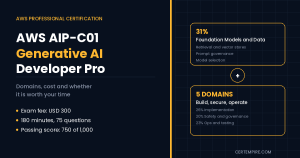

TL;DR: The AWS Certified Generative AI Developer – Professional (AIP-C01) is an advanced AWS exam for developers who build production applications on top of foundation models (FMs). It costs USD 300, runs 180 minutes and has 75 questions (65 scored plus 10 unscored). You need 750 on a scale of 100 to 1,000. AWS recommends 2 or more years building production-grade applications on AWS or with open-source technologies, plus 1 year of hands-on experience implementing generative AI solutions. The exam is split into five domains: Foundation Model Integration, Data Management and Compliance (31%), Implementation and Integration (26%), AI Safety, Security and Governance (20%), Operational Efficiency and Optimization (12%) and Testing, Validation and Troubleshooting (11%). It is not a beginner exam and it is not a model training exam. It tests whether you can design, secure, run and troubleshoot GenAI applications built on services such as Amazon Bedrock. If you are new to AI on AWS, start with the AI Practitioner exam. If you already ship GenAI features and want a recognized professional credential, AIP-C01 is built for you.
Quick Facts
| Item | AIP-C01 details |
| Full name | AWS Certified Generative AI Developer – Professional |
| Exam code | AIP-C01 |
| Level | Professional |
| Exam fee | USD 300 (other costs such as currency conversion are on AWS’s exam pricing page) |
| Duration | 180 minutes |
| Questions | 75 total: 65 scored plus 10 unscored |
| Question types | Multiple choice and multiple response |
| Passing score | 750 on a scaled range of 100 to 1,000 |
| Scoring model | Compensatory (you only need to pass the overall exam) |
| Languages | English, Japanese, Korean and Simplified Chinese |
| Delivery | Pearson VUE test center or online proctored exam |
| Recommended experience | 2+ years building production-grade applications on AWS or with open-source technologies, general AI/ML or data engineering experience, and 1+ year of hands-on experience implementing GenAI solutions |
| Out of scope | Model development and training, advanced ML techniques, data engineering and feature engineering |
Figures come from AWS’s certification page and the AIP-C01 exam guide, checked in November 2026. AWS changes fees, languages and policies, so confirm on the official page before you book. The AWS pages we reviewed do not state the credential’s validity period or the retake policy. AWS certifications are generally valid for 3 years, but check your AWS Certification account for the rule that applies to this exam.
Key Takeaways
- AIP-C01 is a professional-level developer exam for building GenAI applications, not a data science or model training exam.
- It has five domains. Foundation Model Integration, Data Management and Compliance is the biggest at 31%.
- Implementation and Integration (26%) covers agents, deployment, enterprise integration and FM APIs.
- AI Safety, Security and Governance is 20%, which is large for a developer exam. Expect guardrails, privacy, governance and responsible AI.
- The exam has 75 questions in 180 minutes, about 2.4 minutes per question.
- Scoring is compensatory. You can be weaker in one domain if you do well overall.
- It sits above the AI Practitioner (AIF-C01) foundational exam and is aimed at builders, not general learners.
What Is the AWS Certified Generative AI Developer Professional?
AWS describes AIP-C01 as an exam for people who perform a GenAI developer role. It validates your ability to integrate foundation models into applications and business workflows. In practice, that means you can pick the right model, connect it to your data, wrap it in safe and secure application code, make it fast and affordable, and test and troubleshoot it when it misbehaves.
Three phrases in the exam guide tell you how it thinks:
- “Production-grade.” The target candidate builds applications that run in production, not demos.
- “Integrate FMs into applications and business workflows.” The exam cares about plumbing: APIs, vector stores, retrieval, tool use, agents, enterprise systems and CI/CD.
- “Safety, security and governance.” A whole domain, worth 20%, is about guardrails, privacy, compliance and responsible AI.
Who Should Take AIP-C01?
| Your situation | Fit |
| Developer or architect already building GenAI features on AWS | Strong fit |
| Backend engineer adding retrieval-augmented generation (RAG) or agents to a product | Strong fit |
| Cloud engineer supporting GenAI platforms (gateways, deployment, observability) | Good fit, especially for domains 2, 4 and 5 |
| ML engineer who trains models and wants to move into applications | Possible fit, but note the exam is not about model training |
| Data scientist with no AWS application experience | Build AWS and application skills first |
| Beginner curious about AI | Start with the foundational AI Practitioner exam instead |
| Manager who wants to understand GenAI | A foundational credential fits better than a professional developer exam |
If you are still choosing between AWS credentials, our AWS certification guide maps exams by role. For the foundational step before this one, see our AI Practitioner (AIF-C01) guide.
What Experience Does AWS Recommend?
The exam guide states the target candidate should have:
- 2 or more years of experience building production-grade applications on AWS or with open-source technologies.
- General AI/ML or data engineering experience.
- 1 year of hands-on experience implementing GenAI solutions.
AWS also lists recommended AWS knowledge:
- Experience with AWS compute, storage and networking services.
- Understanding of AWS security best practices and identity management.
- Experience with AWS deployment and infrastructure as code (IaC) tools.
- Familiarity with AWS monitoring and observability services.
- Understanding of AWS cost optimization principles.
There is no formal prerequisite exam. These are recommendations, not entry requirements, but a professional exam rewards hands-on practice.
What Are the AIP-C01 Exam Domains and Weights?
| Domain | Weight |
| 1. Foundation Model Integration, Data Management, and Compliance | 31% |
| 2. Implementation and Integration | 26% |
| 3. AI Safety, Security, and Governance | 20% |
| 4. Operational Efficiency and Optimization for GenAI Applications | 12% |
| 5. Testing, Validation, and Troubleshooting | 11% |
Domains 1 and 2 together are 57% of scored content. Add Domain 3 and you reach 77%. If you are short on time, those three domains deserve most of your study hours.
Domain 1: Foundation Model Integration, Data Management, and Compliance (31%)
This is the largest domain and covers six tasks:
| Task | What it asks you to do |
| 1.1 Analyze requirements and design GenAI solutions | Create architectural designs aligned with business needs, build proof-of-concept implementations and create standardized components using the Well-Architected Framework and the GenAI Lens |
| 1.2 Select and configure FMs | Assess and choose FMs for a use case, enable dynamic model selection and provider switching without code changes, design resilient systems with cross-Region deployment, circuit breakers and graceful degradation, and manage customization deployment including fine-tuned models, LoRA adapters and rollbacks |
| 1.3 Implement data validation and processing pipelines for FM consumption | Build data validation workflows, process text, image, audio and tabular data, format inputs to model-specific requirements and improve input data quality |
| 1.4 Design and implement vector store solutions | Build vector database architectures, metadata frameworks, high-performance vector architectures, integration with data sources such as document systems and wikis, and incremental updates with change detection and scheduled refreshes |
| 1.5 Design retrieval mechanisms for FM augmentation | Chunking, embedding selection, vector search, hybrid search and reranking, query expansion, decomposition and transformation, and consistent access mechanisms such as function calling and MCP clients |
| 1.6 Implement prompt engineering strategies and governance for FM interactions | Instruction frameworks, conversation context, prompt management with versioning, approvals and audit logging, prompt regression testing, iterative refinement and complex prompt chains with conditional branching |
What to take from it: Domain 1 is about retrieval-augmented generation done properly. Know how chunking, embeddings, metadata, hybrid search and reranking affect answer quality. Know how to keep a vector store fresh. Know why prompts need versioning and approvals in a governed environment.
Domain 2: Implementation and Integration (26%)
Five tasks:
| Task | Highlights from the exam guide |
| 2.1 Implement agentic AI solutions and tool integrations | Autonomous systems with memory and state, structured reasoning (ReAct, chain-of-thought), safeguarded workflows, multi-model coordination, human review and approval, reliable tool integrations and model extension using MCP servers |
| 2.2 Implement model deployment strategies | Deploy FMs to match performance needs, handle LLM-specific deployment challenges (memory, GPU, tokens, model loading) and balance performance and resources with smaller models and cascading |
| 2.3 Design and implement enterprise integration architectures | Connect to legacy systems, add GenAI to existing applications with microservices, webhooks and events, secure access with identity federation, RBAC and least privilege, handle cross-jurisdiction data compliance and build CI/CD pipelines and GenAI gateway architectures |
| 2.4 Implement FM API integrations | Synchronous and asynchronous calls, real-time streaming, resilience (retries, rate limiting, fallbacks, observability) and intelligent model routing |
| 2.5 Implement application integration patterns and development tools | FM API interfaces (streaming, token limits, timeout retries), accessible AI interfaces (Amplify UI components, OpenAPI, no-code workflows), business system enhancements, developer productivity, agent orchestration and troubleshooting FM applications |
Domain 2 is where agents and tool use appear. Expect scenario questions on how an agent keeps state, how it calls tools safely, when a human should approve a step and how you route requests between models.
Domain 3: AI Safety, Security, and Governance (20%)
Four tasks, with many example services named in the guide:
| Task | What it covers |
| 3.1 Implement input and output safety controls | Content safety for inputs and outputs (for example Amazon Bedrock guardrails, custom moderation with Step Functions and Lambda), hallucination reduction (grounding with knowledge bases, confidence scoring, JSON Schema for structured outputs), defense-in-depth safety layers and detection of prompt injection and jailbreaks |
| 3.2 Implement data security and privacy controls | Protected AI environments (VPC endpoints, IAM policies, Lake Formation, CloudWatch monitoring), privacy-preserving systems (Comprehend and Macie PII detection, Bedrock data privacy features, S3 lifecycle retention) and privacy-focused design (masking, anonymization) |
| 3.3 Implement AI governance and compliance mechanisms | Compliance frameworks (programmatic model cards, Glue data lineage, metadata tagging, decision logs), data source tracking (Glue Data Catalog, CloudTrail), organizational governance and continuous monitoring (misuse, drift and policy violation detection, bias drift monitoring, token-level redaction and response logging) |
| 3.4 Implement responsible AI principles | Transparency (reasoning displays, confidence metrics, source attribution, agent tracing), fairness evaluations (A/B testing, LLM-as-a-judge) and policy-compliant systems (guardrails, model cards, automated compliance checks) |
At 20%, this domain matters. A candidate who knows how to build a RAG pipeline but cannot explain guardrails, PII handling and audit trails will lose points here.
Domain 4: Operational Efficiency and Optimization for GenAI Applications (12%)
Three tasks:
- 4.1 Cost optimization and resource efficiency: token efficiency (estimation, context window optimization, prompt compression, context pruning), cost-effective model selection (tiered usage by query complexity, price-to-performance), high-performance FM systems (batching, capacity planning, provisioned throughput) and caching (semantic caching, prompt caching, deterministic request hashing).
- 4.2 Application performance: latency-cost trade-offs, response streaming, retrieval performance (index optimization, hybrid search), throughput optimization, parameter tuning (temperature, top-k and top-p), resource allocation and vector database query optimization.
- 4.3 Monitoring systems: observability, FM interaction tracing, CloudWatch tracking of token usage, hallucination rates and response quality, Bedrock model invocation logs, tool performance tracking, vector store monitoring and GenAI-specific troubleshooting such as golden datasets and output diffing.
Domain 5: Testing, Validation, and Troubleshooting (11%)
Two tasks:
- 5.1 Evaluation systems: quality metrics (relevance, factual accuracy, consistency, fluency), Bedrock model evaluations, A/B and canary testing, user feedback loops, regression testing and quality gates, RAG evaluation with LLM-as-a-judge, retrieval quality testing, agent performance measurement, reporting and deployment validation.
- 5.2 Troubleshoot GenAI applications: context window overflow and chunking issues, FM integration errors, prompt engineering problems, retrieval issues (embedding quality, drift, vectorization, chunking remediation) and prompt maintenance issues using CloudWatch Logs and X-Ray.
Do not skip this domain just because it is the smallest. Its topics also appear inside scenario questions from other domains.
What Is Out of Scope?
AWS lists job tasks the target candidate is not expected to perform:
- Model development and training
- Advanced ML techniques
- Data engineering and feature engineering
That list is non-exhaustive, but it tells you where not to spend time. You do not need to train a model from scratch. You do need to know how to use, customize, deploy, secure and evaluate one.
How Is the Exam Structured?
| Feature | Detail |
| Length | 180 minutes |
| Questions | 75 (65 scored, 10 unscored) |
| Time per question | About 2.4 minutes |
| Question types | Multiple choice (one correct answer, three distractors) and multiple response (two or more correct answers out of five or more options, all must be selected for credit) |
| Unanswered questions | Scored as incorrect |
| Guessing penalty | None |
| Scoring | Scaled 100 to 1,000, pass at 750 |
| Compensatory | Yes, you do not need to pass each domain |
Two practical points. First, the 10 unscored questions are not marked, so treat every question as scored. Second, multiple response questions give no partial credit, so read the options carefully and select every correct one.
How Much Does AIP-C01 Cost?
The exam fee is USD 300. AWS lists currency conversion and any other charges on its exam pricing page. Your total cost also depends on your preparation:
| Cost item | Notes |
| Exam fee | USD 300 |
| Retake | Pay the exam fee again; check the AWS retake policy for waiting periods |
| Study resources | Free AWS documentation and training, plus optional paid courses and practice sets |
| Cloud lab costs | Using Bedrock, vector stores and other services in your own account can add usage charges, so set budgets and alerts |
| Discounts | AWS offers benefits to certified holders and occasional promotions. See our guide to AWS certification discount vouchers |
Is the AIP-C01 Hard?
AWS does not publish a difficulty rating or pass rate for this exam, so any figure you see online is unconfirmed. What the exam guide shows is a demanding profile: professional-level scenarios, 75 questions in 180 minutes, a broad set of topics from vector search to governance and an expectation of production experience. People who build and operate GenAI applications will find the scenarios familiar. People who have only read about GenAI will struggle with the trade-off questions, such as when to use caching, which retrieval strategy fits a problem or how to layer guardrails.
How Does AIP-C01 Compare With Other AWS Exams?
| Exam | Level | Focus | Fit |
| AI Practitioner (AIF-C01) | Foundational | AI, ML and GenAI concepts, responsible AI | Beginners and non-developers |
| AIP-C01 | Professional | Building, securing and running FM-based applications | Developers and architects shipping GenAI |
| Developer Associate (DVA) | Associate | Building and deploying AWS applications | Developers with general AWS application experience |
| Machine Learning specialty tracks | Associate and specialty levels | ML engineering and model operations | People who build and train models |
If you are a developer and have not yet taken a general AWS developer exam, read our DVA-C02 vs DVA-C03 guide to understand the associate step. If you want to compare AIP-C01 with another vendor’s AI credential, see our guide to the NVIDIA agentic AI certification.
Is AIP-C01 Worth It?
It can be, if GenAI development is your daily work or your target job. Here is how to think about it.
| Question | If yes | If no |
| Do you build or plan to build GenAI applications on AWS? | The exam content matches your work | A foundational credential or hands-on projects may serve you better |
| Do employers in your market mention AWS GenAI skills? | Review job postings and note whether the credential is listed | Weigh the cost against other options |
| Do you have 2+ years of AWS or open-source application experience and 1+ year of GenAI experience? | You meet AWS’s recommended profile | Consider building experience first |
| Does your employer pay for certification? | Lower financial risk | You will pay USD 300 plus study time |
We do not quote salary numbers, because pay varies by employer, region and role. For general context on how AWS credentials relate to pay, see our AWS certification salary overview, and check current job listings in your market.
A 10-Week Study Plan
This is a suggested plan, not an AWS requirement. Adjust it to your background.
| Week | Focus | Output |
| 1 | Read the exam guide and rate yourself 1 to 5 on every task | A gap list ranked by domain weight |
| 2 | Domain 1: FM selection, dynamic model switching, resilient multi-Region designs | A one-page design for a resilient FM application |
| 3 | Domain 1: data validation, chunking, embeddings, vector stores, metadata | A small RAG prototype with chunking experiments |
| 4 | Domain 1: hybrid search, reranking, query transformation, prompt management and versioning | A prompt library with versioning and regression tests |
| 5 | Domain 2: agents, tool integrations, MCP, human-in-the-loop steps | An agent that calls two tools with error handling |
| 6 | Domain 2: model deployment, enterprise integration, FM APIs, streaming, routing | A streaming endpoint with retries and fallback routing |
| 7 | Domain 3: guardrails, prompt injection defense, PII handling, governance and audit | A guardrail and PII-masking layer in front of your prototype |
| 8 | Domain 4: token efficiency, caching, latency, throughput, observability | A dashboard of token use, latency and cost |
| 9 | Domain 5: evaluation (including LLM-as-a-judge), A/B testing, troubleshooting | An evaluation set and regression test for your prompts |
| 10 | Timed practice, weak-area review | Two timed 75-question practice sets |
For practice material, see our AIP-C01 exam questions.
Common Mistakes to Avoid
- Studying model training. It is out of scope. Spend the time on integration, safety and operations.
- Ignoring Domain 3. At 20%, safety, security and governance can decide a pass or a fail.
- Memorizing service names without trade-offs. Scenario questions ask which approach fits a constraint such as latency, cost, privacy or accuracy.
- Skipping hands-on practice. Build a small RAG system and an agent. The questions reward people who have seen real failure modes.
- Leaving answers blank. Unanswered questions are scored as incorrect, and there is no penalty for guessing.
- Forgetting multiple response rules. You must select all correct answers to get credit.
- Not setting cloud budgets. Lab experiments with FMs and vector stores can cost money. Set billing alerts before you start.
Exam-Day Pacing
You have 180 minutes for 75 questions, about 2.4 minutes per question. Professional-level scenarios are long, so read the last sentence of the question first to see what is being asked, then scan the scenario for constraints such as cost, latency, compliance or availability. Flag hard items and return. Because 10 questions are unscored and unmarked, do not spend ten minutes on one question.
FAQS
What is the AWS Certified Generative AI Developer Professional exam?
It is an AWS professional-level exam, coded AIP-C01, for people who build GenAI applications. It validates your ability to integrate foundation models into applications and business workflows.
How much does the AIP-C01 exam cost?
USD 300. AWS lists currency conversion and other costs on its exam pricing page.
How many questions are on AIP-C01 and how long is the exam?
75 questions in 180 minutes. 65 are scored and 10 are unscored.
What is the passing score for AIP-C01?
750 on a scaled range of 100 to 1,000. The exam uses compensatory scoring, so you only need to pass overall.
What are the AIP-C01 exam domains and weights?
Foundation Model Integration, Data Management, and Compliance 31%; Implementation and Integration 26%; AI Safety, Security, and Governance 20%; Operational Efficiency and Optimization for GenAI Applications 12%; and Testing, Validation, and Troubleshooting 11%.
What experience does AWS recommend for AIP-C01?
2 or more years building production-grade applications on AWS or with open-source technologies, general AI/ML or data engineering experience and 1 year of hands-on experience implementing GenAI solutions.
What question types are on AIP-C01?
Multiple choice and multiple response. Multiple response questions need all correct answers selected for credit, and unanswered questions score as incorrect.
Which languages is AIP-C01 offered in?
English, Japanese, Korean and Simplified Chinese, per AWS’s certification page at the time of writing.
Can I take AIP-C01 online?
Yes. AWS lists Pearson VUE test centers and online proctored exams as delivery options.
Do I need AIF-C01 before AIP-C01?
No. AWS does not list a prerequisite exam. The AI Practitioner exam is a foundational step that some candidates take first, but you can go straight to AIP-C01 if you meet the recommended experience.
Does AIP-C01 cover model training?
No. AWS lists model development and training, advanced ML techniques and data and feature engineering as out of scope. The exam focuses on integrating, securing, running and troubleshooting FM-based applications.
How long is the AIP-C01 certification valid and what is the retake policy?
The AWS pages we reviewed do not state either. AWS certifications are generally valid for 3 years. Check your AWS Certification account and the AWS retake policy for the rules that apply to this exam.
Is AIP-C01 worth it?
It is worth considering if you build GenAI applications on AWS and employers in your market value the credential. Review job listings, weigh the USD 300 fee and study time and consider whether hands-on projects might serve you as well.
Final Thoughts
AIP-C01 is a builder’s exam. It rewards people who have connected foundation models to real data, wrapped them in guardrails, watched the token bill and debugged a retrieval problem at midnight. If that sounds like your work, build a small lab alongside your study plan, spend most of your hours on Domains 1, 2 and 3 and practice reading scenarios for constraints. Check the current exam details on AWS’s official Generative AI Developer Professional page before you book, since fees, languages and policies can change.