TL;DR
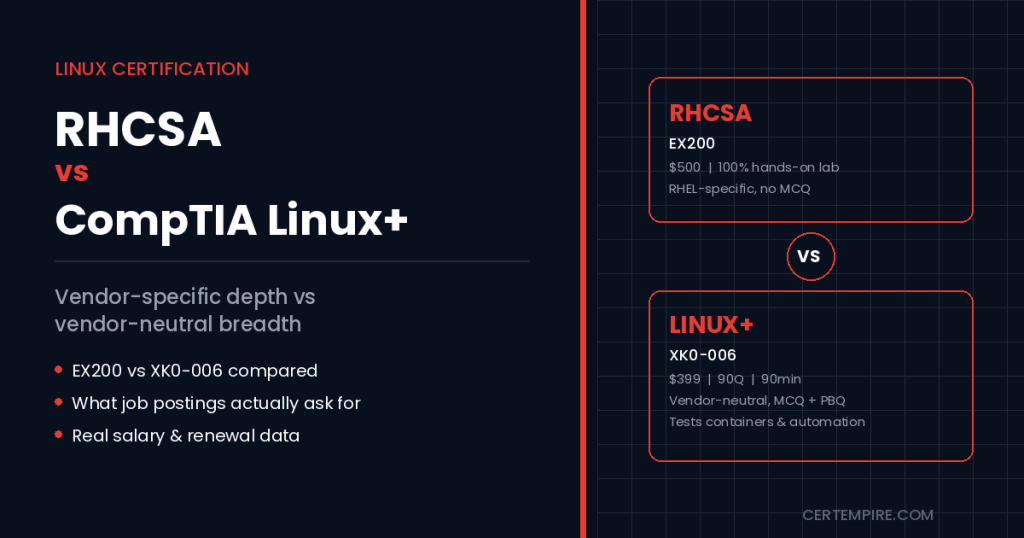
- RHCSA (EX200): $500, a fully hands-on, performance-based lab exam with zero multiple-choice questions, 3 hours, tests Red Hat Enterprise Linux 10 specifically, no formal prerequisite, 3-year validity.
- CompTIA Linux+ (XK0-006, the current version as of this writing): $399, 90 questions in 90 minutes combining multiple-choice and performance-based questions, tests Linux administration in a vendor-neutral way across distributions, no formal prerequisite, 3-year validity, renews with 50 CEUs or a retake plus a $150 fee.
- The real difference isn’t difficulty, it’s what each one proves. RHCSA proves you can actually configure a working RHEL system under time pressure with no reference material. Linux+ proves broader, vendor-neutral Linux knowledge that also touches scripting, automation tooling, and troubleshooting across distributions.
- If your target employer runs Red Hat Enterprise Linux (and a large share of enterprise, government, and regulated-industry environments do), RHCSA is the more direct signal. If you want a credential that’s recognized regardless of which distribution an employer runs, Linux+ is the safer generalist choice.
- Payscale shows RHCSA holders averaging $112,000/year versus $91,000/year for Linux+ holders, though that gap likely reflects RHCSA’s narrower, more senior-skewed candidate pool rather than the certification itself paying more.
- Note: if you’re comparing against older Linux+ content, CompTIA retired the previous version (XK0-005) on January 13, 2026. This comparison uses the current XK0-006 exam; see our full breakdown of what changed if you want that detail specifically.
Quick Facts: RHCSA vs Linux+ Side by Side
| RHCSA (EX200) | CompTIA Linux+ (XK0-006) | |
| Cost | $500 | $399 |
| Format | 100% hands-on performance lab, zero multiple-choice | Multiple-choice + performance-based questions |
| Questions/Tasks | Task-based lab, count not published | Up to 90 questions |
| Time limit | 3 hours (one section) | 90 minutes |
| Passing score | Reported ~210/300 (~70%), not officially disclosed | 720/900 (officially published) |
| Vendor scope | Red Hat Enterprise Linux specifically (RHEL 10) | Vendor-neutral, multiple distributions |
| Prerequisites | None formal (RH124/RH134/RH199 training recommended) | None |
| Validity | 3 years | 3 years |
| Renewal | Retake or higher-level Red Hat exam | 50 CEUs or retake, $150 fee |
| Reference material allowed | None; man pages and pre-installed docs only | None during testing |
Sources: RHCSA EX200 exam guide, CompTIA Linux+ XK0-006 details. For the version history behind the current Linux+ exam code, see our What’s New in CompTIA Linux+ XK0-006 breakdown, and for RHCSA’s full regional pricing, see our RHCSA Certification Cost guide.
The Core Difference: Vendor-Specific Depth vs Vendor-Neutral Breadth
Every comparison of these two certifications eventually lands on the same real distinction, and it’s worth stating plainly before getting into domains and cost tables.
RHCSA certifies you on one specific, extremely widely deployed distribution: Red Hat Enterprise Linux, currently version 10. Everything on the exam, from SELinux configuration to storage management to systemd service control, is tested exactly as it works on RHEL, using RHEL’s own tooling and conventions. There is no multiple-choice safety net. You are handed a set of broken or incomplete systems and told to make them work correctly, and the exam only cares whether the end state is correct, not whether you know the textbook definition of a concept.
CompTIA Linux+ certifies broader Linux literacy that’s meant to apply whether an employer runs RHEL, Ubuntu, Debian, SUSE, or something else entirely. Its questions mix traditional multiple-choice with performance-based simulations, testing concepts and terminology that hold across distributions rather than distribution-specific implementation details. This is why CompTIA markets it as a foundational, vendor-neutral credential rather than a deep specialization in any one Linux flavor.
Neither approach is objectively “better.” They’re built for different signals: RHCSA says “I can operate this specific, dominant enterprise Linux distribution under pressure.” Linux+ says “I understand Linux administration broadly enough to be useful regardless of which distribution I land on.” For a general overview of Linux+ on its own, including career outlook, see Cert Empire’s CompTIA Linux+ Certification guide and Is the Linux+ Exam Difficult and Worth It articles; this piece focuses specifically on the head-to-head decision against RHCSA.
What Job Postings Actually Ask For
Rather than guessing which certification employers value more, it’s worth looking at what actually shows up in job listings, since the two credentials tend to appear in different types of postings.
RHCSA shows up heavily in postings for roles explicitly tied to Red Hat environments: system administrator roles at organizations running RHEL in production, government and defense contractor listings (Red Hat has deep penetration in federal and regulated environments), and DevOps or infrastructure roles at companies standardized on Red Hat’s ecosystem (RHEL, OpenShift, Ansible Automation Platform). Live job board data shows real, substantial demand: LinkedIn lists over 1,000 open roles referencing RHCSA, and Indeed regularly shows 500 to 800+ active listings combining RHCSA with related Linux system administrator titles.
CompTIA Linux+ shows up more often as a baseline qualifier rather than the headline requirement, frequently listed alongside or as an alternative to other entry-to-mid-level credentials in general IT support, junior systems administration, and help desk-to-sysadmin transition roles. It’s less likely to be the certification a senior Red Hat-specific role names as a hard requirement, and more likely to appear in postings that don’t assume any particular distribution.
The practical read: if you already know your target employer or industry runs RHEL (which is extremely common in enterprise, healthcare, finance, and government), RHCSA is the more direct match to what’s actually being screened for. If you’re job hunting broadly without a specific distribution target, or you’re earlier in your career and want a credential that won’t box you into one vendor’s ecosystem, Linux+ keeps more doors open.
RHCSA Domain Coverage (EX200)
| Domain Area | What You Actually Do |
| Essential Tools | Command-line file manipulation, archiving, redirection, pipes |
| Operating Running Systems | Boot process, systemd targets, process management, tuning |
| Local Storage Configuration | Partitioning, LVM, mounting, swap |
| File Systems and Attributes | Creating and mounting file systems, quotas, ACLs, autofs |
| Deploying and Maintaining Systems | Package management (RPM/DNF), software repositories, kernel updates |
| Users and Groups | Local and centralized user/group management, password policies |
| Security | SELinux enforcement modes, firewall configuration, SSH key-based auth |
| Networking | Network configuration, hostname resolution, basic troubleshooting |
| Containers | Note: Podman/container tooling is not part of current RHEL 10 RHCSA objectives, despite appearing in some older third-party study guides |
| Shell Scripting | Basic Bash scripting to automate simple administrative tasks |
Every one of these is tested by actually doing it on a live system, not by answering a question about it.
CompTIA Linux+ Domain Coverage (XK0-006)
| Domain | Weight | Focus |
| System Management | 23% | General Linux administration, file systems, processes |
| Troubleshooting | 22% | Diagnosing issues across system, network, and increasingly cloud/hybrid scenarios |
| Services and User Management | 20% | User administration plus container tooling (Docker, Podman) |
| Security | 18% | Permissions, firewalls, authentication, basic hardening |
| Automation, Orchestration, and Scripting | 17% | Bash and Python scripting, Ansible and Puppet fundamentals, Git |
Notice the direct contrast with RHCSA: Linux+ explicitly tests Podman and Docker, while current RHCSA objectives do not include container tooling at all. If container administration specifically is your priority, Linux+’s current version actually covers more of that ground than RHCSA does right now.
Which One Should You Take?
Take RHCSA if:
- Your target employer, industry, or region has heavy Red Hat Enterprise Linux presence (government, defense, finance, healthcare, and large enterprise environments frequently standardize on RHEL).
- You want a credential that proves hands-on capability under pressure, with no multiple-choice option to fall back on.
- You’re building toward Red Hat’s higher-tier credentials (RHCE, RHCA), which assume RHCSA-level fluency as a foundation.
Take Linux+ if:
- You don’t yet know which distribution your career will center on, or you want a credential that stays relevant across employers regardless of their Linux flavor.
- You want exposure to current automation tooling (Ansible, Puppet) and container basics (Docker, Podman) as part of the certification itself, since RHCSA’s current objectives don’t include containers.
- You’re earlier in your career and want a lower-cost entry point ($399 vs $500) with a more conventional (if still rigorous) testing format.
Take both if: you’re building a serious Linux systems administration career. They’re not mutually exclusive, and holding both signals both broad foundational knowledge (Linux+) and deep, verified hands-on capability on the distribution most enterprises actually run in production (RHCSA). Many working sysadmins accumulate both over a career rather than treating it as an either/or choice. For how this same “generalist versus specialist” question plays out across CompTIA’s broader lineup, see the CompTIA Certification Roadmap.
Career Impact and Salary Data
Payscale reports RHCSA holders averaging $112,000 per year in the United States, based on 338 survey responses updated in July 2026, with a broader range of $69,000 to $181,000 depending on experience and role. CompTIA Linux+ holders average $91,000 per year, based on 644 responses updated in June 2026, with company-level variation from roughly $74,000 to $157,460 depending on employer.
That roughly $21,000 gap is real in the data, but it almost certainly doesn’t mean “get RHCSA instead of Linux+ for a bigger paycheck.” RHCSA’s harder, more expensive, hands-on-only format naturally selects for a more experienced, more committed candidate pool already working in Linux administration roles, while Linux+ is frequently taken earlier in a career or as a broader foundational credential alongside other certifications. The honest read: the salary gap reflects who tends to hold each certification more than it reflects the certification itself commanding a premium.
Live hourly job market data tells a similar story: ZipRecruiter shows RHCSA-related roles in the $48 to $74 per hour range, while CompTIA Linux-related roles run $50 to $68 per hour, ranges that meaningfully overlap once you account for regional and experience-level variation.
How to Prepare for Each
- For RHCSA, build a home lab and practice under a timer. Since there’s no multiple-choice component, reading alone will not prepare you. Install RHEL (or a compatible rebuild like Rocky or AlmaLinux for practice, though the actual exam runs on genuine RHEL 10), and drill the task list, LVM, SELinux, firewall rules, user management, until you can do it without reference material.
- For Linux+, split study time between concepts and hands-on practice, since the exam mixes multiple-choice with performance-based questions. Don’t neglect the Automation domain: Ansible and Puppet fundamentals are worth 17% on their own.
- If you’re aiming for RHCSA, don’t assume container knowledge is required. Current objectives don’t test Podman or Docker, so time spent there is better redirected toward SELinux and storage, which are consistently tested and commonly under-prepared.
- If you’re aiming for Linux+, don’t skip Python. XK0-006 added it alongside Bash, and candidates who only refresh Bash scripting will have gaps in that portion of the Automation domain.
- Use Cert Empire’s current exam resources for whichever path you choose: the XK0-006 exam question bank reflects the current Linux+ version, and our RHCSA cost breakdown covers full regional pricing and retake policy in detail.
Common Mistakes People Make
- Assuming RHCSA is strictly “harder” than Linux+ in every sense. It’s harder in format (no multiple-choice cushion) but narrower in scope (one distribution, no containers). Linux+ is broader but allows partial credit through multiple-choice questions RHCSA simply doesn’t have.
- Studying RHCSA material that includes container/Podman content as if it’s exam-relevant. Current RHCSA objectives for RHEL 10 don’t test containers; that content belongs to Linux+’s Services and User Management domain instead.
- Comparing Linux+ cost or content against the retired XK0-005 version. The current exam is XK0-006, priced at $399, with a materially different 5-domain structure. See our dedicated breakdown of what changed between XK0-005 and XK0-006 if you’re working from older material.
- Picking based on salary data alone without accounting for candidate pool differences. The RHCSA-to-Linux+ salary gap likely reflects experience level and role seniority more than the certifications’ inherent market value.
FAQS
Is RHCSA harder than CompTIA Linux+?
In format, yes: RHCSA has zero multiple-choice questions and is entirely hands-on under time pressure. In scope, RHCSA is actually narrower, since it focuses on one distribution and doesn’t currently test container tooling the way Linux+ does.
How much does each certification cost?
RHCSA (EX200) costs $500. CompTIA Linux+ (XK0-006, the current version) costs $399.
Which certification do employers prefer?
It depends heavily on the employer’s environment. Organizations running Red Hat Enterprise Linux, common in government, defense, finance, and large enterprise, tend to specifically request RHCSA. General IT and junior sysadmin roles more often list Linux+ or accept either.
Does RHCSA test container skills like Docker or Podman?
No, not currently. RHEL 10’s RHCSA objectives don’t include container administration. CompTIA Linux+ (XK0-006) does test Docker and Podman as part of its Services and User Management domain.
Can I take both certifications?
Yes, and many working Linux administrators do over the course of a career, since they signal different things: broad vendor-neutral knowledge (Linux+) and deep, verified hands-on capability on a specific dominant enterprise distribution (RHCSA).
Which pays more, RHCSA or Linux+?
Payscale data shows RHCSA holders averaging $112,000 versus $91,000 for Linux+ holders, but this gap likely reflects differences in the typical experience level of each certification’s holders rather than the certification itself commanding a premium.
Is there a multiple-choice component on the RHCSA exam?
No. RHCSA is 100% hands-on, performance-based tasks on live systems, with no multiple-choice questions at all.
How long is each certification valid?
Both RHCSA and CompTIA Linux+ carry a 3-year validity period before requiring renewal.
What’s the renewal process for each?
RHCSA renews by retaking the current version of the exam or by earning a higher Red Hat certification that supersedes it. Linux+ renews with 50 CEUs or a retake, plus a $150 renewal fee if going the CEU route.
Do I need Linux+ before I can take RHCSA, or vice versa?
No. Neither certification formally requires the other as a prerequisite, and there’s no rule dictating which order to take them in if you choose to pursue both.
Which certification is better for someone completely new to Linux?
Linux+ is generally the more approachable starting point given its multiple-choice component and broader, less RHEL-specific scope, though motivated beginners with hands-on lab practice do pass RHCSA directly as well.
Is CompTIA Linux+ vendor-neutral, meaning it doesn’t focus on any specific distribution?
Yes, that’s its core design intent, testing Linux administration concepts and terminology that generally hold across major distributions rather than one specific implementation.