TL;DR
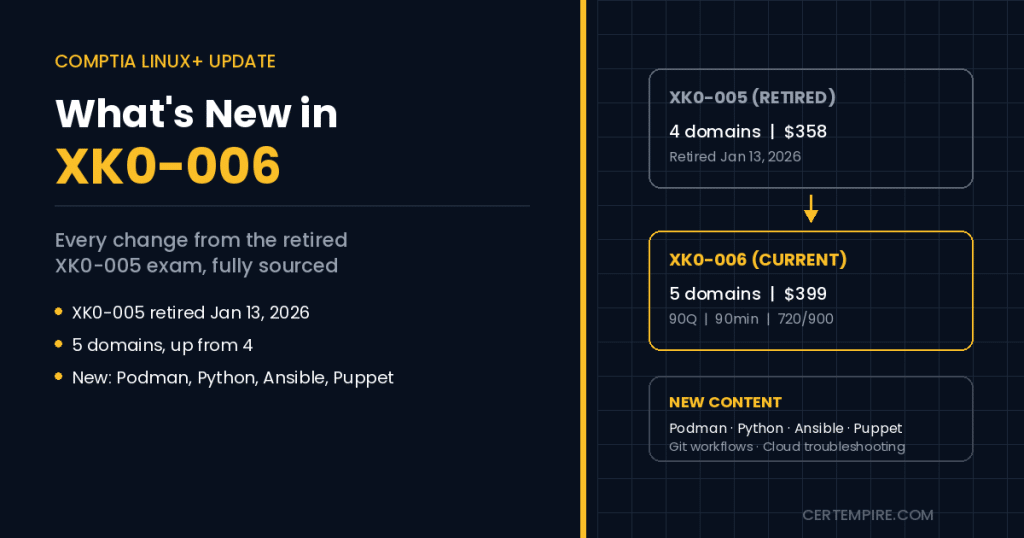
- CompTIA retired Linux+ XK0-005 on January 13, 2026. The current exam, XK0-006, launched July 15, 2025, so there was an overlap period where both versions were active before XK0-005 was phased out.
- The exam grew from 4 domains to 5: System Management (23%), Troubleshooting (22%), Services and User Management (20%), Security (18%), and a newly standalone Automation, Orchestration, and Scripting domain (17%).
- Real new content: Podman is now named explicitly alongside Docker, Python scripting joins Bash, Ansible and Puppet are named directly in the Automation domain, Git workflows are called out, and cloud/hybrid troubleshooting scenarios are woven into the Troubleshooting domain.
- Format stayed the same: 90 questions maximum, 90 minutes, multiple-choice plus performance-based questions, 720/900 scaled passing score.
- Cost went up twice in one year: CompTIA priced XK0-006 at $390 initially, then raised it to $399 in June 2026.
- If you’re studying from material dated before mid-2025, it almost certainly targets the retired XK0-005 blueprint. Confirm your study guide, practice test, or course explicitly says XK0-006 before you rely on it.
Quick Facts: XK0-005 vs XK0-006
| XK0-005 (Retired) | XK0-006 (Current) | |
| Status | Retired January 13, 2026 | Active since July 15, 2025 |
| Domains | 4 | 5 |
| Questions | Up to 90 | Up to 90 |
| Time limit | 90 minutes | 90 minutes |
| Passing score | 720/900 | 720/900 |
| Cost | $358 (last listed price) | $399 (as of June 2026) |
| Containers named | Docker, Kubernetes (bundled into Scripting/Automation) | Docker, Podman (moved into Services and User Management) |
| Scripting languages | Primarily Bash | Bash and Python |
| Automation tools named | Not called out by name | Ansible and Puppet named directly |
| Validity | 3 years | 3 years |
| Renewal | CEUs or retake | 50 CEUs or retake, $150 renewal fee |
Sources: Training Camp’s XK0-006 exam guide, CertiGuard’s XK0-006 cost and format breakdown.
Domain-by-Domain: What Actually Moved
The headline change isn’t just “one more domain,” it’s a genuine restructuring of where topics live and what got added. Here’s the direct comparison.
| XK0-005 Domain (Weight) | XK0-006 Domain (Weight) | What Changed |
| System Management (32%) | System Management (23%) | Weight dropped significantly as content was redistributed into the new standalone domains below |
| Security (21%) | Security (18%) | Largely stable in content, slightly reduced weight |
| Scripting, Containers, and Automation (19%) | Split into: Services and User Management (20%) + Automation, Orchestration, and Scripting (17%) | Containers moved out of the automation-focused domain and into Services and User Management; automation now stands alone with named tools |
| Troubleshooting (28%) | Troubleshooting (22%) | Weight reduced, but scope expanded to include cloud and hybrid environment scenarios that weren’t part of XK0-005 |
The honest read on containers: some XK0-006 study guides describe containers as new to the exam, but that’s not quite accurate. XK0-005 already referenced Docker and Kubernetes inside its “Scripting, Containers, and Automation” domain. What’s genuinely new is Podman being named explicitly alongside Docker, and containers now living inside Services and User Management rather than being bundled with automation content. If you already studied XK0-005’s container material, most of that foundation carries over; you specifically need to add Podman.
What’s genuinely new, not just moved: Python joins Bash as a tested scripting language (XK0-005 focused primarily on Bash), Ansible and Puppet are named directly rather than implied under generic “automation,” Git version control workflows are explicitly called out, and infrastructure-as-code concepts appear in the objectives for the first time.
Why the Domain Reweighting Matters for Your Study Plan
If you already have an XK0-005 study plan and are wondering how much needs to change, the honest answer is: more than a light refresh, less than starting over.
System Management dropped from the single heaviest domain (32%) to a more moderate 23%, while Troubleshooting also dropped from 28% to 22%. That combined 15-point reduction didn’t vanish, it moved into the two domains that split off: Services and User Management (20%) and standalone Automation (17%). If your XK0-005 prep leaned heavily on general system administration and troubleshooting drills without much dedicated automation or scripting practice, that gap is exactly where XK0-006 will catch you out.
Practically: budget real study time for Ansible and Puppet fundamentals even if you’ve never used either in production, get comfortable with basic Python syntax alongside Bash, and make sure your container knowledge includes Podman commands specifically, not just Docker.
Should You Worry If You Already Hold XK0-005?
If you passed XK0-005 before its retirement, your certification remains valid for its full 3-year validity period. Retirement of an exam version doesn’t retroactively invalidate credentials already earned; it only means new candidates can no longer register for that specific exam code. You do not need to retake anything immediately.
If you were mid-study for XK0-005 when it retired on January 13, 2026, your study materials are now effectively out of date for anyone testing today, since XK0-005 is no longer offered. Redirect your remaining preparation toward XK0-006’s actual blueprint rather than finishing out material built for a retired exam code.
Cost: A Two-Part Increase Worth Knowing About
CompTIA priced XK0-006 at $390 when it launched, then raised the fee to $399 in June 2026, an increase worth flagging because it happened mid-cycle rather than at the version launch itself. If you’re budgeting based on an older article quoting $358 (the XK0-005 price) or even $390 (XK0-006’s launch price), confirm the current $399 figure directly on CompTIA’s own certification page before you register, since pricing has moved twice in roughly 18 months.
Renewal also carries a real cost most candidates underestimate: 50 CEUs or a retake to renew every 3 years, plus a $150 renewal fee if you go the CEU route rather than retesting.
Career Impact and Salary Data
Linux+ certification premiums are hard to separate cleanly by exam version, since public salary trackers report on the certification as a whole rather than XK0-005 versus XK0-006 specifically. Here’s what’s actually documented.
Payscale reports an average base salary of $91,000 per year for CompTIA Linux+ certification holders in the United States, based on 644 survey responses updated in June 2026, with real variation by employer: the same dataset shows a range from roughly $74,000 at Northrop Grumman up to $157,460 at Leidos, underscoring how much employer and role matter beyond the certification itself.
Live job market data from ZipRecruiter shows CompTIA Linux-related roles in the $50 to $68 per hour range as of mid-2026 postings. Given that XK0-006’s new content (Ansible, Puppet, Python, Podman) tracks closely with what DevOps-adjacent and cloud infrastructure roles are actually asking for in job postings today, holding the current version’s blueprint knowledge, not just a Linux+ badge from years ago, is likely to matter more to employers evaluating automation and infrastructure skills specifically.
What This Means If You’re Choosing Between Linux+ and RHCSA
If you’re deciding between CompTIA Linux+ and Red Hat’s RHCSA rather than just tracking the version change, the two certifications test fundamentally different things: Linux+ (XK0-006) is multiple-choice plus performance-based questions, while RHCSA is a fully hands-on, no-multiple-choice lab exam. For the full comparison including cost, format, and career fit, see Cert Empire’s dedicated RHCSA certification cost breakdown, and check back for our head-to-head RHCSA vs Linux+ guide covering which one actually fits your career path.
For general Linux+ cost and difficulty questions not specific to this version change, see Cert Empire’s existing CompTIA Linux+ Certification guide and Is the Linux+ Exam Difficult and Worth It articles; this piece specifically covers what changed between XK0-005 and XK0-006. For the broader CompTIA ecosystem, see the CompTIA Certification Roadmap, and if you’re tracking version changes across CompTIA’s other 2026 exam updates, see SY0-701 vs SY0-801: Should You Wait for the New Security+ Exam for a similar transition on the security side.
How to Prepare for XK0-006 Specifically
- Verify your study material’s exam code before you start. Open the table of contents or first chapter of any book, course, or practice test and confirm it says XK0-006, not XK0-005. If it doesn’t say either explicitly, treat that as a red flag rather than assuming it’s current.
- Build real Ansible playbooks and basic Puppet manifests, don’t just read about them. The Automation, Orchestration, and Scripting domain is 17% of the exam on its own now, and conceptual familiarity without hands-on practice tends to show up as missed performance-based questions.
- Add Python fundamentals to your Bash review, focused on basic scripting patterns (file handling, loops, simple system interaction) rather than advanced software development, since the exam tests Linux administration scripting, not general programming.
- Practice Podman commands alongside Docker ones. They’re similar enough that most Docker-familiar candidates pick up Podman quickly, but skipping it entirely leaves a gap in the Services and User Management domain.
- Don’t neglect Troubleshooting just because its weight dropped from 28% to 22%. It’s still the second-heaviest domain, and it now includes cloud and hybrid environment scenarios that XK0-005 never tested.
- Use Cert Empire’s current XK0-006 exam question bank to practice against the actual current blueprint, and cross-check any third-party practice test’s publish date against the July 2025 XK0-006 launch before trusting it as current.
Common Mistakes People Are Making Right Now
- Studying from pre-2025 material without checking the exam code. Anything written before XK0-006’s July 2025 launch is describing a now-retired exam.
- Assuming containers are entirely new content. Docker and Kubernetes were already referenced in XK0-005; the real additions are Podman by name and a domain relocation, not container knowledge from scratch.
- Skipping Ansible and Puppet prep because “it’s just automation.” Automation is now a standalone 17%-weighted domain with named tools, not a minor subtopic buried in a broader domain.
- Budgeting for the launch price instead of the current price. $399 is the current fee as of June 2026, not the $390 launch price or the old $358 XK0-005 fee.
- Assuming your existing XK0-005 credential needs to be retaken. It doesn’t. Retirement of the exam code doesn’t affect certifications already earned within their validity period.
FAQS
When did CompTIA Linux+ XK0-005 retire?
January 13, 2026. XK0-006 had already launched on July 15, 2025, giving candidates an overlap window before the older version was phased out.
How many domains does XK0-006 have compared to XK0-005?
XK0-006 has 5 domains versus XK0-005’s 4. The new structure splits what used to be a combined “Scripting, Containers, and Automation” domain into separate Services and User Management, and standalone Automation, Orchestration, and Scripting domains.
Is the XK0-006 exam format different from XK0-005?
No. Both use up to 90 questions, a 90-minute time limit, multiple-choice plus performance-based questions, and a 720/900 scaled passing score. The format is identical; the content and domain structure changed.
How much does CompTIA Linux+ XK0-006 cost?
$399 as of June 2026, up from a $390 launch price and $358 under the retired XK0-005.
Do I need to retake the exam if I already hold XK0-005?
No. Your certification remains valid for its full 3-year term regardless of the underlying exam code being retired for new candidates.
What’s genuinely new in XK0-006 that wasn’t in XK0-005?
Podman named alongside Docker, Python scripting alongside Bash, Ansible and Puppet named explicitly in a standalone Automation domain, Git workflow coverage, and cloud/hybrid troubleshooting scenarios.
Is Linux+ XK0-006 harder than XK0-005?
Not necessarily harder in raw format, since question count, time, and passing score are unchanged. It does test a broader skill set, particularly in automation tooling and Python, which candidates who only prepared with older Bash-focused material may find unfamiliar.
What is the renewal requirement for CompTIA Linux+?
50 CEUs or a retake every 3 years, plus a $150 renewal fee if renewing through the CEU route.
Are Docker and Kubernetes new to the Linux+ exam?
No, they were already part of XK0-005’s Scripting, Containers, and Automation domain. Podman is the genuinely new container tool named in XK0-006.
Should I study XK0-005 material if that’s what I already have?
No. Since XK0-005 retired January 13, 2026, that material no longer reflects what’s actually tested. Redirect toward current XK0-006 objectives, particularly the new Automation domain content.
How does this affect someone choosing between Linux+ and RHCSA today?
The version change doesn’t alter the fundamental Linux+ vs RHCSA decision (multiple-choice/performance-based vs. fully hands-on lab), but it does mean any Linux+ vs RHCSA comparison you read should specify which Linux+ version it’s referencing, since cost and content changed materially between XK0-005 and XK0-006.
Where can I confirm the current, official XK0-006 exam objectives?
On CompTIA’s own certification page for Linux+, since third-party guides, including this one, can lag behind minor blueprint clarifications CompTIA publishes after a version’s initial launch.