1. AppDynamics Documentation
"End User Monitoring": "End User Monitoring (EUM) gives you a view of your application's performance from the perspective of the end user... Mobile RUM helps you understand the cause of crashes
errors
and slow network requests." (Source: AppDynamics Official Documentation
Product Documentation section on End User Monitoring).
2. AppDynamics Documentation
"Mobile RUM": "With Mobile RUM
you can: Identify and troubleshoot slow network requests
crashes
and other errors." (Source: AppDynamics Official Documentation
"Get Started with Mobile RUM" section).
3. AppDynamics Documentation
"Network Visibility": "Network Visibility provides a dynamic topology map of traffic flows
nodes
and transport connections where network or application/network issues are developing." (Source: AppDynamics Official Documentation
"Network Visibility" section).
4. AppDynamics Documentation
"Server Visibility": "Server Visibility provides an extensive set of metrics that monitor local processes
services
and resource use to explain problematic server performance." (Source: AppDynamics Official Documentation
"Server Visibility" section).
5. AppDynamics Documentation
"Database Visibility": "Database Visibility provides metrics on the performance of the database to troubleshoot performance-related issues." (Source: AppDynamics Official Documentation
"Database Visibility" section).

 A)
A)  B)
B)  C)
C)  D)
D) 
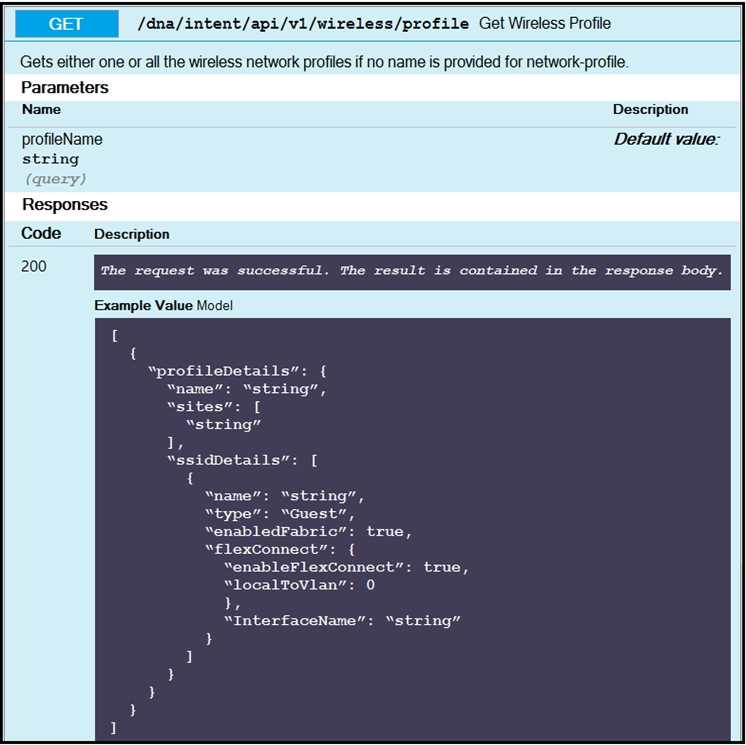
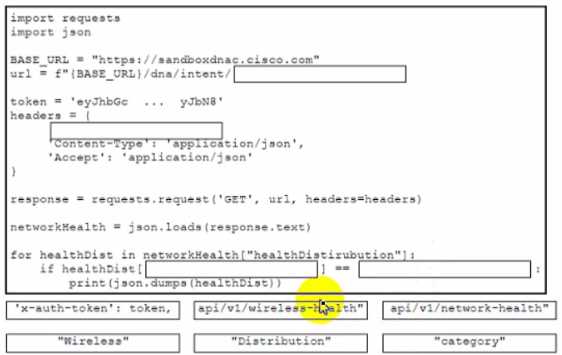
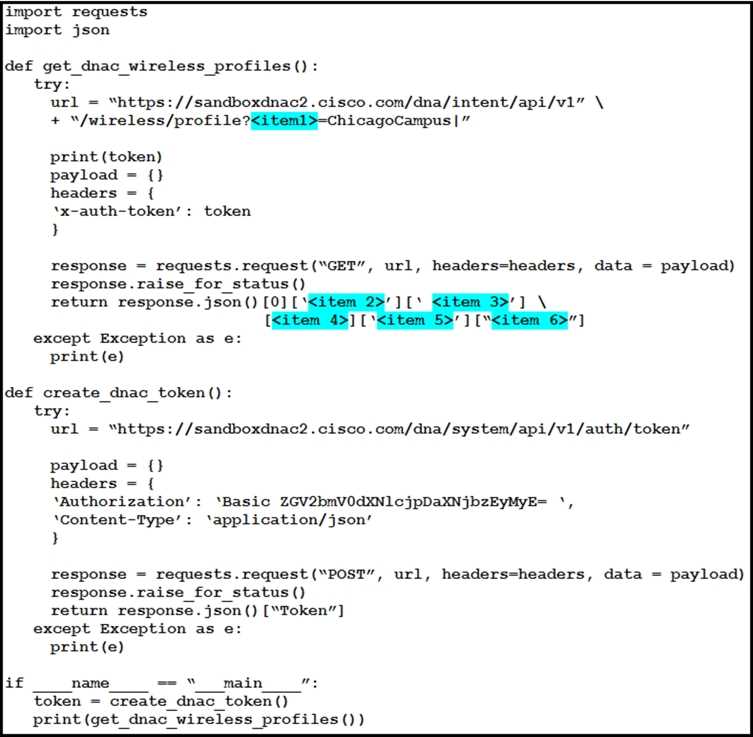 The Python script is supposed to make an API call to Cisco DNA Center querying a wireless profile for the “ChicagoCampus” and then parsing out its enable FlexConnect value. Drag and drop the parts of the Python code from the left onto the item numbers on the right that match the missing sections in the exhibit.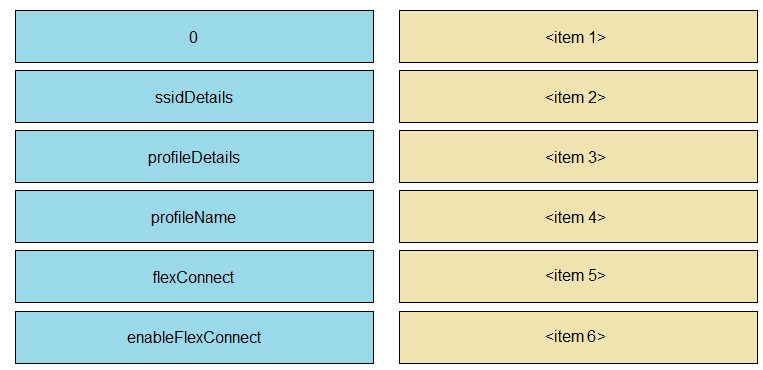
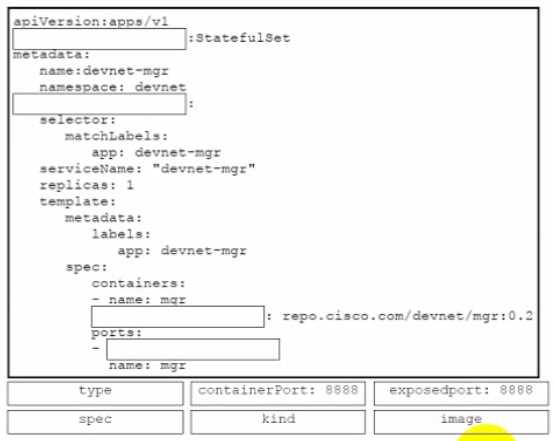
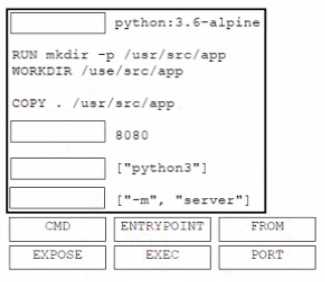
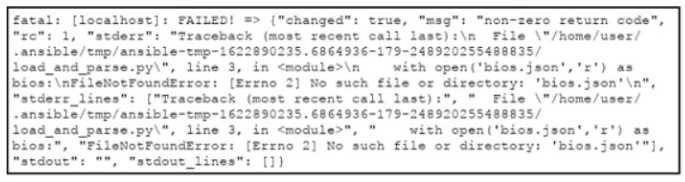 An engineer creates an application that leverages the Ansible framework to provision CPE endpoints that have configuration changes. The application contains an Ansible playbook named provision_cpes.yml that uses the ansible.builtin.script Ansible module to execute these two Python scripts: • gather and_create.py. which creates a JSON file named bios.json that contains the CPE models and their respective IOS file information • load and parse.py. which loads the file data and parses it for later consumption After several successful runs, the application fails. During a review of the Ansible execution logs, the engineer discovers an error output that indicates that one of the stages failed. What is the cause of this issue?