Free CAPM Practice Test Questions and Answers (2026)

View Mode
Q: 1
After winning a large government contract, a company needs to hire a portfolio manager What vital qualification should candidates possess?
Options
29 comments in the community discussion
2
C . Managing multiple projects and getting departments in sync feels like the kind of thing a portfolio manager would need after landing a big contract. Maybe I’m missing the broader strategic angle, but C looks right to me.
1
Probably A for this one. Portfolio management is all about hitting those strategic goals, not just juggling projects across departments (that’s more program level). If the question wanted someone to simply align departments it’d call that out, but here the broader org strategy is key. Pretty sure that's PMI-style. Anyb
Q: 2
Ensuring that both parties meet contractual obligations and that their own legal rights are protected is a function of:
Options
29 comments in the community discussion
3
Makes sense to pick C here.
2
C here, since it's about managing what happens after the contract is signed. Pretty sure that's Administer Procurements not planning or closing.
Q: 3
An input of the Plan Procurement Management process is:
Options
38 comments in the community discussion
6
Option B Official guide and practice tests both confirm activity cost estimates as an input here.
2
Option B, official guide lists activity cost estimates as input and I've seen this called out in some practice sets too.
Q: 4
Definitions of probability and impact, revised stakeholder tolerances, and tracking are components of which subsidiary plan?
Options
26 comments in the community discussion
2
Nah, C is tempting because of "tracking", but that's a risk management function. D is the best fit here, not communications.
1
Had something like this in a mock, pretty sure it's D for risk management plan.
Q: 5
What is the probability of occurrence if the risk rating is 0.56 and the impact if the risk does occur is very high (0.80)?
Options
39 comments in the community discussion
1
C
1
Nah, I don’t think it’s B. C is correct here, because B is just the risk rating, not the probability.
Q: 6
The iterative and interactive nature of the Process Groups creates the need for the processes in which Knowledge Area?
Options
41 comments in the community discussion
5
Option B-C sounds tempting since risk gets a lot of updates, but integration is where the overlap coordination happens.
2
Would C ever be right here if the question focused more on adjusting to changes instead of process group interaction?
Q: 7
The ways in which the roles and responsibilities, reporting relationships, and staffing management will be addressed and structured within a project is described in the:
Options
28 comments in the community discussion
5
Option A, I think? Roles and reporting lines sound like human resource plan stuff. Can someone confirm?
2
Likely B here. Activity resource requirements lists what kind of people and resources are needed for each activity, so I thought it would include roles and responsibilities too. Not totally certain.
Q: 8
Which Control Quality tool is also known as an arrow diagram?
Options
43 comments in the community discussion
5
Option D. some pick C by mistake but arrow diagram means activity network diagram here.
4
Option D activity network diagram, is the right PMI term for arrow diagrams. Tree diagrams (C) look similar but they're used for hierarchy, not showing activity sequence or dependencies.
Q: 9
When a permitting agency takes longer than planned to issue a permit, this can be described as a risk:
Options
37 comments in the community discussion
2
Option A. The delay happening is the risk event per PMI terms. D trips people up, but that's the outcome, not the "event." Seen this asked similarly in practice-feel free to disagree if you read it another way.
1
Option A. saw almost this exact wording on a practice test and it matched "event".
Q: 10
A project manager seeking insight on previous stakeholder management plans and their effectiveness should evaluate:
Options
31 comments in the community discussion
5
Makes sense to go with A. Official guide emphasizes historical info and lessons learned for evaluating what actually did or didn’t work in previous stakeholder plans. Seen similar reasoning in some practice sets too, but open if someone sees it differently.
4
Yeah, I'd pick A here. The lessons-learned database covers what went well or not, and historical info gives the actual plans. B doesn't really give you the effectiveness piece. Pretty sure A's the way to go.
Q: 11
A key benefit of the Manage Communications process is that it enables:
Options
10 comments in the community discussion
1
Why does A keep getting picked? The question's about the overall result, not just choosing how to send messages.
1
Yeah, I think it's B. Manage Communications is really about making sure info is shared smoothly and effectively, not just about the latest tools or cost savings. If I'm wrong, let me know!
Q: 12
Which of the following statements is true regarding project and product lifecycles?
Options
13 comments in the community discussion
2
Option A
2
Option A makes sense. You can have multiple projects over the course of one product’s life, like upgrades or maintenance after launch. Pretty sure PMI always emphasizes that product lifecycle is broader than project lifecycle.
Q: 13
In which domain of project management would a Pareto chart provide useful information?
Options
9 comments in the community discussion
1
Probably D. Pareto charts are a quality tool for identifying problem areas or defects, which ties directly to Project Quality Management. Similar question came up in some exam reports I saw.
Why not D here? Pareto is classic for quality management, not time or scope.
Q: 14
Which of the following processes audits the quality requirements and the results from quality control measures to ensure appropriate quality standards and operational definitions are used?
Options
8 comments in the community discussion
6
Option C makes sense since auditing requirements is more about process checks, not the actual deliverables. Seen similar wording in official guide and exam practice questions.
2
Pretty sure it's C here, but I mix up QA and QC sometimes. Auditing quality requirements sounds like it's more about process checks than output inspection. Would double check with the official guide or run a practice test to be safe.
Q: 15
Control charts, flowcharting, histograms, Pareto charts, and scatter diagrams are tools and techniques of which process?
Options
17 comments in the community discussion
1
C not A
1
Option A
Q: 16
In a project, total float measures the:
Options
10 comments in the community discussion
1
Don’t think it’s C or D. B matches because total float is about how long an activity can be delayed without affecting the finish date. Trap here is confusing float with cost or resource terms.
1
Definitely B here, since total float is all about how much you can push back an activity without making the project late. It doesn't have anything to do with cost or resource estimates. Seen this phrased in other mock exams too, pretty consistent. Open if anyone thinks otherwise but I think this is solid.
Q: 17
Which type of analysis is used to examine project results through time to determine if performance is improving or deteriorating?
Options
7 comments in the community discussion
Call it C, since variance tracks differences as you go. D is tempting but feels like a trap in the wording.
I think it's C, since variance analysis does look at how results differ from planned values. To me, tracking variance as the project moves forward helps see if things are improving or not. Not fully sure though, maybe I'm missing some PMI nuance.
Q: 18
The degree of uncertainty an entity is willing to take on in anticipation of a reward is known as its risk:
Options
10 comments in the community discussion
6
D . Had something like this in a mock, same wording for risk appetite.
D tbh, similar language shows up in a lot of official exam questions and CAPM practice sets. Official guide nails this one.
Q: 19

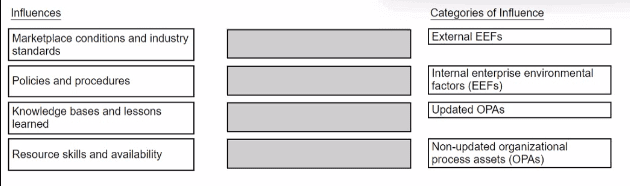
DRAG DROP Match the influence with its corresponding category of influence. PMI CAPM question

Drag & Drop
11 comments in the community discussion
6
Marketplace conditions and industry standards → External EEFs, policies and procedures → Internal EEFs, resource skills and availability → Updated OPAs, knowledge bases and lessons learned → Non-updated OPAs. Had something like this in a mock, pretty sure this is the mapping. Disagree?
5
Marketplace conditions→External EEFs, policies/procedures→Internal EEFs, resource skills/availability→Updated OPAs, knowledge bases/lessons learned→Non-updated OPAs
Q: 20

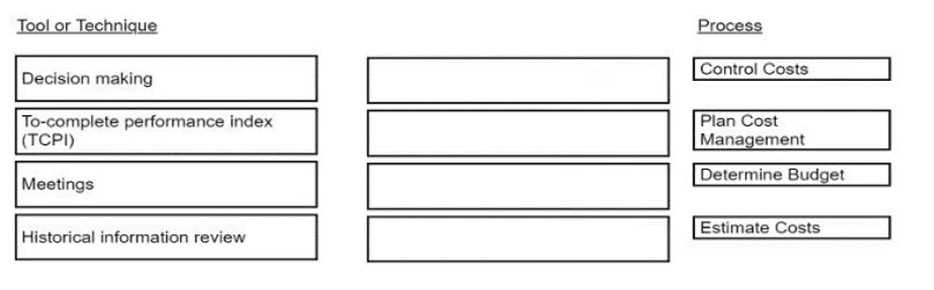
DRAG DROP Match each tool or technique with its corresponding Project Cost Management process. PMI CAPM question

Drag & Drop
9 comments in the community discussion
6
Decision making → Plan Cost Management, TCPI → Control Costs, Meetings → Determine Budget, Historical info review → Estimate Costs. Saw a nearly identical mapping on a practice set and it lines up with how these tools fit each cost process per PMBOK. Pretty sure some might mix up Meetings or Decision making since those
1
Not sure I agree with the usual matches. I put Decision making with Control Costs, TCPI under Plan Cost Management, Meetings for Estimate Costs, and Historical review to Determine Budget. Maybe I'm mixing up the order but I thought TCPI comes up during planning. Anyone else seeing it this way?
Question 1 of 20

Premium Access Includes

  • Quiz Simulator
  • Exam Mode
  • Progress Tracking
  • Question Saving
  • Flash Cards
  • Drag & Drops
  • 3 Months Access
  • PDF Downloads
Get Premium Access
Scroll to Top

FLASH OFFER

Days
Hours
Minutes
Seconds

avail $6 DISCOUNT on YOUR PURCHASE