Free 350-601 Practice Test Questions and Answers (2026)

View Mode
Q: 1
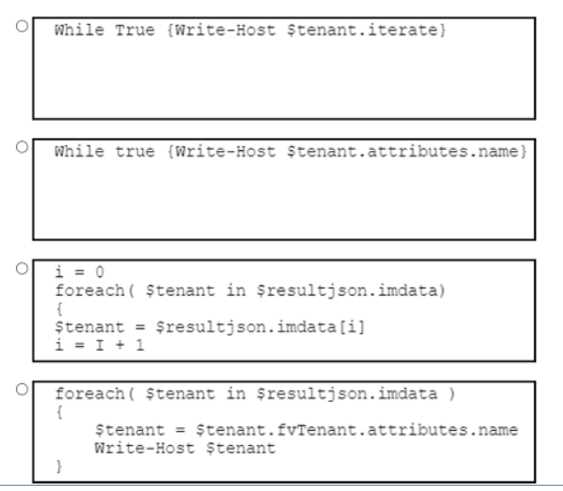
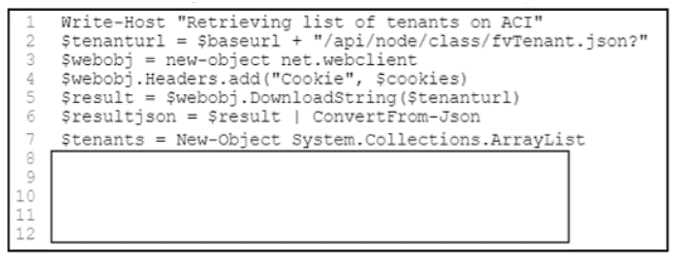
Refer to the exhibit. CISCO 350-601 question Refer to the exhibit. A DevOps engineer must create a PowerShell script to display a list of tenants in the Cisco Application Centric Infrastructure (ACI) by using the Cisco ACI PowerShell module. The engineer does NOT know how many results will be returned, so it is important to iterate through all the results. Which code snippet completes the script? P-95 CISCO 350-601 question
Options
29 comments in the community discussion
1
D makes sense, it's got the loop so every tenant gets listed no matter the total count. None of the others handle dynamic result sizes. I think that's what Cisco wants for this style question, but open to other opinions.
1
C/D? Seen similar format in the official guide and labs, always review those for script looping questions.
Q: 2
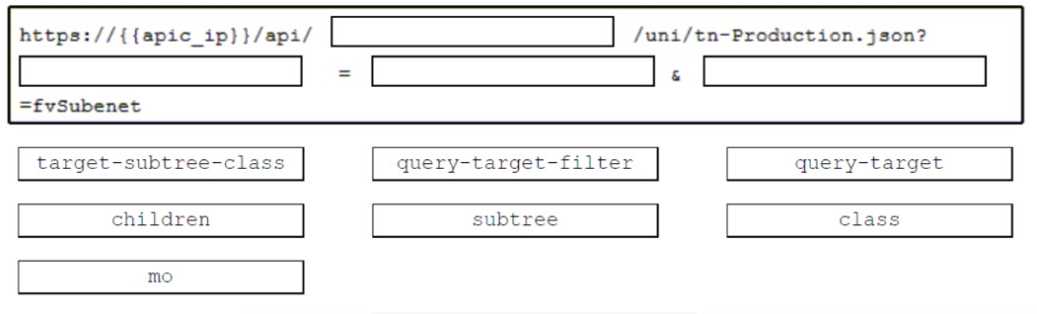
DRAG DROP Drag and drop the keywords onto the URL request to collect all the subnets configured under tenant Production using a REST API. Not all options are used. CISCO 350-601 question
Your Answer
37 comments in the community discussion
1
Pretty sure it's D since the question asks for ALL subnets and not just the immediate ones under Production. API docs usually require the recursive keyword to get everything, including nested subnets in tenants. Saw a similar style on practice exams. If someone disagrees let me know, but that's how I understand it.
1
C vs D for me, but I lean C since not every API needs recursive for child resources. Could be wrong here.
Q: 3
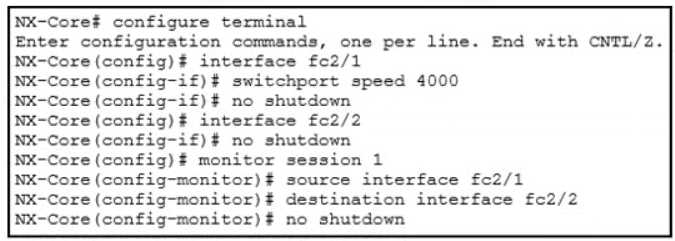
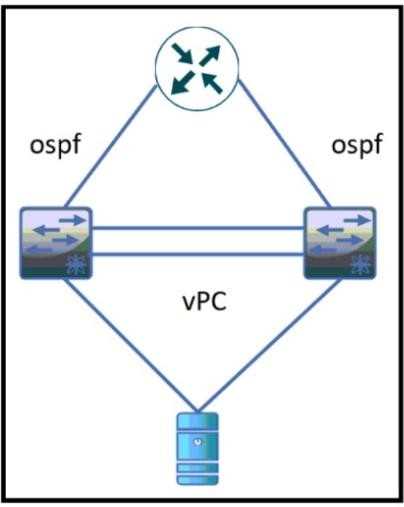
Refer to exhibit. CISCO 350-601 question An engineer implements SPAN configuration on an Nexus 5000 series switch. Which two commands are necessary to complete the SPAN session configuration? (Choose two)
Options
44 comments in the community discussion
2
B/D? Hard to be 100 percent but those seem most correct for Nexus FC SPAN config.
1
C isn't it. B and D are correct, saw similar configs in the official guide. Practicing on real gear or labs helps lock this down for exam day.
Q: 4
Which protocol does Cisco Hyperflex use to share data among nodes in a VMware vSphere environment?
Options
21 comments in the community discussion
3
Option D
2
Option D
Q: 5
An engineer m9ust configure SAN connectivity in Cisco UCS manager. The requirement is to specify the WWPN of the storage array and set the zoning type to single initiator multiple targets. The engineer must also configure interrupt handling and queues of the vHBA interface. Which two Cisco UCS policies should be used to configure the settings? (Choose two.)
Options
38 comments in the community discussion
4
Option B not C. The interrupt/queue config trap is common, but boot policy covers zoning and WWPN in UCS. If anyone has docs showing C handles both, let me know but pretty sure it's just B here.
2
B
Q: 6
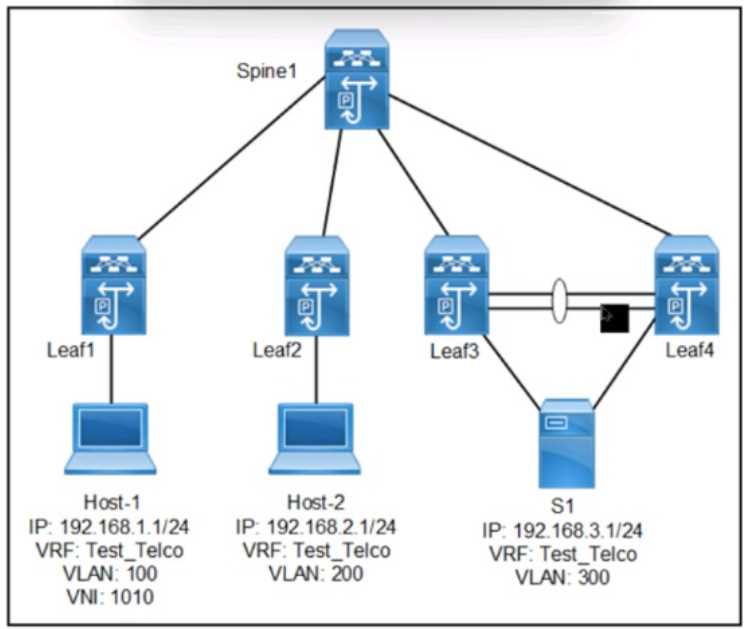
Refer to the exhibit. CISCO 350-601 question Refer to the exhibit During a vPC peer switch reload, there is packet loss between the server and the router Which action must be taken to prevent this behavior during future reloads?
Options
52 comments in the community discussion
3
Option B since "packet loss" here isn’t limited to ARP. D is a trap for just ARP issues.
2
Nah, I don’t think it's D. B stops packet loss during reload since D only touches ARP issues.
Q: 7
A QoS policy on Cisco UCS must meet mese requirements: No-drop class must be configured Jumbo frames must be enabled without fragmentation. Which configuration must be implemented to meet mese conditions?
Options
42 comments in the community discussion
9
C/D? From what I remember, the QoS system class is used for no-drop configs in UCS, and you need to set MTU to 9216 for true jumbo frames. Option D lines up with that and matches what I've seen on official docs. Think that's the way to go but if anyone disagrees let me know. Official guide plus hands-on lab helps a lot
1
Option A official guide and labs usually help with these UCS QoS cases, at least in practice exams.
Q: 8
Which two protocols are used by the NFSv4 protocol? (Choose two.) P-28
Options
49 comments in the community discussion
2
A is wrong, B E. NFSv4 only uses TCP and IP, not FCP or UDP.
2
Its B and E since NFSv4 only uses TCP for transport and runs on top of IP. Earlier versions supported UDP but v4 only does TCP. FCP and Ethernet aren't protocols at that layer. Pretty sure about this but correct me if I missed anything.
Q: 9
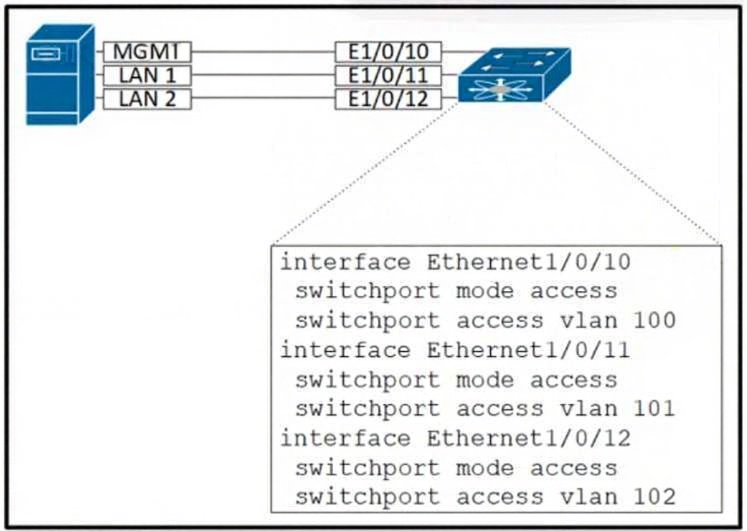
Refer to exhibit. P-37 CISCO 350-601 question Refer to the exhibit A VXLAN data center fabric has three hosts mapped to three different VLANs. Ingress and egress VTEPs perform Layer 2 and Layer 3 lookups VLAN 100 is mapped to VNI 1010 on Lead. Which set of actions allow communication between Host-1 and Host-2?
Options
45 comments in the community discussion
5
Definitely going with A. Mapping VLAN 200 to VNI 2020 on Leaf2 is what makes Host-2 reachable, seen it in lab configs too. Not 100 percent sure but this looks right, correct me if you think otherwise!
3
Option A. I don’t think B is right here, mapping VLAN 200 on Leaf2 is key and that’s in A (suppressing ARP alone is a common trap).
Q: 10
A DevOps engineer must design a solution to push network configurations across a company infrastructure to ensure consistency. The solution must be easy to configure and manage and must support Python and YAML. Which configuration management tool meets these requirements?
Options
35 comments in the community discussion
2
D
1
I don’t think it’s B. D fits better since "easy to configure and manage" is classic Ansible, even though SaltStack does Python/YAML too. The "ease" part trips people up on these.
Q: 11
A network architect must redesign a data center network based on OSPFv2. The network must perform fast reconvergence between directly connected switches. Which two actions must be taken to meet the requirements? (Choose two.)
Options
12 comments in the community discussion
1
C and E tbh. BFD (C) is what Cisco wants for fast, subsecond detection, and OSPF point-to-point (E) reduces convergence time since the topology's simpler. Pretty confident but open to other takes.
1
Option C and E make sense here. BFD is known for fast failure detection, and point-to-point links speed up OSPF convergence. Not totally certain, but saw similar on practice exams. Agree?
Q: 12
A network engineer must configure a Cisco MDS switch to use the local user database for console access if all AAA servers are unreachable. Which configuration should be applied to complete this task?
Options
13 comments in the community discussion
2
Option B
1
Its B
Q: 13

Refer to the exhibit. . Refer to the exhibit An engineer must access a Cisco UCS C-Series server KVM from a remote location. The engineer must use the out-of-band interface to access the KVM Which configuration set meets these requirements?

Options
16 comments in the community discussion
1
C/D? Depends on the NIC mode really. Out-of-band usually means using the dedicated management NIC, which matches D, but some setups might use Shared LOM if configured right. Pretty sure D is what they're expecting here though.
1
D . Out-of-band access for UCS C-Series usually means the dedicated management port is used, not shared LOM. I've seen similar questions in practice sets, and they always go with Dedicated NIC, VLAN state disabled. Pretty sure that's what they're after here-correct me if I'm off.
Q: 14

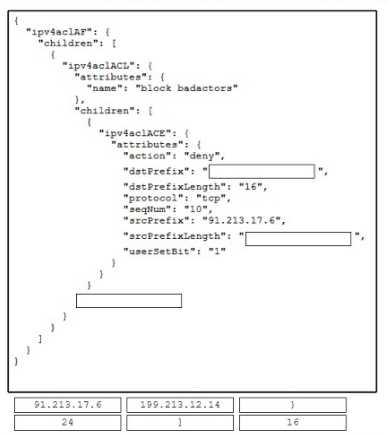
DRAG DROP Refer to the exhibit. CISCO 350-601 question Refer to the exhibit. Drag and drop the code snippets from the bottom onto the blanks in the code to complete the JSON request that implements the ACL presented. Not all code snippets are used. P-50 CISCO 350-601 question
Drag & Drop
9 comments in the community discussion
6
189.213.12.14 to Target 1, 24 to Target 2, } for Target 3. Saw similar on a practice test, think some might pick 91.213 by accident since that address stands out but doesn't fit the JSON request style here-open if anyone sees it differently.
5
189.213.12.14 to Target 1, 24 to Target 2, closing bracket to Target 3. That's the match from what I see here.
Q: 15

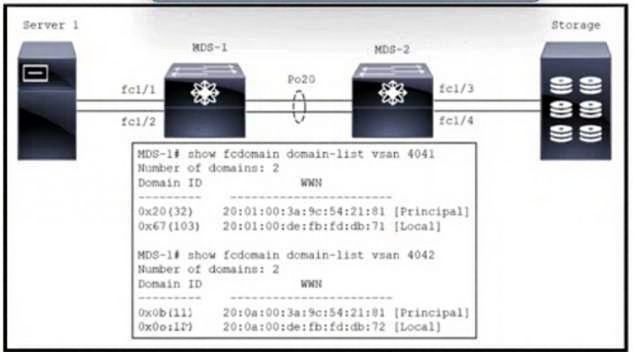
DRAG DROP Refer to the exhibit The VSAN 4041 and 4042 are exchanged between two Cisco MDS 9000 Series Switches called MDS-1 and MDS-2 The objective is to deploy a security mechanism on MDS-1 to allow MDS-2 to join the fabric exclusively Drag and drop the code snippets from the bottom onto the boxes in the code to complete the MDS-1 configuration Not all code snippets are used.
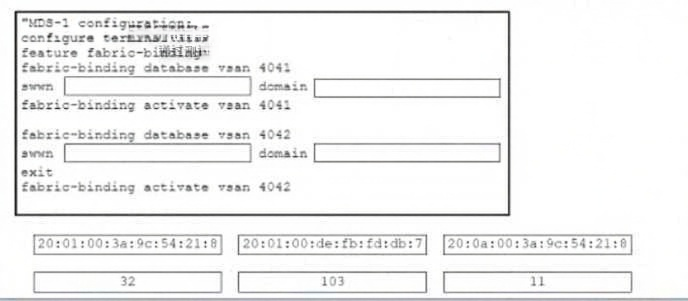
Drag & Drop
19 comments in the community discussion
4
Used this mapping: 20:01:00:38:90:54:21:8 to awwn, 32 to domain, 20:0a:00:38:90:54:21:8 to awwn, 11 to domain. Saw it in the official practice labs so pretty confident, but always good to cross-check official config documentation just in case.
4
20:01:00:38:90:54:21:8 to awwn, 32 to domain, 20:0a:00:38:90:54:21:8 to awwn, 11 to domain. Saw this on a mock, sure.
Q: 16
An engineer must configure a user role interface policy on a Cisco Nexus 9000 Series Switch. The role must prevent access to interface FC3/2 but allow access to interface FC3/1. Which set of actions must be taken to accomplish this goal?
Options
19 comments in the community discussion
6
Option A, Strictly fits what the question asks, deny FC3/2, permit FC3/1. Pretty sure this is how Nexus policies should look. Disagree?
5
A , since you want to block FC3/2 completely but give access to FC3/1. That's what option A does using deny and permit rules in the right order. Pretty sure that's standard Nexus user role config logic, unless I'm missing something.
Q: 17
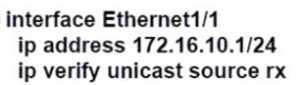
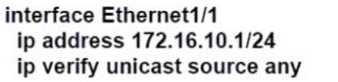
An engineer must implement Strict Unicast Reverse Path Forwarding mode for IPv4 packets on the Ethernet1/1 interface on the Cisco Nexus 9500 Series Switch. Which configuration achieves this goal? A) CISCO 350-601 question B) P-9 CISCO 350-601 question C) CISCO 350-601 question D) CISCO 350-601 question
Options
16 comments in the community discussion
6
Option D is correct since 'reachable-via rx' enforces strict uRPF, making sure the source is on the expected interface. That's what's needed per official docs. Pretty confident but let me know if anyone sees an edge case.
1
C , since 'ip verify unicast source reachable-via any' looks like it's enabling uRPF, and I remember seeing 'any' used in config guides for unicast reverse path. For strict mode, it should verify the source is reachable, and 'any' feels like it covers that. Not 100 percent though, maybe I'm confusing loose mode details
Q: 18
Which two configuration settings are available in the in the cisco UCS firmware Auto sync server policy?
Options
11 comments in the community discussion
C or D here, since "No Action" and "Delayed Action" both show as available settings if the policy isn't set to default sync. If user role limits apply though, that could change it.
C or D? No Action or Delayed Action both sound possible, I see both used in UCS policies. Someone confirm?
Q: 19
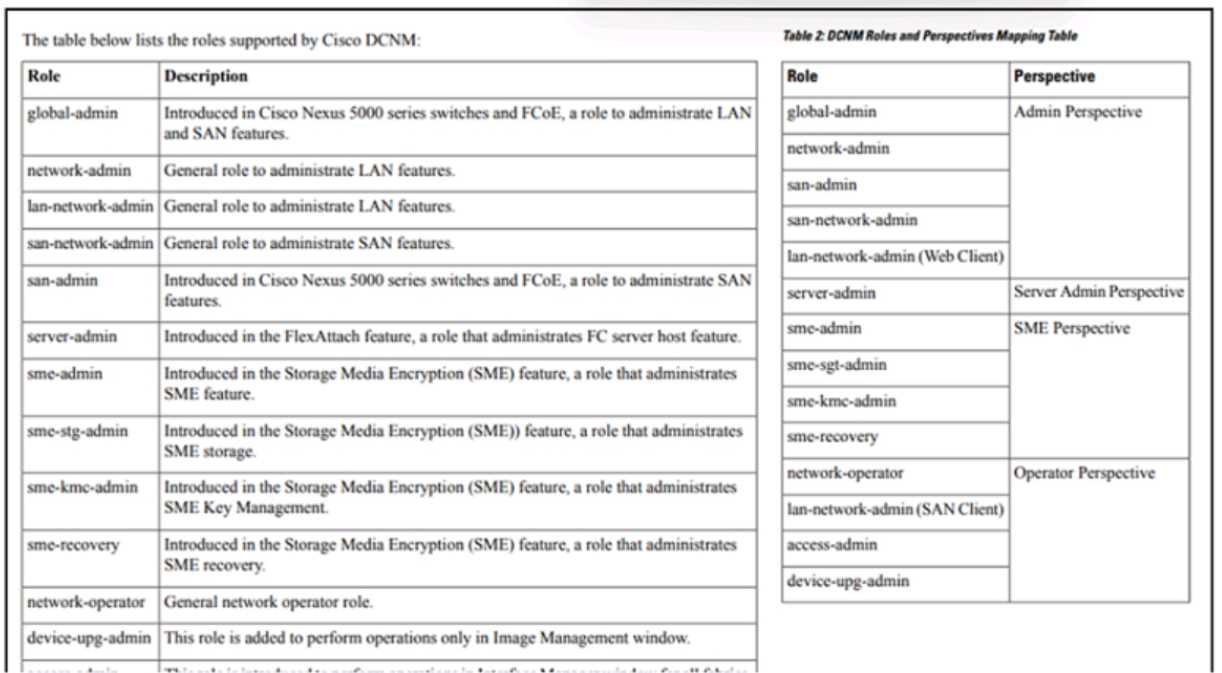
Refer to exhibit. P-38 CISCO 350-601 question Refer to the exhibit. An engineer is configuring Cisco Data Center Network Manager to automate the provisioning of Cisco Nexus 9000 Series Switches. The engineer must configure user access for network engineers to permit device operations in Interface Manager. The solution must hide Admin and Config Menu items in Interface Manager Which two roles must be assigned to the network engineers to meet these requirements? (Choose two.)
Options
17 comments in the community discussion
2
B and D imo. Both grant device operation access in Interface Manager without showing Admin or Config menus, which is what the prompt wants. C is an easy mistake here since network-admin actually brings those extra menus up. Somebody disagree if you see it differently.
1
B and D make sense here, since network-operator and access-admin cover interface tasks without exposing the admin/config menus. C would show too much, including menu items the question wants hidden. Pretty sure this lines up with how DCNM role separation works, but correct me if not.
Q: 20
What is a benefit of using the Cisco UCS Lightweight upgrade feature?
Options
16 comments in the community discussion
6
A . Lightweight upgrade means only components with different firmware get updated, so there's less need for downtime and fewer reboots. That's what makes it 'lightweight' compared to a full update. D would cause more disruption, which the feature is supposed to avoid. Saw something similar in practice questions. Anyone
2
Option A makes sense, since UCS Lightweight upgrade is about only updating components that actually need new firmware. That way, you skip pushing updates and rebooting everything unnecessarily, so less downtime. D would do the opposite by rebooting all servers, which isn't 'lightweight' at all. Pretty sure this matc
Question 1 of 20

Premium Access Includes

  • ✓Quiz Simulator
  • ✓Exam Mode
  • ✓Progress Tracking
  • ✓Question Saving
  • ✓Flash Cards
  • ✓Drag & Drops
  • ✓3 Months Access
  • ✓PDF Downloads
Get Premium Access
Scroll to Top

FLASH OFFER

Days
Hours
Minutes
Seconds

avail 10% DISCOUNT on YOUR PURCHASE