Free 300-810 Practice Test Questions and Answers (2026)

View Mode
Q: 1
Refer to the exhibit. CISCO 300-810 question An administrator is troubleshooting an issue with XMPP Federation between two. eight-node IM and Presence clusters. After looking at the logs, the administrator finds this message and must publish one or more DNS SRV records containing one or more addresses of the IM and Presence node(s). How many nodes must be selected to publish?

Options
14 comments in the community discussion
2
Had something like this in a mock. It's A, just one node has to be listed in the SRV record for XMPP federation to work technically. Optional to include more for redundancy but not required. Anyone pick something else?
1
Call it you'd need to do B for redundancy, not just one node.
Q: 2
What is a step in the SAML SSO process?
Options
16 comments in the community discussion
6
Option A fits because in SAML, the IdP sends the SAML response (with assertion) back to the browser, which then forwards it to the SP. Pretty sure that's the right sequence here. If anyone disagrees let me know.
1
A , since the real SAML SSO step is when the IdP redirects the SAML response (containing the assertion) back to the browser. D trips people up, but that's more about starting the flow than an actual SAML assertion step. Pretty sure from exam reports.
Q: 3
Which SAML component specifies the mapping of SAML assertion protocol message exchanges with standard messaging formats or communication protocols such as SOAP exchanges?
Options
18 comments in the community discussion
4
Option A saw a super similar question on practice. Mapping SAML exchanges to protocols like SOAP is the job of bindings, not profiles or assertions. Let me know if anyone picked C for a good reason.
4
Yeah, this wording always gets me on Cisco. Option A is the only one that deals directly with how SAML messages are actually transported, like via SOAP or HTTP POST. Profiles (C) are more about application-specific use cases. Seen similar Qs in practice sets. Think it's A unless Cisco changed something up.
Q: 4
Which statement describes a role of AXL communications in the BLF Plug-in Service of the Cisco UAC?
Options
14 comments in the community discussion
2
Call it D, since AXL is used post-install to verify CTI manager and UCM versions line up. B looks tricky but that's not AXL's job here, that's more about device status which isn't the point for this plug-in. I think D but open to other reads.
1
C/D? Had something like this in a mock, but pretty sure it's D.
Q: 5
How is automatic fallback enabled on a Cisco IM and Presence server?
Options
13 comments in the community discussion
1
Bit annoying how Cisco splits config between CUCM and IM&P, but this one really is B. You enable automatic fallback in the CUCM Service Parameter, not IM&P settings. Seen similar in both practice and docs, happy to be proven wrong.
1
Not A, it's gotta be B. The automatic fallback config has to be set in CUCM's Service Parameter, which can be confusing since the feature is for IM and Presence. C is a trap since it's never default. Open to correction if anyone's seen something different.
Q: 6
Which component of SAML SSO defines the transport mechanism that is used to deliver the SAML messages between entities?
Options
20 comments in the community discussion
Why not A? Isn't bindings (D) the one that covers actual transport, while profiles are more about use-case behavior?
Yeah, bindings is the one that handles how SAML messages actually get sent over the wire, like HTTP POST or Redirect. D fits best for transport mechanism, not behavior. Pretty sure that's the intent here!
Q: 7
Which step is the first for web-based single sign-on login?
Options
19 comments in the community discussion
1
D pretty sure. First move is always user asking for the protected resource, not the redirect step.
1
D tbh. Web SSO flows always kick off once the user tries to access a protected resource, not at the redirect step. If they asked from IdP's side, then B might work, but not here.
Q: 8
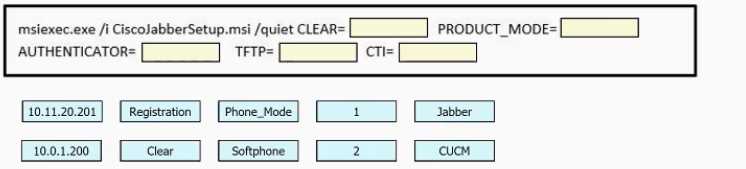
DRAG DROP An engineer is configuring a Jabber client installation switch for a phone system using Cisco UCM as the registration server, with a softphone control address of 10.0.1.200. and configuration files received from 10.11.20.201 after all previous configurations are cleared. Drag and drop the snippets from the bottom of the image onto the blanks in the image to complete this configuration. Not all options are used. CISCO 300-810 question
Your Answer
16 comments in the community discussion
1
I don't think D fits here. C would make more sense if the config files are reset, since that field handles TFTP after clearing previous settings. Not 100% but saw a similar twist in another practice.
Going with B and D for this one. The UCM should be set as the registration server, and config files come from the TFTP at 10.11.20.201, so those two snippets fit. Pretty sure, but I'd double-check if any special Jabber config applies.
Q: 9
Which DNS record is used for on-premises service by Jabber clients?
Options
23 comments in the community discussion
5
Option C, that's what matched the official guide for on-prem Jabber config. Practice tests also keep bringing this up exactly like that.
1
C is correct here. For on-prem Jabber clients, the _cisco-uds._tcp SRV record is used for internal service discovery, not the A record for TFTP. A lot of folks mix up D since TFTP is more for phone config, not Jabber. Seen similar in practice tests.
Q: 10
An administrator is configuring Cisco Jabber 12.8 to work with Cisco UCM and Cisco IM and Presence 12.5 using an encrypted SIP profile. Which record should be configured for Jabber to work when logging into the corporate network with the domain "domain.com?
Options
9 comments in the community discussion
1
D because encrypted SIP should use _sip._tls not _cisco-uds._tcp.
Wouldn’t B be better if encrypted is the key part? Isn’t _cisco-uds._tls for Jabber on TLS?
Q: 11
Which SAML component defines the content of data transferred from an IdP to a service provider?
Options
7 comments in the community discussion
5
Option B is right. The assertion carries the actual data like authentication statements between IdP and service provider, so it defines the content itself. Protocol and binding are more about how it's delivered, not what's inside. Unless I'm missing something, B fits best.
Don't think it's protocol or binding. Those handle transport and encapsulation, not the content itself. Assertion (B) is what actually contains the user info transported from IdP to SP. Profiles can look tempting, but they just standardize use cases. I've seen similar in practice material, so I'm pretty sure B is best.
Q: 12
An engineer is configuring a remote Cisco IM and Presence Service and needs to ensure that users can communicate across clusters in the same domain and receive presence status. Which protocol should be used to accomplish this task?
Options
4 comments in the community discussion
3
Option A, saw this in recent exam reports too.
Cisco wrote the book on making this confusing tbh, but it's A here.
Q: 13
Which two command line arguments can you specify when installing Cisco Jabber for windows? (Choose two.)
Options
11 comments in the community discussion
2
B tbh, think TFTP_ADDRESS is one you can pass directly during install.
1
B and E for me. TFTP_ADDRESS (option B) seems like a legit command line arg since you can specify the server directly at install, plus E is the classic shorthand flag for TFTP. Not totally sure about D, I thought SERVICES_DOMAIN was usually set post-install in settings, not during initial setup. If anyone's run the ins
Q: 14
When trying to send a call out of Cisco Unity Connection, what happens when enabling the transfer to an alternate contact number, located under caller input?
Options
4 comments in the community discussion
1
I think this is same as a common exam questions on practice, it's B.
It’s D, these restriction tables never seem to get checked from the PCA page. Cisco makes this way too confusing sometimes.
Q: 15
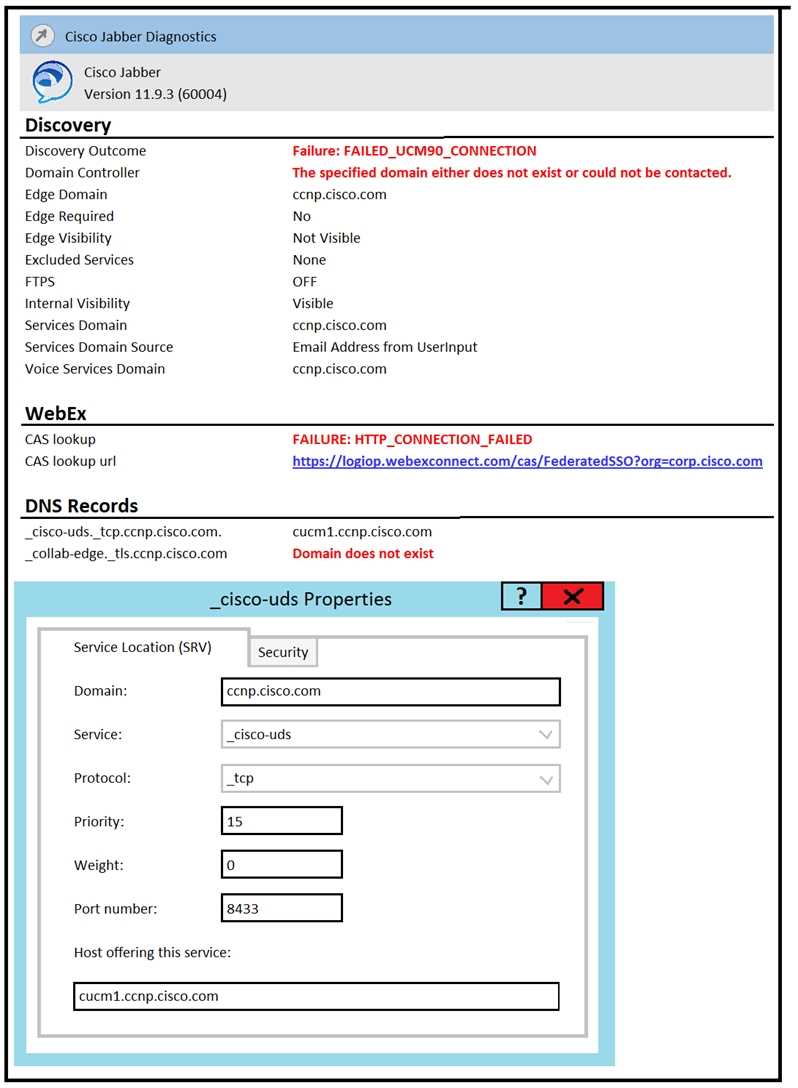
Refer to the exhibit. CISCO 300-810 question Users connected to the internal network report a “Cannot communicate with the server” error while trying to log in to Cisco Jabber using auto service discovery. The Jabber diagnostics and the SRV record configuration are as shown in the exhibit. The host cucm1.ccnp.cisco.com is correctly resolved by the user desktops with the Cisco Unified Communications Manager IP address. Why is the user not able to log in?
Options
3 comments in the community discussion
Are we sure it's B? I think port mismatch on the SRV record (C) would cause login failure with Jabber since it can't reach CUCM properly, even if DNS and the host are fine. Cisco docs mention port accuracy is key for service discovery. Maybe double check the SRV config details in the exhibit?
B tbh, had something like this in a mock and B was the answer there.
Q: 16
Users report that they are unable to check voicemail. and an engineer discovers that the voicemail system is not routing calls between Cisco Unity Connection and Cisco UCM via SCCP Which action should be taken to resolve this issue?
Options
4 comments in the community discussion
Skip B, D . Since they're connecting via SCCP, checking the Calling Search Space on the DN is key. SIP trunk settings like in B are a common distractor but don’t apply here. Pretty sure that's what Cisco's going for in this scenario.
Its D. Had something like this in a mock, it was CSS on the DN causing issues.
Q: 17
Refer to the exhibit. CISCO 300-810 question Which end-user option can resolve this issue?
Options
6 comments in the community discussion
1
Just checking, are we sure the end-user needs phone control for rollover mode, not something like call monitoring? Seen similar in a mock and usually it's about Jabber needing C, but curious if anyone's ever seen B or D be needed in this scenario.
1
A and D don't really apply here. C, not B. This permission is needed for Jabber to control phones that use rollover mode, which matches up with similar questions I've seen on practice exams. Pretty sure that's all it wants, but open to corrections.
Q: 18
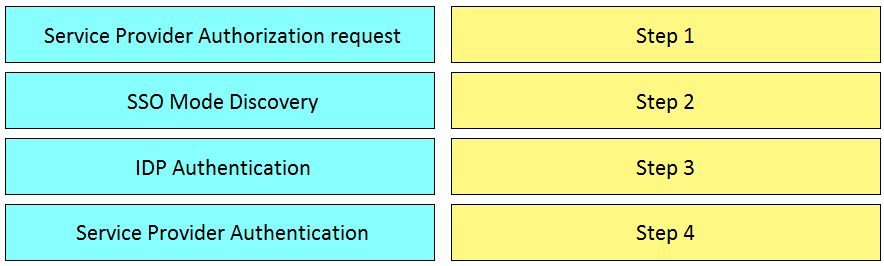
DRAG DROP Drag and drop the events for an on-premises Jabber SAML SSO flow from the left into the correct order on the right. CISCO 300-810 question
Your Answer
5 comments in the community discussion
2
Option D is correct, the typical SAML SSO flow for Jabber starts with a client request then hits IdP, then SAML response is posted to SP. C mixes up the IdP and SP steps, easy trap if you rush it.
1
D tbh, found similar order in the official guide and a couple of practice labs. If you're still stuck, Cisco docs on SAML/Jabber flows are a solid reference.
Q: 19
Digital networking is configured between two Cisco Unity Connection clusters using an HTTPS connection. Which two objects are replicated between these two clusters? (Choose two.)
Options
6 comments in the community discussion
1
AE tbh, user/mailbox objects and routing stuff like partitions are the ones that sync. Not user greetings or handlers.
I’d say A and E, since user greetings (B) and call handlers (D) aren't really replicated via HTTPS networking. Easy to mix up with templates, but pretty sure users and partitions are correct here.
Q: 20
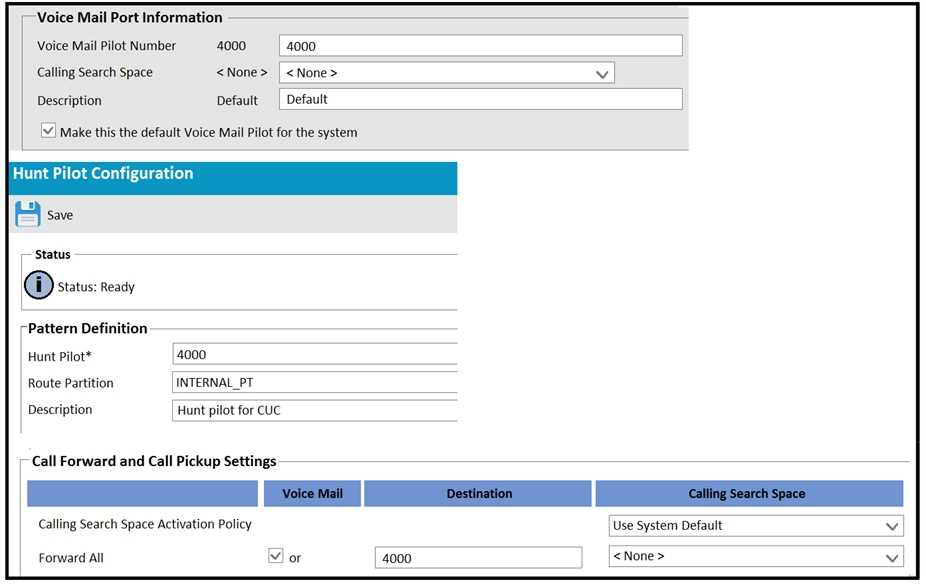
Refer to the exhibit. CISCO 300-810 question Cisco Unity Connection and Cisco Unified Communications Manager are integrated by using SCCP. The Voice Mail Ports are registered. Users report that calls fail when forwarded to voicemail. Which is a cause of the issue?
Options
9 comments in the community discussion
1
Option C
Its C, but only if the INTERNAL_PT is actually needed for those forwarded calls to reach voicemail.
Question 1 of 20

Premium Access Includes

  • Quiz Simulator
  • Exam Mode
  • Progress Tracking
  • Question Saving
  • Flash Cards
  • Drag & Drops
  • 3 Months Access
  • PDF Downloads
Get Premium Access
Scroll to Top

FLASH OFFER

Days
Hours
Minutes
Seconds

avail 10% DISCOUNT on YOUR PURCHASE