
Q: 1
In which direction does the Cisco DNA Center Intent API communicate?
Options
Discussion
No comments yet. Be the first to comment.
Be respectful. No spam.
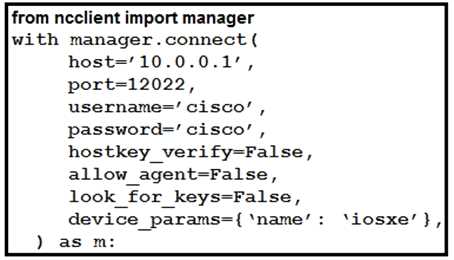 What is the correct ncclient method to use to collect the running configuration of a Cisco IOS XE
device that uses NETCONF?
What is the correct ncclient method to use to collect the running configuration of a Cisco IOS XE
device that uses NETCONF?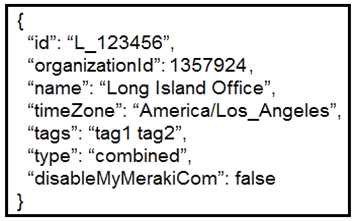 Which two parameters are mandatory when the Cisco Meraki API is used to create a network?
(Choose two.)
Which two parameters are mandatory when the Cisco Meraki API is used to create a network?
(Choose two.)
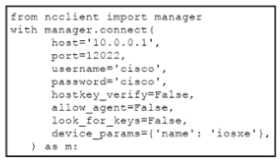 Which ncclient method is used to collect the running configuration of a Cisco IOS XE device that uses
NETCONF?
Which ncclient method is used to collect the running configuration of a Cisco IOS XE device that uses
NETCONF?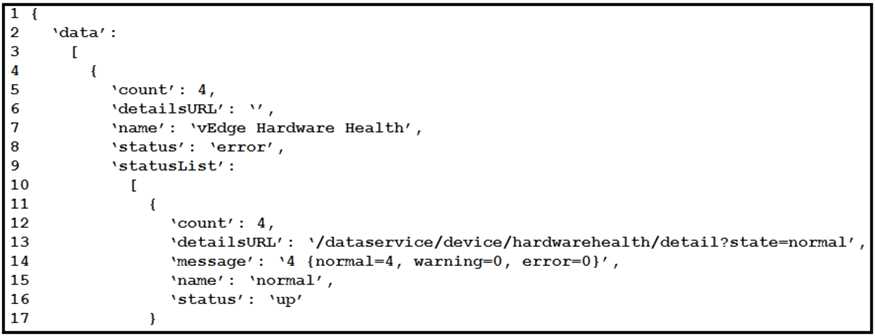 Cisco SD-WAN deployment must be troubleshooted using vManage APIs. A call to vEdge Hardware
Health API returns the data in the exhibit (only a portion is shown). If this JSON is converted to a
Python dictionary and assigned to the variable “d”, how the status is accessed that is indicated on
line 16?
Cisco SD-WAN deployment must be troubleshooted using vManage APIs. A call to vEdge Hardware
Health API returns the data in the exhibit (only a portion is shown). If this JSON is converted to a
Python dictionary and assigned to the variable “d”, how the status is accessed that is indicated on
line 16? A Python script must be created to deactivate vSmart Policy Cisco SD-WAN vManage Configuration
APIs. The documentation states the URL is as shown in the exhibit for this REST call using POST, and
that “policyId” is a required request parameter. Which line of Python code makes this call, assuming
the variable “s” is a valid Requests session object and the variable “policy-id” is the policyId?
A Python script must be created to deactivate vSmart Policy Cisco SD-WAN vManage Configuration
APIs. The documentation states the URL is as shown in the exhibit for this REST call using POST, and
that “policyId” is a required request parameter. Which line of Python code makes this call, assuming
the variable “s” is a valid Requests session object and the variable “policy-id” is the policyId?
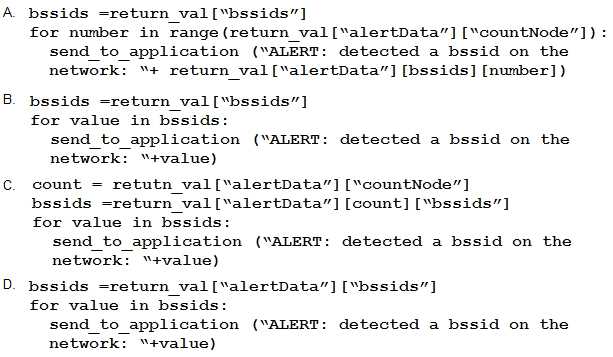
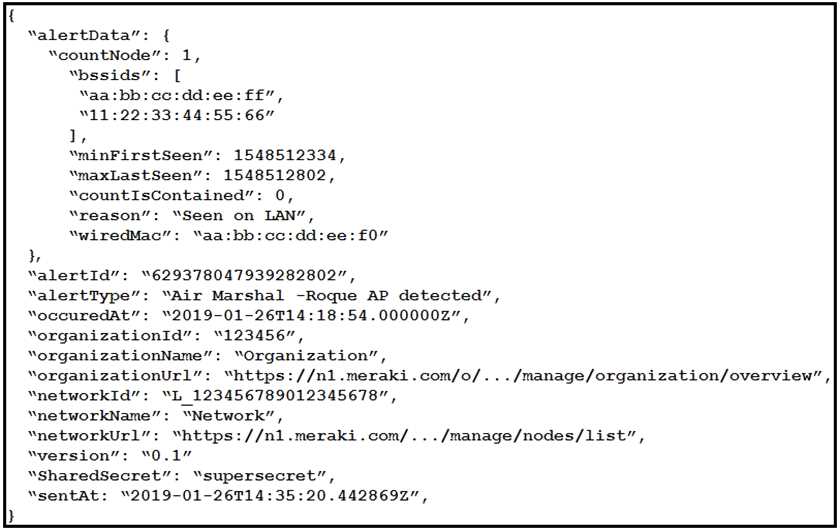 The goal is to write a Python script to automatically send a message to an external messaging
application when a rogue AP is detected on the network. The message should include the broadcast
SSID that is in the alert. A function called “send_to_application” is created, and this is the
declaration:
send_to_application(message)
The exhibit also shows the data that is received by the application and stored in the variable
return_val. Which Python code completes the task?
The goal is to write a Python script to automatically send a message to an external messaging
application when a rogue AP is detected on the network. The message should include the broadcast
SSID that is in the alert. A function called “send_to_application” is created, and this is the
declaration:
send_to_application(message)
The exhibit also shows the data that is received by the application and stored in the variable
return_val. Which Python code completes the task?
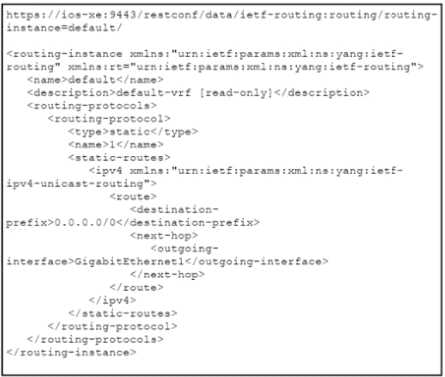 A RESTCONF GET request is sent to a Cisco IOS XE device. The base URL of the request and the
response in XML format are shows in the exhibit. what is the YANG data node that is referenced in
the response?
A RESTCONF GET request is sent to a Cisco IOS XE device. The base URL of the request and the
response in XML format are shows in the exhibit. what is the YANG data node that is referenced in
the response?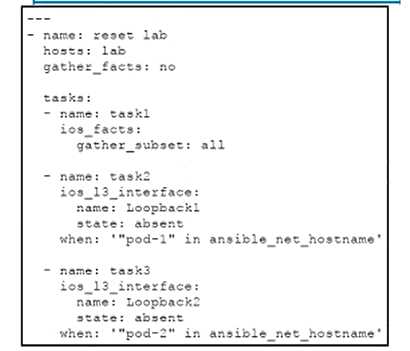 Refer to the exhibit. The lab group consists of four Cisco IOS XE routers named pod-11,pod-12, and
pod-22. What is the result of running the Ansible playbook to reset the lab?
Refer to the exhibit. The lab group consists of four Cisco IOS XE routers named pod-11,pod-12, and
pod-22. What is the result of running the Ansible playbook to reset the lab?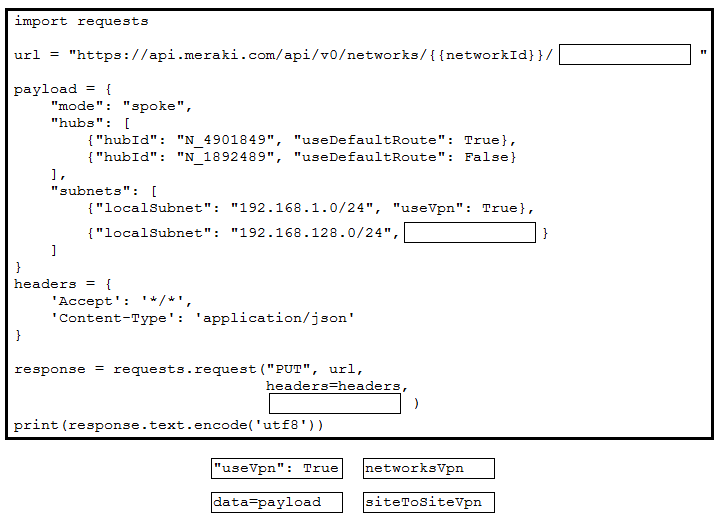
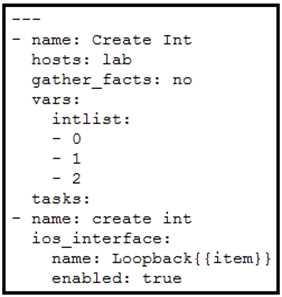 Refer to the exhibit. Interfaces named Loopback0, Loopback1, and Loopback2 must be created and
enabled on a Cisco IOS XE target device in the lab group. Which loop must be added to the end of the
Ansible “create int” task?
Refer to the exhibit. Interfaces named Loopback0, Loopback1, and Loopback2 must be created and
enabled on a Cisco IOS XE target device in the lab group. Which loop must be added to the end of the
Ansible “create int” task?