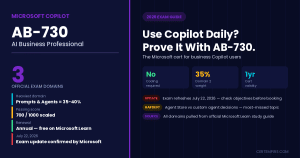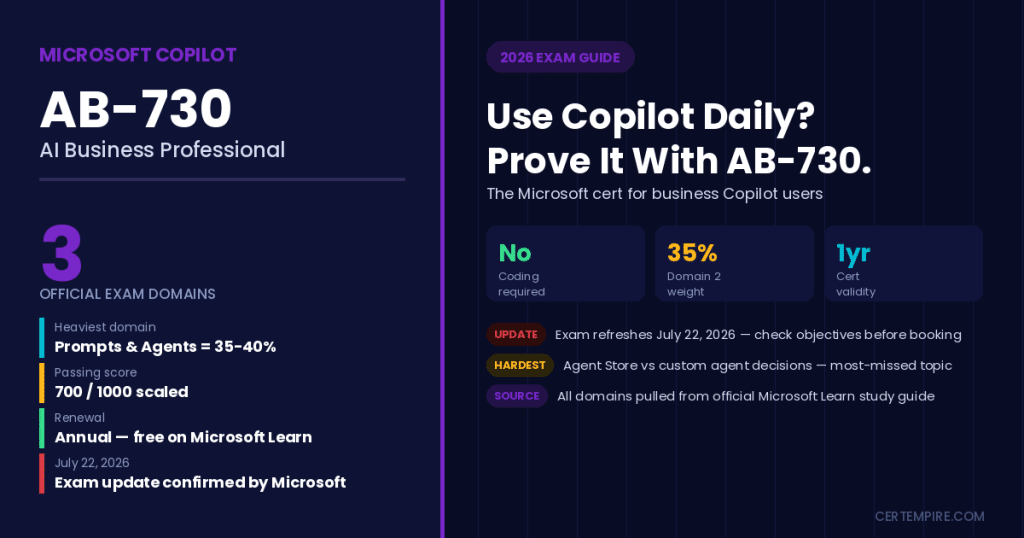
Microsoft AB-730 exam dumps are practice question sets covering all three official skill domains of the Microsoft Certified: AI Business Professional certification exam, a 700/1000 passing score assessment that validates your ability to use Microsoft 365 Copilot, build and manage AI agents, apply responsible AI practices, and draft and analyze business content using generative AI – without writing code or building AI applications. CertEmpire’s AB-730 dumps are aligned to the current official exam objectives published on Microsoft Learn and updated for the July 2026 exam refresh.
Important July 2026 Update: Microsoft has confirmed the AB-730 exam will be updated on July 22, 2026. If you are scheduling your exam close to or after that date, verify the current skill objectives on Microsoft Learn before purchasing any study materials, as domain content changes take effect on that date. CertEmpire’s AB-730 question bank is updated in sync with official Microsoft objective revisions.
Exam Overview: Every Key Detail
| Detail | Specification |
| Exam code | AB-730 |
| Certification name | Microsoft Certified: AI Business Professional |
| Exam cost | $165 USD (standard US pricing; varies by region) |
| Passing score | 700 / 1000 |
| Format | Multiple choice, scenario-based, interactive question types |
| Prerequisites | None enforced; Microsoft 365 navigation familiarity recommended |
| Technical coding required | No |
| Renewal | Annual — free online assessment on Microsoft Learn |
| Renewal frequency | Every 12 months |
| Certification level | Associate |
| Next credential | AB-731 (AI Transformation Leader) or AB-100 (Agentic AI Business Solutions Architect Expert) |
| Next update | July 22, 2026 |
| Free practice assessment | Available on Microsoft Learn |
What Is the AB-730 Certification and Who Is It For
The AB-730 is Microsoft’s Associate-level certification for business professionals who use Microsoft 365 Copilot in their daily work. It is explicitly not a technical certification. Microsoft defines the target candidate as someone who uses generative AI tools to improve daily work, drive business outcomes, and make informed decisions in business contexts without building AI applications or writing code.
This is the credential for the analyst who drafts faster with Copilot in Word, the project manager who runs smarter meetings with Copilot in Teams, the sales professional who researches prospects with Researcher, and the HR professional who uses Copilot to summarize documents and generate communications. If you already use Microsoft 365 Copilot regularly in your job, this exam tests whether your usage reflects genuine competency — not just familiarity.
| Role | Why AB-730 matters |
| Business analyst | Validates Copilot-driven data analysis and document drafting |
| Project manager | Validates meeting intelligence, action item generation, collaboration skills |
| Marketing professional | Validates content creation, summarization, cross-app content movement |
| HR professional | Validates document analysis, policy summarization, communication drafting |
| Sales representative | Validates prospect research with Researcher agent, pipeline communication |
| Operations specialist | Validates workflow automation awareness and AI agent usage |
| Finance professional | Validates Excel Copilot for data analysis and management summaries |
| Any Microsoft 365 user | Validates that Copilot use is responsible, governed, and effective |
The AB-730 is also the natural next credential after AB-900 for business users. AB-900 is for the IT administrator who deploys and governs Copilot. AB-730 is for the professional who uses it every day. They serve completely different roles and are both valid simultaneously for candidates who straddle both functions.
AB-730 Official Exam Domains: Complete Breakdown
Microsoft publishes the exact skills measured for every certification exam. The following breakdown is sourced directly from Microsoft’s official AB-730 study guide on Microsoft Learn, last updated April 2026.
Domain 1: Understand Generative AI Fundamentals (25-30%)
This domain validates your conceptual understanding of how Copilot works, how context affects its outputs, and how to use it responsibly. Despite its name, this is not a theory-heavy domain — every topic is framed around practical application decisions.
Understand generative AI capabilities across Microsoft 365 experiences
This skill group tests your understanding of Copilot’s architecture and behavior:
- How Copilot keeps your organization’s information private and secure — understanding that Copilot accesses data through Microsoft Graph using the signed-in user’s existing permissions, and that it does not train on your organization’s data
- How context affects Copilot responses — your work files, web data, the specific app you are using, and the information you include in a prompt all shape what Copilot returns
- The difference between a chat experience and an agent experience — chat is conversational and contextual, while an agent is a configured AI capability with defined knowledge sources, instructions, and actions
- When to create your own agent versus use the Agent Store — you create a custom agent when prebuilt agents do not address your specific business data or workflows, and you use the Agent Store when a prebuilt agent already solves the problem
- Differences in Copilot features across Microsoft 365 apps — Word, Excel, PowerPoint, Outlook, and Teams each have distinct Copilot capabilities, and the exam tests whether you know which app’s Copilot does what
Identify responsible AI and data protection practices
This is not a compliance checkbox — it is tested in scenario questions that ask you to identify the right course of action when AI introduces risk:
- Common risks: fabrications (hallucinations), prompt injection (malicious instructions embedded in content Copilot processes), and over-reliance (using AI output without appropriate verification)
- Verification steps by task type — knowing when a citation check is appropriate, when human review is required, and when the task is low-stakes enough to trust AI output
- Recognizing and mitigating risks to sensitive data — understanding which data protection controls affect what Copilot can access and return
- How data protection restricts prompt results — sensitivity labels, Microsoft Purview policies, and information barriers all affect what Copilot can surface in its responses
Domain 2: Manage Prompts and Conversations by Using AI (35-40%)
This is the heaviest domain at 35 to 40 percent of the exam. It tests practical Copilot usage skills: prompting technique, conversation management, and AI agent creation and configuration. If you only have time to study one domain deeply, this is the one.
Create and manage prompts in Microsoft 365 Copilot
- How to create an effective prompt — understanding the four elements of a good prompt: goal, context, expectations, and source
- Selecting appropriate resources to reference in a prompt — knowing when to reference a specific file, a SharePoint site, a web source, or leave the context open
- Saving a prompt — understanding the Copilot Prompt Gallery and how to save and reuse effective prompts
- Scheduling a prompt — understanding recurring prompts and automated prompt scheduling
- Sharing a prompt — distributing saved prompts across a team through the Prompt Gallery
The exam specifically tests prompt quality judgment: given a business task and a set of possible prompts, which one is most likely to produce a useful result? Candidates who understand the goal-context-expectations-source framework answer these consistently correctly.
Manage conversations in Copilot
- Finding previous conversations — navigating conversation history in Microsoft 365 Copilot Chat
- Deleting a chat — understanding what deletion removes (conversation history) and what it does not remove (files saved in SharePoint or OneDrive)
- Renaming a chat — organizing conversation history for reuse
- Adding a conversation to a notebook — understanding Copilot Notebooks as persistent AI workspaces for ongoing research and collaboration
Create and manage Microsoft 365 Copilot agents
Agent creation and management is one of the most heavily tested areas and one that many candidates underestimate. The exam specifically tests the Agent Store vs custom agent decision:
| When to use Agent Store | When to create a custom agent |
| A prebuilt agent already addresses your use case | No prebuilt agent covers your specific business data or workflow |
| You need a standard capability quickly | Your team needs an agent with custom knowledge sources |
| The business task is generic | The agent needs custom instructions, actions, or suggested prompts |
| You do not need specific organizational data | Your data lives in SharePoint, OneDrive, or specific line-of-business systems |
Creating and configuring an agent covers:
- Creating an agent from a template in Copilot Studio
- Configuring knowledge sources — which SharePoint sites, OneDrive files, or external data sources the agent can access
- Setting agent instructions — defining the agent’s persona, scope, and behavioral guidelines
- Configuring capabilities and suggested prompts — defining what the agent can do and surfacing relevant prompts to users
- Sharing an agent with team members — publishing to a Teams channel, sharing a link, or submitting to the Agent Store for broader organizational use
Domain 3: Draft and Analyze Business Content by Using AI (25-30%)
This domain tests specific Copilot capabilities within Microsoft 365 applications. Questions are scenario-based: given a business task and a starting point, which Copilot action produces the right output?
Draft business documents and communications
- Creating a new document from a prompt — using Copilot in Word to generate a full draft from a description
- Generating a document from an existing document — using an existing Word file as the source for Copilot to create a new, related document (for example, turning a research brief into a client proposal)
- Generating a management summary from a document — condensing a long document into an executive summary using Copilot in Word
- Moving data and insights between Microsoft 365 apps — for example, using Copilot to take data from an Excel analysis and move key insights into a PowerPoint presentation or Word report
Manage meetings and collaboration
- Using Copilot for meetings in Microsoft Teams — generating meeting summaries, capturing action items, identifying key discussion points, and asking questions about meeting content. Note: Copilot requires transcription to be enabled to generate meeting intelligence
- Using Copilot Pages for collaboration — Copilot Pages are shared AI-generated workspaces where teams can build on Copilot responses together, edit content, and use AI within the shared space
- How Copilot uses memory and instructions — understanding how Copilot remembers preferences set in Copilot instructions and applies them across sessions
What the AB-730 Exam Actually Feels Like
Multiple candidates who have taken the AB-730 consistently describe it as scenario-heavy rather than definition-heavy. You will not be asked “what does Copilot do?” You will be asked “a marketing manager needs to generate a client proposal from last month’s campaign analysis in Excel — what is the most efficient Copilot approach?”
The exam tests judgment more than recall. The right answer is usually the one that:
- Uses the most appropriate app-specific Copilot capability for the task
- Applies responsible AI verification where the output warrants it
- Leverages context (existing files, data sources) rather than generating from scratch when existing content would produce a better result
- Respects data protection constraints rather than working around them
The most commonly reported challenge areas from community feedback are:
- Agent Store versus custom agent decision scenarios — candidates who have not used Copilot Studio get these wrong consistently
- Copilot Pages versus Notebooks — understanding when each collaborative AI tool is appropriate
- Data protection and its effect on prompt results — sensitivity labels restricting what Copilot can surface
- The specific capabilities within each app’s Copilot — Word vs Excel vs Teams vs Outlook each have distinct capability sets that the exam distinguishes precisely
How to Use AB-730 Dumps Effectively
CertEmpire’s AB-730 dumps work best as the second phase of your preparation, after you have completed the official Microsoft Learn learning path. Here is exactly how to sequence your preparation.
Step 1: Complete the Microsoft Learn official learning path (Week 1-2)
Microsoft publishes a free, structured learning path for AB-730 on Microsoft Learn that covers every domain and sub-topic in the official objectives. This is not optional if you want to pass. The dumps alone, without conceptual grounding, produce memorization that breaks down on scenario questions you have not seen before. Complete the Microsoft Learn path first.
Step 2: Practice domain by domain with CertEmpire dumps (Week 2-3)
After completing the learning path, work through CertEmpire’s AB-730 question bank in domain order, not randomly. Start with Domain 2 (35-40% weight), then Domain 1 and Domain 3. For each question you answer incorrectly, return to the relevant Microsoft Learn module and review the specific concept before continuing. Skipping the review step is why candidates who use dumps alone have lower pass rates than candidates who combine dumps with learning content review.
Step 3: Timed full practice exams (Week 3)
Take at least two full timed practice sessions covering all three domains. The AB-730 is scenario-based with interactive question types. Practicing under timed conditions is the only reliable way to know whether you are ready. Target a consistent score of 75 percent or higher in practice before booking your exam day.
Step 4: Gap review, then book and sit
Identify any topic areas where you are consistently scoring below 70 percent in practice. For most candidates this is the agent creation and configuration sub-domain within Domain 2, and the data protection and responsible AI sub-domain within Domain 1. Review those specifically. Then book your exam.
| Candidate background | Recommended prep time | Priority focus |
| Daily Copilot user, 6+ months | 2-3 weeks | Domain 2 agent topics, responsible AI |
| Occasional Copilot user | 3-4 weeks | All domains, heavy Domain 2 |
| New to Copilot, strong M365 background | 4-5 weeks | All domains, hands-on Copilot practice |
| New to both Copilot and M365 | 5-6 weeks | Microsoft Learn path first, then all domains |
AB-730 vs AB-900 vs AB-731: Which Exam Is Right for You
The AB series includes multiple certifications that appear similar but serve completely different professional roles. Candidates often confuse AB-730 with AB-900 in particular.
| Exam | Certification | Who it is for | What it tests |
| AB-900 | Copilot and Agent Admin Fundamentals | IT administrators | Managing and governing Copilot in the enterprise |
| AB-730 | AI Business Professional | Business users and professionals | Using Copilot effectively in daily business work |
| AB-731 | AI Transformation Leader | Leaders and managers | Driving AI adoption strategy and organizational change |
| AB-100 | Agentic AI Business Solutions Architect Expert | Technical architects | Designing enterprise-scale agentic AI solutions |
AB-730 and AB-900 are not the same certification at different levels. They are certifications for different people doing different jobs in the same Copilot-powered organization. The administrator who deploys Copilot holds AB-900. The professional who uses it to do their work holds AB-730. Both credentials make sense simultaneously in the same organization.
See our AB-730 vs AB-731 guide for the full side-by-side comparison of the two business-focused AB series certifications.
AB-730 Salary and Career Impact
The AB-730 is new enough that long-term salary premium data does not yet exist in the same way it does for more established certifications. The business case for it rests on three factors.
First, Microsoft 365 Copilot proficiency is increasingly listed in job postings as a required or preferred skill for business analyst, project management, marketing, and operations roles. The AB-730 is the only credential that specifically validates that proficiency at a Microsoft-certified level.
Second, the certification validates AI literacy to employers at a time when “AI skills” is an extremely high-noise signal on resumes. Anyone can claim to use AI. The AB-730 demonstrates that usage has been formally assessed against Microsoft’s published skill framework.
Third, for professionals pursuing a career path toward AI strategy leadership, the AB-730 is the natural entry point before AB-731, and AB-731 holders consistently report that the combination of both credentials is more powerful in interview and promotion conversations than either alone.
Why CertEmpire’s AB-730 Dumps Are the Right Choice
Aligned to official Microsoft Learn objectives. Every question in CertEmpire’s AB-730 bank is mapped to the official skills measured published on Microsoft Learn. When Microsoft updates the exam on July 22, 2026, CertEmpire’s question bank will be updated to reflect the new objectives.
Scenario-based question format. The AB-730 exam is scenario-heavy. Questions describe a business situation and ask what the most appropriate Copilot action is. CertEmpire’s dumps are written in this format, not as definition-recall questions that do not reflect what the exam actually tests.
Domain-weighted question distribution. The exam is 35 to 40 percent Domain 2 (prompts and agents). CertEmpire’s question bank reflects this weighting, so you practice where the exam concentrates.
Updated for July 2026 changes. CertEmpire monitors and updates all Microsoft exam question banks when official objectives change. The AB-730 July 22 update will be reflected in CertEmpire’s question set at the earliest opportunity.
Trusted by thousands of Microsoft certification candidates. CertEmpire has a documented track record helping professionals pass Microsoft certifications across Azure, Microsoft 365, Power Platform, and now the AB series. Our approach combines scenario-based practice with honest, primary-source grounded guidance.
FAQs
What are Microsoft AB-730 dumps?
AB-730 dumps are practice question sets aligned to the official Microsoft Certified: AI Business Professional exam objectives. They help candidates prepare by practicing scenario-based questions in the same format the exam uses, identifying knowledge gaps, and building timed exam readiness before attempting the real assessment.
What is the AB-730 exam cost in 2026?
$165 USD is the standard US pricing for Microsoft Associate-level exams, which the AB-730 is. Regional pricing varies. Some sources cite $99, which reflects early beta pricing. Verify the current price on the official exam page at learn.microsoft.com before registering.
How many questions are on the AB-730 exam?
Microsoft does not publish exact question counts. The exam covers three domains with scenario-based multiple-choice and interactive question types. A score of 700 or higher out of 1000 is required to pass.
Is the AB-730 exam hard?
Community feedback rates it as beginner to intermediate difficulty. The conceptual content is accessible to business professionals who use Microsoft 365 regularly. The hardest areas are consistently the AI agent creation and configuration sub-domain and the data protection and responsible AI judgment questions. Candidates with hands-on Copilot experience consistently find it easier than those studying purely from documentation.
When is the AB-730 exam being updated?
Microsoft has confirmed the AB-730 exam will be updated on July 22, 2026. If you are scheduling near or after that date, review the current study guide on Microsoft Learn to confirm which version’s objectives apply to your exam sitting.
Does the AB-730 require coding or technical skills?
No. Microsoft explicitly designed this as a non-technical business user certification. No coding, programming, or Azure administration knowledge is required.
How long does AB-730 certification last?
One year. Microsoft Associate, Expert, and Specialty certifications renew annually. The renewal is a free online assessment on Microsoft Learn — you do not need to retake the full proctored exam.
What comes after AB-730?
AB-731 (AI Transformation Leader) is the natural next step for professionals moving into AI strategy and organizational leadership roles. AB-100 (Agentic AI Business Solutions Architect Expert) is the expert path for those moving into technical AI architecture, though it requires an active associate-level prerequisite certification.
Can I use the Microsoft Learn free practice assessment to prepare?
Yes. Microsoft publishes a free practice assessment for AB-730 directly on the certification page at learn.microsoft.com. It gives you a feel for the question style and topic emphasis. It is not a full exam simulator but is a useful calibration tool before using CertEmpire’s more comprehensive question bank.
Is AB-730 the same as AB-900?
No. AB-900 is for IT administrators who deploy and govern Microsoft 365 Copilot. AB-730 is for business users who use Copilot in their daily professional work. They test different roles, different skills, and different tools despite both involving Copilot.