This flips if 'Gift Card' is defined as a reward type instead of just a delivery method, but in the Salesforce context, usually B, C, and E are correct. Gift Card mostly refers to fulfillment rather than the voucher type. If they change how they classify it though, D could be possible. Anyone getting different info?
Q: 11
Which set of features should a Consultant check before setting up expanded partner management?
Options
Discussion
For me, B, C, and E here. Discount Percentage, Fixed Value, and Product or Service are the actual voucher types you can configure in Salesforce Loyalty Management. Gift Card tends to just describe how rewards are delivered. If anyone's seen otherwise let me know.
B C, E tbh. Discount Percentage and Fixed Value are classic voucher types in Loyalty setups, and Product or Service covers those free item rewards. Not totally sure since sometimes 'Gift Card' blurs the line, but this matches most resources.
Probably B, C, and E. Had something like this in a mock recently and the correct voucher types were Discount Percentage, Fixed Value, and Product or Service. Promo Code is more about how you deliver the voucher, not the actual reward type. Gift Card is similar. Not 100% sure but pretty confident based on what I've seen. Agree?
B C, E for this one I think. Discount Percentage and Fixed Value match the typical voucher types you'd see in loyalty setups, and Product or Service sounds like the 'freebie' kind programs offer. Promo Code and Gift Card are more like delivery methods or reward formats, not voucher types themselves. Still a bit fuzzy on Product vs Service but that's what docs usually say. Anyone else agree?
Be respectful. No spam.
Q: 12
Northern Trail Outfitters wants to show member information in its member portal hosted outside of
Salesforce.
What is a prerequisite for using Loyalty APIs to fetch the member information?
Options
Discussion
Its C and D, seen some similar phrasing in official practice tests and the study guide.
Agree with the picks, it's A and B.
A and B
B , A is the other one. D looks tempting but that one’s more about a single event. Seen similar in practice tests.
Had the exact question on my exam, it's A and B.
Its A and B
Tracking ongoing behavior is key here, so A and B fit. Both need aggregation over time, not just a single event.
Be respectful. No spam.
Q: 13
A Loyalty Program Manager has proposed a new promotion with the following redemption
requirements on their non-qualifying points for the two respective tiers.
* for Gold-tier members, a single non-qualifying point is equal to $2 if the total purchase value is
$200 or more.
* for Gold-tier members, a single non-qualifying point is equal to $1 if the total purchase value is less
than $200.
* for Gold-tier members, a single non-qualifying point is equal to $1, irrespective of the total value
of the purchase.
Considering the above requirements, which three redemption rule options should be selected for the
proposed promotion?
Options
Discussion
C vs D here. I think it's D since each way to earn points (referral, bonus, etc) is a subtype of an accrual. Pretty sure Journal Subtype is built for this but I'm new to Loyalty Mgmt, so could be missing something. Agree?
Be respectful. No spam.
Q: 14
The Loyalty Analytics Base App license provides technical Consultants access to Loyalty analytics data
with what limitations?
Options
Discussion
C for sure. Transaction Journals show every point activity, so you get the most accurate read on how people actually use the program. Analytics Studio is more for summarizing, not tracking each engagement step. Pretty sure that's what they're testing here.
Why not A here? I’ve seen similar questions in the official guide and Analytics Studio is where most of the reporting and dashboards happen. Seems like a logical way to measure engagement too.
Be respectful. No spam.
Q: 15
In order to view the information pertaining to a member’s recent transactions and manual
adjustments on the Contact record, what are the two suggestions that an IT Administrator should
propose to the Member Services team? Select two
Options
Discussion
A/C/E imo. C (tiers) is for the gamification part, and you need both types of currency (A) so you can track earning vs. redemption. E because promotions are how you issue points in the first place. Not totally sure about A vs. B, but pretty sure it's A due to the need for non-qualifying points too.
A/C/E makes sense, since you need both currencies for qualifying and redemption, plus tiers for gamification, and promotions to actually award points. Pretty well-worded question honestly. Anyone else see similar structure on their actual exam practice?
A/C/E not B/C/E. B is just one currency, but redemption needs both types (qualifying and non).
I don’t think B is right here. You really need both qualifying and non-qualifying currency (A) if you want customers to redeem points for products, not just earn them. C covers the tier system for gamification, and E is how those points actually get awarded. B is a common trap in these kinds of Salesforce Loyalty questions. I’m pretty sure A/C/E is the proper config, but happy to hear other views.
Be respectful. No spam.
Q: 16
What three types of vouchers can be configured in Loyalty Management?
Options
Discussion
Option C makes sense because the Profile Cards component needs a primary loyalty program set to know what data to show. Even with all access granted, if the program isn’t marked as primary, Salesforce doesn’t know which member details to pull in. Happened to me before, so pretty confident here. Agree?
B . I was under the impression that if Member Preferences Embedded Dashboard isn't set up, some profile components won't render correctly, especially if the cards show custom member fields. I get the argument for primary program, but missing embedded dashboards can also hide components in Lightning. Not 100 percent, maybe someone had this issue too?
C tbh
C
Definitely C here
Why wouldn't it just be C? If no primary loyalty program, the profile cards can't pull data.
Be respectful. No spam.
Q: 17
Which Loyalty Management Key Component should be used to quickly aggregate a high volume of
data spread across many Loyalty Management objects?
Options
Discussion
Option B Clear question, since you need a Connected App to allow external API access.
B imo. Trap here is thinking C matters more, but without the Connected App you can't even hit the API.
B here. If you don't set up a Connected App in Salesforce, those Loyalty APIs can't be consumed by an external portal.
B
B tbh
C , since integration code sounds like a basic step for connecting external portals. Might be missing the point about authentication though, so open to being wrong if it's more about access setup than coding.
Be respectful. No spam.
Q: 18
The Loyalty Administrator for Northern Trail Outfitters (NTO) Insider program defines tier groups -
Status Tier Group with a Fixed Model and Period of one year. The three tiers are defined - Silver
(base), Gold (next tier), and Platinum (the highest tier).
Qualifying Points reset date is set at December 31,2022, with a frequency of one year.
Extend Expiration for this tier group is Qualifying Points Reset Date.
A member joins NTO Insider in the Silver tier and, after a year of engagement, gets upgraded to the
Gold tier on March 16, 2023.
Which date would be the new Expiry date for this member after the tier is upgraded to Gold?
Options
Discussion
I’d say A and B. Rewards definitely matter, and I thought segmentation (B) would help target offers for higher spend, which should impact customer lifetime value too. Kinda torn with D though, since both seem like core features. Open to hearing why D wins over B here.
B tbh. Segmentation (B) seems important for customizing offers to drive repeat purchases and target high-value groups, which should help with spend and lifetime value. Not sure why D would be higher priority unless they're really focusing on gamification. What am I missing?
Official guide and practice exams always highlight A and D for these program-building features.
Makes sense since loyalty programs need actual benefits for the members plus tier levels to motivate people. A and D.
A and B. Member rewards make sense but I think segments are also important for targeted offers.
Be respectful. No spam.
Q: 19
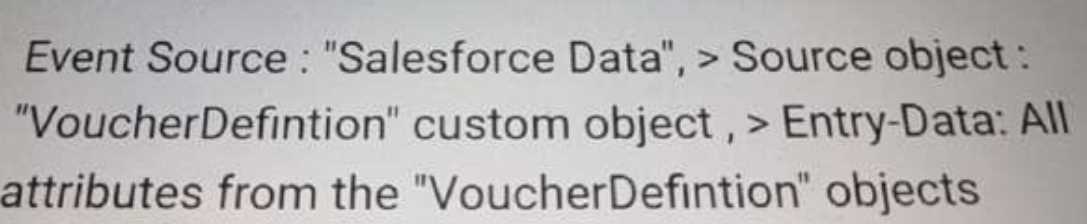
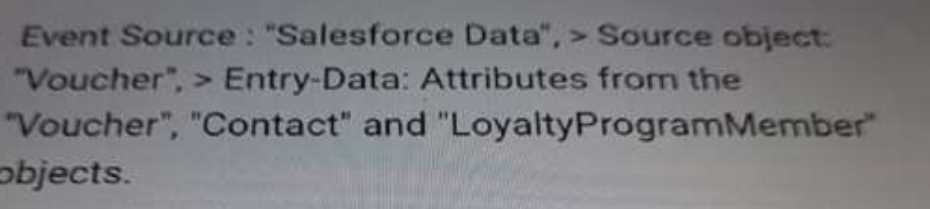
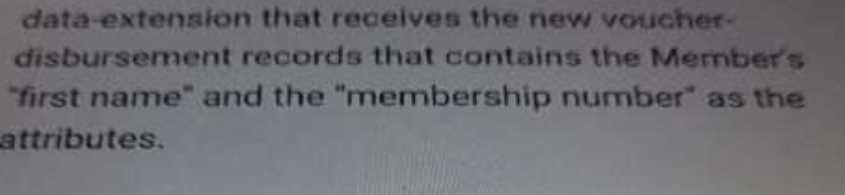
A loyalty Program would like to set up a new process where a push notification or email will be sent
to the client immediately after a voucher is added to their member account within Salesforce
Marketing Cloud.
The notification message will require the “first name” and the “membership number” to personalize
the message and, a custom object named
“voucher issued” with the necessary data attributes.
Which option for the entry event should be selected as the preferred implementation approach that
can meet the requirements with the least amount of development effort?
A)
B)
C)
D)

B)
C)
D)

Options
Discussion
B tbh, since they got upgraded on March 16, 2023, feels like the new expiry would be a year from that date.
Be respectful. No spam.
Q: 20
A Consultant needs to design a new tier-upgrade process for a new Loyalty Program. The custom
object to store the qualified members and a batch job is identified for this process.
Which two components should the Consultant select for this process?
Options
Discussion
B/D? Makes sense for global March 31 reset, but C could work if based on join date. Not totally sure.
C , since qualifying period could be based on anniversary. I thought about B too, but seems like both could work depending how the program is designed. Not fully sure though, open to other takes.
Probably B and D. Fixed tier model (B) is how you set a reset date for everyone, not by enrollment, and No Extension (D) matches the 'not extended' part. Anniversary (C) is a trap since it resets by join date, not Mar 31. Anyone see another angle?
Nah, not C. Fixed tier model and no extension are needed for a set annual reset. B and D.
Its B and D. Fixed tier model lines up with the yearly March 31 reset for everyone, not the enrollment date, which is what anniversary does. No extension makes sense since the member tier isn’t supposed to auto-renew. Pretty sure this matches what the scenario asks for, but let me know if you see it differently.
B and D. Fixed tier model fits the annual reset date and no extension matches the non-renewal requirement.
Be respectful. No spam.
Question 11 of 20 · Page 2 / 2