Artificial intelligence security is one of the fastest-growing specializations in cybersecurity, and for good reason. As organizations integrate AI systems into their core operations, the attack surface has expanded dramatically. Securing large language models, protecting AI pipelines, and defending against adversarial machine learning attacks require specialized knowledge that traditional cybersecurity training simply does not cover.
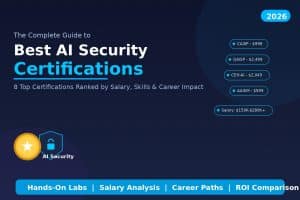
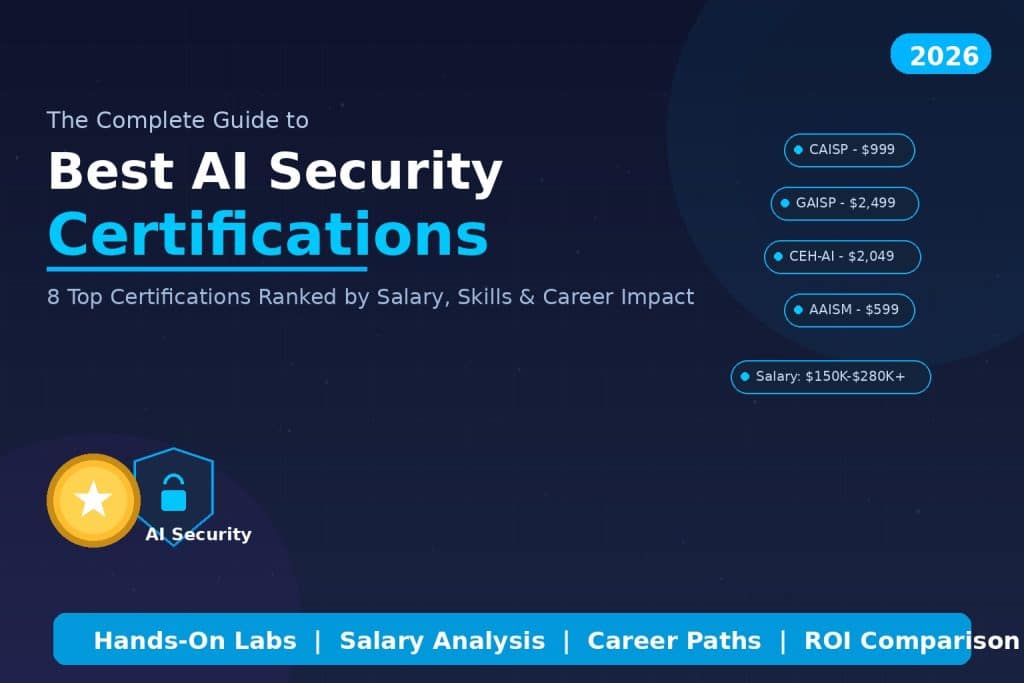
In 2026, AI security professionals are commanding salaries that range from $150,000 to well over $280,000 depending on role and specialization. The demand is high, the talent pool is shallow, and the skills gap is real. This guide breaks down the best AI security certifications available right now, what they actually teach, who they are designed for, and which ones deliver the strongest return on investment for your career.
Why AI Security Certifications Matter in 2026
The cybersecurity industry has always rewarded specialization, but AI security represents a uniquely valuable niche. Most security professionals understand network defense, penetration testing, and application security. Far fewer understand prompt injection attacks, model poisoning, membership inference vulnerabilities, or how to secure a machine learning pipeline from training through deployment.
This knowledge gap creates opportunity. Organizations need professionals who can secure Artificial Intelligence systems, but they struggle to find candidates with the right mix of cybersecurity fundamentals and AI-specific expertise. Earning a recognized AI security certification signals to employers that you possess both.
The AI Security Skills Gap
According to industry reports, over 70% of organizations are deploying AI systems in production, but fewer than 20% have dedicated AI security teams. Traditional security frameworks like ISO 27001 and NIST CSF do not adequately address AI-specific threats like adversarial examples, data poisoning, or model inversion attacks.
This creates a dangerous situation where AI systems are being deployed without proper security oversight, and it creates a lucrative opportunity for professionals who can fill that gap.
Salary Premium for AI Security Skills
Professionals with AI security certifications consistently command 15% to 25% higher salaries than peers with only traditional cybersecurity credentials. The combination of cybersecurity knowledge and AI expertise is rare enough that employers are willing to pay a significant premium for it.
The 8 Best AI Security Certifications in 2026
Below is an in-depth analysis of the top AI security certifications available in 2026, ranked by a combination of hands-on value, industry recognition, and career impact.
1. Certified AI Security Professional (CAISP)
Provider: Practical DevSecOps
Cost: $999
Format: Self-paced online with hands-on labs
Exam: Practical assessment
Best For: Security engineers, DevSecOps professionals, penetration testers, application security specialists
What Makes CAISP Stand Out
The CAISP is the most technically rigorous AI security certification on the market. Unlike certifications that focus on theory and policy, CAISP is built around hands-on practice. You work directly with vulnerable AI systems, implement attacks, and then build defenses against those same attacks.
The curriculum is structured around two core frameworks: OWASP Top 10 for LLMs and MITRE ATLAS. These are the industry-standard references for understanding AI vulnerabilities and attack patterns.
What You Actually Learn
- Prompt injection attacks — exploiting user input to manipulate LLM behavior
- Model poisoning — introducing malicious data during training to compromise model integrity
- Supply chain security for AI — securing dependencies, datasets, and third-party models
- AI threat modeling — using STRIDE methodology adapted for AI systems
- Securing DevOps pipelines for AI — integrating security into MLOps workflows
- Adversarial machine learning — crafting inputs designed to fool AI models
- Data exfiltration and privacy attacks — preventing models from leaking sensitive training data
Hands-On Lab Environment
One of the strongest features of CAISP is the lab environment. You get 60 days of browser-based lab access where you work with real vulnerable AI systems. The labs cover:
- Building and breaking LLMs
- Implementing guardrails and safety mechanisms
- Auditing AI supply chains
- Deploying secure AI pipelines in containerized environments
This is not simulated or theoretical. You are working with actual AI infrastructure, which means the skills transfer directly to real job responsibilities.
Who Should Get CAISP
If you are a security engineer looking to specialize in AI, a penetration tester who wants to expand into AI red teaming, or a DevSecOps professional integrating AI into CI/CD workflows, CAISP is the strongest choice. It provides immediate, applicable skills that employers actively seek.
ROI Analysis
At $999, CAISP is reasonably priced for the depth of training provided. Professionals who earn this certification report salary increases averaging 18% within the first year. Given the hands-on nature of the training, candidates often start applying skills on the job within weeks of completing the course.
2. GIAC AI Security Professional (GAISP)
Provider: SANS Institute / GIAC
Cost: $2,499 (exam only, course additional)
Format: In-person or live online
Exam: Multiple choice
Best For: Enterprise security architects, senior security analysts, compliance-focused roles
What GAISP Covers
The GIAC AI Security Professional certification is part of the SANS curriculum and follows their traditional model of comprehensive coverage across a broad domain. GAISP focuses on understanding AI security from an enterprise risk perspective.
Key areas include:
- AI system architecture and attack surfaces
- Regulatory compliance for AI (GDPR, CCPA, EU AI Act)
- Risk assessment frameworks for AI deployments
- Incident response for AI-related breaches
- Securing cloud-based AI infrastructure
- AI governance and policy development
Strengths and Weaknesses
Strengths:
- GIAC certifications are highly respected in government and enterprise environments
- Comprehensive coverage of AI security as a domain
- Strong focus on compliance and governance, which is valuable for senior roles
Weaknesses:
- Expensive, especially when factoring in the associated training course
- Exam is multiple-choice, which tests knowledge recall rather than hands-on ability
- Less emphasis on offensive security and red teaming compared to CAISP
Who Should Get GAISP
If you work in a highly regulated industry like finance or healthcare, or if you are moving into a security leadership role where policy and compliance matter more than technical implementation, GAISP is a strong credential. It is less suitable for hands-on security engineers who need to actively defend AI systems.
3. Certified Ethical Hacker – AI Edition (CEH-AI)
Provider: EC-Council
Cost: $1,199 (exam), $850 (training)
Format: Self-paced or instructor-led
Exam: Multiple choice
Best For: Penetration testers, ethical hackers, red team operators
What CEH-AI Adds to the Standard CEH
The CEH-AI builds on the well-known Certified Ethical Hacker framework but adds specific modules focused on AI systems. If you already hold a CEH, this is a logical next step to specialize.
Topics include:
- Exploiting AI models through adversarial inputs
- Reverse-engineering machine learning models
- Social engineering attacks enhanced by AI tools
- Deepfakes and synthetic media manipulation
- AI-powered phishing and automated exploitation
- Defending against AI-augmented attacks
Practical Application
CEH-AI is aimed at offensive security professionals. The focus is on understanding how attackers can weaponize AI and how to use AI to improve penetration testing workflows. The training includes labs, though they are less extensive than those in CAISP.
Who Should Get CEH-AI
If you are already a penetration tester or red team operator and want to add AI-specific attack techniques to your skillset, CEH-AI is a practical choice. It is not ideal for defensive security roles or those focused on building secure AI systems.
4. Advanced Certificate in AI Security Management (AAISM)
Provider: ISACA
Cost: $599 (exam), training varies
Format: Self-study with optional instructor-led courses
Exam: Multiple choice
Best For: CISOs, security managers, governance and risk professionals
Management-Level Focus
Unlike the more technical certifications on this list, AAISM is designed for security leaders who need to understand AI risks at a strategic level. This is not a hands-on certification. It focuses on building AI security programs, managing risk, and ensuring compliance.
Key areas include:
- AI governance frameworks
- Risk management for AI deployments
- Building an AI security program from scratch
- Third-party AI risk assessment
- Regulatory landscape and compliance requirements
- Communicating AI risks to executive leadership
Who Should Get AAISM
If you are a CISO, security director, or governance professional responsible for organizational AI strategy, AAISM provides the frameworks and language needed to manage AI risk at scale. It is less relevant for individual contributors or those focused on technical implementation.
5. Certified AI Governance Professional (AIGP)
Provider: International Association of Privacy Professionals (IAPP)
Cost: $799 (exam), additional training fees
Format: Self-study
Exam: Multiple choice
Best For: Privacy officers, legal counsel, compliance professionals
The Intersection of AI and Privacy
AIGP is not a security certification in the traditional sense. It focuses on the legal, ethical, and regulatory dimensions of AI, particularly as they relate to data privacy. In 2026, with the EU AI Act fully in force and increasing regulatory scrutiny worldwide, understanding these issues is critical.
Topics include:
- AI and data protection laws (GDPR, CCPA, AI Act)
- Ethical AI principles and frameworks
- Bias detection and mitigation
- Transparency and explainability requirements
- Privacy-preserving AI techniques
- Accountability and governance structures
Who Should Get AIGP
If you work in legal, compliance, or data privacy and need to understand how AI impacts those domains, AIGP is the right certification. It is not designed for technical security professionals but is valuable for those advising on AI governance and risk.
6. Microsoft Certified: AI Security Specialist
Provider: Microsoft
Cost: $165 (exam)
Format: Self-study
Exam: Multiple choice and scenario-based
Best For: Azure security engineers, cloud security architects
Azure-Specific AI Security
This certification is focused on securing AI workloads specifically within the Microsoft Azure ecosystem. If your organization runs AI systems on Azure, this credential demonstrates that you understand how to secure them using Azure-native tools.
Topics include:
- Azure AI services security configurations
- Securing Azure Machine Learning workspaces
- Identity and access management for AI services
- Data encryption and key management for AI workloads
- Monitoring and logging AI activities in Azure
- Compliance and governance in Azure AI
Strengths and Limitations
Strengths:
- Affordable and accessible
- Highly relevant if your organization is Azure-focused
- Recognized by Microsoft partners and Azure customers
Limitations:
- Narrow scope—only applies to Azure environments
- Does not cover AI security concepts that are cloud-agnostic
- Less valuable if you work in multi-cloud or on-premises AI deployments
7. Advanced Certificate in AI Audit (AAIA)
Provider: ISACA
Cost: $599 (exam), training varies
Format: Self-study
Exam: Multiple choice
Best For: IT auditors, internal audit professionals, compliance officers
Auditing AI Systems
The AAIA is designed for professionals who need to audit AI systems for compliance, risk, and control effectiveness. This is a specialized certification for auditors, not for security engineers.
Topics include:
- AI system audit methodologies
- Evaluating AI controls and governance
- Auditing for algorithmic bias and fairness
- Assessing AI model transparency and explainability
- Regulatory compliance audits for AI
- Reporting AI audit findings to stakeholders
Who Should Get AAIA
If you are an IT auditor or work in internal audit and your organization is deploying AI systems, AAIA provides the frameworks needed to audit those systems effectively. It is not relevant for security engineers or developers.
8. AWS Certified AI Practitioner – Security Specialty
Provider: Amazon Web Services
Cost: $150 (exam)
Format: Self-study
Exam: Multiple choice
Best For: AWS security engineers, cloud architects
AWS-Specific AI Security
Similar to the Microsoft certification, this is focused on securing AI workloads within AWS. It covers services like Amazon SageMaker, Amazon Bedrock, and AWS AI infrastructure.
Topics include:
- Securing SageMaker model training and deployment
- IAM policies for AI services
- Data encryption and privacy in AWS AI
- Monitoring AI workloads with CloudWatch and CloudTrail
- Compliance and governance for AWS AI services
When This Certification Makes Sense
If you work primarily in AWS and are responsible for securing AI workloads, this certification is a logical addition to your AWS certification portfolio. It is less valuable if you work across multiple clouds or need cloud-agnostic AI security knowledge.
Side-by-Side Certification Comparison
| Certification | Cost | Format | Hands-On Labs | Best For |
| CAISP | $999 | Self-paced | Extensive (60 days) | Security engineers, penetration testers |
| GAISP | $2,499+ | Live/Online | Minimal | Enterprise architects, compliance roles |
| CEH-AI | $2,049 | Self/Instructor | Moderate | Ethical hackers, red teams |
| AAISM | $599+ | Self-study | None | CISOs, security managers |
| AIGP | $799+ | Self-study | None | Privacy officers, legal counsel |
| Microsoft AI Security | $165 | Self-study | None | Azure security engineers |
| AAIA | $599+ | Self-study | None | IT auditors |
| AWS AI Security | $150 | Self-study | None | AWS security engineers |
AI Security Salary Expectations by Role (2026)
Understanding salary ranges helps you evaluate the ROI of any certification investment. Below are realistic salary expectations for AI security roles in 2026 based on market data.
| Role | Salary Range (USD) |
| AI Security Engineer | $150,000 – $210,000 |
| Lead AI Security Architect | $200,000 – $280,000+ |
| LLM Red Team Specialist | $160,000 – $230,000 |
| DevSecOps Engineer (AI Focus) | $150,000 – $210,000 |
| Adversarial ML Engineer | $160,000 – $225,000 |
| AI/ML Security Engineer | $152,000 – $210,000 |
| AI Security Specialist | $130,000 – $185,000 |
| AI Threat Intelligence Analyst | $140,000 – $195,000 |
| AI Governance Lead | $160,000 – $240,000 |
| AI Compliance Officer | $130,000 – $190,000 |
These figures represent base salaries in major tech markets. Total compensation including bonuses and equity can push these numbers significantly higher, particularly at top-tier technology companies and financial institutions.
How to Choose the Right AI Security Certification
If You Want Hands-On Technical Skills
Choose CAISP or CEH-AI. These certifications focus on doing, not just knowing. You will leave with skills you can apply immediately in penetration testing, security engineering, or DevSecOps roles.
If You Manage Security Programs
Choose AAISM or GAISP. These are designed for security leaders who need to build programs, manage teams, and communicate risk to executives. They focus on governance, compliance, and strategic oversight.
If You Work in Legal or Privacy
Choose AIGP. This is the only certification on this list that focuses on the legal and regulatory dimensions of AI. It is essential for privacy professionals but not relevant for technical security roles.
If You Work in a Specific Cloud
Choose Microsoft AI Security Specialist or AWS AI Security Practitioner if your organization is committed to one cloud platform. These certifications are narrowly focused but highly relevant within their ecosystems.
If You Are an Auditor
Choose AAIA. This is the only certification specifically designed for auditing AI systems. It is not relevant outside of audit and compliance functions.
Common Mistakes When Choosing AI Security Certifications
Choosing Based on Cost Alone
The cheapest certification is not always the best investment. A $165 exam that does not teach relevant skills is more expensive than a $999 certification that leads to a $30,000 salary increase.
Ignoring Hands-On Requirements
Multiple-choice exams test knowledge recall. Hands-on labs and practical assessments test ability. Employers care far more about what you can do than what you can memorize.
Pursuing Certifications That Do Not Match Your Role
A penetration tester does not need a governance certification. A CISO does not need a red teaming certification. Choose the credential that aligns with your actual job responsibilities.
Overlooking Prerequisites
Some certifications assume foundational cybersecurity knowledge. If you are new to security, starting with an advanced AI security certification may be premature. Build the fundamentals first.
Frequently Asked Questions
Is AI security a good career path in 2026?
Yes. It is one of the highest-paying specializations in cybersecurity with significant projected growth. The combination of high demand and limited supply of qualified professionals creates strong leverage for skilled practitioners.
Do I need to know machine learning to work in AI security?
You need to understand how machine learning works at a conceptual level and how AI systems are built and deployed. You do not need to be a data scientist or ML engineer, but you should be comfortable with basic AI concepts.
What is the difference between AI security and AI safety?
AI security focuses on defending AI systems from adversaries — preventing hacking, data theft, and manipulation. AI safety focuses on ensuring AI systems behave as intended and do not cause unintended harm. Security is about external threats. Safety is about system behavior.
Can I get an AI security job without a certification?
Yes, but it is significantly harder. Certifications provide a standardized way to demonstrate knowledge and skills. Without them, you need to prove your expertise through work experience, portfolio projects, or other credentials.
Which certification is best for career changers?
CAISP is the strongest choice for someone transitioning into AI security from a traditional cybersecurity role. It provides the technical depth needed to be effective while being accessible to those without prior AI experience.
How long does it take to earn an AI security certification?
It varies widely. CAISP typically takes 4 to 8 weeks of focused study and hands-on practice. Multiple-choice certifications like GAISP or AAISM can be completed faster if you already have security experience, typically 2 to 4 weeks of study.
Are AI security certifications worth the cost?
For most security professionals, yes. The salary premium associated with AI security expertise typically pays for the certification within the first few months. The long-term career impact is even more significant.
Conclusion
AI security is not a passing trend. It is a permanent expansion of the cybersecurity domain driven by the widespread adoption of AI systems across every industry. The professionals who develop expertise in securing AI workloads, defending against adversarial attacks, and building safe AI pipelines will be among the highest-paid and most in-demand in the field.
Choosing the right certification depends on your current role, career goals, and learning preferences. For hands-on technical roles, CAISP delivers the strongest return. For management and governance, AAISM or GAISP provide the frameworks needed to lead at scale. For legal and privacy professionals, AIGP is essential.
The key is to choose strategically and then apply what you learn. Certifications open doors, but expertise keeps them open. Invest in the credential that best aligns with where you want your career to go, and commit to building real skills, not just collecting certificates.
For exam preparation resources and practice questions for AI security certifications, visit CertEmpire.com.