
CCNA vs Network+ for a 2027 start? Choose Network+ if you are new to IT. Choose the CCNA if you already know the basics and want hands-on Cisco skills. But 2027 adds a twist. Cisco launches CCNA v2.0 on February 3, 2027, and CompTIA is working on a new Network+ (V10). So the exam you can actually sit matters as much as the exam you pick. This guide gives you a side-by-side comparison, a start-date decision grid, and a 30-day plan that works for either path. Read on, then book the right exam once.
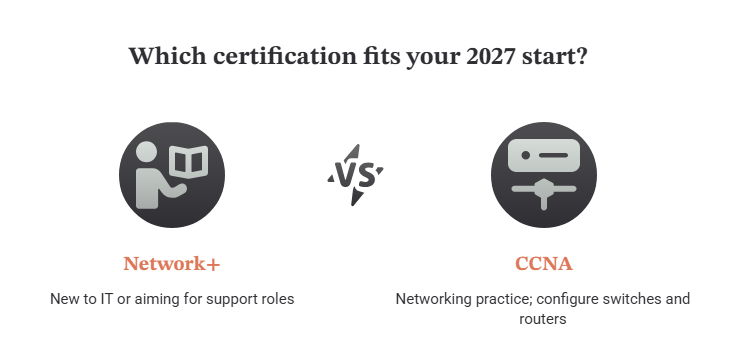
The short answer: which certification fits a 2027 start?
Pick Network+ (N10-009) if you are new to IT or aiming for support roles. Pick the CCNA if you have some networking practice and want to configure switches and routers.
Neither exam has a formal prerequisite. Cisco lists none for the CCNA. CompTIA only recommends A+ plus 9 to 12 months of hands-on experience for Network+. Use this table as a first filter:
| If this sounds like you | Start with | Why |
| New to IT, no job yet | Network+ | Broad, vendor-neutral and concept-led |
| On a help desk, getting more network tickets | Network+, then CCNA | Builds the vocabulary first, then adds depth |
| Comfortable with subnetting or running a home lab | CCNA | Rewards hands-on practice |
| Aiming for network engineer roles in Cisco shops | CCNA | Tests Cisco device configuration |
| Targeting defense or government work | Check the job post | CompTIA lists Network+ for DoD 8140 work roles |
| Not sure yet | The 30-day plan below | Both exams share the same core |
What changes in 2027, and why it matters
The CCNA changes on February 3, 2027. Network+ N10-009 is current today, but its replacement is already in development.
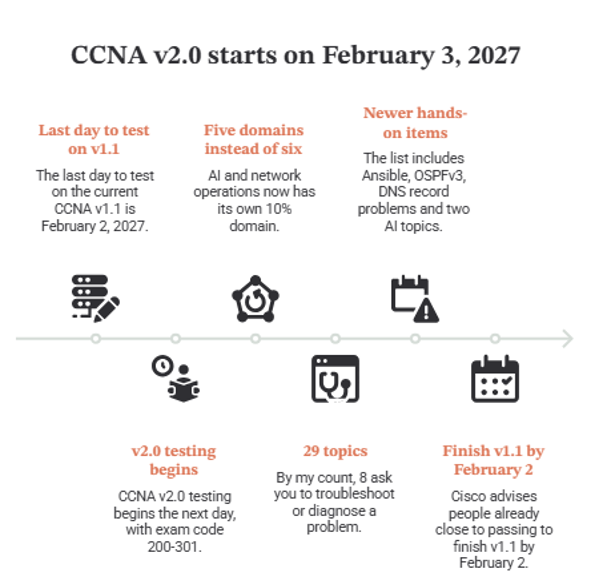
CCNA v2.0 starts on February 3, 2027
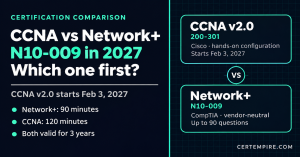
Cisco says the last day to test on the current CCNA v1.1 is February 2, 2027, and v2.0 testing begins the next day, according to Cisco’s CCNA blog. The exam code stays 200-301. Cisco calls the update a revision, not an overhaul. It adds more practical tasks, more troubleshooting, and more security and AI content.
Cisco’s v2.0 exam topics PDF shows the shift:
- Five domains instead of six. AI and network operations now has its own 10% domain.
- 29 topics. By my count, 8 of them ask you to troubleshoot or diagnose a problem. That is about 28%.
- Newer hands-on items. The list includes Ansible, OSPFv3, DNS record problems and two AI topics.
If you start studying in 2027, you will almost certainly sit v2.0. Cisco’s advice for people already close to passing is to finish v1.1 by February 2.
Network+ N10-009 is live, and V10 is on the way
CompTIA launched N10-009 on June 20, 2024. Its Network+ page says the exam usually retires about three years after launch, with 2027 as the estimate. CompTIA has also posted draft V10 objectives, and the draft lists AI concepts.
I could not confirm a V10 launch date on CompTIA’s pages. One training site, Achievable, cites CompTIA’s roadmap for April to June 2027, but I could not open that roadmap myself. Treat any date as unconfirmed.
History helps here. CompTIA says the English N10-008 retired in December 2024, about six months after N10-009 launched. If V10 follows that pattern, N10-009 should stay bookable for a while after V10 arrives. That is my inference, not a CompTIA promise. CompTIA also says a voucher works for any exam version if you use it within its 12-month life.
CCNA vs Network+ at a glance
The CCNA is Cisco-focused, longer and more hands-on. Network+ is vendor-neutral and shorter. Here is how the two compare today:
| CCNA (200-301) | Network+ (N10-009) | |
| Issued by | Cisco | CompTIA |
| Focus | Configuring and troubleshooting Cisco-based networks | Vendor-neutral networking concepts and troubleshooting |
| Length | 120 minutes | 90 minutes |
| Questions | Not published | Up to 90 |
| Question types | Performance-based, multiple choice, drag-and-drop | Multiple choice and performance-based |
| Passing score | Not published | 720 on a 100–900 scale |
| Exam fee (US) | $300 | $369 in CompTIA’s Dec 2024 FAQ; resellers now list 390–399, so check the store |
| Prerequisites | None | None required; A+ plus 9–12 months recommended |
| Valid for | 3 years | 3 years |
| Languages | English, Japanese | English, German, Japanese, Portuguese, Spanish |
Prices change, so confirm them on the official pages before you pay.
What each exam tests
Both exams cover IP addressing, switching, routing, wireless and troubleshooting. The CCNA goes deeper on Cisco configuration, while Network+ spreads wider.
The five domains side by side
CompTIA publishes Network+ weights on its exam page. Cisco publishes CCNA v2.0 weights in its topics PDF. The rows below are not matched topics. They only line up the layout.
| Network+ N10-009 domain | Weight | CCNA v2.0 domain | Weight |
| Networking concepts | 23% | Network infrastructure and connectivity | 25% |
| Network implementation | 20% | Switching and network access | 25% |
| Network operations | 19% | IP routing | 20% |
| Network security | 14% | Network services and security | 20% |
| Network troubleshooting | 24% | AI, and network operations and management | 10% |
Notice that troubleshooting is already the biggest Network+ domain. The CCNA is catching up to that focus in v2.0.
Where they overlap and where they split
The overlap is large. Achievable’s comparison lists IP addressing, subnetting, switching, VLANs, routing, wireless, DHCP, DNS and security basics on both exams. That is why a first month of study helps either way.
The split is in depth. Cisco’s topics ask you to configure trunks, EtherChannel, Rapid PVST+, single-area OSPF, NAT, ACLs and Layer 2 security on Cisco devices. CompTIA’s page adds cloud, data centers, documentation and network hardening across a broader, vendor-neutral view.
Is the CCNA harder than Network+?
Usually yes. The CCNA asks you to configure and fix Cisco devices, and v2.0 leans harder on troubleshooting.
Network+ also has performance-based questions, so it is not a pure memory test. Still, most beginners find the CCNA’s command-line work the steeper climb. INE’s analysis of the v2.0 blueprint points to a heavier focus on diagnosis and interpretation, not just recall.
Be careful with pass-rate claims. Neither Cisco nor CompTIA publishes them, as ComputingForGeeks also notes. Study sites do offer time estimates. ITStudyHub suggests about 6 to 14 weeks for Network+, and Open Exam Prep suggests 3 to 6 months for the CCNA. Treat both as rough guides.
What learners report about prep time and exam day
I read through public pass reports on Reddit, the CompTIA Community and personal blogs. They are self-reported, so treat them as colour, not data. A few patterns repeat.
Network+ N10-009. Prep time ranges from about six weeks to three months. One learner spent two months on lessons and one month on practice exams. The count of performance-based questions varies a lot, from two or three up to six or more, and one learner met six right at the start. Others mention nerves when the first simulation appears and multiple-choice items worded only in acronyms. A common tip is to mark the simulations for review and return to them last.
CCNA. Subnetting is the skill learners worry about most, because it must be quick and done without a calculator. One prep site blames most failures on skipped subnetting practice in weeks two and three. One candidate counted over 300 small labs at about an hour a day. Another scored 75 to 78 percent on practice exams before passing. Beginners often quote four to six months in total.
The takeaway: for Network+, practise simulations as well as reading. For the CCNA, lab every week, and drill subnetting early.
Jobs and pay: what the data actually shows
Neither certification guarantees a job. The best-paid networking roles ask for years of experience, not only a credential.
The U.S. Bureau of Labor Statistics (BLS) gives a useful baseline from May 2025 data:
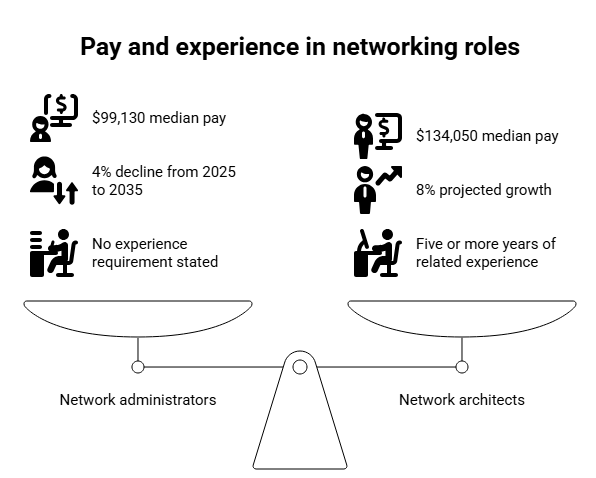
- Network and computer systems administrators: median pay of $99,130 and about 323,600 jobs. BLS projects a 4% decline from 2025 to 2035.
- Computer network support specialists: median pay of $76,220.
- Computer network architects: median pay of $134,050 and 8% projected growth. The role typically asks for five or more years of related experience.
CompTIA’s State of the Tech Workforce 2026 adds context. U.S. net tech employment slipped 0.3% in 2025, to about 9.6 million workers. CompTIA projects 1.9% growth in 2026.
What does this mean for you? An entry certification helps you get interviews for support, NOC and junior network roles. Higher pay comes with experience. So choose the cert that fits the first job you want. CompTIA names technical support, network operations and system administration as Network+ roles. ITU Online maps the CCNA to network technician, administrator and junior engineer roles.
If you want government or defense work, read the job post closely. CompTIA says Network+ meets U.S. Department of Defense directive 8140/8570.01-M requirements, and its page ties the exam to three DoD 8140 work roles. Each employer sets its own list of accepted certifications, so confirm before you pay for an exam.
I found no independent study that compares pay for CCNA and Network+ holders with a clear method. I left out salary-by-cert figures from aggregator sites because they vary widely.
A start-date decision grid for 2027
If you start studying in early 2027, plan for CCNA v2.0 and Network+ N10-009. If you start later, check whether V10 has launched. This grid is my own reasoning from the dates above, as of November 2026.
| When you start studying | CCNA | Network+ |
| Now to January 2027 | Sit v1.1 only if you can pass by Feb 2. Otherwise study the v2.0 topics. | N10-009 is live. Book once your practice scores are steady. |
| February to June 2027 | v2.0 is the only version. | N10-009 is likely current. Check CompTIA’s site before you buy materials. |
| July to December 2027 | v2.0 | Check whether V10 has launched. If it has, study the V10 objectives. |
| Unsure | Follow the 30-day plan below | Follow the 30-day plan below |
Re-check Cisco’s and CompTIA’s pages the week you book. Dates can move.
A 30-day plan that works for either exam
Spend your first 30 days on the shared core, then choose. This plan is my suggestion, not an official one.
- Week 1: Learn the OSI and TCP/IP models, common ports and basic device roles.
- Week 2: Practice IPv4 and IPv6 subnetting every day. See our CCNA 200-301 study guide for subnetting tips.
- Week 3: Study switching, VLANs and wireless basics.
- Week 4: Build a small lab in a simulator such as Cisco Packet Tracer. Break it, then fix it, and keep a troubleshooting log.
At day 30, ask two questions. Did the command-line labs feel fun? Do you want network engineer roles? If both are yes, lean CCNA. If you prefer broad IT and support work, lean Network+. If you start with A+, see our CompTIA A+ Core 1 vs Core 2 guide.
Free videos to pair with the plan: Professor Messer’s Network+ N10-009 course playlist covers the full exam objectives. For the CCNA, KBTrainings’ v2.0 vs v1.1 walkthrough explains what changed. Check any video’s date against Cisco’s and CompTIA’s pages.
What you will really pay
Expect to pay $300 for the CCNA exam and roughly $369 to $399 for Network+, plus study materials. A failed attempt means another fee. Cisco says a retake costs the same unless you bought CCNA Exam Safeguard.
Both certifications last three years. Renewing Network+ with continuing education units carries a $150 CompTIA fee. CompTIA also lists 35–55% student discounts, so check eligibility before you pay full price.
Five mistakes to avoid when you choose
Most bad picks come from timing and assumptions, not from the exams themselves. Watch for these:
- Booking v1.1 without being ready. Cisco’s deadline is real. If your practice scores are shaky in January, switch to the v2.0 topic list instead of rushing.
- Buying study material for the wrong version. Check the version on the objectives or topics page before you spend money.
- Treating Network+ as a memory test. It includes performance-based questions, so you need to apply ideas, not only recall them.
- Treating a certificate as a job offer. BLS data shows pay rising with experience. Pair the exam with labs, a help desk role or a home network project.
- Trusting random salary or pass-rate numbers. Both exam makers stay quiet on pass rates, and aggregator salaries swing widely.
Before you book, run through this short checklist. Confirm the exam version. Confirm the current fee. Match your study material to the version. Pick a test date that leaves a two-week buffer. The most avoidable mistake is choosing by forum opinion, because the threads disagree. Open three job listings for the role you want and note which certification they name.
Frequently asked questions
Should I take CCNA v1.1 or wait for CCNA 2.0?
Take v1.1 only if you can pass by February 2, 2027. Cisco tells close-to-ready candidates to keep going and finish before the deadline. Both versions earn the same CCNA and the same three-year validity. If you are months away, study v2.0 and skip the rush.
Is the CCNA harder than Network+?
For most beginners, yes. The CCNA tests Cisco configuration and troubleshooting on a longer exam. Network+ is broader but more concept-based. Your background matters more than any average.
Do I need Network+ before the CCNA?
No. Neither exam requires the other. Cisco lists no prerequisites for the CCNA. Reddit threads show real disagreement. Some people call Network+ first the classic route, while others call it a myth. If you are new to IT, Network+ first is the gentler path.
Is Network+ N10-010 coming, and should I wait for it?
A V10 exam is in development, but you should not wait for it. CompTIA has posted draft objectives, and I could not confirm a launch date on its pages. Core topics like subnetting and troubleshooting carry over, so studying now is rarely wasted.
Does the CCNA exam code change with v2.0?
No. It stays 200-301. Cisco’s v2.0 topics PDF carries the same code. Only the blueprint version changes, from v1.1 to v2.0.
Is AI on the CCNA exam?
Yes, in a small way. The v2.0 blueprint gives AI and network operations a 10% domain. Two topics cover agentic AI in network operations and picking a generative AI prompt. You do not build AI models. You describe and select.
Which certification gives better job prospects for beginners?
It depends on the job you want. Network+ fits support and general IT roles. The CCNA fits network technician and junior engineer roles, according to ITU Online. BLS data shows that pay climbs with experience, so pick the cert that matches your first target role.
Conclusion: choose by background, then by calendar
CCNA vs Network+ comes down to two things: where you are starting and which exam version you can sit. Choose Network+ if you are new to IT or heading to support roles. Choose the CCNA if you want hands-on Cisco skills and can handle the troubleshooting focus of v2.0. Use the 30-day plan if you are unsure.
Next step: open the Cisco v2.0 topics PDF and CompTIA’s Network+ page. Tick off what you already know, then start your 30 days. For more depth, read our guide to CCNA 200-301 v2.0 changes or see how CompTIA certifications stack after Network+. Want to test yourself first? Try our free practice tests at Cert Empire.