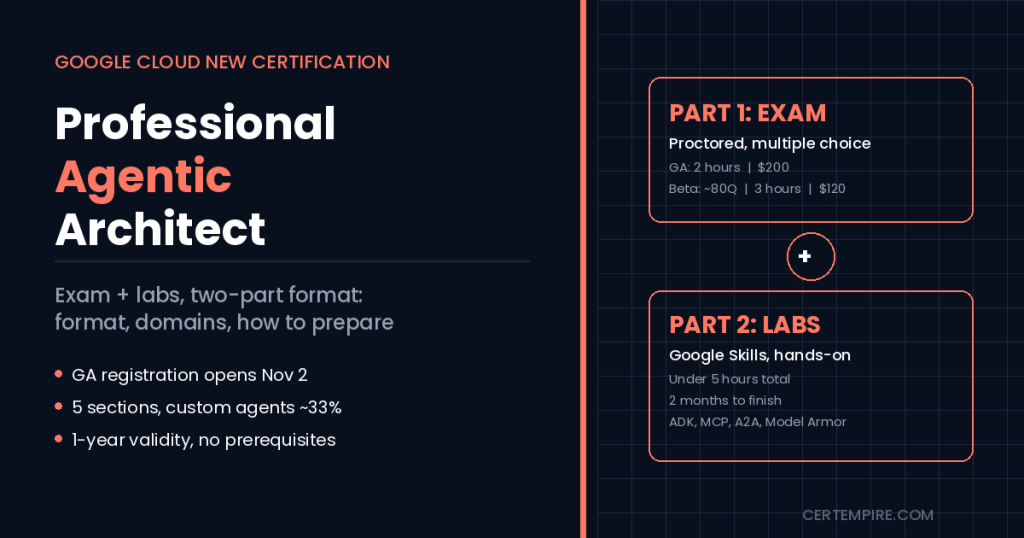
TL;DR: Google Cloud has launched a new professional certification, the Professional Agentic Architect. It validates that you can design and manage autonomous, AI-driven agent workflows on Google Cloud, and it works differently from other Google exams: you must pass two parts, a proctored multiple-choice exam and hands-on labs, and the credential is valid for one year instead of two. The beta ran September 3 to 30 for $120 and is now closed. General availability (GA) registration opens November 2, with GA expected in mid-November, a 2-hour exam and a $200 price. Google’s exam guide lists five sections: Building Agents Using Low-Code Tools (about 13%), Using Coding Agents for Application Development (about 17%), Developing Custom Agents (about 33%), Evaluating and Deploying Agentic Workflows (about 22%), and Securing and Governing Agentic Workflows (about 15%). This guide covers the dates, the format, the five sections, the new product names, and what Google has not said yet.
If you build cloud or AI systems on Google Cloud, this is the first Google certification aimed squarely at agents. Here is how it works and how to get ready.
Quick Facts
| Item | What the sources say |
| Certification | Google Cloud Professional Agentic Architect |
| Tier | Professional |
| Structure | Two parts, and both are required |
| Part 1 | Proctored multiple-choice exam, delivered by Pearson, online or at a test center |
| Part 2 | Hands-on labs in Google Skills, available only after you pass Part 1 |
| Lab time | Estimated under 5 hours, with two months to complete them after passing |
| Beta | Registration September 3 to 30, 2026. Exam window September 8 to 30. Closed |
| Beta format | About 80 questions, 3 hours, English only, $120 |
| GA registration | Opens November 2 (Google’s certification page) |
| GA release | Expected mid-November |
| GA format | 2-hour exam, results in 7 to 10 business days, $200 retail |
| Prerequisites | None required |
| Recommended experience | 3+ years of hands-on cloud experience, including 1+ year building agentic solutions on Google Cloud |
| Validity | 1 year |
| Renewal | A continuous education path is offered because of the one-year validity |
The Two-Part Timeline
Because this certification has an exam and labs, dates matter more than usual. Here is the sequence as Google describes it.
| Date | What happens | What it means for you |
| September 3, 2026 | Beta registration opens | Passed |
| September 8 to 30, 2026 | Beta multiple-choice exam window | Closed |
| Late October 2026 | Beta exam results appear in CM Connect | Only affects people who sat the beta |
| Late October to December 31, 2026 | Labs open to beta passers | Beta passers must finish by December 31 |
| November 2 | GA registration opens | Your first chance to book if you missed the beta |
| Mid-November | GA release expected | The exam becomes generally available |
| After passing the GA exam | Two months to complete the labs | Plan your lab time in advance |
| 1 year after certification | Credential expires | Renewal path required |
Which route are you on?
| Your situation | Route |
| You sat the beta exam | Wait for your results in late October, then complete the labs by December 31 if you passed |
| You did not sit the beta | Register for GA when registration opens on November 2 |
| You want to get ready first | Use the five-section study plan below |
A detail worth noting: Google says you can earn the certification by passing either the beta or the GA exam. Beta attempts do not count toward the attempt limit.
What the Certification Validates
Google describes a Professional Agentic Architect as a technical practitioner who designs and manages autonomous, AI-driven agentic workflows on Google Cloud. The profile is an experienced developer or architect who weighs reliability, performance, cost, security and scalability, with deep experience with large language models (LLMs), agent design patterns, coding and integrating data sources.
The certification assesses the ability to:
- Build agents using low-code tools
- Use coding agents for application development
- Develop custom agents
- Evaluate and deploy agentic workflows
- Secure and govern agentic workflows
Part 1 tests conceptual knowledge, system design choices and architectural standards. Part 2 tests whether you can actually do it, through hands-on labs.
Why the Two-Part Format Matters
| Feature | What it means |
| Both parts are required | Passing the multiple-choice exam alone does not earn the certification or the digital badge |
| Labs unlock only after Part 1 | You cannot practice the graded labs in advance |
| Under 5 hours of labs | A real time commitment on top of exam day |
| Two months to finish | A deadline you need to plan around |
| One year validity | Shorter than most Google professional certifications, so renewal comes sooner |
Many Google professional exams are a single sitting. This one adds a practical component, which shifts how you should prepare. Reading is not enough. You need hands-on time with the tools named in the exam guide.
The Five Sections, Weighted
These weights and topics come from Google’s exam guide. The percentages add up to 100.
| # | Section | Weight |
| 3 | Developing custom agents | ~33% |
| 4 | Evaluating and deploying agentic workflows | ~22% |
| 2 | Using coding agents for application development | ~17% |
| 5 | Securing and governing agentic workflows | ~15% |
| 1 | Building agents using low-code tools | ~13% |
Section 3: Developing custom agents (~33%)
This is the largest section by a wide margin. It has three parts.
| Part | Topics in Google’s guide |
| 3.1 Designing and building agentic workflows in code | Choosing LLM vs SLM, self-hosted vs SaaS, and open-source vs proprietary models based on cost, security and architecture. Building custom agents with the Agent Development Kit (ADK). Configuring sessions and memory. Configuring skills with Agents CLI |
| 3.2 Integrating enterprise domain knowledge | Designing and managing RAG pipelines and vector retrieval (embedding models, similarity scoring, reranking). Configuring agent permissions with Agent Identity. Using Agent Registry and Google Cloud MCP servers for prebuilt and custom capabilities |
| 3.3 Orchestrating and coordinating agentic workflows | Orchestrating agents with MCP and Agent2Agent (A2A). Coordinating multi-agent handoffs in parallel, sequential and graph workflows |
Section 4: Evaluating and deploying agentic workflows (~22%)
| Part | Topics in Google’s guide |
| 4.1 Evaluating agents in development and production | Building test sets with golden data, prompts and edge cases. Creating continuous evaluation pipelines that assess tool execution against success criteria. Choosing evaluation tooling such as ADK evalset, the Gen AI evaluation service and custom autoraters |
| 4.2 Deploying and scaling production workloads | Selecting a runtime (Agent Runtime, Cloud Run or GKE) based on use case and cost. Troubleshooting drift, tool invocation latency, reasoning loops and system failures. Monitoring performance, reliability and cost, including hallucinations |
Section 2: Using coding agents for application development (~17%)
| Part | Topics in Google’s guide |
| 2.1 Using coding agents effectively | Configuring coding agents with MCP servers, custom skills and tool access. Running coding agents in secure sandboxes such as GKE and Cloud Workstations. Using coding agents to refactor code, optimize runtimes and patch application-layer vulnerabilities |
| 2.2 Customizing coding agents for enterprise workflows | Creating skills, plugins, extensions, hooks, rules and subagents in Antigravity. Using Agents CLI with Antigravity to build, scale, govern and optimize deployed agents |
One detail stands out: the guide names Claude Code on Google Cloud alongside Antigravity as an example of a coding agent you may need to configure. That makes this exam relevant to people who also work with Anthropic tooling.
Section 5: Securing and governing agentic workflows (~15%)
| Part | Topics in Google’s guide |
| 5.1 Configuring agent security and governance | Authentication and secure tool execution with OAuth 2.0. Principal access boundary policies with Agent Identity. Monitoring traffic and tracking agents with Agent Gateway. Governance and policy enforcement with Agent Registry and Model Armor |
| 5.2 Implementing secure agent behavior and execution | Safety frameworks and guardrails, including Agent Gateway, Model Armor and human-in-the-loop controls. Secure data access and identity propagation |
Section 1: Building agents using low-code tools (~13%)
| Part | Topics in Google’s guide |
| 1.1 Configuring agentic workflows and behavior using low-code tools | State-based workflows (pages, transition routes, event handlers) in Gemini Enterprise Agent Designer and CX Agent Studio. System instructions and prompt templates, such as few-shot and chain-of-thought prompting |
| 1.2 Connecting enterprise data to Gemini Enterprise | Securely connecting to and querying proprietary data. Ingesting and processing unstructured multimodal data such as video, audio and images |
The Tools You Need to Know
Google’s guide lists the in-scope tools. Here they are, grouped so you can plan your hands-on time.
| Group | Tools named in the guide |
| Agent building | Agent Development Kit (ADK), Agents CLI, Agent Designer and CX Agent Studio, Gemini Enterprise, Gemini LLMs, Model Garden |
| Coding agents | Antigravity (CLI, SDK, App), Claude Code on Google Cloud, MCP servers, Skill Registry |
| Data and retrieval | Agent Search, Agent Retrieval, Vector Search, RAG Engine, BigQuery, Cloud SQL, Cloud Storage, Firestore, Memorystore for Redis |
| Runtime and deployment | Agent Runtime, Cloud Run, GKE, Cloud Workstations |
| Evaluation and observability | Agent evaluation, Google Cloud Observability (Cloud Logging and Cloud Trace) |
| Security and governance | Agent Identity, Agent Gateway, Agent Registry, Auth Manager (OAuth 2.0), Model Armor, Sensitive Data Protection |
| Protocols | A2A and MCP |
Several of these have new names. The guide itself notes that Agent Runtime was formerly Agent Engine, and that Agent Search was formerly Vertex AI Search. If your study material uses older names, map them before you practice.
Beta vs GA: What Differs
| Item | Beta | GA |
| Status | Closed | Registration opens November 2, release expected mid-November |
| Exam length | 3 hours | 2 hours |
| Questions | About 80 | Not stated |
| Price | $120 (40% off) | $200 retail |
| Language | English only | Not stated |
| Results | Late October for the exam | 7 to 10 business days |
| Labs | Late October to December for beta passers | Two months after passing the exam |
Google explains that beta results arrive later because the data helps set the GA passing standard. It also says the final version may differ from the beta. Because we do not know the GA question count or passing score, avoid assuming the beta format carries over.
Who Should Take It
| Your profile | Fit | Why |
| Cloud architect or developer building LLM agents on Google Cloud | Strong | Matches the recommended 3+ years of experience and 1+ year building agentic solutions |
| ML engineer moving into agent systems | Good | Sections 3 and 4 cover model choice, RAG and evaluation |
| Platform or security engineer | Good | Section 5 and part of Section 4 cover governance, identity and monitoring |
| Early-career developer with little cloud experience | Weak for now | Google recommends 3+ years of experience, though it does not require it |
| Someone who only wants a quick credential | Poor fit | The labs and one-year validity add effort and upkeep |
If you are comparing agent-related credentials across vendors, these CertEmpire guides can help:
- AWS Generative AI Developer (AIP-C01) exam guide
- AI-103 vs AI-200 for Microsoft’s AI developer exams
- CCAR-F vs CCA-F for Anthropic’s architect certifications
- Best cloud computing certifications for the wider picture
Cost and Upkeep
| Item | Amount | Note |
| GA exam fee | $200 retail | Beta was $120. Tax may apply |
| Labs | Included with Part 2 | Google does not list a separate lab fee in the pages we read |
| Validity | 1 year | Shorter than the usual two years for Google professional certifications |
| Renewal | A continuous education path is offered | Details are not in the pages we read |
| Practice | Google’s free tier and new-customer credits | Google’s certification page mentions $300 in new-customer credits |
For a wider look at Google Cloud exam pricing, see our GCP certification cost guide.
The one-year validity changes the math. A two-year certification pays you back over a longer window. A one-year certification needs renewal sooner, so check the renewal path before you decide how much to invest.
A Study Plan Built Around the Weights
This plan assumes you have some experience with Google Cloud and LLM applications.
| Week | Focus | Goal |
| 1 | Section 3.1: models and ADK | Model selection tradeoffs, ADK basics, sessions and memory |
| 2 | Section 3.2: RAG and enterprise data | Embeddings, similarity scoring, reranking, Agent Identity, Agent Registry |
| 3 | Section 3.3: orchestration | MCP, A2A, and parallel, sequential and graph handoffs |
| 4 | Section 4: evaluation and deployment | Test sets, evaluation pipelines, runtimes, troubleshooting |
| 5 | Section 5: security and governance | OAuth 2.0, Agent Gateway, Model Armor, guardrails, human-in-the-loop |
| 6 | Section 2: coding agents | MCP servers, sandboxes, Antigravity customization |
| 7 | Section 1: low-code | Agent Designer, CX Agent Studio, prompt templates, multimodal data |
| 8 | Practice and labs prep | Timed questions, and hands-on practice with the in-scope tools |
For extra practice questions on the broader Google Cloud track, you can use our Professional Cloud Architect practice questions, keeping in mind they do not cover agent-specific content.
Five practice prompts
These are study prompts, not real exam questions.
| # | Prompt | Section |
| 1 | You need an agent to answer questions from private documents. Describe the retrieval pipeline and one way to improve ranking | 3.2 |
| 2 | Two agents must hand work to each other. Explain when you would choose a sequential versus a parallel workflow | 3.3 |
| 3 | An agent keeps looping on a tool call. List three places you would look to diagnose it | 4.2 |
| 4 | Describe how you would give an agent limited access to a database without sharing a human user’s credentials | 5.1 |
| 5 | A coding agent will run in a sandbox. List two controls you would require before letting it patch production code | 2.1 |
Common Mistakes
| Mistake | Why it hurts |
| Treating it as a single-sitting exam | Both parts are required, and labs add real work |
| Studying with older product names only | The guide uses names such as Agent Runtime and Agent Search |
| Spreading time evenly across sections | Custom agents carry about 33% |
| Skipping evaluation because it feels like a side topic | It carries about 22% |
| Planning only for the exam date | You have two months to finish the labs after passing |
| Ignoring the one-year validity | Renewal arrives sooner than for most Google professional credentials |
| Assuming the GA exam matches the beta | The beta was 3 hours and the GA exam is 2 hours |
Career Value
The certification targets developers, cloud architects and engineers who design and run agent systems, which is a fast-growing area of cloud work. A hands-on lab requirement gives employers a stronger signal than a multiple-choice exam alone.
We have not included salary figures in this post. The certification is new, and we could not find a pay figure that separates people holding it from everyone else in a similar role. For the wider market, see our artificial intelligence salary and jobs guide.
What We Don’t Know Yet
| Open question | Why it matters |
| The GA question count and passing score | The beta used about 80 questions, but Google says the final version may differ |
| GA languages | The beta was English only |
| The exact GA release date | Registration opens November 2, and Google says GA is expected in mid-November |
| What passing the labs requires | Google describes the labs but we did not find a scoring rule |
| Whether you can retake the labs separately | We found no statement |
| The renewal details | Google mentions a continuous education path but we did not find specifics |
| Whether GA weights match the beta | The guide we read is not dated |
| Pass rates | No data published |
FAQSs
What is the Google Cloud Professional Agentic Architect certification?
It is a professional-level Google Cloud certification for people who design and manage autonomous, AI-driven agentic workflows. It tests building agents, using coding agents, developing custom agents, evaluating and deploying workflows, and securing and governing them.
How is the exam structured?
In two parts. Part 1 is a proctored multiple-choice exam delivered by Pearson. Part 2 is hands-on labs in Google Skills, available only after you pass Part 1. You must pass both.
Is the beta still open?
No. Beta registration ran September 3 to 30, 2026 and is closed.
When can I take the exam now?
GA registration opens November 2, and Google expects GA in mid-November.
How much does it cost?
The beta cost $120. The GA price is $200 retail, plus tax where applicable.
How long is the exam?
The beta was 3 hours with about 80 questions. The GA exam is a 2-hour session. The GA question count is not stated.
How long are the labs?
Google estimates under 5 hours, and you have two months to finish them after passing the exam.
What are the five sections and their weights?
Building agents using low-code tools (about 13%), using coding agents for application development (about 17%), developing custom agents (about 33%), evaluating and deploying agentic workflows (about 22%), and securing and governing agentic workflows (about 15%).
Are there prerequisites?
None are required. Google recommends 3+ years of hands-on cloud experience, including 1+ year building agentic solutions on Google Cloud.
How long is the certification valid?
One year, shorter than most Google professional certifications. Google offers a continuous education path for renewal.
Does the exam cover Claude Code?
The exam guide names Claude Code on Google Cloud as an example of a coding agent, alongside Antigravity, in the coding agents section.
Is it the same as the Professional Machine Learning Engineer exam?
No. The Machine Learning Engineer exam focuses on building and operating ML systems, while this one focuses on agent workflows, tool use, evaluation and governance.
Can I earn it by passing the beta?
Yes. Google says you can earn the certification by passing either the beta or the GA exam. Beta passers must finish the labs by December 31, 2026.