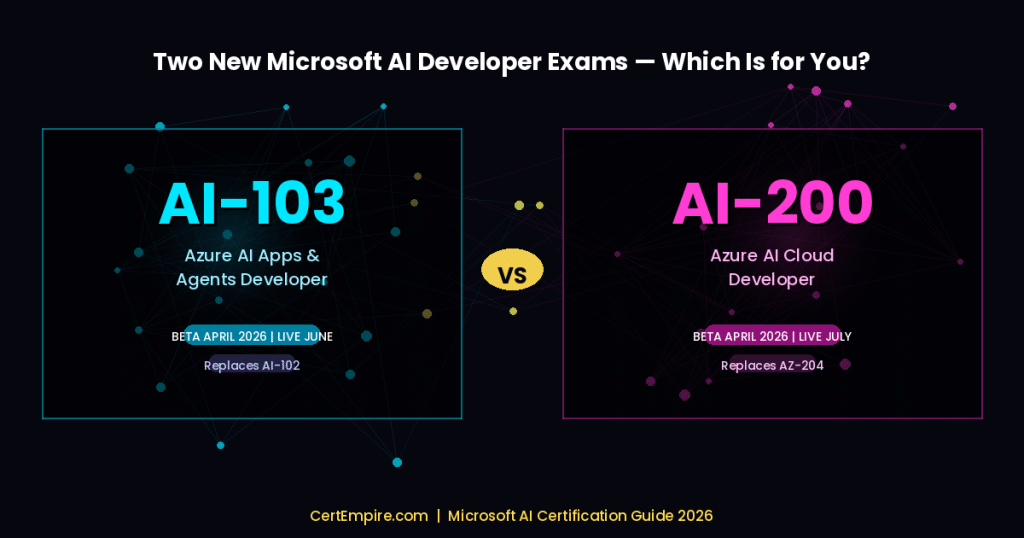
The direct answer: AI-103 is for developers who build AI applications and autonomous agents using Microsoft Foundry. AI-200 is for cloud developers who build and integrate AI solutions across Azure’s full cloud infrastructure — containers, serverless functions, vector databases, and event-driven pipelines.
Both are brand new in 2026. Both go live in June–July 2026. Both target developers. But they validate fundamentally different skill sets for fundamentally different roles. Choosing the wrong one wastes months of preparation on content that does not match your actual job.
What Is the Difference Between AI-103 and AI-200?
| Factor | AI-103 | AI-200 |
| Official name | Developing AI Apps and Agents on Azure | Developing AI Cloud Solutions on Microsoft Azure |
| Certification earned | Azure AI Apps and Agents Developer Associate | Azure AI Cloud Developer Associate |
| Replaces | AI-102 (retiring June 30, 2026) | AZ-204 (retiring July 31, 2026) |
| Primary platform | Microsoft Foundry | Azure cloud infrastructure |
| Primary focus | Build AI applications and autonomous agents using Foundry | Build, integrate, and monitor AI solutions on Azure cloud-native infrastructure |
| Agent development | Core domain — multi-agent orchestration, tool calling, agent memory | Covered but as integration pattern, not primary focus |
| Microsoft Foundry | Central — every domain runs through it | Adjacent — Foundry integrates with Azure infrastructure |
| Containerized compute | Not the primary focus | Core domain — Azure Container Apps, AKS |
| Serverless functions | Not the primary focus | Core domain — Azure Functions, event-driven pipelines |
| Vector databases | Covered in RAG context | Core domain — Cosmos DB, PostgreSQL pgvector, Azure Managed Redis |
| Event-driven architecture | Not the primary focus | Core domain — Azure Service Bus, Event Grid |
| Computer vision | Dedicated domain — multimodal, video analysis | Not a primary focus |
| Text analysis | Dedicated domain — NLP, sentiment, extraction | Not a primary focus |
| Distributed observability | Not primary | Core domain |
| Beta available | April 2026 (this month) | April 2026 |
| General availability | June 2026 | July 2026 |
| Exam cost | $165 USD | $165 USD |
| Passing score | 700/1000 | 700/1000 |
| Duration | ~120 minutes | ~120 minutes |
What Is AI-103?
AI-103 is the Microsoft certification for developers who build AI applications and autonomous agents using Microsoft Foundry as their primary platform. It replaces AI-102 (Azure AI Engineer Associate) which retires June 30, 2026.
Official Microsoft description: AI-103 is for Azure AI engineers who build, manage, and deploy agents and AI solutions that take advantage of Microsoft Foundry — the unified platform for model management, agent configuration, and evaluation pipelines.
The shift from AI-102 to AI-103 is significant. AI-102 tested implementation of discrete Azure AI services — search, vision, NLP, document intelligence, Azure OpenAI. AI-103 goes beyond individual service implementation into building complete, production-ready AI applications and multi-agent systems.
AI-103 Exam Domains
| Domain | What You Do |
| Plan and manage Azure AI solutions | Choose appropriate models (LLMs, SLMs, multimodal), select Foundry services for generative tasks, design Azure infrastructure for AI apps and agent solutions, configure security including managed identity and private networking, apply responsible AI governance |
| Implement generative AI and agentic solutions | Build generative AI apps using Microsoft Foundry, implement RAG (retrieval-augmented generation) patterns, develop AI agents with tool calling and function calling, implement multi-agent orchestration, build multistep reasoning workflows, configure agent memory and knowledge integration |
| Implement computer vision solutions | Configure Azure Content Understanding in Foundry Tools for visual characteristics extraction, implement video analysis workflows, implement single-task and pro-mode Content Understanding pipelines, detect and mitigate indirect prompt injection via images |
| Implement text analysis solutions | Extract entities, topics, summaries, and structured JSON outputs using generative prompting and Foundry Tools, detect sentiment, tone, safety issues, and sensitive content |
| Implement information extraction solutions | Build information extraction pipelines for RAG, configure retrieval and indexing methods, process complex documents for knowledge grounding |
Core tools tested: Microsoft Foundry (hub and project architecture), Azure AI Foundry Agent Service, Semantic Kernel, Copilot Studio, Azure OpenAI Service, RAG pipelines, A2A and MCP protocols, Azure AI Search, Document Intelligence.
Who AI-103 is for: Developers building generative AI applications, engineers implementing autonomous AI agents, developers working with Microsoft Foundry as their primary AI development platform, professionals transitioning from AI-102.
What Is AI-200?
AI-200 is the Microsoft certification for cloud developers who build and integrate AI solutions across Azure’s full cloud infrastructure. It replaces AZ-204 (Azure Developer Associate) which retires July 31, 2026.
Official Microsoft description: AI-200 validates the ability to build, integrate, and monitor AI solutions on Azure using containerized compute, vector-enabled databases, event-driven AI pipelines, serverless functions, secret management, and distributed observability.
The shift from AZ-204 to AI-200 reflects where Azure application development is heading. AZ-204 validated broad Azure developer competencies — compute, storage, security, API management, messaging. AI-200 narrows to the cloud infrastructure skills specific to building AI-powered applications — how you deploy AI workloads, connect AI services to enterprise data through vector search, build event-driven AI pipelines, and observe distributed AI systems in production.
AI-200 Exam Domains
| Domain | What You Do |
| Plan and manage AI resources | Plan Azure AI solution architecture, select appropriate Azure compute and data services for AI workloads, manage AI resource configuration and lifecycle |
| Build AI solutions on Azure | Implement Azure compute and containerization patterns (Azure Container Apps, AKS), build serverless APIs with Azure Functions, integrate services using event-driven and message-based architectures (Azure Service Bus, Event Grid) |
| Work with vector-enabled data | Design and query solutions with Cosmos DB for NoSQL, Azure Database for PostgreSQL with pgvector, Azure Managed Redis for caching and vector search, implement vector indexing and semantic search patterns |
| Implement AI pipelines and integrations | Build event-driven AI pipelines, connect AI services to enterprise data sources, implement RAG patterns with Azure-native data services |
| Secure and observe AI solutions | Implement secret management with Azure Key Vault, configure managed identities, implement distributed observability with Azure Monitor, Application Insights, and tracing |
Core tools tested: Azure Container Apps, Azure Kubernetes Service, Azure Functions, Azure Service Bus, Azure Event Grid, Cosmos DB for NoSQL, Azure Database for PostgreSQL with pgvector, Azure Managed Redis, Azure Key Vault, Azure Monitor, Application Insights, Azure API Management.
Who AI-200 is for: Cloud developers and backend engineers building AI-powered applications on Azure infrastructure, solution architects designing enterprise AI platforms, developers with strong Azure foundations who want to specialize in AI cloud solutions.
The Core Philosophical Difference
AI-103 asks: Can you build AI applications and agents?
AI-200 asks: Can you build the cloud infrastructure that AI applications run on?
Think of it this way:
The AI-103 developer writes the AI logic — designs the agent, implements tool calling, builds the RAG pipeline, configures the Foundry project. They are focused on making AI work correctly and responsibly.
The AI-200 developer builds the cloud platform that hosts and connects those AI solutions — configures the containerized deployment, sets up the event-driven pipeline that feeds data to the AI system, implements vector search in the database layer, and observes the distributed system in production.
Both roles are essential in enterprise AI development teams. They are different specializations that often work side by side.
How AI-103 and AI-200 Relate to AI-102 and AZ-204
This is the context that matters most for candidates already in the Microsoft certification ecosystem.
| Old Certification | Retires | New Replacement | What Changed |
| AI-102 Azure AI Engineer Associate | June 30, 2026 | AI-103 Azure AI Apps and Agents Developer | Shifts from service implementation to complete app and agent development via Microsoft Foundry |
| AZ-204 Azure Developer Associate | July 31, 2026 | AI-200 Azure AI Cloud Developer | Shifts from broad Azure development to AI-focused cloud-native infrastructure and AI solution integration |
If you hold AI-102: You have until June 30 to renew, then AI-102 retires. Your credential remains valid until it expires. AI-103 is the natural next step — it is the evolution of your certification into agentic and generative AI territory. Our detailed AI-102 vs AI-103 guide covers that specific transition.
If you hold AZ-204: You have until July 31 to renew, then AZ-204 retires. AI-200 is the replacement. Our detailed AZ-204 vs AI-200 guide covers that specific transition.
If you are starting fresh with no prior certification: Choose based entirely on your role and daily work, not on what is retiring.
Which Should You Take Based on Your Role?
| Your Role | Take This |
| You build generative AI apps and agents as your primary work | AI-103 |
| You build AI-powered applications on Azure cloud infrastructure | AI-200 |
| Your work is centered on Microsoft Foundry, Copilot Studio, or Semantic Kernel | AI-103 |
| Your work involves containerizing AI workloads on Azure | AI-200 |
| You implement RAG pipelines and multi-agent orchestration | AI-103 |
| You work with vector databases, Azure Functions, and event-driven architectures | AI-200 |
| You were studying for AI-102 and it is retiring | AI-103 — it is the direct replacement |
| You were studying for AZ-204 and it is retiring | AI-200 — it is the direct replacement |
| You are a software developer building AI-first applications | AI-103 |
| You are a cloud architect designing infrastructure for AI solutions | AI-200 |
| You want the most immediately available certification | AI-103 (June 2026 vs July 2026 for AI-200) |
Can You Take Both AI-103 and AI-200?
Yes. They are complementary credentials that together validate full-stack Azure AI development competency.
AI-103 validates the AI application and agent development skills. AI-200 validates the cloud infrastructure skills that those applications run on. A developer who holds both can credibly claim end-to-end Azure AI development expertise — from Foundry-based agent design to containerized cloud deployment and distributed observability.
Most professionals specialize in one dimension or the other. But for senior AI solution architects or full-stack AI engineers whose work genuinely spans both layers, pursuing both certifications builds a credential profile that is genuinely distinctive in the 2026 job market.
Timeline: AI-103 and AI-200 in April 2026
This matters because both exams are moving through their release cycle right now:
| Milestone | AI-103 | AI-200 |
| Training available | March 31, 2026 ✅ | April 2026 ✅ |
| Beta exam available | April 2026 — happening now | April 2026 — happening now |
| General availability | June 2026 | July 2026 |
| Beta discount | 80% off — code AI103Claxton (first 300, by May 7, 2026) | Check Microsoft Learn for current offer |
AI-103 is available in beta right now. If you are preparing for the beta, free AI-103 practice questions can help you assess whether you are ready to be among the first certified. AI-200 beta is also available in April 2026. Both exams go live within the next two to three months.
How to Prepare for AI-103
Step 1: Get deeply hands-on with Microsoft Foundry. Foundry is the central platform for AI-103. Set up a Foundry hub and project. Deploy a model from the model catalog. Configure an evaluation pipeline. Build a prompt flow. The exam tests operational Foundry skills — reading about Foundry is not sufficient.
Step 2: Build a complete AI agent. The agentic AI and generative solutions domain is the most distinctive content area of AI-103. Build an agent using the Foundry Agent Service or Semantic Kernel. Implement tool calling — give your agent the ability to call external APIs. Implement multi-agent orchestration where one agent coordinates work across others. Understand the A2A (Agent-to-Agent) and MCP (Model Context Protocol) protocols.
Step 3: Implement a production-grade RAG pipeline. RAG is central to both grounding AI responses in real data and AI-103 assessment. Build a RAG system: chunk documents, create embeddings, index in Azure AI Search, retrieve relevant context, and pass it to an LLM. Understand hybrid search, relevance tuning, and knowledge base management.
Step 4: Cover the multimodal and text analysis domains. These domains (computer vision, text analysis, information extraction) carry content that AI-102 holders will recognize — Azure AI Vision, Document Intelligence, sentiment analysis, entity extraction. AI-103 updates this content to reflect Foundry-based implementations and generative approaches rather than purely service-based implementations.
Step 5: Study responsible AI governance for production systems. AI-103 explicitly tests safety filters, guardrails, risk detection, content moderation, responsible AI instrumentation including evaluators and safety evaluations, and auditing through trace logging and provenance metadata. This is not optional content — it is tested throughout the exam.
Step 6: Use current practice materials. Our Microsoft exam preparation section covers current active Microsoft certifications.
How to Prepare for AI-200
Step 1: Build strong Azure cloud-native infrastructure skills first. AI-200 builds on Azure cloud development fundamentals. If you do not already understand containerization with Docker and Azure Container Apps, Azure Functions triggers and bindings, Azure Service Bus and Event Grid messaging patterns, and Azure Monitor observability — build that foundation before focusing on the AI-specific content.
Step 2: Get hands-on with vector databases on Azure. Vector database integration is a distinctive new content area for AI-200 compared to AZ-204. Practice with three platforms: Cosmos DB for NoSQL vector search, Azure Database for PostgreSQL with the pgvector extension, and Azure Managed Redis for caching and vector search. Implement a semantic search scenario on each to understand the tradeoffs between them.
Step 3: Build an event-driven AI pipeline. The event-driven architecture domain is central to AI-200. Build a pipeline where an event triggers an Azure Function, which calls an Azure AI service, which stores results in a vector database, which serves a downstream AI application. Understanding how Azure Service Bus and Event Grid serve different use cases in AI pipelines is specifically tested.
Step 4: Master observability for distributed AI systems. AI-200 tests distributed observability — the ability to monitor AI applications across multiple components that communicate asynchronously. Study Azure Monitor, Application Insights, distributed tracing, and log-based diagnostics in the context of AI application monitoring rather than traditional application monitoring.
Step 5: Study the official AI-200T00 course content. Microsoft’s official course AI-200T00: Develop AI Cloud Solutions on Microsoft Azure covers the full exam scope. The course covers containerization patterns, serverless APIs with Azure Functions, event-driven and message-based architectures, and working with Cosmos DB, PostgreSQL pgvector, and Azure Managed Redis for AI workloads.
AI-103 vs AI-200 vs AI-102 vs AZ-204: The Full Picture
Many candidates in April 2026 are trying to understand how all four certifications relate. Here is the complete map:
| Factor | AI-102 (Retiring June 30) | AI-103 (New June 2026) | AZ-204 (Retiring July 31) | AI-200 (New July 2026) |
| Focus | Implement Azure AI services | Build AI apps and agents via Foundry | Build Azure applications broadly | Build AI solutions on Azure cloud infrastructure |
| Core platform | Azure AI services | Microsoft Foundry | Azure (broad) | Azure cloud-native (containers, serverless, vector DBs) |
| Agent development | Limited | Core domain | Not covered | Integration pattern |
| Action required now | Renew before June 30 or switch to AI-103 | Take beta now if ready | Finish before July 31 or switch to AI-200 | Take beta now if ready |
For complete guidance on the AI-102 to AI-103 decision specifically, see our AI-102 vs AI-103 guide. For the AZ-204 to AI-200 decision specifically, see our AZ-204 vs AI-200 guide. For the full picture of every Microsoft certification change in 2026, our Microsoft certifications retiring in 2026 guide covers every retirement date and replacement.
Salary and Career Context
| Role | Average US Salary |
| Azure AI App and Agent Developer (AI-103 level) | $115,000 to $155,000 |
| Senior AI Application Engineer / Foundry Specialist | $140,000 to $180,000 |
| Azure AI Cloud Developer (AI-200 level) | $110,000 to $150,000 |
| Senior Cloud AI Architect | $140,000 to $185,000 |
AI developer roles across both specializations are among the highest-compensated positions in enterprise technology in 2026. The combination of cloud infrastructure expertise and AI application development skills is exactly what enterprises deploying AI at scale are hiring for aggressively.
Frequently Asked Questions: AI-103 vs AI-200
What is the difference between AI-103 and AI-200?
AI-103 validates skills in building AI applications and autonomous agents using Microsoft Foundry. AI-200 validates skills in building and integrating AI solutions on Azure cloud infrastructure — containers, serverless functions, vector databases, and event-driven pipelines. They are different certifications for different developer specializations.
Which is harder — AI-103 or AI-200?
Both are associate-level certifications requiring hands-on technical preparation. AI-103 requires deep familiarity with Microsoft Foundry, agent development patterns, and generative AI implementation. AI-200 requires deep familiarity with Azure cloud-native infrastructure and how AI workloads integrate with it. Difficulty depends entirely on your background, and trying practice tests for different certifications can help you determine which path better matches your current skills
When are AI-103 and AI-200 available?
AI-103 beta is available in April 2026 with general availability expected June 2026. AI-200 beta is also available in April 2026 with general availability expected July 2026. AI-103 reaches general availability approximately one month before AI-200.
Does AI-103 replace AI-102?
Yes. AI-102 (Azure AI Engineer Associate) retires June 30, 2026 and AI-103 (Azure AI Apps and Agents Developer Associate) is its official replacement. The shift is significant — AI-103 moves from implementing discrete Azure AI services to building complete AI applications and autonomous agents through Microsoft Foundry.
Does AI-200 replace AZ-204?
Yes. AZ-204 (Azure Developer Associate) retires July 31, 2026 and AI-200 (Azure AI Cloud Developer Associate) is its official replacement. The shift moves from broad Azure application development to AI-focused cloud-native infrastructure specifically for AI solutions.
Can I take both AI-103 and AI-200?
Yes. They are complementary credentials. AI-103 validates AI application and agent development skills. AI-200 validates the cloud infrastructure skills those applications run on. Together they represent full-stack Azure AI development competency. Most candidates specialize in one, but senior AI solution architects may benefit from both.
What is Microsoft Foundry and why does it matter for AI-103?
Microsoft Foundry (also called Azure AI Foundry) is Microsoft’s unified platform for model management, agent configuration, and AI evaluation pipelines. AI-103 tests Foundry skills throughout every domain — it is the central platform for building AI applications and agents that the exam validates. Candidates who have not worked with Foundry hands-on will find the exam significantly harder than those who use it daily.
What experience do I need before taking AI-103?
Microsoft specifies that AI-103 candidates should have experience developing apps using Python and familiarity with general AI, generative AI, and Azure services. Practical experience building AI applications with Azure OpenAI Service, Azure AI Search, or similar services is important. Foundry-specific knowledge is the new area most candidates need to build.
What experience do I need before taking AI-200?
AI-200 targets developers who have strong Azure cloud fundamentals. Experience with containerization (Docker, Kubernetes), serverless functions (Azure Functions), messaging (Service Bus, Event Grid), and Azure data services is important. The AI-specific content adds to this foundation rather than replacing it.
Is AI-103 or AI-200 better for someone without prior Microsoft AI certification?
It depends entirely on your role. If you build AI applications and agents, start with AI-103. If you architect and build the cloud infrastructure for AI solutions, start with AI-200. Neither is a prerequisite for the other. Both are accessible as first Microsoft AI certifications for candidates with the right technical background.