Free 300-425 Practice Test Questions and Answers (2026)

View Mode
Q: 1
A wireless network consists of: • two IOS XE controllers installed in a data center • 9100 series APs • corporate and a guest WLAN The customer must high availability pair two Cisco WLCs for the client SSO. Which two design approaches must the engineer take to meet the requirement? (Choose two.)
Options
35 comments in the community discussion
1
B and D. I thought both controllers needed matching service port IPs for HA, plus unique redundancy management IPs.
1
C/D? I remember practice labs plus the Cisco doc both point to D and E as required for WLC SSO setup. You need unique redundancy IPs and the same software version, not matching licenses. Anyone see official guide list it differently?
Q: 2
During a wireless design all APs are mapped to designated controllers in case of a failure. The controllers are located in the same data center but in different racks. An AP failed over to a controller that was not defined on its High Availability tab. The customer does not want the AP to move back to its defined Cisco WLCs until they manually intervene. What needs to be addressed in the design?
Options
32 comments in the community discussion
2
Option B. Was it specifically asked for the AP not to revert automatically, or would auto-fallback be preferred if the original controller becomes available? That would change if A or B is correct here, since fallback setting is key.
1
Probably B
Q: 3
The wireless survey report shows APs staggered throughout a facility, with several of them placed on the exterior walls. Other APs are located at building corners and major turns in the structure layout. Assuming that all survey locations are optimized with a minimum of -67 RSSI at cell edges with 20% overlapping cells, for which purpose is this survey model used?
Options
35 comments in the community discussion
4
My pick: A - APs on exterior walls and corners lines up with location services coverage so I think this fits best. Not 100% but that's what I've seen in practice exams, open to corrections.
2
Makes sense to go with A here. The corner and exterior APs are textbook for location services setups.
Q: 4
An engineer must identify the network requirements for a company that has a main o®ce and 10 branch support data, voice, video, and location tracking. Which two factors must be considered? (Choose two.)
Options
33 comments in the community discussion
1
B and C
1
If they were asking about deployment planning instead of network requirements, wouldn't D (power sockets) actually matter more? The way it's worded feels like B and C fit better for design though.
Q: 5
An enterprise network administrator is asked to set up an experimental WLAN for a collaboration project with a local service provider. The WLAN must be anchored to a WLC in the service provider data center using legacy mobility mode. After the configurations are completed on the WLCs and the firewalls in the path, the data path mobility tunnel is failing to come up. What should be performed by the administrator to debug the issue?
Options
35 comments in the community discussion
4
Option B. but only if the tunnel config is confirmed and not just a port/firewall issue. Some exam reports say port testing comes up, but for actual tunnel debug, WLC mapping commands matter more.
4
B. not C. Saw a similar question in some exam reports, pretty sure debugging mobility tunnels means running commands on the WLC itself. Telnet/port checks are more about connectivity, not actual debug output.
Q: 6
A company is in the process of relocating to a new force space and ends out that the Internet circuit will not be ready before the move. The new building has a non-Cisco WLAN to which they can connect. The engineer has a 12-port switch and one Cisco autonomous AP and must connect multiple wired devices. Which additional device is needed to get all clients connected over the workgroup bridge?
Options
37 comments in the community discussion
4
My pick: A, hub won't get you L3 traffic to the WLAN so router is needed here.
1
A here. The router handles traffic from wired devices to the Internet via the workgroup bridge, which a hub alone can't do. Hub would just get local connectivity, but not route out. Pretty sure that's what they want-unless there's some catch I'm missing.
Q: 7

A customer has a single anchor WLC named Anchor A. Anchor A is in a DMZ and provides guest access. The customer wants to deploy an additional anchor controller named Anchor B to provide redundancy if Anchor A fails. Which design approach should be taken for the guest WLAN priority on the foreign WLC for each anchor WLC?

Options
38 comments in the community discussion
1
D , lower number = higher priority so set Anchor A to 1 and Anchor B to 3.
1
D is the way I'd set it up for pure redundancy. Lower number is higher priority, so Anchor A gets 1 (primary) and Anchor B gets 3 (secondary). That's straight from Cisco docs on anchor WLC failover, pretty sure that's how most people do it.
Q: 8
Two cisco 5520 wireless LAN controllers are managing all access points throughout the network. The WLCs are in different locations to provide geographical redundancy a mobility group has been configured on both WLCs and has a UP status on both controllers. The Aps in location A are statically configured to use controller A as the primary and controller B as the secondary. If the WLC in location A goes offline. The Aps successfully join the WLC in location, but they do not fail over to their primary configured controller. Which configuration task fixes the issue?
Options
39 comments in the community discussion
2
D imo , since changing the AP Failover Priority to critical seems like it should force the APs to return to their primary faster. The auto-fallback part feels like a trap in C but open to another take.
2
Option C fixes it because without global AP fallback enabled, APs won't move back to their primary controller once it's online again. I remember a similar edge case in a practice test where fallback had to be explicitly turned on. Correct me if someone knows a firmware that flips this.
Q: 9
A customer has a central Cisco WLC that manages APs in FlexConnect mode. The wireless infrastructure supports multiple small branches. One branch deploys new CCX wireless phones that are authenticated by a central Cisco ISE via PEAP/IMSCHAPv2, and tra®c is switched locally. The customer must reduce the number of full authentication requests and optimize roaming for the new phones. Which action accomplishes the requirement?
Options
39 comments in the community discussion
4
A . FlexConnect group with CCKM lets you optimize fast roaming and keeps auth requests down, which is what the question wants.
2
Option D is tempting but only FlexConnect groups let APs share keys for local switching, so A.
Q: 10
Clustering Cisco WLCs into a single RF group enables the RRM algorithms to scale beyond the capabilities of a single Cisco WLC. How many WLC and APs in an RF group can the controller software scale up to in WLC release 8.9 depending on the platform?
Options
45 comments in the community discussion
6
Option D for sure, since with WLC release 8.9 and the right hardware, you can cluster up to 20 WLCs and 6000 APs in a single RF group. Cisco upped the max APs per RF group at this version, so older numbers like 4000 (C) are outdated. Not totally sure for every platform, but pretty confident for top models. Someone catc
1
D . The Cisco config guide for WLC 8.9 says 6000 APs, and official docs plus practice questions back that up. Would double check the official guide if you're reviewing limits like this.
Q: 11
A customer is concerned about mesh backhaul link security. Which level of encryption does the backhaul link use?
Options
14 comments in the community discussion
1
Maybe B here since AES is standard for backhaul on current Cisco mesh, but if they're sneaking in an old hardware scenario it could flip. Don't think they'd use WEP or 3DES for this now. Anyone see official doc mention another option?
Its D for me. 3DES was still used by some older mesh backhaul configs if you go back far enough, so I pick that unless they confirm it's recent gear only. Feel free to correct me if I'm off though.
Q: 12
An engineer has performed a predictive site survey for high-speed data and voice in an indoor office. What is the recommended data rate with -67 dBm signal level for optimal VoWLAN design?
Options
14 comments in the community discussion
4
C. That's the VoWLAN recommendation, matches standard Cisco design guides.
2
C tbh, that's the Cisco standard for VoWLAN at -67 dBm. 12 Mbps on 802.11an balances coverage with quality for both voice and data. Maybe B if legacy clients, but pretty confident C is what they want here.
Q: 13
A university is in the process of designing a wireless network in an auditorium that seats 500 students and supports student laptops. Which design methodology should the university implement in the auditorium?
Options
14 comments in the community discussion
1
Pretty sure it's D since the main challenge is supporting a lot of clients in a tight space, which is what high-density design targets. Saw a similar question in practice sets. Open to other takes if someone thinks voice applies here.
Maybe D, but only if they're expecting all seats filled and everyone having a device. If the room is rarely full or devices are staggered, it might be overkill. Anyone else run into edge cases on exam sims like this?
Q: 14
An AP is receiving 802.11 packets on its 802.11a radio with an RSSI value of -77 dBm. The current AP is part of an AP group that has been assigned an RF profile with RX-SOP set to Medium for 802.11 a. Which action does the AP take with the packets?
Options
17 comments in the community discussion
6
Option D. With RX-SOP set to Medium for 802.11a, -77 dBm is still above the default rejection threshold, so the AP's 5 GHz radio would decode those frames. Pretty sure that's how Cisco implements it unless the profile got tweaked. Let me know if you saw custom thresholds on your exam.
1
Option A Had something like this in a mock and I picked A because I thought frames that weak weren't decoded, but now I'm not so sure. Medium RX-SOP sounded strict enough to filter out -77 dBm, at least in those labs.
Q: 15
An engineer must create data-link redundancy for the company’s Cisco Wireless LAN Controller. The engineer has decided to configure LAG-based redundancy instead of port-based redundancy. Which three features of LAG-based redundancy influenced this decision? (Choose three.)
Options
15 comments in the community discussion
1
Sounds like the benefits they want are consistency in port usage, redundancy as long as one port stays up, and grouping ports together. So A, B, and F make sense here. These match LAG features for WLC, pretty sure about this from config guides. If anyone thinks D fits, let me know.
Hard to say, C. In my notes, LAG might use multiple untagged dynamic interfaces per port so I figured C applies here.
Q: 16
An engineer changed the TPC Power Threshold for a wireless deployment from the default value to - 65 dBm. The engineer conducts a new post-deployment Survey to validate the results. What is the expected outcome?
Options
18 comments in the community discussion
1
Probably D for decreased channel overlap. Upping the threshold should in theory tighten AP coverage, so less overlap, right? I might be missing something but that's what comes to mind. Anyone disagree?
1
Option C
Q: 17
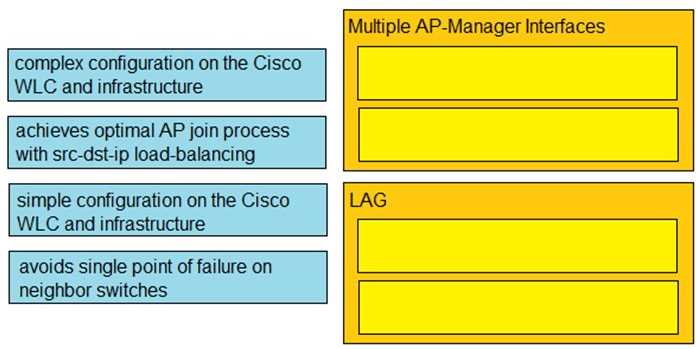
DRAG DROP Drag and drop the characteristics from the left onto the correct functionalities on the right. Cisco 300-425 question
Your Answer
16 comments in the community discussion
1
I’m saying D for this one. Cisco config guide matches up with D for how those features are grouped, I think.
1
Option D
Q: 18
An engineer is setting up the WLC to support a high-density design for a lecture hall. The engineer must modify the existing high-density RF protocol to obtain a smaller cell size. Also, the clients must connect to the nearest AP using the highest possible data rates. Which setting allows this design?
Options
14 comments in the community discussion
1
Is the main requirement to limit cell size or prioritize client distribution? If it's mainly about balancing connections, I'd pick B.
C not D. D is tempting since RX-SOP helps with interference, but for actual cell size reduction power threshold (C) is what the exam looks for.
Q: 19
A customer has two Cisco 550B WLCs that manage all the access points in their network and provide N+1 redundancy and load balancing. The primary Cisco WLC has 60 licenses and the secondary Cisco WLC has 40. The customer wants to convert the N+1 model to an HA model and provide SSO. Configuration must be performed during a maintenance window. After performing all the configurations on both controllers, the config redundancy unit secondary command is issued on the secondary Cisco WLC and it fails. Which parameter needs to be in place to complete the configuration?
Options
12 comments in the community discussion
5
Option B is right here. Secondary WLC must have at least 50 base licenses for HA SSO to work, otherwise the redundancy config won't go through. Ran into that in practice labs, pretty sure that's the blocker.
1
Ran into this in a similar exam question, B. The secondary WLC needs at least 50 base licenses for HA SSO config to work. Could be tricky if you forget about the licensing requirement.
Q: 20
An engineer is designing a new wireless network. The network needs to ful¬ll the following requirements: ✑ support multimedia applications ✑ support a high concentration of wireless clients ✑ support data over wireless ✑ support roaming Which approach should be used?
Options
13 comments in the community discussion
6
Option A, Saw this asked similarly on a practice test-the micro cells help manage high densities and roaming. Nice straightforward question.
1
D , honestly Cisco's recommendations get confusing sometimes with all the cell sizing. I figured macro cells at max power would give broader coverage and help with roaming since fewer APs to switch between, and you'd still get data over wireless. Maybe I'm missing something about client density though 🤷🏻‍♂️
Question 1 of 20

Premium Access Includes

  • Quiz Simulator
  • Exam Mode
  • Progress Tracking
  • Question Saving
  • Flash Cards
  • Drag & Drops
  • 3 Months Access
  • PDF Downloads
Get Premium Access
Scroll to Top

FLASH OFFER

Days
Hours
Minutes
Seconds

avail 10% DISCOUNT on YOUR PURCHASE