Free ENCOR-350-401 Practice Test Questions and Answers (2026)

Last Update Check
View Mode
Q: 1

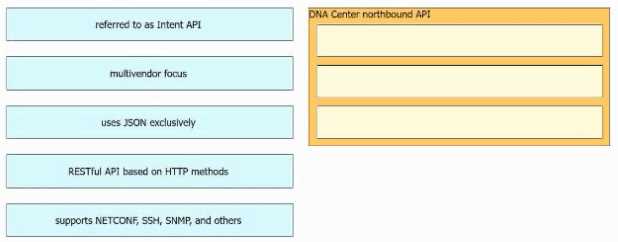
DRAG DROP Drag and drop the Cisco Catalyst Center (formerly DNA Center) northbound API characteristics from the left to the right. Not all options are used. Cisco CCNP 350-401 ENCOR question

Drag & Drop
2 comments in the community discussion
3
referred to as Intent API, RESTful API based on HTTP methods, uses JSON exclusively
I’m pretty sure the northbound API has a multivendor focus as one of its main points, since it’s supposed to work with multiple platforms. So I’d map Target 1 to "multivendor focus," Target 2 to "RESTful API based on HTTP methods," and Target 3 to "uses JSON exclusively." Not fully confident here, since Cisco likes
Q: 2

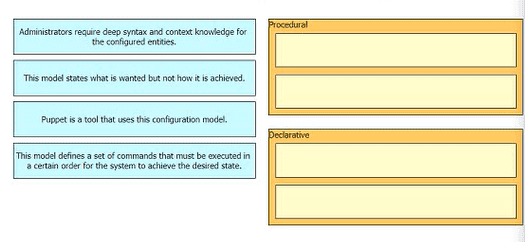
DRAG DROP Drag anti drop the characteristics from the ten onto the configuration models on the right. Cisco CCNP 350-401 ENCOR question

Drag & Drop
4 comments in the community discussion
6
Ugh, these model questions are always wordy. Procedural gets the step-by-step and deep syntax, Declarative gets what/wanted and Puppet.
2
Procedural: Deep syntax knowledge, step order. Declarative: What is wanted, Puppet tool. Official guide and some hands-on labs help here.
Q: 3

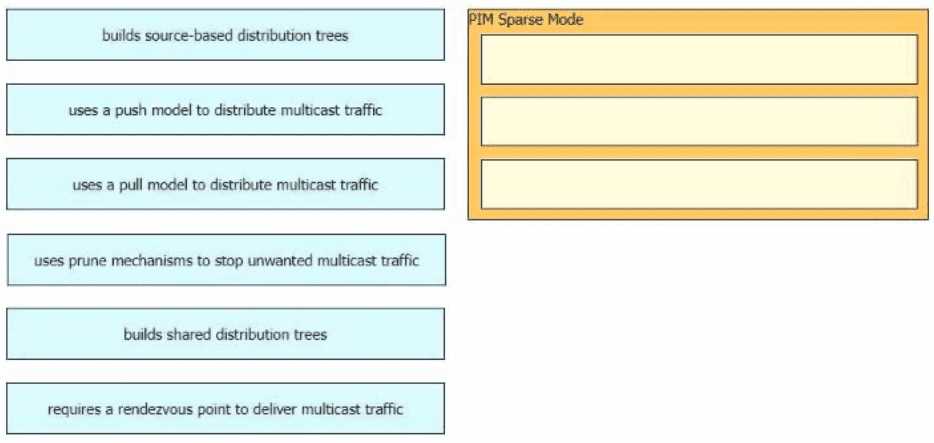
DRAG DROP Drag and drop the characteristics of PIM Sparse Mode from the left to the right. Not all options are used. Cisco CCNP 350-401 ENCOR question

Drag & Drop
4 comments in the community discussion
5
uses a pull model, builds shared distribution trees, requires a rendezvous point. Official guide covers this well, worth reviewing multicast chapters.
1
builds source-based distribution trees, uses a push model, requires a rendezvous pointI matched these based on PIM SM sometimes switching to source-based trees after the initial shared tree. I think 'push model' could apply since routers send data to all until pruned. Not totally confident here, let me know if you
Q: 4
Which type of API enables Cisco Catalyst Center (formerly DNA Center) to focus on outcome instead of the individual steps that are required to achieve the outcome?
Options
4 comments in the community discussion
1
Northbound Intent API is the way to go for outcome-based control, so definitely C here.
1
Nah, it's not D. The northbound Intent API (C) is made for intent-based networking, so you just describe the goal and let Catalyst Center handle the details. Southbound is a trap here.
Q: 5

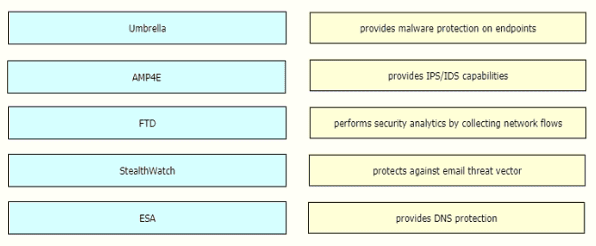
DRAG DROP Drag and drop the threat defense solutions from the left onto their descriptions on the right. Cisco CCNP 350-401 ENCOR question

Drag & Drop
6 comments in the community discussion
6
Umbrella -> provides DNS protection, AMP4E -> malware protection on endpoints, FTD -> IPS/IDS, StealthWatch -> security analytics with network flows, ESA -> email threat vector.Pretty sure this is the right mapping. Umbrella always works at the DNS layer, AMP4E for endpoint malware, FTD integrate
5
Umbrella -> DNS protection, AMP4E -> endpoint malware, FTD -> IPS/IDS, StealthWatch -> network analytics, ESA -> email threats.
Q: 6
In a Cisco SD-Access solution, which component offers the Anycast Gateway service?
Options
Q: 7

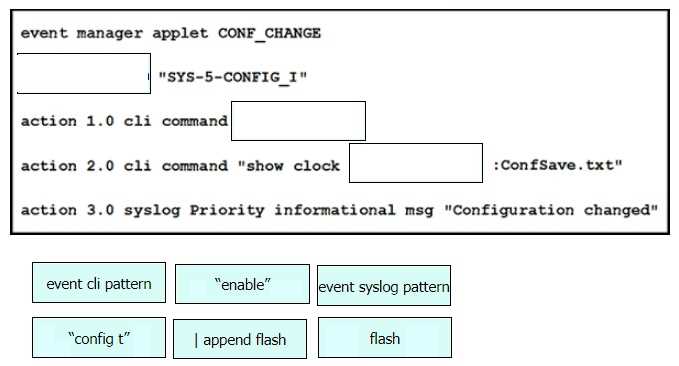
DRAG DROP Drag and drop the snippets onto the blanks within the code to create an EEM script that adds an entry to a locally stored text file with a timestamp when a configuration change is made. Not all options are used. Cisco CCNP 350-401 ENCOR question

Drag & Drop
8 comments in the community discussion
9
event syslog pattern, "enable", | append flash. Not totally sure, feels like exam practice ones. Can someone confirm this order?
5
Nah, I think it's event syslog pattern, "enable", then | append flash. The 'event cli pattern' jumps out as a trap since config changes are better caught with syslog events in EEM scripts. Anyone else see it differently on similar exam sets?
Q: 8
What is one method for achieving REST API security?
Options
Q: 9
Which method creates an EEM applet policy that is registered with EEM and runs on demand or manually?
Options
5 comments in the community discussion
2
Option C is the one you want. Using event none means the EEM applet isn't tied to any specific trigger, so you can launch it whenever you want from the CLI with event manager run. I've seen similar setups in labs and some exam walkthroughs. Pretty sure this is what they look for unless you're
1
Maybe B. The 'manual' keyword sounds like it would let you run the applet on demand, so I picked that thinking it was the trigger for manual execution. The trap is that 'none' is actually more widely supported, but I was sure 'manual' did this too. Not 100% confident.
Q: 10
A system must validate access rights to all its resources and must not rely on a cached permission matrix. If the access level to a given resource is revoked but is not reflected in the permission matrix, the security is violates Which term refers to this REST security design principle?
Options
5 comments in the community discussion
Option C, because if two-factor auth is enforced even for cached sessions, doesn't that count as separation of privilege?
A is wrong, it's B. Complete mediation means the system checks permissions every time, not just relying on cached data. If you skip this and permissions change (like revoked access), people could still get in using old privileges. Economy of mechanism is a trap since it's more about simplicity, not ongoing checks. Pret
Q: 11
How does SSO work with HSRP to minimize network disruptions?
Options
Q: 12
What is a characteristic of a virtual machine?
Options
2 comments in the community discussion
Guessing B. VMs usually use less resources since they can share hardware through the hypervisor.
Q: 13
Which function does a Cisco SD-Access extended node perform?
Options
1 comment in the community discussion
Wait, does extended node actually tunnel traffic? I thought it just lets L2 switches join fabric. Can someone confirm?
Q: 14
Which component of the Cisco Cyber Threat Defense solution provides user and flow context analysis?
Options
1 comment in the community discussion
Seen almost the same in a mock, it's B.
Q: 15

SIMULATION Cisco CCNP 350-401 ENCOR question Cisco CCNP 350-401 ENCOR question

Your Answer
Q: 16
What is a characteristic of a traditional WAN?
Options
Q: 17

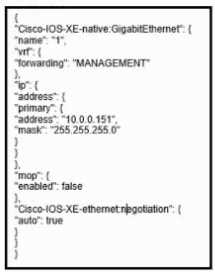
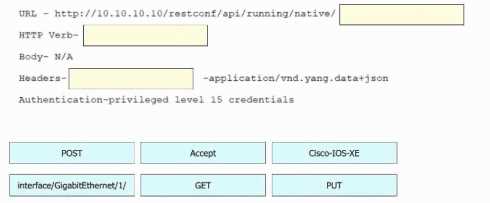
DRAG DROP Refer to the exhibit. Cisco CCNP 350-401 ENCOR question Refer to the exhibit. Drag and drop the snippets into the RESTCONF request to form the request that returns this response. Not all options are used. Cisco CCNP 350-401 ENCOR question
Drag & Drop
Q: 18
What is the intent API in Cisco Catalyst Center (formerly DNA Center)?
Options
2 comments in the community discussion
Probably A. The intent API is northbound and lets external apps interact with Catalyst Center. Option C refers to device-level southbound APIs.
Option D is kind of a distractor here, but does the question specifically ask about consumer-facing APIs or just any integration point? If it wanted southbound/internal comms, C would make sense.
Q: 19

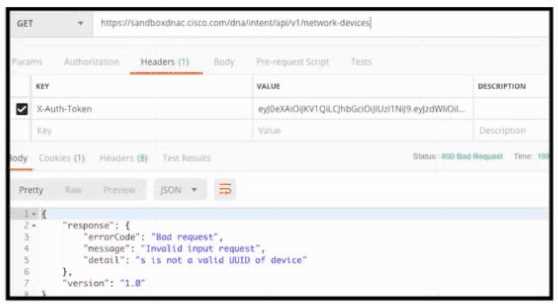
Refer to the exhibit. Cisco CCNP 350-401 ENCOR question Refer to the exhibit. POSTMAN is showing an attempt to retrieve network device information from Cisco Catalyst Center (formerly DNA Center) API. What is the issue?
Options
1 comment in the community discussion
Is the question specifically asking for the first issue you'd see, or the most likely root cause if there are multiple problems in the request? That could affect whether it’s B or possibly C.
Q: 20

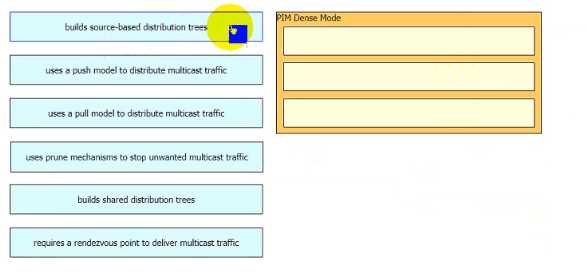
DRAG DROP Drag and drop characteristics of PIM dense mode from the left to the right. Cisco CCNP 350-401 ENCOR question

Drag & Drop
1 comment in the community discussion
Pretty sure for PIM Dense Mode it's: source-based trees, push model, and prune mechanisms. That matches what I remember from exam reports. Pull model and RPs are more for sparse mode.Target 1: builds source-based distribution treesTarget 2: uses a push model to distribute multicast traffic
Question 1 of 20

What's covered in this practice questions set

6: Automation · 7 questions

📖 About this Domain

The Automation domain accounts for 15% of the ENCOR 350-401 v1.2 exam. This domain reflects the industry's shift towards network programmability and automation. It covers topics such as Python scripting, data modeling with YANG, APIs, and automation tools. A foundational understanding of these concepts is now essential for enterprise network engineers.

🎓 What You Will Learn

  • You will learn to interpret basic Python components and scripts. This includes understanding data types, loops, and conditional statements in the context of network automation.
  • You will gain the ability to construct valid JSON encoded files. JSON is a common data format used in network automation and APIs.
  • You will learn to describe the high-level principles and benefits of a data modeling language, such as YANG. YANG is used to model the configuration and state data of network devices.
  • You will develop an understanding of the APIs for Cisco Catalyst Center and SD-WAN Manager. This will enable you to interact with these platforms programmatically.
  • You will learn to interpret REST API response codes and results in the payload using Cisco Catalyst Center and RESTCONF. This is a practical skill for working with network APIs.
  • You will gain knowledge on how to construct an EEM applet to automate configuration, troubleshooting, or data collection on a Cisco device.
  • You will learn to compare agent vs. agentless orchestration tools like Ansible, Puppet, and Chef. This will help you understand the different approaches to network automation.

🛠️ Skills You Will Build

  • You will build the foundational skill of reading and understanding Python scripts. This is the first step towards writing your own automation scripts.
  • You will develop the ability to create and validate JSON data structures. This is an essential skill for working with modern network APIs.
  • You will be able to explain the role of YANG in network automation. This conceptual understanding is important for working with model-driven programmability.
  • You will gain the competency to describe how to use the APIs of Cisco's management platforms. This will enable you to integrate these platforms with other tools and systems.
  • You will learn to parse and understand the responses from REST APIs. This is a crucial skill for building reliable automation workflows.
  • You will develop the practical skill of creating EEM applets for on-box automation. This is a powerful tool for automating tasks directly on network devices.
  • You will be able to compare and contrast different automation and orchestration tools. This will help you choose the right tool for a given automation task.

💡 Top Tips to Prepare

  • Even if you are not a programmer, focus on understanding the basic constructs of Python and how they can be used for network tasks.
  • Familiarize yourself with the structure of JSON and be able to identify valid JSON.
  • Understand the purpose of YANG and its relationship with protocols like NETCONF and RESTCONF.
  • While you don't need to be an expert in all automation tools, you should be able to explain the fundamental differences between agent-based and agentless tools.

3: Infrastructure · 4 questions

📖 About this Domain

The Infrastructure domain is the largest section of the ENCOR 350-401 v1.2 exam, making up 30% of the total score. This domain covers the core routing and switching technologies that form the foundation of enterprise networks. It includes in-depth topics on Layer 2 technologies, Layer 3 routing protocols, and IP services. A deep and practical understanding of the topics in this domain is critical for any network engineer and is heavily weighted in the exam.

🎓 What You Will Learn

  • You will learn to troubleshoot Layer 2 technologies, including static and dynamic 802.1Q trunking and EtherChannel. This involves diagnosing and resolving common issues related to VLANs and link aggregation.
  • You will gain a comprehensive understanding of Spanning Tree Protocol (STP) and its variants, including RSTP and MST. You will learn how to configure and verify these protocols to build redundant and loop-free switched topologies.
  • You will learn to compare routing concepts of EIGRP and OSPF. This includes understanding their metrics, path selection processes, and key characteristics to determine the appropriate protocol for a given network design.
  • You will develop the ability to configure and verify OSPFv2 and OSPFv3. This includes setting up adjacencies, configuring different area types, and implementing route summarization and filtering for both IPv4 and IPv6.
  • You will learn to describe the concepts, path selection, and configuration of BGP. This includes understanding the basics of inter-domain routing and how BGP is used to connect an enterprise to the internet or other autonomous systems.
  • You will gain knowledge of IP services such as NTP, NAT, and First Hop Redundancy Protocols (FHRPs). You will learn how to configure and verify these essential services in an enterprise network.
  • You will explore multicast routing concepts, including PIM-SM, IGMP, and RPF checks. This knowledge is important for networks that support applications like video streaming and other multicast-based services.

🛠️ Skills You Will Build

  • You will build advanced troubleshooting skills for Layer 2 networks. This includes the ability to quickly identify and resolve issues with VLANs, trunks, and EtherChannel.
  • You will develop the expertise to design and implement resilient switched networks using STP, RSTP, and MST. This involves optimizing STP to ensure fast convergence and stability.
  • You will gain the ability to configure, verify, and troubleshoot OSPF in both IPv4 and IPv6 environments. This is a core skill for enterprise network engineers.
  • You will build a foundational understanding of BGP and its role in enterprise networks. This will enable you to work with internet connectivity and more complex routing scenarios.
  • You will develop practical skills in configuring and verifying essential IP services like NAT and FHRPs. These are common tasks in day-to-day network operations.
  • You will be able to analyze and compare the features and behaviors of different routing protocols. This skill is crucial for making informed decisions about routing protocol selection and design.
  • You will learn to configure and verify multicast routing. This is a specialized but important skill for supporting modern applications that rely on multicast traffic.

💡 Top Tips to Prepare

  • This is the largest domain, so allocate a significant portion of your study time here. The topics are broad and require in-depth knowledge.
  • Hands-on practice is essential for the Infrastructure domain. Use physical hardware, virtual labs, or simulators to configure and troubleshoot the technologies covered.
  • Pay close attention to the details of OSPF configuration and verification for both IPv4 and IPv6. This is a frequently tested area.
  • Don't neglect multicast. While it may seem like a niche topic, the exam blueprint includes several key multicast concepts that you need to understand.

5: Security · 4 questions

📖 About this Domain

The Security domain makes up 20% of the ENCOR 350-401 v1.2 exam. This section covers the fundamental security concepts and technologies that network engineers need to implement and manage secure enterprise networks. It includes topics on device access control, infrastructure security features, REST API security, and the components of network security design. A strong emphasis is placed on securing the network infrastructure itself.

🎓 What You Will Learn

  • You will learn to configure and verify device access control. This includes securing the console and vty lines, implementing local user authentication, and configuring authentication and authorization using AAA with protocols like TACACS+ and RADIUS.
  • You will gain knowledge on how to configure and verify infrastructure security features. This involves implementing Access Control Lists (ACLs) to filter traffic and using Control Plane Policing (CoPP) to protect the router's CPU from denial-of-service attacks.
  • You will learn to describe REST API security. This is crucial for securing the programmatic interfaces that are increasingly used for network automation and management.
  • You will develop an understanding of the components of network security design. This includes concepts like threat defense, endpoint security, next-generation firewalls, TrustSec for policy-based segmentation, and MACsec for Layer 2 encryption.
  • You will explore wireless security concepts, including different authentication methods and encryption protocols used to secure wireless networks. While deep wireless configuration has been removed, understanding security principles is still relevant.
  • You will learn about Layer 2 security mechanisms. This includes features like port security, DHCP snooping, and Dynamic ARP Inspection to mitigate common LAN-based attacks.

🛠️ Skills You Will Build

  • You will build the practical skill of securing access to network devices using AAA. This is a fundamental security practice in any enterprise network.
  • You will develop expertise in writing and applying ACLs for traffic filtering. This is a core competency for network security.
  • You will gain the ability to configure and verify CoPP to protect your network infrastructure. This is a critical skill for maintaining network stability and availability.
  • You will be able to describe the security considerations for REST APIs. This is an increasingly important skill as network automation becomes more prevalent.
  • You will develop a holistic understanding of network security design principles. This will enable you to contribute to the design of secure and resilient networks.
  • You will learn to implement and troubleshoot various Layer 2 security features. This is essential for securing the access layer of your network.
  • You will be able to explain the concepts of TrustSec and MACsec. This knowledge is important for understanding modern network security architectures.

💡 Top Tips to Prepare

  • Get hands-on practice with configuring AAA, ACLs, and CoPP. These are practical skills that are likely to be tested.
  • Understand the concepts behind TrustSec and MACsec, even if you don't have extensive hands-on experience with them.
  • Pay attention to REST API security concepts. As automation is a growing field, securing APIs is a critical topic.
  • Review the different Layer 2 security features and the types of attacks they are designed to prevent.

1: Architecture · 4 questions

📖 About this Domain

The Architecture domain comprises 15% of the ENCOR 350-401 v1.2 exam. This section evaluates a candidate's understanding of enterprise network design principles, including high-level designs like 2-tier, 3-tier, and fabric architectures. It also covers the working principles of modern solutions such as Cisco SD-WAN and SD-Access. The domain emphasizes the importance of high availability and redundancy to ensure network resilience. A solid grasp of these architectural concepts is fundamental for designing and implementing robust and scalable enterprise networks.

🎓 What You Will Learn

  • You will learn to explain and differentiate between various enterprise network design principles, including the traditional 2-tier and 3-tier hierarchical models, as well as modern fabric and cloud-based designs. This knowledge is crucial for selecting the appropriate architecture based on an organization's specific requirements for scalability, resilience, and performance.
  • You will gain a thorough understanding of high availability techniques that are critical for network reliability. This includes the implementation and verification of redundancy protocols, First Hop Redundancy Protocols (FHRP) like HSRP and VRRP, and Stateful Switchover (SSO) to minimize downtime during failures.
  • You will learn the fundamental working principles of the Cisco Catalyst SD-WAN solution. This involves understanding the distinct roles of the control plane and data plane elements and being able to articulate the benefits and limitations of implementing an SD-WAN architecture in an enterprise environment.
  • You will explore the principles of the Cisco SD-Access solution, which is a key component of Cisco's intent-based networking. You will learn about the control and data plane elements of SD-Access and how a traditional campus network can interoperate with an SD-Access fabric.
  • You will develop the ability to interpret Quality of Service (QoS) configurations within an enterprise network. This includes understanding how QoS policies are applied to manage bandwidth, latency, and jitter for different types of traffic, ensuring that critical applications receive the necessary network resources.

🛠️ Skills You Will Build

  • You will build the skill to analyze and compare different enterprise network architectures, enabling you to make informed design decisions. This includes evaluating the trade-offs between traditional and modern network designs to meet specific business and technical goals.
  • You will develop the ability to design and implement highly available networks. This involves selecting and configuring appropriate redundancy mechanisms and protocols to ensure continuous network operation and minimize the impact of device or link failures.
  • You will gain the skill to explain the architecture and components of a Cisco SD-WAN solution. This will enable you to participate in discussions and planning for the adoption of SD-WAN, a critical technology for modern wide-area networking.
  • You will build the competency to describe the architecture and operation of Cisco's SD-Access solution. This skill is essential for engineers working with modern campus networks that leverage automation and policy-based management.
  • You will develop the practical skill of interpreting and analyzing QoS configurations. This will allow you to troubleshoot and optimize network performance to ensure that application service level agreements are met.
  • You will be able to articulate the functions of different network planes (control, data, and management) within various architectures. This foundational knowledge is crucial for understanding and troubleshooting complex network behaviors.
  • You will learn to design for network scalability and resilience. This involves applying design principles that allow the network to grow and adapt to changing business needs while maintaining a high level of performance and availability.

💡 Top Tips to Prepare

  • Focus on understanding the 'why' behind different design choices, not just the 'how'. The exam will test your comprehension of design principles and their implications.
  • Gain a solid conceptual understanding of SD-WAN and SD-Access. While deep configuration knowledge may not be required, you must be able to explain their architectures and benefits.
  • Review high availability concepts thoroughly, including FHRPs and SSO. Be prepared to explain how these technologies contribute to network resilience.
  • Use Cisco's official documentation and design guides to supplement your studies. These resources provide in-depth information on the design principles covered in the exam.

2: Virtualization · 1 questions

📖 About this Domain

The Virtualization domain accounts for 10% of the total exam score for the ENCOR 350-401 v1.2. This section focuses on the technologies that allow for the abstraction of network resources and the creation of logical network services on a shared physical infrastructure. It covers device virtualization, data path virtualization, and network virtualization concepts. A strong understanding of virtualization is essential for modern network engineers as it is a foundational element of cloud computing and software-defined networking.

🎓 What You Will Learn

  • You will learn to describe various device virtualization technologies. This includes understanding the differences between Type 1 (bare-metal) and Type 2 hypervisors, the concept of virtual machines, and the function of virtual switching.
  • You will gain knowledge on how to configure and verify data path virtualization technologies. This involves practical skills in implementing Virtual Routing and Forwarding (VRF) to create separate routing tables within a single router, and configuring GRE and IPsec tunnels for secure overlay networks.
  • You will learn about key network virtualization concepts that enable the creation of logical networks on top of a physical underlay. This includes understanding the Locator/ID Separation Protocol (LISP) and its role in providing endpoint mobility and scalability.
  • You will develop an understanding of Virtual Extensible LAN (VXLAN) as a network virtualization technology. You will learn how VXLAN is used to create overlay networks that can span across physical data centers and provide a large number of isolated network segments.
  • You will explore the benefits and use cases of different virtualization technologies in enterprise networks. This includes understanding how virtualization can improve resource utilization, provide network segmentation, and enable more agile service delivery.

🛠️ Skills You Will Build

  • You will build the skill to differentiate between and explain the use cases for Type 1 and Type 2 hypervisors. This knowledge is fundamental to understanding server and device virtualization.
  • You will develop the practical ability to configure and troubleshoot VRFs on Cisco devices. This skill is crucial for implementing network segmentation and supporting multi-tenant environments.
  • You will gain hands-on skills in configuring and verifying GRE and IPsec tunnels. This is a vital skill for creating secure and private communication channels over public networks.
  • You will build the competency to explain the concepts of LISP and VXLAN. This will enable you to understand and work with modern data center and campus network fabrics that utilize these overlay technologies.
  • You will develop the ability to analyze network requirements and determine the appropriate virtualization technology to apply. This includes understanding the trade-offs and benefits of different virtualization solutions.
  • You will learn to describe the interaction between physical and virtual network components. This skill is essential for troubleshooting and managing networks that incorporate virtualization.
  • You will be able to explain how network virtualization contributes to the agility and scalability of modern network infrastructures. This understanding is key for engineers involved in network design and evolution.

💡 Top Tips to Prepare

  • Get hands-on practice with VRF and GRE tunnel configurations. Use virtual labs or simulators to build your practical skills in these areas.
  • Focus on the conceptual understanding of LISP and VXLAN. Be able to explain their purpose, how they work at a high level, and their role in technologies like SD-Access.
  • Understand the key differences between Type 1 and Type 2 hypervisors and be able to provide examples of each.
  • Relate virtualization concepts back to real-world use cases. Understanding how these technologies solve specific problems will help solidify your knowledge.

4: Network Assurance

📖 About this Domain

The Network Assurance domain constitutes 10% of the ENCOR 350-401 v1.2 exam. This domain focuses on the tools and techniques used to monitor, troubleshoot, and maintain the health and performance of an enterprise network. It covers a range of technologies from traditional command-line tools to modern network management protocols and platforms. A solid understanding of network assurance is crucial for ensuring network reliability and quickly resolving issues when they arise.

🎓 What You Will Learn

  • You will learn to diagnose network problems using a variety of tools and protocols. This includes using debugs, conditional debugs, traceroute, ping, SNMP, and syslog for effective troubleshooting.
  • You will gain knowledge on how to configure and verify Flexible NetFlow. This will enable you to collect and analyze detailed traffic statistics for capacity planning, security analysis, and troubleshooting.
  • You will learn to configure and verify SPAN, RSPAN, and ERSPAN. These technologies are essential for traffic analysis and intrusion detection by allowing you to mirror traffic from source ports or VLANs to a destination.
  • You will develop an understanding of how to configure and verify IP SLAs. This will allow you to proactively monitor network performance and availability by simulating different types of network traffic.
  • You will learn about the capabilities of Cisco DNA Center for network assurance. This includes understanding how it uses AI and machine learning to provide insights into network health and performance.
  • You will gain knowledge of NETCONF and RESTCONF as network management protocols. You will learn how these protocols can be used to configure and monitor network devices in a programmatic way.

🛠️ Skills You Will Build

  • You will build a systematic approach to network troubleshooting using a variety of tools and techniques. This will enable you to efficiently identify and resolve network problems.
  • You will develop the practical skill of configuring and verifying Flexible NetFlow to gain deep visibility into network traffic patterns.
  • You will gain hands-on experience with configuring different types of SPAN sessions for traffic monitoring and analysis.
  • You will learn to implement and interpret the results from IP SLA operations to proactively manage network performance.
  • You will be able to describe the key features and benefits of Cisco DNA Center for network assurance. This is important for working with modern intent-based networks.
  • You will develop a conceptual understanding of NETCONF and RESTCONF. This knowledge is foundational for network automation and programmability.
  • You will learn to correlate information from multiple sources, such as syslog, SNMP, and NetFlow, to get a comprehensive view of network health and to troubleshoot complex issues.

💡 Top Tips to Prepare

  • Practice using the various troubleshooting tools in a lab environment. Be comfortable with the syntax and output of commands like `debug`, `traceroute`, and `ping`.
  • Understand the differences between SPAN, RSPAN, and ERSPAN and their respective use cases.
  • Gain a solid conceptual understanding of how Cisco DNA Center provides network assurance. You don't need to be an expert in using it, but you should be able to describe its functions.
  • Familiarize yourself with the purpose and basic concepts of NETCONF and RESTCONF, as these are important for the automation part of the exam as well.

Premium Access Includes

  • ✓Quiz Simulator
  • ✓Exam Mode
  • ✓Progress Tracking
  • ✓Question Saving
  • ✓Flash Cards
  • ✓Drag & Drops
  • ✓3 Months Access
  • ✓PDF Downloads
Scroll to Top