Free AZ-305 Practice Test Questions and Answers (2026)

DRAG DROP You have an on-premises datacenter named Site1. Site1 contains a VMware vSphere cluster named Cluster1 that hosts 100 virtual machines. Cluster1 is managed by using VMware vCenter. You have an Azure subscription named Sub1. You plan to migrate the virtual machines from Cluster1 to Sub1. You need to identify which resources are required to run the virtual machines in Azure. The solution must minimize administrative effort. What should you configure? To answer, drag the appropriate resources to the correct targets. Each resource may be used once, more than once, or not at all. You may need to drag the split bar between panes or scroll to view content. NOTE: Each correct selection is worth one point.
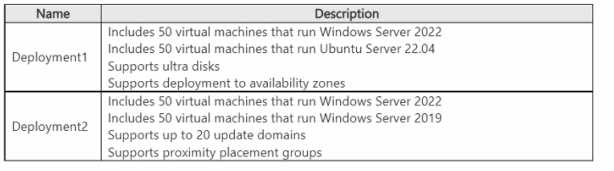
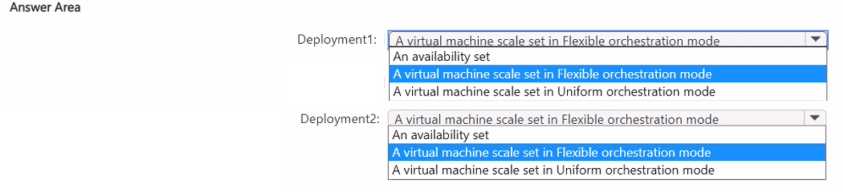
HOTSPOT You have an Azure subscription. You plan to deploy two 100-virtual machine deployments as shown in the following table. 
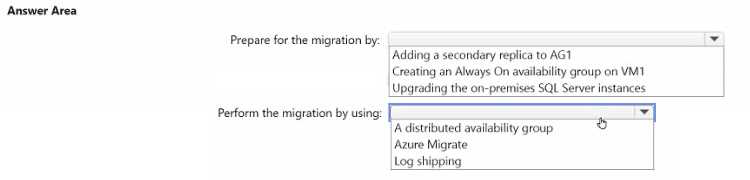
HOTSPOT You have two on-premises Microsoft SQL Server 2017 instances that host an Always On availability group named AG1. AG1 contains a single database named DB1. You have an Azure subscription that contains a virtual machine named VM1VM1 runs Linux and contains a SQL Server 2019 instance. You need to migrate DB1 to VMI. The solution must minimize downtime on DBI. What should you do? To answer, select the appropriate options in the answer area. NOTE: Each correct selection is worth one point.
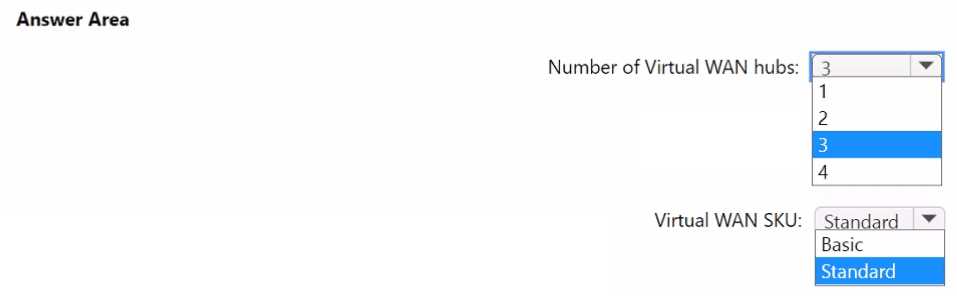
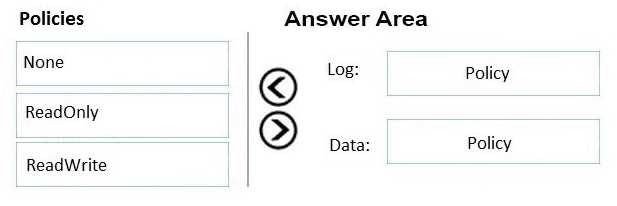
DRAG DROP You are designing a virtual machine that will run Microsoft SQL Server and will contain two data disks. The first data disk will store log files, and the second data disk will store dat a. Both disks are P40 managed disks. You need to recommend a caching policy for each disk. The policy must provide the best overall performance for the virtual machine. Which caching policy should you recommend for each disk? To answer, drag the appropriate policies to the correct disks. Each policy may be used once, more than once, or not at all. You may need to drag the split bar between panes or scroll to view content. NOTE: Each correct selection is worth one point.
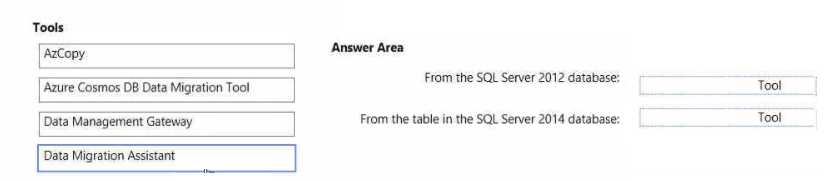
DRAG DROP You plan to import data from your on-premises environment to Azure. The data Is shown in the following table. 
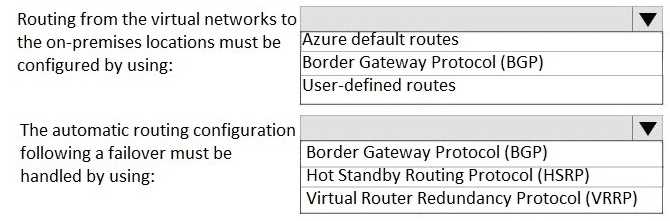
HOTSPOT Your company has two on-premises sites in New York and Los Angeles and Azure virtual networks in the East US Azure region and the West US Azure region. Each on-premises site has Azure ExpressRoute circuits to both regions. You need to recommend a solution that meets the following requirements: Outbound traffic to the Internet from workloads hosted on the virtual networks must be routed through the closest available on-premises site. If an on-premises site fails, traffic from the workloads on the virtual networks to the Internet must reroute automatically to the other site. What should you include in the recommendation? To answer, select the appropriate options in the answer area. NOTE: Each correct selection is worth one point.
DRAG DROP You have two app registrations named App1 and App2 in Azure AD. App1 supports role-based access control (RBAC) and includes a role named Writer. You need to ensure that when App2 authenticates to access App1, the tokens issued by Azure AD include the Writer role claim. Which blade should you use to modify each app registration? To answer, drag the appropriate blades to the correct app registrations. Each blade may be used once, more than once, or not at all. You may need to drag the split bar between panes or scroll to view content. NOTE: Each correct selection is worth one point.
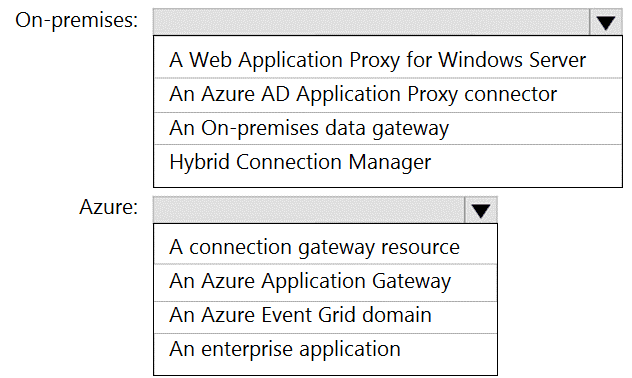
HOTSPOT You have an Azure subscription named Subscription1 that is linked to a hybrid Azure Active Directory (Azure AD) tenant. You have an on-premises datacenter that does NOT have a VPN connection to Subscription1. The datacenter contains a computer named Server1 that has Microsoft SQL Server 2016 installed. Server1 is prevented from accessing the internet. An Azure logic app named LogicApp1 requires write access to a database on Server1. You need to recommend a solution to provide LogicApp1 with the ability to access Server1. What should you recommend deploying on-premises and in Azure? To answer, select the appropriate options in the answer area. NOTE: Each correct selection is worth one point.
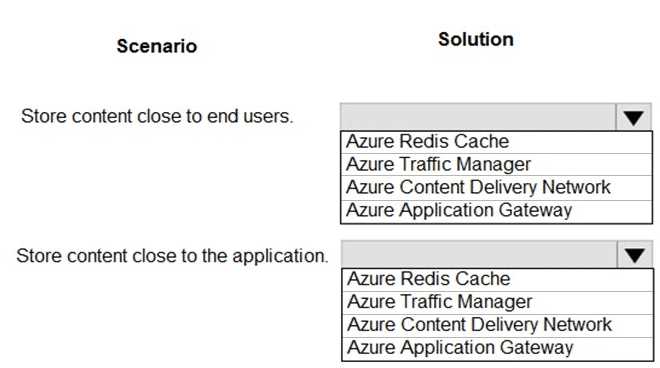
HOTSPOT Your company deploys an Azure App Service Web App. During testing the application fails under load. The application cannot handle more than 100 concurrent user sessions. You enable the Always On feature. You also configure auto-scaling to increase counts from two to 10 based on HTTP queue length. You need to improve the performance of the application. Which solution should you use for each application scenario? To answer, select the appropriate options in the answer area. NOTE: Each correct selection is worth one point.
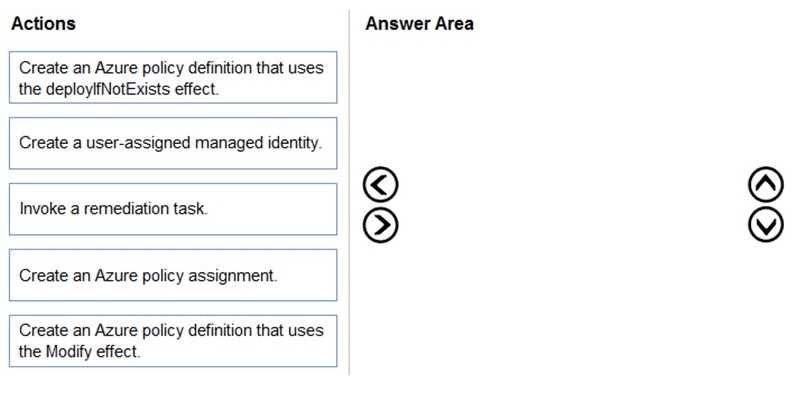
DRAG DROP You need to configure an Azure policy to ensure that the Azure SQL databases have TDE enabled. The solution must meet the security and compliance requirements. Which three actions should you perform in sequence? To answer, move the appropriate actions from the list of actions to the answer area and arrange them in the correct order.
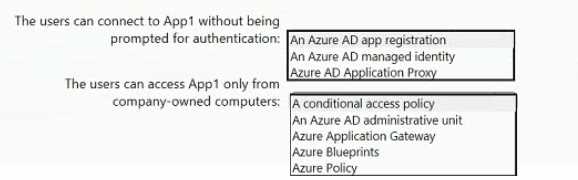
HOTSPOT You plan to deploy an Azure web app named Appl that will use Azure Active Directory (Azure AD) authentication. App1 will be accessed from the internet by the users at your company. All the users have computers that run Windows 10 and are joined to Azure AD. You need to recommend a solution to ensure that the users can connect to App1 without being prompted for authentication and can access App1 only from company-owned computers. What should you recommend for each requirement? To answer, select the appropriate options in the answer area. NOTE: Each correct selection is worth one point.

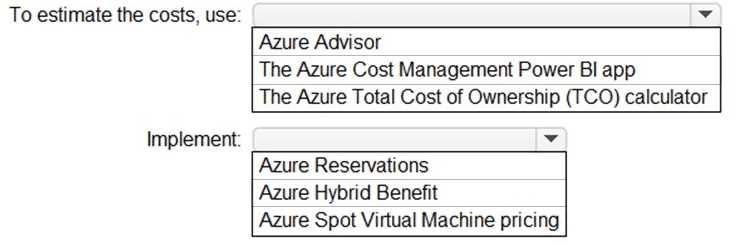
HOTSPOT You plan to migrate App1 to Azure. You need to estimate the compute costs for App1 in Azure. The solution must meet the security and compliance requirements. What should you use to estimate the costs, and what should you implement to minimize the costs? To answer, select the appropriate options in the answer area. NOTE: Each correct selection is worth one point.
What's covered in this practice questions set
1: Design identity, governance, and monitoring solutions · 9 questions
📖 About this Domain
This domain covers designing solutions for identity, governance, and monitoring. It emphasizes architecting authentication and authorization with Azure AD, implementing governance controls like Azure Policy, and designing monitoring with Azure Monitor and Log Analytics.
🎓 What You Will Learn
- Design logging and monitoring solutions using Azure Monitor, Log Analytics, and Azure Sentinel for comprehensive observability.
- Architect authentication and authorization solutions leveraging Azure AD, Privileged Identity Management (PIM), and Conditional Access policies.
- Design governance at scale with management groups, Azure Policy, Azure Blueprints, and resource tagging strategies.
- Design identity and access for applications using managed identities, service principals, and application registrations.
🛠️ Skills You Will Build
- Architect identity solutions using Azure AD tenants, federation, and hybrid identity with Azure AD Connect.
- Implement governance frameworks using management groups, Azure Policy for compliance, and Azure Blueprints for environment standardization.
- Design holistic monitoring strategies by integrating Azure Monitor with Log Analytics workspaces and configuring alert rules.
- Secure application access by designing solutions with managed identities, service principals, and OAuth 2.0 or OpenID Connect flows.
💡 Top Tips to Prepare
- Deep dive into Azure AD features including PIM, Conditional Access policies, and hybrid identity synchronization models.
- Master the governance hierarchy from management groups down to resources, and the inheritance of Azure Policy and RBAC.
- Gain practical experience with Azure Monitor, Log Analytics KQL queries, and configuring action groups for alerting.
- Understand the design considerations for application identity, including choosing between managed identities and service principals.
2: Design data storage solutions · 5 questions
📖 About this Domain
This domain focuses on designing robust and scalable data storage solutions on Azure. You will evaluate requirements for relational, non-relational, and semi-structured data to recommend optimal services. Key considerations include performance tiers, data protection, and integration patterns.
🎓 What You Will Learn
- Learn to design solutions for relational data using Azure SQL Database, SQL Managed Instance, and SQL Server on Azure VMs, considering service tiers and high availability.
- Understand how to design storage for non-relational data by selecting appropriate services like Azure Cosmos DB APIs and Azure Storage account types.
- Discover how to design data lake solutions using Azure Data Lake Storage Gen2 for large-scale analytics workloads.
- Learn to design data integration solutions with Azure Data Factory or Azure Synapse Pipelines, including data flows and integration runtimes.
🛠️ Skills You Will Build
- You will build the skill to recommend appropriate data storage solutions based on technical and business requirements.
- You will be able to design for data scalability and performance by selecting correct service tiers, SKUs, and partitioning strategies.
- You will build skills in designing data protection strategies, including backup policies, geo-replication, and failover configurations.
- You will learn to design cost-effective storage solutions by evaluating pricing models and utilizing features like storage lifecycle management.
💡 Top Tips to Prepare
- Master the decision criteria for choosing between Azure SQL DB, SQL MI, and SQL on VMs based on specific workload requirements.
- Understand the consistency levels in Azure Cosmos DB and how they relate to the CAP theorem for distributed data solutions.
- Deeply learn the high availability and disaster recovery options for Azure Storage and Azure SQL, including RPO/RTO considerations.
- Use the Azure Pricing Calculator and TCO Calculator to practice estimating costs for different storage configurations and data migration scenarios.
4: Design infrastructure solutions · 4 questions
📖 About this Domain
This domain covers designing core Azure infrastructure components based on workload requirements. It emphasizes selecting appropriate compute, networking, and storage solutions. You will also design strategies for migrating on-premises resources to Azure.
🎓 What You Will Learn
- Learn to design compute solutions by selecting services like Azure VMs, App Service, and Azure Kubernetes Service (AKS).
- Learn to design networking solutions including VNet addressing, subnets, routing, and hybrid connectivity.
- Learn to design Azure Storage solutions, choosing between Blob, Files, and Disks based on performance and access tiering.
- Learn to design migration strategies using Azure Migrate for assessment and Azure Database Migration Service for execution.
🛠️ Skills You Will Build
- Build skills in recommending specific compute services and SKUs for performance, scalability, and cost optimization.
- Build skills in architecting secure and resilient network topologies like hub-spoke models with VNet peering and NSGs.
- Build skills in designing storage account configurations, including replication strategies and data lifecycle management.
- Build skills in formulating a migration plan by assessing workloads and selecting appropriate migration tools and methods.
💡 Top Tips to Prepare
- Master the decision criteria for choosing between IaaS and PaaS compute, including VMs, App Service, and AKS.
- Practice designing network flows, including ingress/egress traffic patterns, NSG rule evaluation, and UDRs.
- Understand the performance tiers and redundancy options (LRS, ZRS, GRS, GZRS) for Azure Storage accounts.
- Familiarize yourself with the phases of the Azure Migrate framework, from discovery and assessment to migration.
3: Design business continuity solutions · 2 questions
📖 About this Domain
This domain covers designing resilient and available solutions for Azure workloads. You will focus on architecting for business continuity by implementing robust backup, disaster recovery, and high availability strategies to meet RTO and RPO objectives.
🎓 What You Will Learn
- Design backup and recovery solutions using Azure Backup and Azure Site Recovery for IaaS and PaaS services.
- Architect disaster recovery strategies, including failover and failback processes and meeting RTO/RPO targets.
- Design highly available solutions using availability zones, availability sets, and load balancing configurations.
- Implement data archiving and retention policies using Azure Storage lifecycle management and backup policies.
🛠️ Skills You Will Build
- Architecting resilient infrastructure using Azure Site Recovery for DR orchestration and regional failover.
- Implementing data protection strategies with Azure Backup, including configuring policies and restore operations.
- Designing for high uptime by correctly implementing availability sets, availability zones, and multi-region deployments.
- Translating business requirements into technical designs that meet specific RTO and RPO targets.
💡 Top Tips to Prepare
- Master Azure Site Recovery (ASR) for replicating workloads between Azure regions and from on-premises.
- Understand the components and use cases for Azure Backup, including Recovery Services Vaults and backup policies.
- Differentiate clearly between high availability (HA) and disaster recovery (DR) design patterns and services.
- Practice mapping business requirements for RTO, RPO, and SLAs to specific Azure technology choices.