Free 350-501 Practice Test Questions and Answers (2026)

View Mode
Q: 1
How much must the MTU be increased when configuring the 802.1q VLAN tag?
Options
26 comments in the community discussion
8
Option B, Similar question popped up on practice exams, always 4 bytes for 802.1q tag.
3
B . It's 4 bytes for the 802.1q VLAN tag, official Cisco docs and lab sims always show that value. If you want to see it hands-on, try packet captures in a lab environment. Correct me if I'm missing something.
Q: 2

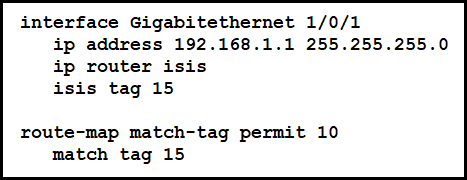
Refer to the exhibit. A large organization is merging the network assets of a recently acquired competitor with one of its own satellite offices in the same geographic are a. The newly acquired network is running different routing protocol than the company's primary network. As part of the merger a network engineer implemented this route map Which task must the engineer perform to complete the Implementation?
Options
25 comments in the community discussion
1
Pretty sure it's C here.
1
Had something like this in a mock, isn't B the step where you enable wide metrics for IS-IS interoperability?
Q: 3

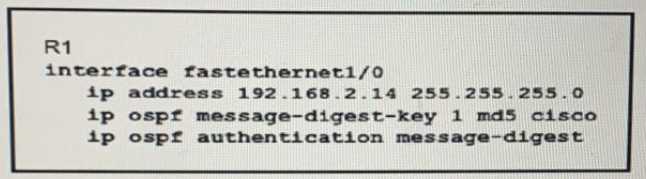
Refer to the exhibit: Cisco 350-501 question Which condition must be met by the OSPF peer of router R1 before the two devices can establish communication?
Options
33 comments in the community discussion
1
A , the key ID mismatch is what actually blocks OSPF MD5 peers in practice.
1
A is wrong, A. Both sides have to match key ID and key value for OSPF MD5 authentication, or they'll never form adjacency. I remember getting tripped up by this in lab before. Correct me if I'm missing a special case!
Q: 4
Which utility can you use to locate MPLS faults?
Options
27 comments in the community discussion
6
Option C here. Tricky since A is usually a trap for path mapping, but C is for pinpointing MPLS LSP faults specifically.
2
C imo. MPLS traceroute (A) is tempting but only shows hops, doesn't actually catch LSP faults like C does.
Q: 5

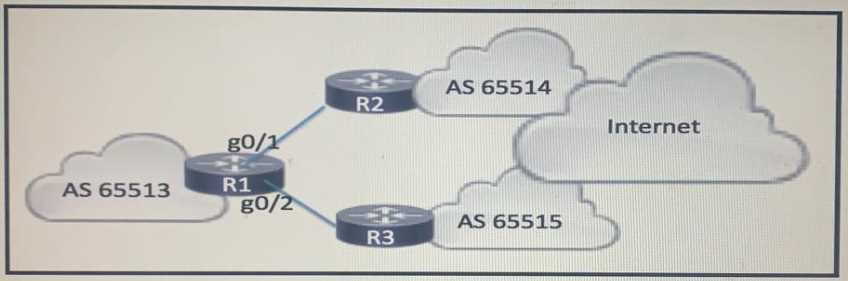
Refer to the exhibit: Cisco 350-501 question R1 is connected to two service providers and is under a DDoS attack Which statement about this design is true if uRPF in strict mode is configured on both interfaces'?
Options
38 comments in the community discussion
1
D imo
1
D
Q: 6
Which feature will an operator use while implementing MPLS TE on customer's network, to prevent an LSP from using any overseas inks?
Options
29 comments in the community discussion
6
C. not B
1
C tbh
Q: 7

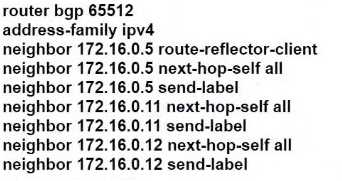
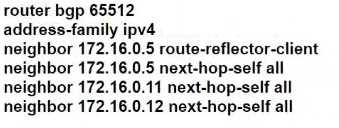
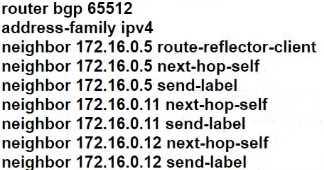
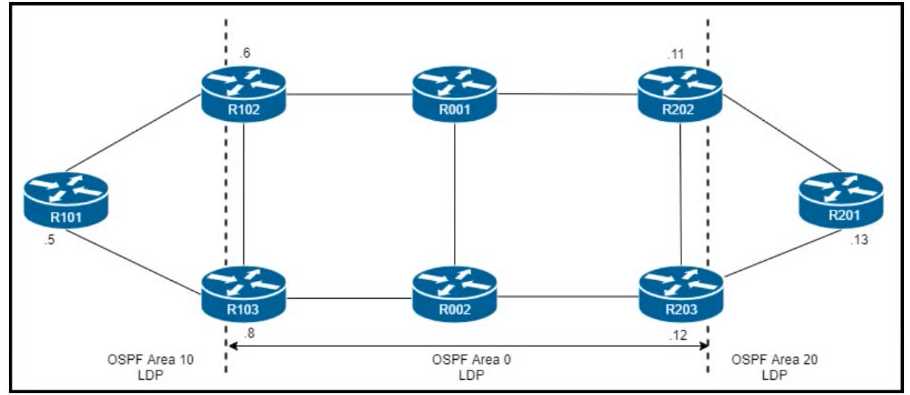
Refer to the exhibit. Cisco 350-501 question R101 is peering with R102 and R103, and R201 is peering with R202 and R203 using iBGP Labeled Unicast address families. The OSPF area 0 border routers are in a full iBGP Labeled Unicast mesh, and VPNv4 routes are exchanged directly between PE routers R101 and R201 through iBGP Which address family-level configuration must be applied on ABR R102 on ABR R102 to support a Unified MPLS routing architecture with partitioned IGP domains? A) Cisco 350-501 question B) Cisco 350-501 question C) Cisco 350-501 question D) Cisco 350-501 question

Options
38 comments in the community discussion
2
Option B pretty sure since some lab guides show similar config. Check official guide and look over exam practice too.
1
B , looks like it could work because it sets up iBGP but I'm missing the labeled unicast part for partitioned domains. Maybe I'm overthinking and B is fine since VPNv4 is exchanged directly. Not 100% though, anyone see B as valid?
Q: 8

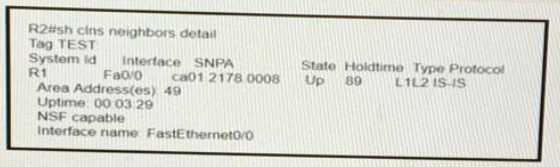
Refer To the exhibit: Cisco 350-501 question On R1, which output does the show isis neighbors command generate? A) Cisco 350-501 question B) Cisco 350-501 question C) Cisco 350-501 question D) Cisco 350-501 question

Options
31 comments in the community discussion
1
D imo, A is a classic trap since it shows the 'detailed' output not just basic show isis neighbors.
1
Probably D, I saw a similar format pop up on practice exam sites for show isis neighbors.
Q: 9
When configuring traffic engineering tunnels in Cisco MPLS core network, you see the traffic is not taking the expected path in the core. Which command do you use to quickly check path of a TE tunnel?
Options
28 comments in the community discussion
2
C , "show mpls traffic-engineering tunnels" is what actually shows the TE tunnel path, not just the IP route. D is a trap since it only checks underlay IP hops, missing MPLS specifics. Pretty sure it's C unless they asked differently.
2
Nah, I don’t think it’s D. C gives you the detailed tunnel path end-to-end, including all hops along the LSP. D just shows basic IP routing, not the actual MPLS TE tunnel info. Pretty sure C is what you want here, unless they were asking about plain IP routing. Anyone disagree?
Q: 10

An engineer needs to implement QOS mechanism on customer's network as some applications going over the internet are slower than others are. Which two actions must the engineer perform when implementing traffic shaping on the network in order to accomplish this task? (Choose two)

Options
37 comments in the community discussion
1
D imo, shaping is really about buffering packets and using the token bucket, so A and B fit best. E is more for policing where you drop packets. Not 100 percent, but this matches what I've seen in Cisco docs.
1
Maybe A/B, but if the app requirements specify strict real-time delivery, D could come into play instead.
Q: 11

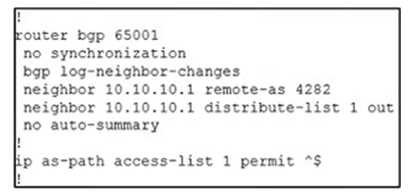
Refer to the exhibit. Cisco 350-501 question An engineer is reviewing the BGP configuration. Which routes must be advertised to 10.10.10.1
Options
8 comments in the community discussion
Option D. Saw a similar question in an exam report where D was the pick.
B . If the distribute-list on outbound is misconfigured, it's possible that no routes-local or remote-would be sent to the neighbor. I remember a similar scenario in lab where everything got denied.
Q: 12

What is a constraint of Cisco MPLS TE tunnel configurations?

Options
9 comments in the community discussion
2
B or C. B is tempting since ISIS metrics can trip people up, but I remember folks struggling with unnumbered links for MPLS TE configs too. D feels like a distractor, not convinced that's the main constraint.
1
Hard to say, D, since Cisco MPLS TE tunnels don't natively do QoS-aware path selection. Saw similar in the official guide and practice tests. Check those out if you want more on MPLS TE constraints.
Q: 13

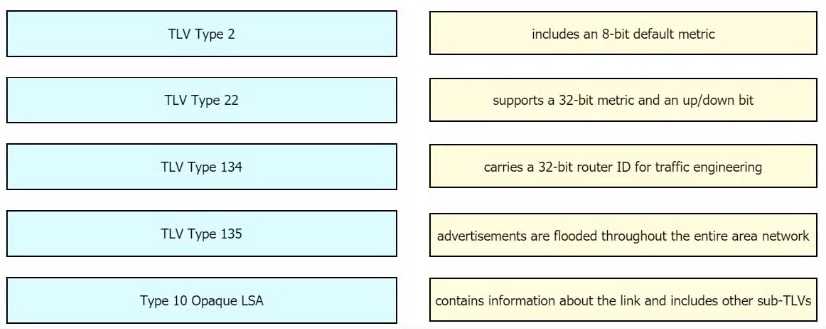
DRAG DROP Drag and drop the OSPF and IS-IS Cisco MPLS TE extensions from the left to their functional descriptions on the right. Cisco 350-501 question

Drag & Drop
3 comments in the community discussion
4
TLV Type 22 -> includes an 8-bit default metric, TLV Type 135 -> supports a 32-bit metric and up/down bit, TLV Type 134 -> carries a 32-bit router ID for TE, TLV Type 2 -> advertisements are flooded throughout entire area network, Type 10 Opaque LSA -> contains info about the link and includes other sub-
Q: 14

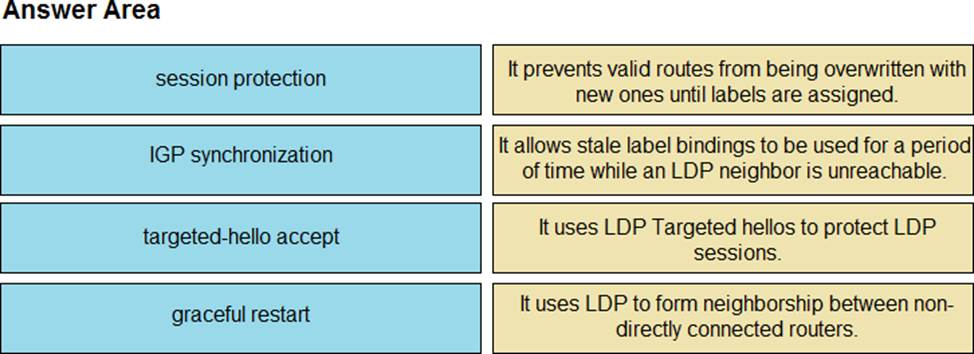
DRAG DROP Drag and drop the LDP features from the left onto their usages on the right. Cisco 350-501 question

Drag & Drop
6 comments in the community discussion
2
session protection → uses LDP Targeted hellos, IGP synchronization → allows stale label bindings, graceful restart → prevents valid routes from being overwritten, targeted-hello accept → forms neighborship with non-direct routers. Pretty sure that's right from what I remember in the OCG. If someone sees it differently
2
Had something like this in a mock: session protection -> uses LDP Targeted hellos to protect sessions, IGP synchronization -> allows stale label bindings, graceful restart -> prevents valid routes from being overwritten, targeted-hello accept -> forms neighborship between non-directly connected routers.
Q: 15

DRAG DROP Drag and drop the LDP features from the left onto the correct usages on the right.

Drag & Drop
7 comments in the community discussion
1
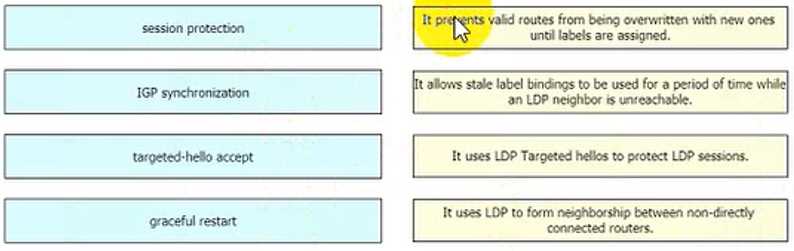
session protection -> It uses LDP Targeted hellos to protect LDP sessionsIGP synchronization -> It allows stale label bindings to be used for a period of time while an LDP neighbor is unreachabletargeted-hello accept -> It uses LDP to form neighborship between non-directly connected routersgraceful
session protection → It uses LDP Targeted hellos to protect LDP sessionsIGP synchronization → It prevents valid routes from being overwritten with new ones until labels are assignedtargeted-hello accept → It uses LDP to form neighborship between non-directly connected routersgraceful restart → It allows sta
Q: 16

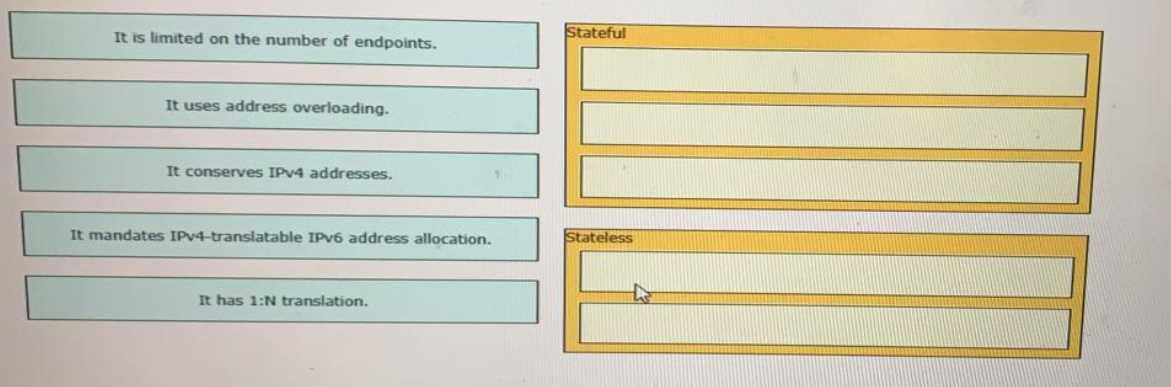
DRAG DROP Drag and drop the NAT64 descriptions from the left onto the correct NAT64 types on the right. Cisco 350-501 question

Drag & Drop
7 comments in the community discussion
7
Pretty sure this mapping holds up, but worth noting: Stateless NAT64 needs explicit IPv4-translatable IPv6 addresses, so no address overloading there. Stateful NAT64 does the traditional overloading/conservation trick with 1:N translation. Seen a similar question on some practice sets.
5
This matches what I've seen in the Cisco docs: stateful uses address overloading with 1:N translation to save IPv4, while stateless can't overload and is limited by needing IPv4-translatable IPv6. Probably the right mapping but someone shout if they see otherwise.
Q: 17

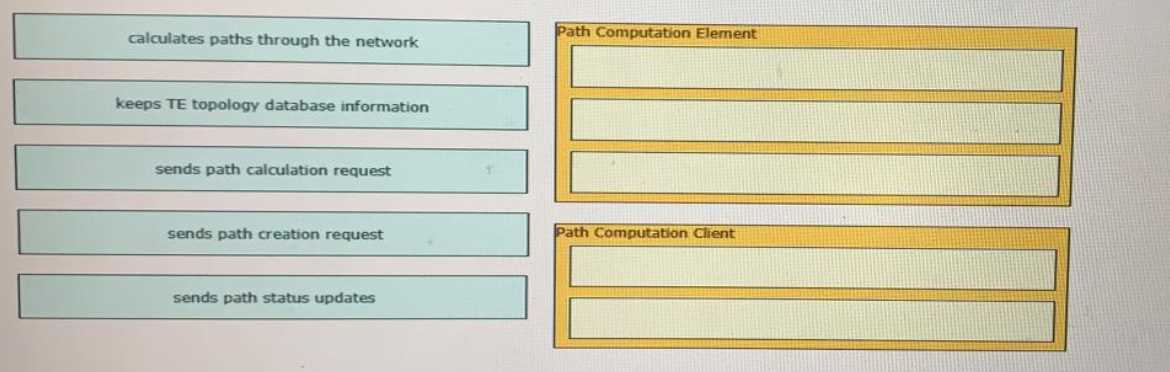
DRAG DROP Drag and drop the functions from the left onto the correct Path Computation Element Protocol roles on the right Cisco 350-501 question

Drag & Drop
8 comments in the community discussion
9
Pretty straightforward if you've worked with PCEP. Path Computation Element gets "calculates paths through the network" and "keeps TE topology database information", while Path Computation Client handles "sends path calculation request" plus the creation and status updates. That's what I've seen in similar practice set
5
PCE: calculates paths through the network, keeps TE topology database info.PCC: sends path calculation request, sends path creation request, sends path status updates.I've seen some folks put status updates under PCE but that's a trap, PCC is responsible for those. Based on practice and exam reports I'm pret
Q: 18

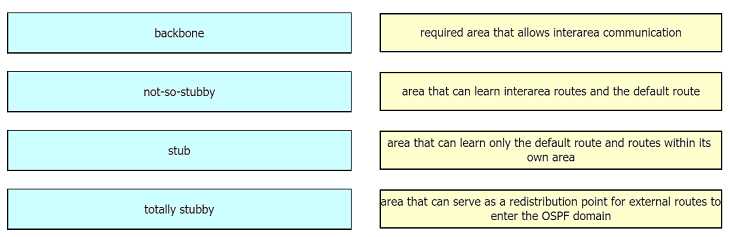
DRAG DROP Drag and drop the OSPF area types from the left onto the correct statements on the right Cisco 350-501 question

Drag & Drop
5 comments in the community discussion
6
backbone → required area that allows interarea communication, stub → area that can learn interarea routes and the default route, totally stubby → area that can learn only the default route and routes within its own area, not-so-stubby → area that can serve as a redistribution point for external routes to enter the OSPF
6
backbone → required area that allows interarea communication, stub → area that can learn interarea routes and the default route, totally stubby → area that can learn only the default route and routes within its own area, not-so-stubby → area that can serve as a redistribution point for external routes to enter the OSPF
Q: 19

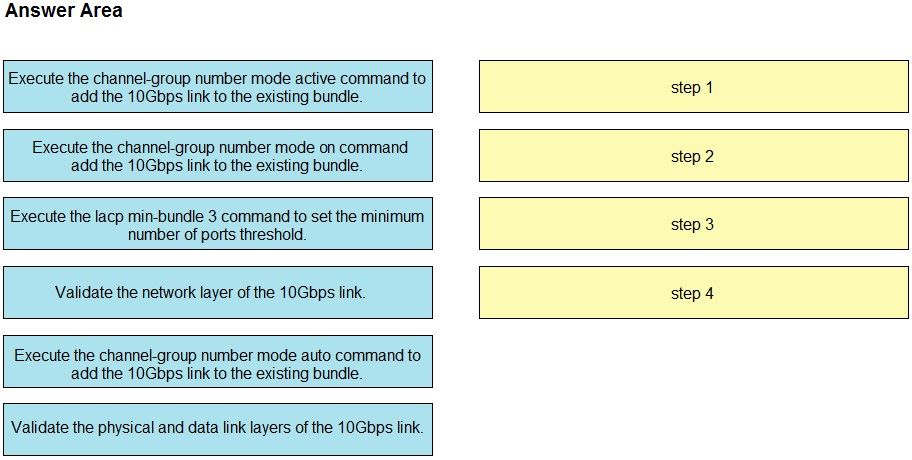
DRAG DROP A network engineer is adding 10Gbps link to an existing 2X1Gbps LACP-based LAG to augment its capacity. Network standards require a bundle interface to be take out of service if one of its member links does down, and the new link must be added with minimal impact to the production network. Drag and drop the tasks that the engineer must perform from the left into the sequence on the right. Not all options are used.

Drag & Drop
7 comments in the community discussion
6
Physical/data link check, then network layer, channel-group mode on, last is lacp min-bundle 3.
5
Pretty sure it should be: Validate physical/data link, validate network layer, add with channel-group mode on, then lacp min-bundle 3.
Q: 20

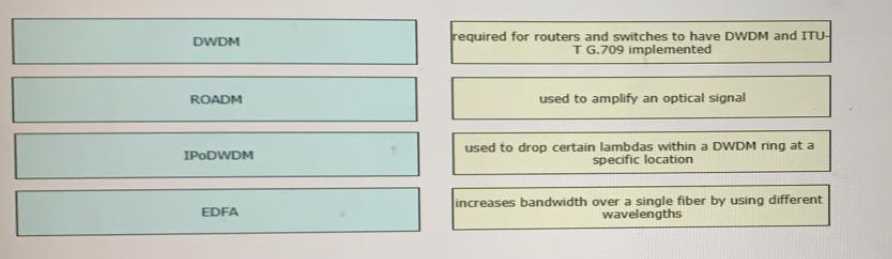
DRAG DROP Drag and drop the technologies from the left onto the correct definitions on the right. Cisco 350-501 question

Drag & Drop
6 comments in the community discussion
5
Why does Cisco love jamming all the optics acronyms in one drag and drop? Mapping: IPODWDM to routers/switches support, EDFA for amplification, ROADM for lambda drops, DWDM for bandwidth.
3
Yeah, same mapping here: IPODWDM fits the router/switch requirement, EDFA for signal boost, ROADM does the lambda drops, DWDM handles bandwidth increase. Pretty sure that's what Cisco is looking for on this one.
Question 1 of 20

Premium Access Includes

  • Quiz Simulator
  • Exam Mode
  • Progress Tracking
  • Question Saving
  • Flash Cards
  • Drag & Drops
  • 3 Months Access
  • PDF Downloads
Get Premium Access
Scroll to Top

FLASH OFFER

Days
Hours
Minutes
Seconds

avail 10% DISCOUNT on YOUR PURCHASE