Free 300-815 Practice Test Questions and Answers (2026)

View Mode
Q: 1
An SRST site must use pickup functionality on the Chicago remote site to allow the users to take incoming calls. The pickup command is configured under the call-manager-fallback section on the SRST router What are two results of that configuration? (Choose two.)
Options
20 comments in the community discussion
1
A/C here. The plain pickup under SRST call-manager-fallback only shows the PickUp soft key on phones, not GPickUp, so B is a distractor. You can answer calls ringing on another DN, matching C. Not totally sure since SRST and UCM behave a bit differently, but that's what I remember from previous labs. If so
1
A and C imo. The plain pickup command on SRST only gives you the regular PickUp soft key, not group pickup, so B isn't right. Also, picking up calls from another DN is supported with that config. Could be wrong but that's how it works in my lab.
Q: 2
A Collaboration engineer is implementing call processing capabilities on the Cisco UCM and needs to configure Call Queuing to place callers in a queue until hunt members are available to answer them. Which action must be completed before this feature can be configured?
Options
23 comments in the community discussion
1
Nah, I think it's A. B's a common trap since the service needs to run, but config-wise Hunt Pilot Queuing comes first.
1
Makes sense it's A. Without configuring Hunt Pilot Queuing you can't even access the queuing settings in CUCM. B (the service) needs to be running, but config-wise A always comes first from what I've seen. Correct me if I'm off.
Q: 3
An engineer needs to deploy Cisco Extension Mobility. The engineer already activated the required services, configured the Extension Mobility Phone Service, and created an Extension Mobility device profile that is associated with end users. Which two additional steps are required to complete the configuration? (Choose two.)
Options
20 comments in the community discussion
1
D and E imo. Device profile subscription (D) is what actually enables the service per user, and E covers logout/template stuff, which can break Extension Mobility if skipped. Saw a similar question in practice dumps. If anyone thinks A is needed here, let me know.
1
Honestly, D and E make sense here. You need to subscribe the device profile so users can use Extension Mobility, and E covers the logout/default device template piece that actually lets users go back to a default config after logging out. Not 100% but that's what's always worked for me in labs. Agree?
Q: 4
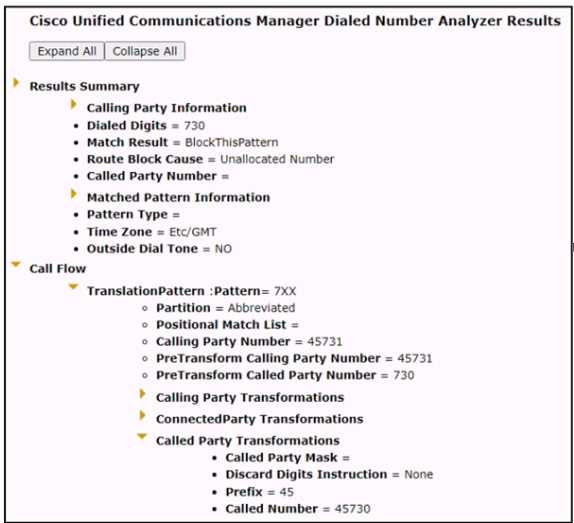
Refer to the exhibit. CISCO 300-815 question A user cannot call number 730. which Is an abbreviated number for 45730. The engineer recently configured a translation pattern In Cisco UCM. The newly configured translation pattern of 7XX prefixes the digits 45. The engineer uses DNA to troubleshoot the issue. What is the reason for this problem?

Options
22 comments in the community discussion
6
A . DNA wouldn't show any match if the partition isn't in the CSS, so translation pattern never even gets hit. C is tricky but that's not what's blocking it here from what I remember on similar practice questions.
1
Why not C here? If the translation pattern is off, 730 won't convert to 45730 either way.
Q: 5
A company has users that frequently visit locations outside the office. These users need to be able to make calls and keep the company integrity by presenting a company caller ID. The users are equipped with company-paid mobile phones. The company uses Cisco UCM with Cisco Unified Border Element and Expressway-C and Expressway-E for external communications. Which technology must be configured to meet this requirement?
Options
25 comments in the community discussion
6
Option B
Probably B. D is a trap here since it's more about seamless Wi-Fi/cellular handoff while B (Unified Mobility) covers the need for showing the company caller ID when using mobile devices outside the office. Pretty sure that's what they're after.
Q: 6
An engineer is configuring a Cisco UCM solution. The requirements state that some users in one location will receive calls from a number during work hours 09AM to 5PM, and another group will get the calls from the same number outside this defined timeslot. Users will also change the outgoing number when reaching out to customers based on the same time-of-day routing rules. Which feature is needed to allow for this type of configuration?
Options
24 comments in the community discussion
6
Option A Partitions let you pair with Time Schedules for time-of-day call routing control, which is needed here. CSS (D) just selects partitions, but the actual time logic sits at the partition level. Pretty sure about A based on exam topics, but D is tempting if you miss the time-based part of the scenario.
4
A . You need partitions so you can link them with Time Schedules for time-of-day routing in CUCM. CSS just controls which partitions users can reach, but the actual time logic is handled at the partition level. Let me know if anyone thinks otherwise.
Q: 7
An engineer needs to configure a translation pattern in Cisco UCM to match dialed numbers that start with 9011 so that the calls can be routed with a single route pattern of VH If the engineer uses translation pattern 9011.! which two called party transformation settings must be configured in Cisco UCM? (Choose two.)
Options
22 comments in the community discussion
2
B and C imo. Discard Digits Predot drops the 9011 prefix, then using +! as transform gives you E.164 format needed for international routing. Similar scenario came up in official guide labs, but open to corrections if someone thinks otherwise.
1
B/C tbh, discard predot and +! are what you need for proper E.164 conversion in UCM.
Q: 8
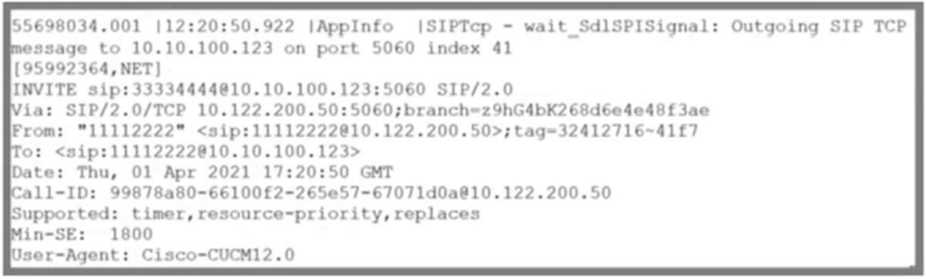
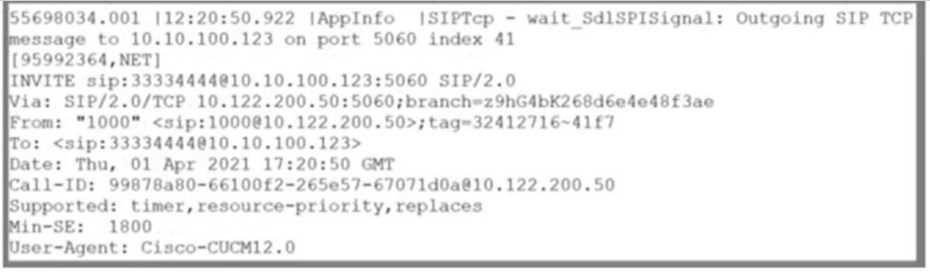
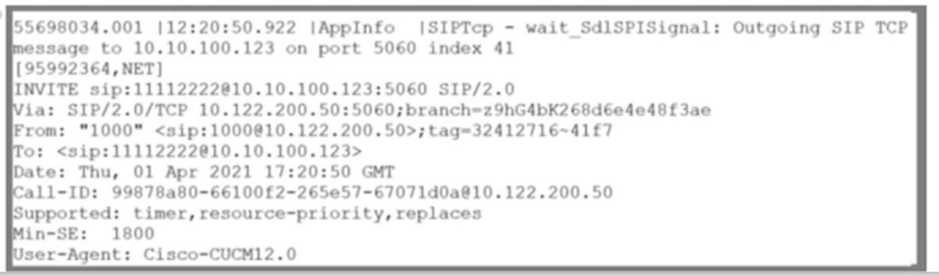
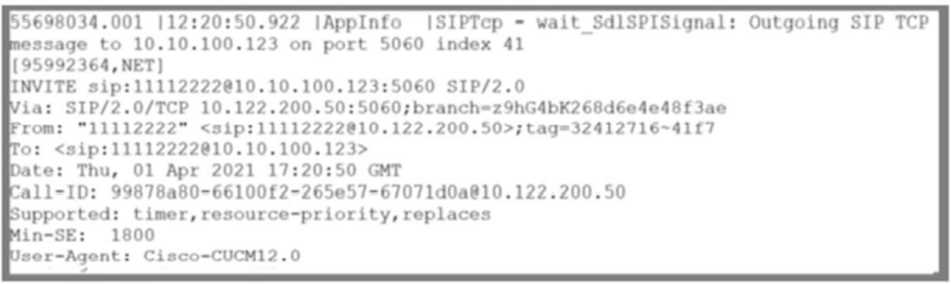
Refer to the exhibit. CISCO 300-815 question Which INVITE is sent to 10.10.100.123 as a result of this log? A) CISCO 300-815 question B) CISCO 300-815 question C) CISCO 300-815 question D) CISCO 300-815 question
Options
15 comments in the community discussion
1
SDP details actually trip you up here. For C to be right, the log has to match the Contact or sent-by specifically with 10.10.100.123, and if that changes due to NAT or proxy behavior then another option could fit. Similar questions in exam dumps flipped based on tiny detail changes so double check headers before pi
1
B seems more likely to me. Matching the SIP headers from the log, I noticed B's INVITE lines up closer with the Call-ID and SDP payload, at least from what I can tell. Not 100 percent on this though, corrections welcome.
Q: 9
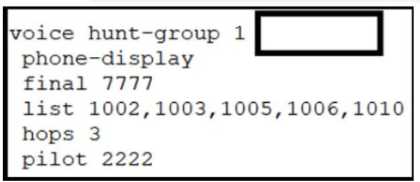
Refer to the exhibit. CISCO 300-815 question DN 1003 was the last to ring during the most recent call. Which hunting method ensures that DN 1005 is presented with the next call when the hunt pilot is dialed?
Options
21 comments in the community discussion
1
Yeah, it's D here. Peer hunting picks up with the next DN after the last one that rang, so if 1003 was last, 1005 is next in line. Pretty sure that's what the feature does.
1
D , because peer hunting picks up where the last call ended and gives it to the next DN, so it doesn't always start at the top. Sequential (C) would just keep starting at 1001. Anyone disagree?
Q: 10
The company Cisco UCM cluster has two different gateways for off-net calls. The current configuration uses 9 as a prefix to get to the main gateway. The secondary gateway is for any calls that start with 9713, but this is not yet configured. The admin does not want to add more route patterns other than the current 9 prefix for the gateway to the Cisco UCM. How must the Cisco UCM be configured to meet the requirements?
Options
22 comments in the community discussion
5
A. Saw something similar on a practice test, they wanted translation patterns + CSS, not route lists.
1
A
Q: 11
What is the relationship between partition, time schedule, and time period in Time-of-Day routing in Cisco Unified Communications Manager?
Options
5 comments in the community discussion
4
Option A is correct here. Partitions can have multiple time schedules, that’s a common trap since some confuse it with only one. Time schedule grouping of time periods matches Cisco docs. Seen this phrasing before, pretty sure about it.
A , but not 100 percent sure. Pretty sure partitions can have multiple time schedules and a time schedule is made up of several time periods, right?
Q: 12
An engineer is implementing survivability for a collaboration environment. The environment is utilizing a centralized Cisco UCM at the headquarters and Cisco IOS-XE gateways in the remote branches. Which action must the engineer take to enable both shared lines and B-ACD for SIP branch phones during a WAN outage?
Options
2 comments in the community discussion
C or D? I've seen references to both in different practice sets, but I think C makes more sense since SIP phones use voice register global. Not 100 percent sure though.
Q: 13
What are two functions of the metadata in SIP recording? (Choose two.)
Options
7 comments in the community discussion
B and D tbh. Had something like this in a mock, metadata in SIP recording is for stuff like crypto context and agent stats, not the actual media streams. Main audio/video is not considered metadata here. Agree?
B or D. If they're asking specifically about SIP recording metadata, it's things like crypto context and agent report, not media streams. Saw a similar question in practice banks. Anyone have actual traces showing these fields?
Q: 14
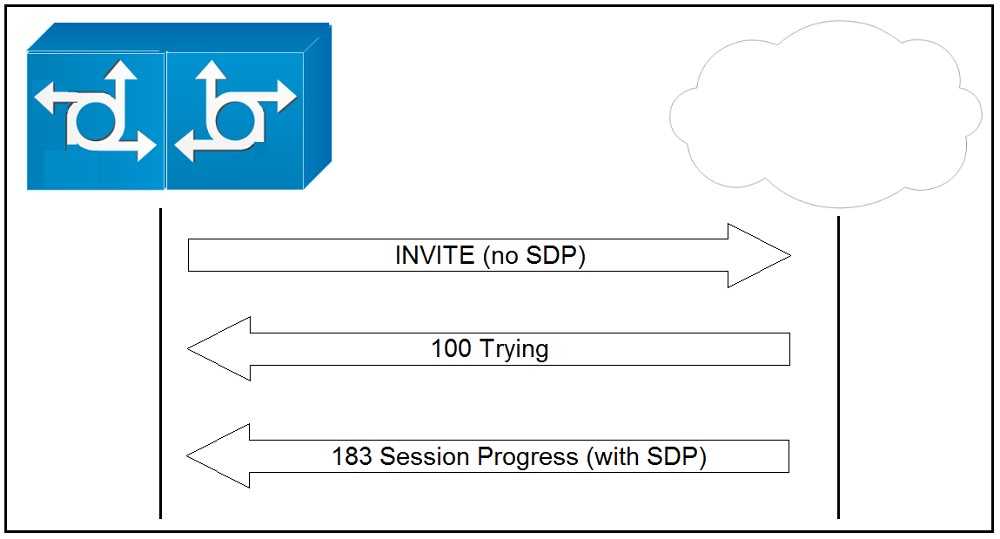
A customer reports that outbound calls from Cisco UCM to Cisco Unified Border Element are not getting early medi a. During troubleshooting, the customer finds that Cisco UCM is sending a delayed offer SIP INVITE. Cisco Unified Border Element responds with a 183 Session Progress with SDP message. However, the customer finds that Cisco UCM does not respond to the 183 messages. Which action must the customer perform to resolve the problem?
Options
4 comments in the community discussion
2
C imo, B is a common trap but early-offer forced on CUBE sorts early media here.
1
C tbh, official Cisco docs and lab sims point to early-offer forced as the fix for early media with UCM and CUBE.
Q: 15
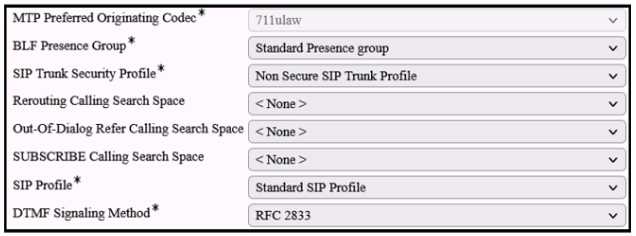
Refer to the exhibit. CISCO 300-815 question An administrator just Implemented SIP trunking on their Cisco UCM and reports that calls using the SIP trunk are using Media Termination Point resources unnecessarily. Which action resolves the issue?
Options
10 comments in the community discussion
C
C not D
Q: 16
Refer to the exhibit. CISCO 300-815 question An administrator is troubleshooting why users are not hearing audio when dialing long distance numbers across their Cisco Unified Border Element. The customer’s carrier has a requirement that dialing long distance requires an access code to be entered. Looking at the exhibit, what two actions can be taken to correct signaling? (Choose two.)
Options
10 comments in the community discussion
1
AB imo. Early Offer (B) and PRACK (A) both help with SIP signaling, especially when the carrier wants the signaling to be confirmed before media flows. Pretty sure D is not needed since it's media-related not SIP signaling.
1
B and A tbh, fits what the carrier asks for with signaling. Don't think D is relevant here.
Q: 17
A company wants to use a Cisco phone system without the need for a local generic server. It is maximum 30 phones using a vendor-independent, industry-standard call protocol. What is the first command that must be entered to add this type of phone when registering a Cisco phone to this device?
Options
6 comments in the community discussion
1
B is right here. SIP phones on CME use 'voice register pool', not 'ephone', since it's vendor-neutral and SCCP is proprietary to Cisco. Seen similar in lab configs, so pretty confident about B.
Yeah, it's B. 'voice register pool' is used for SIP phones on CME, matches the vendor-independent protocol point.
Q: 18
An administrator is configuring an Intercluster Lookup Service between 10 Cisco UCM clusters. Due to security requirements, certificate-based authentication must be used. Due to the deployment size, the administrator wants to avoid manually exchanging certificates between the clusters. Which two steps must be followed to meet these requirements? (Choose two)
Options
10 comments in the community discussion
1
B. C
B/C? If "must" really means only certificate auth, I'd double check if password-based is even allowed.
Q: 19
Which two descriptions of the Standard Local Route Group deployment are true? (Choose two.)
Options
7 comments in the community discussion
Same options I got on a recent mock exam. B and C are the picks.
B/C here. Standard Local Route Group can only be associated under the route list (not the route group directly) and it picks the RG based on the device pool of the calling-party device. E is a common trap since SLRG can't be assigned directly to route patterns. I'm pretty sure about this, but open i
Q: 20

A newly deployed site in Pennsylvania uses SIP-to-SIP legs on a Cisco Unified Border Element. The administrator wants to match the incoming dial peer based on the calling number. Which configuration is needed in the dial-peer?

Options
12 comments in the community discussion
1
C tbh, had something like this in a mock and picked C there too.
1
I’d say B, because incoming called-number is the only supported match for inbound dial peers on SIP-to-SIP CUBE configs. Agree?
Question 1 of 20

Premium Access Includes

  • ✓Quiz Simulator
  • ✓Exam Mode
  • ✓Progress Tracking
  • ✓Question Saving
  • ✓Flash Cards
  • ✓Drag & Drops
  • ✓3 Months Access
  • ✓PDF Downloads
Get Premium Access
Scroll to Top

FLASH OFFER

Days
Hours
Minutes
Seconds

avail 10% DISCOUNT on YOUR PURCHASE