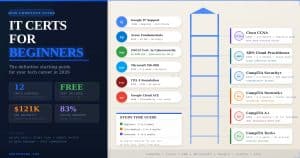
Who this guide is for: You have little or no IT experience. You want a certification that employers actually recognize. You want to know exactly what each cert costs, how hard it is, what salary it leads to, and whether it is the right starting point for your specific career goal. This guide answers all of that. The two articles currently ranking above this one cover 5 certifications between them and include no salary data. This guide covers 12 topics and includes a full comparison table, a career-path decision matrix, and a step-by-step study roadmap.
Why IT Certifications Beat Degrees for Career Starters in 2026
The traditional path into IT used to be a four-year computer science degree. That path still exists, but it is no longer the fastest or most cost-effective route into an entry-level IT job, and in many cases it is not even the preferred one.
The numbers tell the story clearly. The average cost of a four-year computer science degree in the United States is between $40,000 and $120,000. The average cost of the most recognized entry-level IT certifications ranges from $119 to $400. The Bureau of Labor Statistics projects that IT support roles will grow 8% through 2030, adding over 70,000 new jobs. And a 2025 CompTIA survey found that 83% of hiring managers consider certifications important when evaluating candidates for IT roles.
The shift is structural, not cyclical. Companies like Google, IBM, and Microsoft have officially dropped degree requirements for many IT positions and replaced them with certification and skills-based hiring. Google’s own IT Support Professional Certificate was specifically designed to create an alternative pathway into IT without a degree.
For someone starting from zero in 2026, certifications offer four things a degree cannot: speed (most entry-level certs take 3 to 6 months to prepare for), cost efficiency (under $500 for exam and study materials), immediate job relevance (certs map directly to job descriptions), and a stackable credential path that lets you build expertise incrementally rather than committing to a four-year program.
This guide covers the 12 best IT certifications for beginners in 2026, organized by career track, difficulty level, cost, and salary outcome. If you want to validate the credentials worth pursuing, the IT certification resources at CertEmpire cover practice exams and exam prep materials for most of the certifications listed here.
The Difference Between a Certification and a Certificate (It Matters)
Before diving into the list, one distinction that most beginner guides skip deserves clarification. These two terms are used interchangeably online, but they mean different things, and understanding the difference affects which credential you should pursue.
A certification is earned by passing a proctored exam that validates your knowledge and skills against a defined standard. Examples include CompTIA A+, CompTIA Security+, and AWS Certified Cloud Practitioner. Certifications are vendor-administered or vendor-neutral, they expire and require renewal, and they are what most employer job postings are referring to when they list credential requirements.
A certificate is earned by completing a training program or course. Examples include the Google IT Support Professional Certificate and the IBM Applied AI Professional Certificate on Coursera. Certificates demonstrate that you completed a curriculum, but they do not prove you passed an independent exam. They are valuable for building knowledge and can prepare you for certification exams, but they are generally not equivalent substitutes on a resume.
Both have value. The smartest path for most beginners is to use a certificate program to build your knowledge, then sit the certification exam to validate it.
What to Consider Before Choosing Your First IT Certification
With 12 certifications covered in this guide, the right question is not “which certification is best?” It is “which certification is best for where I want to go?” Here are the five factors that should drive your decision:
Career track interest. IT is not one field. It is a collection of specializations, including technical support, networking, cybersecurity, cloud computing, data, and project management. Your first certification should align with the specialization that excites you most. If you choose a certification in a track you do not enjoy, you will either struggle to stay motivated during prep or earn a credential that leads to a job you do not want.
Time available. Entry-level certifications range from 4 weeks of prep (Google IT Support) to 6 months (CCNA). Be realistic about how many hours per week you can dedicate to studying and match that to the exam’s difficulty and depth.
Budget. Exam fees range from free to $400+. Study materials and practice exams add to that cost. Set a realistic budget and factor in retake fees if you do not pass on your first attempt.
Employer demand in your market. Research job postings in your city or region. The certifications listed in job descriptions in your target market should carry more weight than any general ranking.
Progression pathway. Your first certification should open a door, not close one. Choose a cert that leads naturally to the next level in your chosen track.
The 12 Best IT Certifications for Beginners in 2026
1. CompTIA Tech+ (FC0-U71)
Difficulty: Beginner (absolute zero experience required)
Exam Cost: $119
Prep Time: 2 to 4 weeks
Passing Score: 75%
Validity: None (does not expire)
Best For: People who are completely new to IT and want to confirm it is the right career before committing to a harder cert
What It Is
CompTIA Tech+ (formerly called IT Fundamentals or ITF+) was rebranded and relaunched in 2023 as the true entry point into the CompTIA certification ecosystem. It is the only certification on this list specifically designed for people with no prior IT knowledge. It does not qualify you for any IT job on its own, but it builds the foundational knowledge that makes every subsequent certification easier.
Topics covered include IT concepts and terminology, infrastructure, applications and software, software development concepts, database fundamentals, and security basics. There are no prerequisites, no prior experience required, and the exam can be taken at a Pearson VUE test center or online.
Who Should Take It
Take CompTIA Tech+ if you are a career changer from a non-technical field and want a structured introduction to IT concepts before committing to CompTIA A+. Skip it if you already have any hands-on IT experience or have completed any IT-related training. Go straight to A+.
Salary Outcome
Tech+ alone does not qualify for specific job roles, but it is often paired with an employer’s internal training programs. Use it as a confidence builder and stepping stone to A+.
2. CompTIA A+ (220-1101 / 220-1102)
Difficulty: Beginner to Intermediate
Exam Cost: $253 per exam x2 (total ~$506, or $97 with student discount)
Prep Time: 3 to 5 months
Passing Score: 675/900 (Core 1), 700/900 (Core 2)
Validity: 3 years (renewable with CEUs or higher certs)
Best For: Anyone targeting IT support, helpdesk, and technical support roles
What It Is
CompTIA A+ is the most widely recognized entry-level IT certification in the world. It is the gold standard for technical support roles and is explicitly required or preferred in more job postings than any other entry-level IT credential. The Department of Defense requires it for IT support roles across U.S. military branches under Directive 8570.
The certification requires passing two separate exams: Core 1 covers mobile devices, networking technology, hardware, virtualization, and cloud computing. Core 2 covers operating systems, security, software troubleshooting, and operational procedures.
The exam format is scenario-based and includes performance-based questions (PBQs) where you must demonstrate tasks in a simulated environment, not just answer multiple choice questions. This makes practical preparation more important than memorization.
2026 Update
CompTIA updated the A+ exam objectives in late 2022 with the 1100 series. There are no new major updates for 2026, but cloud connectivity, remote access tools, and security fundamentals have increased weighting in recent scoring distributions.
Salary Outcome
| Role | Average US Salary |
| Help Desk Technician | $42,000 to $58,000 |
| IT Support Specialist | $48,000 to $65,000 |
| Desktop Support Analyst | $50,000 to $68,000 |
| Field Service Technician | $45,000 to $62,000 |
Career Path After A+: CompTIA Network+, CompTIA Security+, or Microsoft 365 Certified: Fundamentals
3. Google IT Support Professional Certificate
Difficulty: Beginner (no experience required)
Cost: Free to audit; ~$49/month for Coursera subscription (~$200 total to complete)
Prep Time: 3 to 6 months (at 10 hours/week)
Format: Course completion certificate (not an exam-based certification)
Best For: People who prefer structured video learning over self-study; career changers with no IT background
What It Is
Google’s IT Support Professional Certificate, offered through Coursera, is a five-course series developed by Google to create an alternative pathway into entry-level IT support roles. It covers technical support fundamentals, computer networking, operating systems, system administration, and IT security.
It is important to understand what this credential is and is not. It is a certificate of completion, not an exam-based certification. It does not carry the same weight as CompTIA A+ on a job posting that explicitly lists certification requirements. However, it is an excellent preparation program for people who find CompTIA’s self-study materials difficult to navigate alone, and it includes a 30% discount on the CompTIA A+ exam upon completion.
In 2022, Google updated the certificate to include foundational cybersecurity content aligned with its Google Cybersecurity Certificate. The combination of Google IT Support and Google Cybersecurity is now one of the most common entry pathways into security operations center (SOC) analyst roles for people without a degree.
Salary Outcome
Holders of the Google IT Support Certificate in entry-level roles earn between $40,000 and $55,000 annually in the U.S. Those who combine it with CompTIA A+ typically see starting salaries 15 to 20% higher.
Who Should Take It
Best for people who learn well through structured video instruction and want a curated curriculum before taking the CompTIA A+ exam. If you are confident in self-study, go straight to A+.
4. CompTIA Network+ (N10-009)
Difficulty: Intermediate
Exam Cost: $358
Prep Time: 3 to 6 months (recommended: hold CompTIA A+ first)
Passing Score: 720/900
Validity: 3 years (renewable)
Best For: Anyone targeting network administration, network support, or infrastructure roles
What It Is
CompTIA Network+ validates the fundamental skills required to configure, manage, and troubleshoot wired and wireless networks. It is vendor-neutral, meaning it covers networking concepts applicable across Cisco, Juniper, and other major hardware vendors rather than locking you into one ecosystem.
The N10-009 exam covers networking concepts, network implementation, network operations, network security, and network troubleshooting. Like the A+ exam, it includes performance-based questions requiring hands-on simulation.
Network+ is the most common certification requirement for network support technician and junior network administrator roles. It also serves as a stepping stone toward the Cisco CCNA, which goes significantly deeper into Cisco-specific networking.
2026 Context
With network infrastructure increasingly moving to hybrid environments, the N10-009 version includes updated content on cloud networking, software-defined networking (SDN), and zero-trust network architecture. These topics reflect real-world demand in 2026 enterprise environments.
Salary Outcome
| Role | Average US Salary |
| Network Support Technician | $52,000 to $70,000 |
| Junior Network Administrator | $60,000 to $78,000 |
| Network Operations Center Analyst | $55,000 to $72,000 |
Career Path After Network+: Cisco CCNA, CompTIA Security+, or CompTIA Cloud+
5. CompTIA Security+ (SY0-701)
Difficulty: Intermediate
Exam Cost: $392
Prep Time: 2 to 4 months (recommended: 2 years IT experience or Network+ first)
Passing Score: 750/900
Validity: 3 years (renewable)
Best For: Anyone targeting entry-level cybersecurity roles, security operations, or compliance
What It Is
CompTIA Security+ is the most important entry point into cybersecurity. It is DoD 8570 approved, globally recognized, and frequently listed as a minimum requirement for security analyst, SOC analyst, and IT security administrator positions across both private sector and government employers.
The SY0-701 exam (released November 2023, current as of 2026) covers general security concepts, threats, vulnerabilities and mitigations, security architecture, security operations, and security program management and oversight. The exam includes performance-based questions and requires applied understanding of security concepts, not just definitions.
Security+ is technically not a pure beginner certification since CompTIA recommends two years of IT experience before attempting it. However, motivated beginners with no IT background who complete CompTIA A+ and study for 3 to 4 months consistently can and do pass it on their first attempt.
Salary Outcome
| Role | Average US Salary |
| SOC Analyst (Level 1) | $55,000 to $75,000 |
| IT Security Administrator | $65,000 to $85,000 |
| Cybersecurity Analyst | $70,000 to $95,000 |
| Information Security Analyst | $75,000 to $100,000+ |
CompTIA reports that Security+ certified professionals earn an average of $121,653 annually, though this reflects mid-career professionals, not entry-level starters.
Career Path After Security+: CompTIA CySA+, CompTIA CASP+, CEH, or CISSP (with experience)
6. Cisco CCNA (200-301)
Difficulty: Intermediate to Advanced
Exam Cost: $330
Prep Time: 4 to 6 months
Passing Score: ~825/1000 (Cisco does not publish exact passing scores)
Validity: 3 years (renewable)
Best For: Anyone who specifically wants to work with enterprise networking or Cisco technologies
What It Is
The Cisco Certified Network Associate (CCNA) is the most respected entry-to-mid-level networking certification in the industry. Unlike CompTIA Network+, which is vendor-neutral, the CCNA is Cisco-specific and significantly more technical. It requires hands-on lab practice with Cisco equipment or Cisco Packet Tracer (a free simulation tool).
The 200-301 exam covers network fundamentals, network access, IP connectivity, IP services, security fundamentals, and automation and programmability. The automation and programmability section, which covers network configuration via Python and REST APIs, reflects the reality of modern enterprise networking and is a differentiator for CCNA holders.
CCNA holders are competitive for network engineer roles that CompTIA Network+ holders are not. The salary gap reflects this: CCNA-certified professionals earn measurably more than Network+ holders in equivalent years of experience.
Salary Outcome
| Role | Average US Salary |
| Network Engineer (Junior) | $65,000 to $85,000 |
| Network Administrator | $68,000 to $90,000 |
| Network Support Engineer | $60,000 to $80,000 |
Career Path After CCNA: Cisco CCNP, Cisco DevNet Associate, or CompTIA Security+
7. Microsoft Azure Fundamentals (AZ-900)
Difficulty: Beginner
Exam Cost: $165
Prep Time: 2 to 4 weeks
Passing Score: 700/1000
Validity: Does not expire
Best For: Beginners who want to enter cloud computing or validate cloud knowledge for a non-technical role
What It Is
AZ-900 is Microsoft’s entry-level cloud certification, covering cloud concepts, Azure core services, security and compliance, and Azure pricing and support. It is explicitly designed for non-technical audiences as well as technical ones, making it genuinely accessible to beginners.
AZ-900 alone does not qualify you for a technical cloud role, but it demonstrates cloud fluency that is increasingly valuable across all areas of IT and business. Many organizations moving workloads to Azure prefer candidates who understand cloud fundamentals, even in non-cloud-specific roles.
It is also the least expensive major cloud certification at $165 and the fastest to prepare for, making it an excellent first certification to earn quickly and build momentum.
2026 Context
Microsoft Azure is the second-largest cloud platform globally, with Azure revenue growing 26% year-over-year as of late 2025. Cloud skills are among the top five in-demand competencies across every IT job category in 2026.
Salary Outcome
AZ-900 alone does not typically drive salary increases directly, but it opens paths to AZ-104 (Azure Administrator) and AZ-500 (Azure Security Engineer), which lead to average salaries of $95,000 to $130,000.
Career Path After AZ-900: AZ-104 Azure Administrator, AZ-204 Azure Developer, or SC-900 Security Fundamentals
8. AWS Certified Cloud Practitioner (CLF-C02)
Difficulty: Beginner
Exam Cost: $100
Prep Time: 1 to 2 months
Passing Score: 700/1000
Validity: 3 years (renewable)
Best For: Beginners who want to enter the cloud computing space, particularly on AWS which holds 31% of the global cloud market
What It Is
The AWS Certified Cloud Practitioner is the entry point into Amazon Web Services’ certification path. At $100, it is the cheapest proctored cloud certification from a major vendor and one of the fastest to prepare for. It covers cloud concepts, AWS core services, security, compliance, pricing, and billing.
Like AZ-900, Cloud Practitioner alone does not qualify you for a technical cloud role. Its value is as a foundation credential that signals cloud awareness and opens the path to associate-level certifications like AWS Solutions Architect Associate, which is consistently one of the highest-paying associate-level IT certifications in the industry.
The CLF-C02 version, current as of 2026, includes updated content on generative AI services on AWS, reflecting the integration of AI capabilities into enterprise cloud infrastructure.
Salary Outcome
Cloud Practitioner holders who progress to AWS Solutions Architect Associate typically reach salaries of $95,000 to $140,000 within 2 to 4 years.
Career Path After Cloud Practitioner: AWS Solutions Architect Associate, AWS SysOps Administrator Associate, or AWS Developer Associate
9. Google Cloud Associate Cloud Engineer (ACE)
Difficulty: Intermediate
Exam Cost: $200
Prep Time: 2 to 4 months
Passing Score: Not published (typically around 70%)
Validity: 2 years (renewable)
Best For: Beginners targeting cloud roles in organizations using Google Cloud, particularly in data, analytics, or AI infrastructure
What It Is
Google Cloud holds roughly 11% of the global cloud market, but it is the dominant platform in data analytics, machine learning infrastructure, and AI workloads. Organizations like Spotify, Twitter, and Deutsche Bank run significant workloads on Google Cloud, and demand for Google Cloud skills is growing faster than supply.
The Associate Cloud Engineer certification covers deploying applications, monitoring operations, and managing enterprise solutions on Google Cloud. Unlike AZ-900 and AWS Cloud Practitioner, it is not a pure foundational cert. It is Associate-level, meaning it requires demonstrable hands-on skills and is competitive for cloud operations roles.
Salary Outcome
| Role | Average US Salary |
| Cloud Operations Engineer | $75,000 to $100,000 |
| Junior Cloud Engineer | $80,000 to $105,000 |
Career Path After ACE: Google Cloud Professional Cloud Architect, Google Cloud Professional Data Engineer
10. Microsoft 365 Certified: Fundamentals (MS-900)
Difficulty: Beginner
Exam Cost: $165
Prep Time: 2 to 3 weeks
Passing Score: 700/1000
Validity: Does not expire
Best For: IT support professionals working in Microsoft 365 environments; career changers in office administration
What It Is
MS-900 covers the fundamentals of Microsoft 365 cloud services, including productivity and teamwork, business management, security, compliance, privacy, trust, and licensing. It is one of the most practically useful certifications for people already working in IT support within organizations that run Microsoft 365, which has over 300 million commercial users worldwide.
MS-900 is not a technically demanding certification, but it is highly relevant for helpdesk and support roles in Microsoft-heavy environments. Combined with CompTIA A+, it makes candidates significantly more competitive for IT support roles in corporate environments.
Career Path After MS-900: MD-102 Endpoint Administrator, MS-700 Teams Administrator, or SC-900 Security Fundamentals
11. ITIL 4 Foundation
Difficulty: Beginner to Intermediate
Exam Cost: $435 (varies by provider; some offer bundled training packages)
Prep Time: 1 to 3 months
Passing Score: 65% (26 out of 40 questions)
Validity: Does not expire
Best For: Beginners targeting IT service management, IT operations, or enterprise IT roles rather than technical hands-on roles
What It Is
ITIL 4 Foundation is the globally recognized entry-level certification for IT Service Management (ITSM). While most certifications on this list are technical, ITIL is process-oriented. It certifies your understanding of how IT services are planned, delivered, managed, and improved within enterprise environments.
ITIL is not what you study if you want to configure servers or troubleshoot networks. It is what you study if you want to manage IT processes, work in a service desk leadership role, or move into IT operations management. It is the most common certification requirement for IT service management roles at large enterprises and is valued in industries like banking, healthcare, and government where IT governance is critical.
AXELOS updated ITIL to version 4 in 2019, and it remains current as of 2026 with the ITIL 4 Practice Manager and Strategic Leader extensions available for more advanced study.
Salary Outcome
| Role | Average US Salary |
| IT Service Desk Analyst | $50,000 to $68,000 |
| ITSM Coordinator | $65,000 to $85,000 |
| IT Operations Manager | $85,000 to $110,000 |
12. (ISC)2 Certified in Cybersecurity (CC)
Difficulty: Beginner
Exam Cost: Free (through (ISC)2’s 1 million certification program)
Prep Time: 1 to 3 months
Passing Score: 700/1000
Validity: 3 years (renewable with CPEs)
Best For: Anyone who wants to enter cybersecurity with zero experience and zero budget for exam fees
What It Is
The (ISC)2 Certified in Cybersecurity was launched in 2022 as a free entry-level cybersecurity certification designed to address the global cybersecurity workforce gap. As of 2026, it remains free to attempt, making it the only legitimate, industry-recognized cybersecurity certification with no exam cost.
It covers five domains: security principles, business continuity, disaster recovery, and incident response concepts, access controls concepts, network security, and security operations. It is not as comprehensive as CompTIA Security+, but for someone starting with zero budget and zero experience in cybersecurity, it is an exceptional first credential.
The (ISC)2 Certified in Cybersecurity is best used as a stepping stone toward Security+ rather than as a standalone credential. Employers recognize (ISC)2 as a highly credible organization, and even this entry-level certification carries the brand credibility of the organization that administers CISSP, the most respected advanced security credential in the industry.
Career Path After CC: CompTIA Security+, then (ISC)2 SSCP or CompTIA CySA+
The Complete Comparison Table
| Certification | Cost | Difficulty | Prep Time | Expires | Best Career Track |
| CompTIA Tech+ | $119 | Absolute beginner | 2 to 4 weeks | No | Foundation only |
| CompTIA A+ | $506 (2 exams) | Beginner | 3 to 5 months | 3 years | IT Support |
| Google IT Support | ~$200 | Beginner | 3 to 6 months | No | IT Support |
| CompTIA Network+ | $358 | Intermediate | 3 to 6 months | 3 years | Networking |
| CompTIA Security+ | $392 | Intermediate | 2 to 4 months | 3 years | Cybersecurity |
| Cisco CCNA | $330 | Intermediate/Adv | 4 to 6 months | 3 years | Networking |
| Azure Fundamentals | $165 | Beginner | 2 to 4 weeks | No | Cloud |
| AWS Cloud Practitioner | $100 | Beginner | 1 to 2 months | 3 years | Cloud |
| Google Cloud ACE | $200 | Intermediate | 2 to 4 months | 2 years | Cloud/Data |
| Microsoft MS-900 | $165 | Beginner | 2 to 3 weeks | No | IT Support/M365 |
| ITIL 4 Foundation | $435 | Beginner/Int | 1 to 3 months | No | IT Service Mgmt |
| (ISC)2 CC | Free | Beginner | 1 to 3 months | 3 years | Cybersecurity |
Career Path Decision Matrix: Which Certification for Which Goal
The most common question beginners ask is not “what is the best certification?” It is “which certification is right for my situation?” This matrix maps your starting point and goal to the right first certification.
| Your Situation | Your Goal | Start With | Then Move To |
| Zero IT experience | IT support or helpdesk job | CompTIA A+ | Network+ or Security+ |
| Zero experience, tight budget | Cybersecurity career | (ISC)2 CC (free) | CompTIA Security+ |
| Zero experience, prefer video learning | IT support career | Google IT Support Certificate | CompTIA A+ exam |
| Some IT experience | Networking career | CompTIA Network+ | Cisco CCNA |
| Some IT experience | Cybersecurity career | CompTIA Security+ | CySA+ or CEH |
| No experience, want cloud career | Cloud computing | AWS Cloud Practitioner | AWS Solutions Architect |
| Working in Microsoft environment | Corporate IT support | MS-900 + CompTIA A+ | MD-102 or SC-900 |
| Want IT management, not technical | IT service management | ITIL 4 Foundation | ITIL 4 Practitioner |
| Career changer, unsure about IT | Exploring IT as career | CompTIA Tech+ | Whichever track interests you |
| IT support role, want to move to security | Security transition | CompTIA Security+ | CompTIA CySA+ |
Salary Expectations by Certification Level
One of the questions every beginner needs answered honestly is: what will this actually pay? Here is a realistic salary guide for the U.S. market in 2026 across experience levels.
| Certification(s) Held | Experience Level | Realistic Salary Range |
| CompTIA A+ only | 0 to 1 year | $40,000 to $58,000 |
| A+ plus Network+ | 1 to 2 years | $55,000 to $72,000 |
| A+ plus Security+ | 1 to 2 years | $60,000 to $80,000 |
| CCNA | 1 to 3 years | $65,000 to $90,000 |
| AWS Cloud Practitioner plus Solutions Architect | 1 to 3 years | $80,000 to $110,000 |
| Security+ plus CySA+ | 2 to 4 years | $80,000 to $105,000 |
| Multiple certs plus 3 to 5 years experience | Mid-career | $95,000 to $130,000+ |
These ranges reflect actual job posting data, not aspirational figures. Location matters significantly. San Francisco, New York, Seattle, and Washington DC consistently pay 20 to 40% above national averages for the same roles.
How to Study: A Realistic 12-Week Plan for CompTIA A+
The most common certification failure is not difficult. It is a poor study structure. This 12-week plan works for CompTIA A+ and can be adapted for any exam on this list.
Weeks 1 to 2: Learn the exam structure
Download the official CompTIA A+ exam objectives from CompTIA’s website. This document is free and is the single most important study tool available. Every question on the exam comes from these objectives. Read through them once to understand what you are committing to. Identify the sections that already feel familiar and the ones that are completely new.
Weeks 3 to 6: Core 1 content
Study all Core 1 objectives systematically. Use Professor Messer’s free CompTIA A+ course on YouTube (the most highly rated free resource in the community), a paid study guide like Mike Meyers or Jason Dion’s on Udemy, or a combination. Take notes. Build a personal glossary of terms you do not recognize. Do not attempt practice questions yet.
Weeks 7 to 10: Core 2 content
Repeat the same process for Core 2 objectives. Focus heavily on operating systems, security, and troubleshooting scenarios, as these sections carry higher question weight in the current exam.
Week 11: Practice exams
Take full-length timed practice exams under real conditions. Do not look anything up during the test. Review every wrong answer, not just the right ones. Understand why each wrong answer is wrong. Score below 75% on practice exams? Spend an extra week on your weakest two domains before booking the real exam.
Week 12: Light review and exam
Do not cram the night before. Review your personal glossary and weak areas only. Sleep well. On exam day, read every scenario fully before looking at the answers, flag uncertain questions and come back to them, and remember that performance-based questions count for more points and appear at the start of the exam.
For scenario-based practice questions that mirror the current A+ exam format, the CompTIA A+ practice resources at CertEmpire are worth using alongside your primary study materials in the final two to three weeks before your exam date.
Common Mistakes That Cause Beginners to Fail
Choosing a certification based on prestige rather than readiness. CISSP and CCIE are prestigious. They are also designed for professionals with 5 to 10 years of experience. Starting with a certification that requires experience you do not have is a guaranteed way to fail and lose both money and confidence. Start where you actually are, not where you want to end up.
Treating practice exams as learning tools. Practice exams should test your knowledge, not teach it. If you are doing practice questions before you have studied the material, you are memorizing answers, not learning concepts. The exam will ask the same concepts in different ways. Understand the material first. Test afterward.
Underestimating the performance-based questions. Multiple-choice memorization gets you to about 60% of the score. PBQs require you to actually do things: configure a network, troubleshoot a security issue, set up a printer in a simulated environment. If you have not practiced hands-on tasks, you will struggle with PBQs even if you know all the theory.
Not using the official exam objectives. Every certification vendor publishes the official exam objectives for free. This document tells you exactly what topics are tested and with what approximate weight. Most beginners never read it. The ones who do have a structural advantage from day one.
Booking the exam before you are ready to save money. Retake fees are almost always 50% to 100% of the original exam cost. Booking too early because you want to “force yourself” often results in a failed attempt that costs more money than taking an extra two weeks to prepare. Book when you are consistently scoring above the passing threshold on full-length practice exams.
Free Study Resources Worth Using
Professor Messer (professormesser.com) offers free CompTIA A+, Network+, and Security+ study courses on YouTube that are widely considered the best free prep resources available. The video quality and depth are comparable to paid courses.
Trailhead (trailhead.salesforce.com) is free and relevant for anyone interested in Salesforce administration as a secondary IT skill alongside core certifications.
AWS Skill Builder (skillbuilder.aws) offers free cloud practitioner prep content directly from Amazon.
Microsoft Learn (learn.microsoft.com) provides free structured learning paths for all Microsoft certification exams, including AZ-900 and MS-900.
Cybrary (cybrary.it) offers free foundational cybersecurity courses aligned with Security+ and (ISC)2 CC objectives.
Reddit communities including r/CompTIA, r/ITCareerQuestions, and r/AWSCertifications are invaluable for current exam feedback, study tips, and honest advice from people who just passed.
Frequently Asked Questions
Which IT certification is best for absolute beginners?
CompTIA A+ is the most universally recommended first certification for anyone targeting IT support roles. If you have zero IT knowledge and want to test the waters before committing, start with CompTIA Tech+. If your budget is zero and cybersecurity is your goal, start with (ISC)2 Certified in Cybersecurity, which is currently free.
How long does it take to get an IT certification?
It depends on the certification and how many hours per week you study. Foundational certs like CompTIA Tech+, AZ-900, and AWS Cloud Practitioner can be prepared for in 4 to 8 weeks at 10 hours per week. Intermediate certs like CompTIA A+, Security+, and CCNA typically require 3 to 6 months at the same study intensity.
Are IT certifications worth it without a degree?
Yes. The shift toward skills-based hiring is real and accelerating. Google, IBM, Microsoft, and many other major employers have officially removed degree requirements for entry-level IT roles. Certifications are the primary signal employers use to evaluate candidates without degrees.
What is the easiest IT certification to get?
CompTIA Tech+, AZ-900 (Azure Fundamentals), MS-900 (Microsoft 365 Fundamentals), and AWS Cloud Practitioner are all designed for beginners and have high first-attempt pass rates with focused preparation. (ISC)2 Certified in Cybersecurity is free and also accessible to beginners.
Can I get an IT job with just one certification?
Yes, but it depends on the certification and the role. CompTIA A+ is enough to land entry-level helpdesk and IT support roles. One cloud fundamentals cert (AZ-900 or Cloud Practitioner) alone is usually not enough without pairing it with at least one associate-level cloud cert. For cybersecurity, Security+ or CC opens doors to entry-level analyst and SOC roles.
Which certification has the best salary ROI?
For the fastest path to $70,000+, AWS Solutions Architect Associate (after Cloud Practitioner) offers the best salary ROI in the shortest time. For cybersecurity, Security+ plus one year of experience leads to $65,000 to $80,000 starting salaries. The Cisco CCNA consistently leads to some of the highest entry-level salaries in traditional enterprise IT.
Do IT certifications expire?
Most do. CompTIA certifications expire every 3 years and can be renewed through continuing education units (CEUs), completing higher-level exams, or retaking the certification. AWS certifications expire every 3 years. Microsoft fundamentals certifications (AZ-900, MS-900) do not expire. ITIL 4 Foundation does not expire.
How much does it cost to get an IT certification as a beginner?
Budget between $100 and $600 for the exam fee plus study materials for most entry-level certifications. The cheapest path is (ISC)2 CC (free exam) or AWS Cloud Practitioner ($100 exam plus free AWS Skill Builder prep). The most expensive path on this list is CompTIA A+ at roughly $500 to $700 including study materials. Student discounts are available for CompTIA exams through the CompTIA Academic Marketplace.
The Bottom Line
The IT certification landscape in 2026 is richer and more accessible than it has ever been. From free credentials like (ISC)2 Certified in Cybersecurity to structured programs like the Google IT Support Certificate to industry-standard technical certs like CompTIA A+ and CCNA, there is an entry point for every background, budget, and career goal.
The mistake most beginners make is spending weeks researching instead of starting. Choose the certification that aligns with your career track and start studying this week. The job market for entry-level IT professionals is active, the skills shortage is real, and every certification you earn is a permanent credential that opens doors even as technologies evolve.
Your first certification will not be your last. It will be the foundation everything else is built on.