Important update for 2026 candidates: The AIGP Body of Knowledge was updated to version 2.1 on February 2, 2026. Most guides online still reference the old seven-domain structure or the previous version. This guide reflects the current four-domain BoK v2.1 that every candidate sitting the exam right now must prepare for. If your study materials do not reference this version, you are preparing for the wrong exam.
The AI Governance Skills Gap Is Real and Growing Fast
77% of organizations are already working on AI governance, and among those actively using AI, nearly 90% have governance efforts underway. Yet despite this surge, fewer than 60% have dedicated governance roles or response playbooks, leaving a massive skills gap in the workforce. Smaller firms are even further behind, with only 36% employing dedicated governance officers.
That gap has a price. Over 80% of organizations feel unprepared for new AI regulations, while 93% lack confidence in their ability to govern AI responsibly. The professionals who close that gap are in extraordinary demand right now.
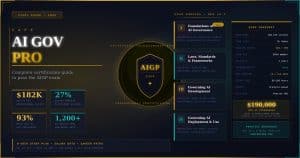
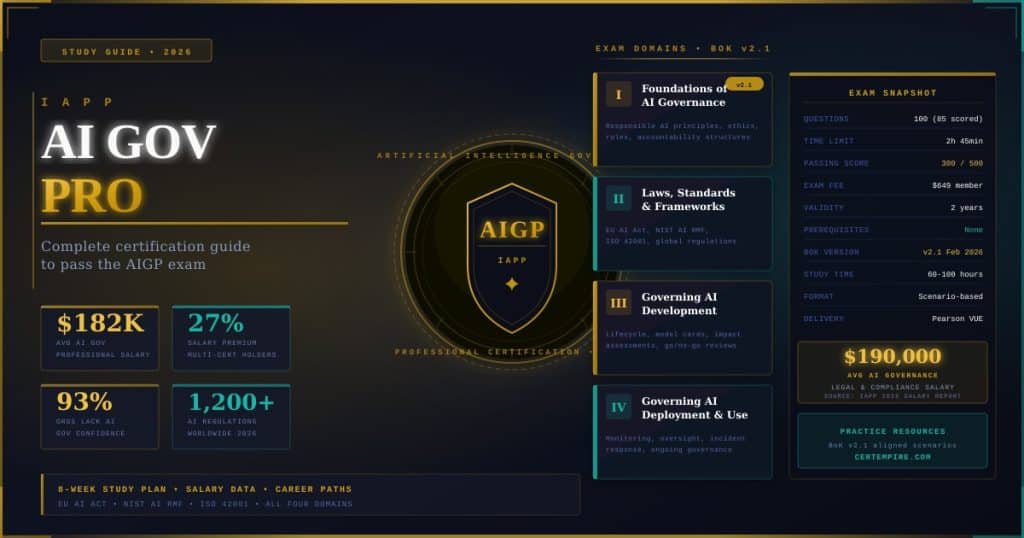
The numbers back this up. The average salary for AI governance professionals has reached $182,000. Employees with AI skills enjoy a 56% wage premium. 100% of industries are increasing AI usage. Over 1,200 regulations and policy initiatives worldwide are requiring that organizations master AI risk.
Organizations scrambling to comply with the EU AI Act, implement NIST AI RMF controls, and build defensible AI governance programs need people who can translate frameworks into operational reality. That is precisely what the IAPP Artificial Intelligence Governance Professional (AIGP) certification validates.
If you are preparing for the AIGP exam, our AIGP practice resources are built around the current BoK v2.1 and give you the scenario-based question practice that makes the difference between passing and retaking.
What Is the IAPP AIGP Certification?
The AIGP credential demonstrates competency in AI development, the ability to conduct ethical AI deployment, and the ability to utilize best practices in AI management to ensure safety and trust.
What makes AIGP different from other AI certifications is its focus on governance rather than technical implementation. You will not learn to build AI systems. You will learn to oversee them responsibly, understanding risks, ensuring compliance, and managing ethical challenges that arise when AI affects real people and business operations.
The certification has gained significant traction across industries since its launch. The official training curriculum was released on October 2, 2023, followed by exam availability on April 2, 2024. The inaugural in-person exams were administered at the IAPP Global Privacy Summit on April 4, 2024, marking the official launch of what has quickly become the most sought-after AI governance credential in the market.
The AIGP is the International Association of Privacy Professionals’ credential for professionals who design, implement, and oversee responsible AI governance. It validates your ability to create and run AI governance programs across the full lifecycle, covering policy, risk, controls, documentation, oversight, and continuous monitoring.
The 2026 Exam Update: What Changed in BoK v2.1
When the IAPP released version 2.1 of the AIGP Body of Knowledge, effective February 2, 2026, it did not represent an entire overhaul. IAPP has historically stated that annual updates to its certification exams include new content that will consist of no more than 10 to 15% of the overall exam. This is a recalibration, not a reinvention.
When the IAPP moved from v1.0 to v2.0.1 in February 2025, it restructured the BoK from seven high-level domains to just four domains. With the v2.1 update, this same four-domain structure remains in place with specific refinements:
Performance Indicator I.C.2 was modified to now include evaluating and updating data governance and intellectual property policies for AI. Performance Indicator I.C.3 was modified to now include updated third-party risk documents, assessments, and contracts to manage third parties. These changes reflect the shift in the field from governing individual AI models to governing complete, dynamic AI systems that interact with other software, data sources, and external vendors.
Prior performance indicators III.A.3 and IV.B.2 were removed, reflecting a reorganization rather than a substantive removal of content. Domain II already addresses what laws apply to AI models and systems, and this is necessary knowledge to successfully obtain AIGP certification.
The practical implication for 2026 candidates is that the exam has shifted its perspective toward how AI interacts with other systems and third parties across the full lifecycle. Operational, lifecycle-oriented questions are more prominent than purely conceptual ones. This AIGP practice exam is fully updated to reflect BoK v2.1 and includes scenario questions built around these updated performance indicators.
Complete Exam Details
| Detail | Information |
| Exam Name | Certified Artificial Intelligence Governance Professional (AIGP) |
| Current BoK Version | 2.1 (effective February 2, 2026) |
| Number of Questions | 100 (85 scored + 15 unscored pilot questions) |
| Time Limit | 2 hours 45 minutes |
| Passing Score | 300 out of 500 (scaled scoring) |
| Exam Fee (Member) | $649 |
| Exam Fee (Non-Member) | $799 |
| Retake Fee (Member) | $475 |
| Retake Fee (Non-Member) | $625 |
| Prerequisites | None |
| Certification Validity | 2 years |
| Maintenance | 20 CPE credits + maintenance fee every 2 years |
| Delivery | Pearson VUE test centers or OnVUE remote proctoring |
| Scheduling | Within one year of purchase |
Of those 100 questions, 85 are scored while 15 are unscored pilot questions being tested for future exams. You will not know which questions are which, so treat them all seriously. IAPP uses scaled scoring from 100 to 500, with 300 being the passing threshold. About 30% of questions are connected to case studies that present real-world AI governance challenges.
The Four AIGP Exam Domains: BoK v2.1 Breakdown
Domain I: Understanding the Foundations of AI Governance
This domain establishes the conceptual bedrock everything else builds on. It covers fundamental AI concepts and types of systems, the principles of responsible AI, how AI creates value and introduces risk, the ethical dimensions of AI deployment, and the governance roles and accountability structures within organizations.
Key topics you need to understand for this domain include the distinction between ethical, responsible, and trustworthy AI. This is a tricky conceptual area that the exam tests with scenario questions. You also need to understand how to evaluate data governance policies and intellectual property implications for AI, newly emphasized in v2.1, and how to manage third-party AI risk through updated assessment frameworks and contracts, also updated in v2.1.
What the exam actually tests here: Scenario questions in this domain ask you to identify which responsible AI principle is being violated, which governance role should own a specific decision, or how to update an existing governance policy to address a new AI use case.
Study approach: Draft a simple AI governance charter for a fictional organization. Define the principles, assign ownership roles, and identify where third-party risk appears in the value chain. This exercise covers roughly 70% of what Domain I tests in applied form. The CertEmpire AIGP practice set includes Domain I scenario walkthroughs that follow exactly this structure.
Domain II: Understanding How Laws, Standards, and Frameworks Apply to AI
This is the regulatory and framework literacy domain. It covers the EU AI Act in detail, NIST AI RMF and NIST ARIA, ISO 42001 and ISO 23894, national and regional AI regulations, and how different frameworks map onto organizational roles and responsibilities.
The EU AI Act is the centerpiece of this domain. It is the first comprehensive AI law which took effect on August 1, 2024, with most provisions applying throughout 2026. It is quickly becoming a global model for AI regulation. The AIGP exam does not cover individual U.S. state AI laws, but the EU AI Act is essential.
The EU AI Act is role-specific in how it assigns obligations. Be ready to explain what providers versus deployers must do under the Act. Memorizing the law without understanding its role-specific obligations is one of the most common Domain II preparation mistakes. The regulation assigns very different compliance responsibilities depending on which party you are in the AI supply chain.
The NIST AI RMF is the other major framework in this domain. You need to understand its four core functions, which are Govern, Map, Measure, and Manage, how its outcomes translate into organizational controls, and how it relates to the EU AI Act and ISO 42001. These frameworks are not tested in isolation. The exam regularly presents scenarios that require you to understand how NIST AI RMF maps to EU AI Act requirements, or how ISO 42001 management system controls operationalize governance principles.
Study approach: Build a requirement-to-control mapping table. For the EU AI Act high-risk AI provisions, NIST AI RMF Govern function, and ISO 42001 management system requirements, identify the specific control each requires and which organizational role owns it. This mapping exercise directly prepares you for Domain II scenario questions.
Domain III: Understanding How to Govern AI Development
This domain moves from law and frameworks to the practical work of governing AI systems as they are built. It covers the AI development lifecycle, risk assessment methodologies during development, data governance in the AI context, model evaluation and testing practices, documentation requirements including model cards, data sheets and AI impact assessments, and the go/no-go decision process before deployment.
A common candidate mistake is studying ethics without the operations component. The AIGP asks how you operationalize ethical principles into controls, processes, and documentation. Expect scenario questions that hinge on the right documentation at the right lifecycle stage. Knowing what a model card contains and when it must be completed is the kind of specific, applied knowledge that Domain III tests.
Familiarity with how to conduct an AI Impact Assessment and tailor it to your organization is important here. Like data protection impact assessments in privacy, AI impact assessments in governance follow a structured methodology that the exam tests through scenario questions.
What the exam actually tests here: Go/no-go decision scenarios where you must identify which governance conditions must be satisfied before a model is deployed. Documentation scenarios asking which artifact applies at which lifecycle stage. Risk assessment scenarios asking how to identify and mitigate specific development-stage risks.
Study approach: Create a model risk checklist covering data quality, bias testing, documentation completeness, and approval gates. Run a mock go/no-go review for a fictional AI model. Identify which conditions would cause you to halt deployment and what documentation would be required to proceed. The CertEmpire AIGP study guide includes worked examples of exactly this type of go/no-go scenario.
Domain IV: Understanding How to Govern AI Deployment and Use
This is the operational, post-deployment governance domain and where many candidates under-prepare. Monitoring, human oversight, incident response, and reporting are frequent exam focus areas that candidates who focus only on pre-deployment preparation miss.
Domain IV covers continuous monitoring of deployed AI systems, performance drift detection and response, fairness and bias monitoring in production, human oversight mechanisms and when they must be applied, incident response for AI system failures, regulatory reporting obligations, and the processes for updating, retraining, or retiring AI systems.
The connection to real-world practice is direct. Organizations that deploy AI and never monitor it are exactly the ones that end up with regulatory violations and operational failures. Domain IV validates that you can build the oversight infrastructure that prevents this.
What the exam actually tests here: Monitoring scenario questions asking what metrics should trigger a human review escalation. Incident response scenarios asking which stakeholders must be notified and within what timeframe. Oversight model questions asking when human-in-the-loop versus human-on-the-loop applies to specific deployment contexts.
Study approach: Draft a monitoring and incident runbook for a fictional deployed AI system. Define your KPIs, fairness metrics, drift thresholds, alert levels, escalation path, and reporting obligations. This runbook directly maps to the scenario questions Domain IV presents.
Complete Cost Breakdown
Understanding the full cost of the AIGP certification before you commit matters because the exam fee is only part of the investment.
| Cost Item | IAPP Member | Non-Member |
| IAPP Annual Membership | $295 | N/A |
| Exam Fee | $649 | $799 |
| CertEmpire Practice Exam Bundle | Available at certempire.com | Available at certempire.com |
| Certification Maintenance Fee (every 2 years) | Included in membership | $250 |
| Retake (if needed) | $475 | $625 |
Member path: $649 exam + $295 membership = $944 upfront, plus your CertEmpire prep materials. The $150 exam discount from membership versus the $295 membership cost means membership pays for itself if you plan to sit more than one IAPP exam.
Non-member path: $799 exam upfront plus your prep materials. Budget $250 for the certification maintenance fee at your two-year renewal.
The most cost-effective preparation strategy is to combine the free AIGP BoK v2.1 download from the IAPP website with CertEmpire’s AIGP practice resources, which are specifically built around the current exam format and include scenario-based questions matched to BoK v2.1 performance indicators. This combination delivers exam-ready preparation at a fraction of other approaches.
Salary and Career Outcomes
The financial case for the AIGP is one of the strongest in the certification space right now because supply of qualified AI governance professionals is dramatically below demand.
According to IAPP’s 2025 Salary and Jobs Report, professionals in AI governance legal and compliance roles average $190,000 in base salary. The global average for total compensation across privacy, AI governance, and cybersecurity roles reaches $200,000.
IAPP’s research shows that holding one IAPP certification correlates with 13% higher salaries compared to non-certified peers. That jumps to 27% for professionals holding multiple IAPP certifications. If you already have CIPP or CIPM credentials, adding AIGP creates a powerful credential combination that employers are actively seeking.
Professionals whose roles encompass both privacy and AI governance earn a median salary of $169,700, compared to $151,800 for those focused solely on AI governance. That is nearly an $18,000 premium for bridging these disciplines. If you already work in privacy, adding AI governance expertise through AIGP makes real financial sense.
AI governance job postings show an average annual salary of $141,139, with concentration between $140,000 and $167,500. Specific job listings mentioning AIGP certification reveal consistently high salary ranges: Compliance Manager at $80,000 to $120,000, Privacy Counsel at $165,000 to $195,000, and Senior Counsel at $155,000 to $211,000.
Salary by role in 2026:
| Role | Typical US Salary Range |
| AI Governance Analyst | $85,000 to $115,000 |
| AI Risk Manager | $110,000 to $145,000 |
| AI Compliance Manager | $100,000 to $140,000 |
| AI Governance Manager | $130,000 to $165,000 |
| AI Ethics Lead | $125,000 to $160,000 |
| Privacy Counsel with AI | $165,000 to $200,000 |
| Chief AI Officer / VP AI Governance | $200,000 to $280,000+ |
The certification’s cost structure provides strong return on investment. Preparation costs typically total $1,000 to $1,500 depending on the resources you choose, while associated salary premiums range from 13 to 27% depending on experience level, industry, and whether you stack AIGP with other IAPP credentials. For a professional earning $120,000, even the conservative 13% premium yields $15,600 annually, recovering your investment within the first few months.
Who Should Get the AIGP
The AIGP targets a genuinely broad professional audience across legal, compliance, technical, and leadership roles.
Legal, compliance, and privacy professionals who need to translate AI rules into operational controls represent the most natural fit. If you already hold CIPP, CIPM, or CIPT credentials, AIGP is the natural next step that extends your expertise into the AI domain.
Risk, security, audit, and governance leaders who must define oversight and assurance for AI systems will find the AIGP gives them the vocabulary and credentialing to lead those conversations authoritatively.
Data, ML, and product teams building or integrating AI who need to align technical workflows with governance requirements are a growing AIGP audience. Organizations increasingly want developers and product managers to understand the compliance implications of what they build.
Program managers and consultants tasked with implementing AI governance at scale, advising on EU AI Act compliance, or building NIST AI RMF programs will find the AIGP validates their expertise to clients in a way no other current credential does.
You should wait if you are completely new to both AI and governance and have no foundational knowledge in either area. The AIGP has no formal prerequisites but is not a beginner certification. Candidates with zero background in compliance, risk, or AI-adjacent work will struggle significantly. Build at least 6 to 12 months of relevant work or study experience before attempting the exam.
The 8-Week Study Plan
This plan assumes 8 to 10 hours of study per week and some background in compliance, risk, or AI-adjacent work. Candidates with less background should extend to 12 weeks.
Week 0: Setup
Download the AIGP BoK v2.1 and the Candidate Handbook from the IAPP website. Both are free. Read them completely before opening any other study material. The BoK is your map. Every question on the exam comes from it. Scan all four domains, mark every term or concept you cannot explain clearly in plain English, and those are your primary weak spots.
Enroll in the CertEmpire AIGP prep program so your practice question bank is ready to use from Week 2 onward.
Weeks 1 to 2: Domain I
Study all Domain I objectives. Focus especially on the trustworthy AI principles, governance roles and accountability structures, and the updated data governance and IP policy requirements from v2.1. Draft a one-page AI governance charter for a fictional organization. Build flashcards for any term you cannot define without looking it up. End of Week 2: take 20 mixed practice questions from your CertEmpire practice bank.
Weeks 3 to 4: Domain II
Work through the EU AI Act systematically, focusing on the risk classification tiers and the provider versus deployer obligation split. Then cover NIST AI RMF, focusing on the four functions and how they map to governance controls. Then cover ISO 42001. Build your requirement-to-control mapping table. End of Week 4: take 30 to 40 mixed practice questions with heavy Domain II weighting.
Week 5: Domain III
Work through the AI development lifecycle governance materials. Build your model risk checklist. Practice identifying which documentation artifact belongs at which lifecycle stage. Run a mock go/no-go review scenario. Identify where data governance failures during development create downstream compliance risk.
Week 6: Domain IV
Draft your monitoring and incident runbook. Define KPIs, fairness metrics, drift thresholds, escalation paths, and regulatory reporting timelines. Practice scenario questions asking what monitoring failure triggers a human review and what the appropriate incident response looks like for different AI failure modes.
Week 7: Integration and Practice Exams
Take two full-length timed practice exams from your CertEmpire practice bank. Do not look anything up during the exam. Review every wrong answer carefully, including the ones you got right by guessing. Understand why each wrong answer is wrong, not just why the right answer is right. The AIGP scenario questions are designed so that three of four options look reasonable. Understanding the elimination logic is as important as knowing the right answer.
Week 8: Consolidation and Exam
Light review of your flashcards and the sections where your practice exam scores are weakest. Do not cram new material in the final week. The night before the exam, review your one-page governance charter and your requirement-to-control mapping table as a mental warm-up. Sleep well. On exam day, read every scenario completely before evaluating any answers.
Study Resources
Free Resources
The AIGP Body of Knowledge v2.1 is the most important free resource available. Download it directly from the IAPP website at no cost. Every exam question traces back to this document. Use it as your primary study map and return to it whenever practice questions reveal a gap.
The IAPP Key Terms for AI Governance is a free glossary that defines the terminology you need for the exam. Work through it systematically and flag every term you cannot explain in your own words without reading the definition.
The NIST AI RMF 1.0 and Playbook are freely available at nist.gov. The EU AI Act full text is freely available at the EUR-Lex website. For exam purposes, focus on definitions, risk classification tiers, and high-risk AI obligations.
CertEmpire AIGP Resources
For paid preparation, CertEmpire’s AIGP exam prep is purpose-built for the current BoK v2.1 exam and offers the most exam-aligned scenario-based practice available. The CertEmpire AIGP resource set includes:
A full practice exam bank with scenario-based questions matched to all four BoK v2.1 domains, written to replicate the format and difficulty of the actual IAPP exam. Each question comes with a detailed explanation of why the right answer is correct and why each wrong answer is eliminated, which is exactly the reasoning skill the exam requires.
Domain-specific question sets that let you target your weakest areas with focused practice before moving to full mixed-domain exams. This is particularly useful for Domain IV, where most candidates under-prepare.
A BoK v2.1 alignment guide that maps every CertEmpire question to the specific performance indicator it tests, so you can verify complete domain coverage before your exam date.
The practice questions are updated to reflect BoK v2.1, including the newly modified performance indicators I.C.2 and I.C.3 that emphasize data governance, IP policy, and third-party risk management, which are new emphasis areas for the current exam.
Common Mistakes That Cause Candidates to Fail
Studying an outdated BoK. The seven-domain structure from before February 2025 is obsolete. BoK v2.0.1 is now superseded by v2.1 effective February 2, 2026. If your study materials do not reference the current version, you are preparing for a different exam. CertEmpire resources are fully aligned to v2.1.
Treating the exam as a theory test. The biggest preparation mistake is thinking that understanding concepts is enough. The AIGP is scenario-based. Three out of four answers often seem plausible. Only one aligns with the responsible AI governance framework IAPP has defined. You need applied understanding, not memorized definitions. This is precisely why scenario-based practice, rather than reading alone, is the most important preparation activity.
Ignoring post-deployment governance. Most candidates focus heavily on Domains I through III and under-prepare for Domain IV. Monitoring, incident response, and ongoing oversight are not afterthoughts in the AIGP exam. Candidates who practice Domain IV scenario questions before their exam are significantly better prepared than those who treat deployment governance as a secondary topic.
Memorizing laws without understanding roles. The EU AI Act is role-specific. Be ready to explain what providers versus deployers must do in concrete operational terms. Abstract knowledge of what the law says is not enough. The exam asks what your organization must do as a specific type of actor.
Underestimating the documentation questions. Expect scenario questions that hinge on the right documentation at the right lifecycle stage. Know what a model card contains, when an AI impact assessment is required, what a data sheet documents, and which artifact applies at which stage of the AI development lifecycle.
Taking the exam without scenario practice. Candidates who rely only on reading and note-taking without doing scenario-based questions under timed conditions consistently report being surprised by the exam format. Use CertEmpire’s AIGP practice bank to simulate real exam conditions before your test date.
Maintaining Your AIGP Certification
The AIGP certification term is two years, beginning the day after you pass your exam. To maintain certification, you must submit evidence of 20 continuing education credits that correspond to the content in the AIGP BoK and pay a certification maintenance fee. For IAPP members, this fee is covered as part of membership benefits.
Many CPE opportunities are free through IAPP webinars, reading articles, and attending local chapter events. If you are active in the AI governance field, accumulating credits happens naturally through normal professional development activities.
The AIGP also qualifies you for the IAPP Fellow of Information Privacy (FIP) designation, which requires holding a CIPP credential alongside either CIPM, CIPT, or AIGP. The FIP designation signals elite-level expertise across the full privacy and AI governance spectrum and is increasingly sought by senior employers.
Frequently Asked Questions
What are the prerequisites for the AIGP?
There are no formal prerequisites for the AIGP credential. However, candidates with no background in compliance, risk, legal, or AI-adjacent work will find the exam significantly more challenging. A minimum of 1 to 2 years of relevant professional experience is strongly recommended before attempting the exam, even though it is not formally required.
How hard is the AIGP exam?
The exam is considered moderately challenging, focusing on applied knowledge of AI governance frameworks, compliance obligations, and ethical risks across the AI lifecycle. Candidates with a background in privacy, legal, compliance, or AI project management usually find the exam manageable with structured preparation. Most successful candidates recommend 8 to 12 weeks of consistent study using the BoK, scenario-based practice questions, and regular timed mock exams. Using CertEmpire practice materials significantly improves first-attempt pass rates by building the scenario-reasoning skills the exam requires.
How long should I study?
IAPP recommends a minimum of 30 hours of study time even for experienced professionals. Most practitioners report spending 60 to 100 hours for comfortable readiness. The 8-week plan in this guide builds toward that range while keeping weekly commitment manageable at 8 to 10 hours.
Can I take the exam online?
Yes. Exams are offered year-round through Pearson VUE testing centers worldwide and online through OnVUE, Pearson VUE’s remote proctoring platform. You must schedule and complete your exam within one year of purchase.
Is AIGP worth it if I already have CIPP?
Almost certainly yes. IAPP’s research shows that holding multiple IAPP certifications correlates with 27% higher salaries compared to non-certified peers, versus 13% for a single certification. The CIPP and AIGP combination is one of the most valuable credential stacks in privacy and AI governance right now, and employers actively seek professionals who bridge both disciplines.
Does the AIGP cover technical AI topics?
Partially. Domain I covers foundational AI concepts, machine learning types, and how AI systems create risk. But the AIGP is not a technical certification. You will not be tested on model architectures, training algorithms, or code. The focus is on governing, complying with, and managing risk around AI systems, not on building them.
What if I fail the exam?
Retake fees are $475 for members and $625 for non-members. Budget for a potential retake when planning your total investment. The most common reason candidates fail is insufficient scenario-based practice rather than lack of knowledge. Using the full CertEmpire AIGP practice bank before your exam date directly addresses the most common failure point.
The Bottom Line
The IAPP AIGP is the most important credential in the AI governance space, and 2026 is the best possible time to earn it. The EU AI Act high-risk AI provisions hit their enforcement deadline in August. Organizations worldwide are scrambling to build governance programs. The professionals who hold this credential and can operationalize AI governance frameworks, not just describe them, are the ones getting hired and promoted right now.
The salary data supports it. The job market demands it. And the regulatory landscape virtually requires it as organizations scramble to meet EU AI Act requirements and prepare for what comes next.
The AIGP BoK v2.1 is what you are studying toward today. Download it, build your study plan around its four domains, and practice scenario-based questions until you can consistently eliminate wrong answers rather than just recognizing the right ones.
CertEmpire’s AIGP exam prep resources give you the scenario-based practice bank built specifically for BoK v2.1, the domain-targeted question sets, and the full mock exam experience that makes the difference between a confident first-attempt pass and an expensive retake.
The field needs people who can do this work. This credential proves you are one of them.