
Fortinet NSE7_SOC_AR-7.6 Real Exam Dumps [September 2026 Update]
Our Fortinet NSE7_SOC_AR-7.6 real exam questions deliver authentic and updated preparation material for the Fortinet NSE 7 – Security Operations 7.6 Architect certification. Each question is reviewed by cybersecurity experts and includes verified answers with easy-to-follow explanations. With free demo questions and our exam simulator, Cert Empire helps you prepare smarter and improve your exam readiness.
What Users Are Saying:
The Fortinet NSE7_SOC_AR-7.6 exam, officially titled Fortinet NSE 7 – Security Operations 7.6 Architect, validates advanced skills in designing, deploying, operating, and managing a Fortinet security operations center. Its technical focus is the coordinated use of FortiSIEM 7.3 and FortiSOAR 7.6 to detect threats, investigate incidents, orchestrate response, support threat hunting, and troubleshoot SOC workflows.
The exam is intended for professionals who already understand security monitoring and incident response. It moves beyond basic product administration by asking candidates to interpret adversary behavior, design SOC architecture, create useful FortiSIEM detection logic, manage FortiSOAR incidents, build and debug playbooks, and integrate security technologies through connectors.
NSE7_SOC_AR-7.6 Exam Snapshot
The official Fortinet Security Operations Architect page confirms the following details:
| Exam detail | Official information |
| Exam name | Fortinet NSE 7 – Security Operations 7.6 Architect |
| Exam code | NSE7_SOC_AR-7.6 |
| Time allowed | 75 minutes |
| Number of questions | 35–40 |
| Language | English |
| Product versions | FortiSOAR 7.6 and FortiSIEM 7.3 |
| Scoring | Pass or fail, with a Pearson VUE score report |
| Delivery | Pearson VUE testing center or OnVUE online proctoring |
| Exam status | Available |
Fortinet publishes four main topic areas but does not provide percentage weights for this exam. A balanced preparation plan is therefore safer than assuming that detection or playbooks will dominate. Fortinet also does not publish a numerical passing score.
How the Exam Supports NSE 7 Security Operations
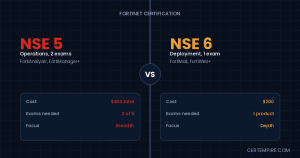
The exam aligns with the NSE 7: Security Operations certification, which validates the ability to design, administer, monitor, and troubleshoot Fortinet security-operations solutions. Under Fortinet’s current program, candidates need an NSE 5 or NSE 6 certification in the Security Operations track and must pass the applicable NSE 7 proctored exam.
Passing the exam also produces an exam badge, while certification status depends on meeting the complete pathway requirements. Fortinet certifications currently expire two years after being earned. Candidates should verify current prerequisite and recertification rules because the program can change independently of an exam’s technical blueprint.
Who Is Ready for This Architect-Level Assessment?
Fortinet identifies network and security professionals responsible for SOC architecture, deployment, operation, and monitoring as the intended audience. Its experience guidance includes one year in network security and six months working in a SOC. In practice, candidates also benefit from direct experience with FortiSIEM incident rules, event searches, FortiSOAR connectors, incident queues, playbooks, and security investigations.
Before beginning exam-specific preparation, candidates should understand log sources, normalization, correlation, indicators of compromise, incident severity, network and endpoint telemetry, authentication events, malware behavior, basic scripting logic, APIs, and the incident-response lifecycle. Knowledge of MITRE ATT&CK, the Cyber Kill Chain, and NIST incident-handling concepts creates the framework needed to interpret Fortinet product behavior.
The Architecture Behind the Blueprint
FortiSIEM collects, normalizes, correlates, and analyzes security and infrastructure data to produce visibility and incidents. FortiSOAR manages investigation and response workflows, enriches data through integrations, coordinates analyst work, and automates actions through playbooks. The products solve different parts of the SOC process.
A useful mental model is:
- Security tools and infrastructure generate events.
- FortiSIEM ingests and normalizes relevant data.
- Queries, rules, and analytics identify suspicious patterns.
- Incidents are investigated, tuned, or escalated.
- FortiSOAR enriches and manages response workflows.
- Playbooks coordinate containment, eradication, recovery, and documentation.
The exam tests whether candidates can preserve this logic when a scenario includes incomplete evidence, integration failures, false positives, or a playbook that does not behave as expected.
Domain 1: SOC Concepts and Frameworks
Incident Analysis and Adversary Behavior
Candidates must be able to analyze a security incident and associate observable activity with likely adversary behavior. This includes understanding attack surface, common initial-access methods, credential attacks, malware execution, persistence, lateral movement, command and control, data collection, and exfiltration.
The MITRE ATT&CK Enterprise Matrix provides tactics and techniques for describing adversary behavior. The Cyber Kill Chain offers another way to view attack progression. Learn how each framework supports detection engineering, investigation, and response without treating them as interchangeable lists. A SOC uses frameworks to organize evidence, identify visibility gaps, and prioritize defensive action.
Questions may present a group of events and ask which behavior, attack phase, or investigative conclusion is most appropriate. Focus on what the evidence proves. A single failed login does not establish compromise, while a sequence involving unusual authentication, privilege use, and outbound communication may justify escalation.
Fortinet SOC Enterprise Architecture
The architecture objective covers the functions of a SOC and the roles of FortiSIEM and FortiSOAR within an enterprise solution. Candidates should understand data producers, collectors, workers, supervisors, analytics, incident management, connectors, content, and response integrations at a functional level.
Architecture decisions must consider event volume, availability, network placement, data access, tenancy, operational ownership, and the response tools being integrated. Study how the two platforms exchange incident information and how Fortinet technologies such as FortiGate, FortiClient EMS, Active Directory, and FortiSandbox can contribute evidence or support containment.
Fortinet’s Security Operations Architect course also covers SOC roles, deployment architectures, FortiSOAR Content Hub, connectors, and the use of FortiAI within security workflows. Candidates should understand the operational purpose of these capabilities while prioritizing the explicit exam objectives.
Identifying Attack Vectors
Attack-vector analysis links an attacker’s entry or movement path to observable telemetry. Review phishing, malicious files, exposed services, vulnerable applications, credential misuse, compromised endpoints, and lateral movement. Know which log sources can confirm or disprove each hypothesis.
The architect’s responsibility is not merely to label the attack. It is to ensure the SOC collects suitable data, generates actionable detections, routes incidents correctly, and supports response. A detection that cannot be investigated because required data is missing indicates an architectural gap.
Domain 2: Detection Capabilities
FortiSIEM Incident Rules
FortiSIEM rules convert event patterns into incidents. Candidates should understand rule conditions, subpatterns, filters, group-by attributes, thresholds, time windows, severity, and triggering behavior. A useful rule detects meaningful risk while avoiding an unmanageable volume of noise.
Study how normalized attributes allow one rule to work across supported data sources and how device-specific fields can affect reliability. Practice identifying why a rule does not trigger, triggers too often, or groups unrelated activity into one incident. Typical causes include incorrect filters, missing attributes, unsuitable time windows, event-source gaps, and thresholds that do not match the environment.
Rule tuning should preserve visibility while improving signal quality. Exclusions, thresholds, asset context, user context, severity changes, and source-specific conditions can all help, but excessive suppression can conceal real attacks.
Queries and Event-Log Searches
Queries help analysts validate detections, reconstruct timelines, scope affected assets, and hunt for related behavior. Candidates should know how to select useful fields, build filter logic, combine conditions, choose time ranges, and interpret returned events.
Effective investigation begins with a focused question. Instead of searching all events for a broad indicator, start with the incident’s users, hosts, addresses, process data, or authentication attributes and expand as evidence develops. Recognize how inconsistent timestamps, missing normalization, or an overly narrow filter can create a false conclusion.
FortiSIEM Incident Analysis
Incident analysis requires correlating rule output with the underlying events. Review incident status, severity, triggering conditions, related entities, timeline, affected assets, and contextual data. Determine whether the alert represents true malicious behavior, expected administration, a policy violation, or a detection problem.
The analyst should document evidence, adjust ownership or status, and tune the rule only when justified. Closing an incident and repairing a noisy rule are separate tasks. The exam may test which action addresses the current alert and which improves future detection.
Domain 3: SOAR Incident Handling and Threat Hunting
Reactive and Proactive Threat Hunting
Reactive hunting begins with an alert, incident, indicator, or known campaign. Proactive hunting starts with a hypothesis based on threat intelligence, environmental risk, adversary behavior, or a visibility gap. Candidates should be able to distinguish the two and select appropriate data sources.
A structured hunt defines a hypothesis, required telemetry, query logic, expected evidence, scope, validation method, and possible response. Results may confirm malicious activity, reject the hypothesis, reveal missing data, or inspire a new detection rule. Hunting is therefore connected to detection engineering rather than being an isolated search exercise.
Managing Incidents in FortiSOAR
FortiSOAR provides records, relationships, tasks, indicators, notes, attachments, and workflow controls for incident handling. Candidates should understand the transition from alerts to incidents, record enrichment, assignment, escalation, and status management.
Queues and shifts distribute work among analysts. Study how workload routing, ownership, severity, service requirements, and handoffs affect timely response. War rooms support collaboration by centralizing relevant discussion and activity around an incident. The correct design should improve accountability without hiding information in unnecessary queues or manual steps.
Incident Response Across FortiSIEM and FortiSOAR
Fortinet’s training aligns response with the NIST SP 800-61 process: preparation; detection and analysis; containment, eradication, and recovery; and post-incident activity. Understand how FortiSIEM detection feeds FortiSOAR handling and how evidence and actions are maintained throughout the lifecycle.
Examples include enriching a suspicious hash with FortiSandbox intelligence, containing traffic through FortiGate, disabling or changing an account in Active Directory, isolating an endpoint through FortiClient EMS, removing malicious artifacts, and releasing a host after recovery. Automated response must include validation and safeguards because a mistaken containment action can disrupt legitimate business.
Domain 4: SOAR Playbook Development
Playbook Logic and Automation Design
FortiSOAR playbooks automate or guide repeatable actions. Candidates should understand triggers, steps, decisions, loops, record updates, enrichment, notifications, manual approval points, error paths, and completion conditions. A well-designed playbook makes response faster and more consistent while preserving analyst control for high-impact actions.
Start with clear input and output requirements. Identify which fields a connector action needs, what it returns, how the returned data changes the next decision, and how failures are recorded. Avoid building a linear success-only workflow. Production playbooks need handling for unavailable services, empty results, permissions errors, rate limits, and conflicting evidence.
Connectors and the Content Hub
Connectors let FortiSOAR interact with external security, identity, endpoint, network, and intelligence products. Study connector configuration, authentication, operations, permissions, and output mapping. The Content Hub provides integrations and solution content that can accelerate deployment, but imported content still requires environmental review and testing.
A connector can be reachable while a playbook action fails because credentials lack permission, an input field is malformed, the selected operation is unsuitable, or the remote API returns unexpected data. Troubleshooting should separate connectivity, authentication, authorization, input, and response-processing problems.
Jinja Filters, Debugging, and Playbook History
Jinja filters transform or extract data used by playbook steps. Candidates should understand common manipulation needs involving strings, lists, dictionaries, defaults, and nested values. The goal is to produce the format required by a decision or connector without corrupting the underlying evidence.
Debugging requires reviewing playbook execution, step inputs and outputs, connector responses, conditions, and history logs. Identify the first unexpected result rather than focusing only on the final failed action. Playbook history also supports auditability by showing which automated and manual steps occurred during an incident.
Exam Question Style and Time Strategy
Fortinet describes operational scenarios, incident analysis, integration, and troubleshooting as central to the assessment. Expect questions where several answers are technically possible but only one matches the evidence, response stage, product function, or safest operational design.
With 35–40 questions in 75 minutes, candidates have approximately 112–129 seconds per item. First classify the question as architecture, detection, incident handling, hunting, connector, or playbook logic. For troubleshooting items, find the earliest failed stage in the workflow. Flag long scenarios for review instead of allowing one item to consume time needed for the remaining exam.
Preparation Plan for a Working SOC Professional
- Build the framework first. Review MITRE ATT&CK, the Cyber Kill Chain, SOC responsibilities, and the incident-response lifecycle.
- Practice FortiSIEM detection. Ingest data, inspect normalized fields, create queries, configure rules, generate incidents, and tune false positives.
- Operate FortiSOAR cases. Manage alerts, incidents, queues, shifts, war rooms, tasks, indicators, and analyst handoffs.
- Develop safe playbooks. Add enrichment, decisions, connector actions, approvals, error handling, and audit-friendly record updates.
- Run integrated scenarios. Move an incident from FortiSIEM detection into FortiSOAR, enrich it, contain the threat, document recovery, and review the process.
- Complete timed mixed practice. Combine framework, rule, query, incident, hunting, connector, and Jinja questions under a 75-minute limit.
Cert Empire’s SOC Scenario Preparation Layer
Test Decisions Across the Incident Lifecycle
Cert Empire’s NSE7_SOC_AR-7.6 exam questions give candidates practice moving from adversary behavior to detection, investigation, orchestration, and response. This helps reveal whether a candidate understands the full workflow or only individual FortiSIEM and FortiSOAR features.
Verified answers with explanations clarify why a rule, query, queue, connector, playbook step, or response action fits the scenario. Reviewing the incorrect options is important because architect-level questions often include several valid features applied at the wrong stage.
Convert Missed Questions Into Detection Improvements
Each error can become a practical review task. A missed rule question can lead to testing thresholds and windows. A connector mistake can be reproduced by checking permissions and payloads. A threat-hunting error can be converted into a hypothesis and query exercise.
This method gives Cert Empire practice material a purpose beyond scoring. It turns exam-style questions into prompts for strengthening operational skills.
Keep a Searchable PDF Revision Record
The downloadable NSE7_SOC_AR-7.6 PDF dumps and study material support portable review of frameworks, FortiSIEM concepts, FortiSOAR workflows, playbook logic, connectors, and troubleshooting patterns. Candidates can annotate weak areas and build a concise record of recurring mistakes.
Use exam dumps as a structured supplement to Fortinet training and hands-on practice. Avoid memorizing option order because the exam expects analysis of incidents, data, and operational dependencies.
Rehearse Architect-Level Pacing in the Simulator
Cert Empire’s online simulator helps candidates practice 35–40-question sessions within the 75-minute limit. It encourages disciplined reading when exhibits or workflows contain more detail than a simple knowledge question.
After each attempt, review results by decision type. Difficulty with queries may indicate weak event-field knowledge, while repeated playbook mistakes may show gaps in data manipulation or connector behavior.
Resource Confidence From Study Start to Exam Day
Cert Empire provides updated practice sets, answer explanations, a quality guarantee, a refund policy subject to its published conditions, and 24/7 customer support for access, downloads, and simulator-related assistance.
No platform can guarantee a candidate’s result. Cert Empire supports readiness by making practice organized, reviewable, and measurable, while the candidate remains responsible for mastering FortiSIEM, FortiSOAR, and SOC architecture.
Start with one full Cert Empire simulation, classify every missed answer by SOC stage, and use the results to design the next FortiSIEM query or FortiSOAR playbook exercise.
FAQ’S
What does NSE7_SOC_AR-7.6 test?
It tests Fortinet SOC architecture, security frameworks, FortiSIEM detection and incident analysis, FortiSOAR incident handling, threat hunting, connectors, playbook development, Jinja filters, and troubleshooting.
Which product versions are covered?
The official exam page lists FortiSOAR 7.6 and FortiSIEM 7.3. Candidates should use version-aligned user, connector, and playbook guidance during preparation.
How long is the exam?
Candidates receive 75 minutes for 35–40 questions. The assessment is delivered in English and reports a pass-or-fail result with a score report available through Pearson VUE.
Are official domain weights published?
No percentage weights are listed. Fortinet identifies four main areas: SOC concepts and frameworks, detection capabilities, SOAR incident handling and threat hunting, and SOAR playbook development.
What experience does Fortinet recommend?
Fortinet recommends one year of network-security experience and six months of SOC experience. Familiarity with FortiSIEM and FortiSOAR administration makes the applied scenarios considerably easier to interpret.
Is this only a FortiSOAR exam?
No. The exam integrates FortiSIEM detection and investigation with FortiSOAR incident management, threat hunting, connectors, automation, playbooks, and response across a broader Fortinet SOC architecture.
Why are Jinja filters included?
Playbooks often need to extract, transform, or format data before a decision or connector action. Jinja filters help manipulate strings, lists, dictionaries, and nested values inside FortiSOAR workflows.
How should I use Cert Empire’s SOC exam questions?
Answer without notes, review the reasoning, map errors to the incident lifecycle, and reproduce missed concepts through FortiSIEM queries, rules, FortiSOAR cases, connectors, or playbooks.
Does Cert Empire provide timed practice?
Yes. Its simulator helps candidates rehearse the 75-minute format, manage scenario-heavy questions, and measure readiness across detection, incident handling, hunting, and playbook-development objectives.
Is passing guaranteed with Cert Empire?
No provider can guarantee an automatic pass. Cert Empire offers updated questions, PDF resources, explanations, and simulator practice to support preparation, while results depend on the candidate’s knowledge and decisions.
Related Fortinet Certifications
- NSE 6: FortiSOAR Administration (NSE6_FSR-7.3) – Develops advanced security operations skills through automation, orchestration, incident response workflows, and administration of Fortinet SOC technologies.
- NSE 6: FortiSIEM Analytics (NSE6_FSM_AN-7.4) – Extends security monitoring expertise into event analysis, threat detection, log management, and incident investigation across complex IT environments.
- FCP: FortiAnalyzer Analytics (FCP_FAZ_AN-7.4) – Builds advanced skills in security analytics, reporting, monitoring, and threat visibility using Fortinet centralized logging and analysis solutions.
Reviews
Related Posts
-

-
-
-
-


Sam S. –
Are the practice materials here only questions and explanations, or do they also include any hands-on labs or a simulator for real scenario practice?
Arjun H. –
Just checking, do you get instant download files or is everything accessed online through a web portal for these dumps? Trying to figure out if I can study offline.