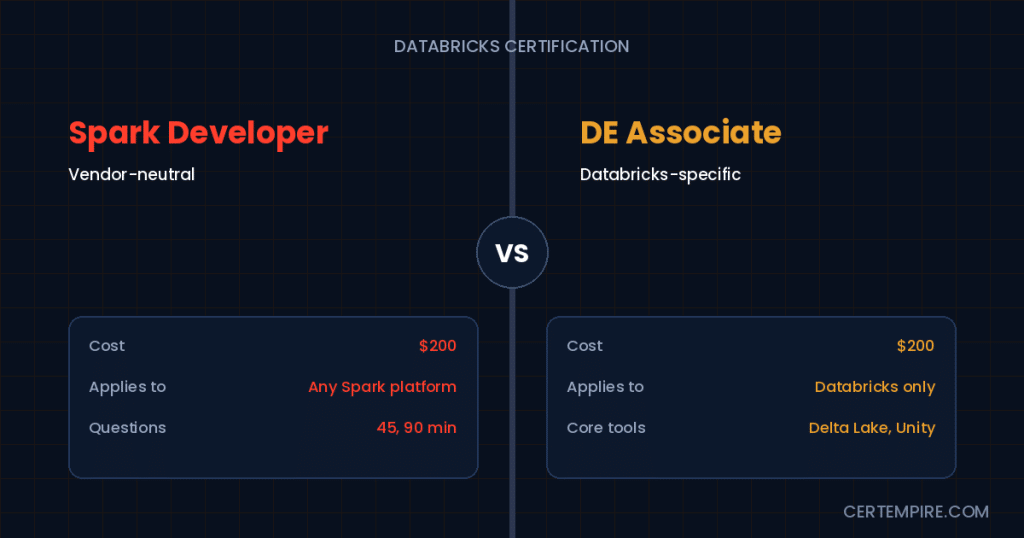
Associate Developer for Apache Spark and Data Engineer Associate both cost $200 and both run 45 questions in 90 minutes, but they test genuinely different things: one validates vendor-neutral Spark programming skill that applies on AWS EMR, Azure HDInsight, or Google Dataproc, while the other validates Databricks-specific platform expertise, Delta Lake, Unity Catalog, and Workflows, and confusing the two is the single most common mistake candidates make when researching this pairing. Official exam guides live on Databricks’ certification page.
The direct answer: Take Associate Developer for Apache Spark if you want to prove general Spark DataFrame API skill that transfers across any Spark environment, not just Databricks. Take Data Engineer Associate if you specifically need to demonstrate Databricks platform expertise, including features that don’t exist outside Databricks entirely. If your goal is a Databricks-specific job, Data Engineer Associate is the more directly relevant credential.
At a Glance
| Detail | Associate Developer for Apache Spark | Data Engineer Associate |
| Cost | $200 | $200 |
| Question count | 45 | 45 |
| Duration | 90 minutes | 90 minutes |
| Passing score | 70 percent | 70 percent |
| What it tests | Core Spark DataFrame API and architecture, applicable to any Spark environment | Databricks-specific platform features |
| Platform dependency | Vendor-neutral | Databricks-specific |
| Where it applies | Databricks, AWS EMR, Azure HDInsight, Google Dataproc, any Spark environment | Databricks specifically |
Important: This is the pairing where reading the exam name carefully actually matters. “Apache Spark Developer” sounds like it might be the more advanced or more comprehensive Databricks credential. It isn’t. It’s narrower and platform-independent, testing Spark itself rather than the Databricks ecosystem built around it.
What Apache Spark Developer Actually Tests
| Focus Area | What It Covers |
| Spark DataFrame API, roughly 30 percent of the exam | Selecting, renaming, and manipulating columns; filtering, dropping, sorting, and aggregating rows; handling missing data; combining, reading, writing, and partitioning DataFrames with schemas; working with UDFs and built-in Spark SQL functions |
| Spark Architecture, roughly 20 percent | Execution and deployment modes, the execution hierarchy, fault tolerance, garbage collection, lazy evaluation, shuffling, and the use of actions and broadcasting |
| Spark SQL, roughly 20 percent | Writing and reasoning about Spark SQL queries against DataFrames |
| Remaining content | Structured Streaming, Spark Connect, and common troubleshooting and tuning techniques |
Note: This exam assumes Python specifically for completing DataFrame tasks, and candidates who pass are expected to be comfortable applying these operations hands-on, not just recognizing correct syntax in a multiple-choice format. It also tests genuine Spark internals, Catalyst Optimizer behavior, broadcast joins, and repartition versus coalesce decisions, that go beyond surface-level DataFrame syntax into why certain operations perform the way they do.
What Data Engineer Associate Actually Tests
Data Engineer Associate covers core ETL using Spark SQL and Python, but layers in Databricks-specific components that Apache Spark Developer never touches at all.
| Domain | Weight | Focus |
| Databricks Lakehouse Platform | 24 percent | Platform architecture, clusters, notebooks |
| ELT with Spark SQL and Python | 29 percent | Building pipelines across both languages |
| Incremental Data Processing | 22 percent | Batch and streaming patterns |
| Production Pipelines | 16 percent | Orchestration via Databricks Workflows |
| Data Governance | 9 percent | Permissions through Unity Catalog |
If your actual job involves Delta Lake’s transaction log and time travel features, Unity Catalog’s governance model, or Databricks Workflows orchestration daily, this credential proves it directly. Apache Spark Developer does not, and can’t, since none of those features exist outside the Databricks platform.
The Real Difference: General Spark Skill vs Databricks-Specific Depth
Apache Spark Developer tests whether you understand Spark itself, deeply enough to reason about execution plans, optimize a slow job by understanding shuffle behavior, and write correct DataFrame transformations regardless of which vendor’s infrastructure is running underneath. Data Engineer Associate tests whether you understand how to build and operate pipelines specifically within Databricks’ ecosystem, using tools that only exist there. A candidate could pass Apache Spark Developer with zero Databricks-specific knowledge if they’ve worked with Spark on a different platform, and a candidate could pass Data Engineer Associate with relatively shallow understanding of Spark’s internal execution model, since that exam doesn’t test the Catalyst Optimizer or broadcast join mechanics the way Spark Developer does.
| Your Situation | Better Fit |
| You work with Spark on AWS EMR, Azure HDInsight, or GCP Dataproc, not Databricks | Apache Spark Developer |
| Your organization runs Databricks specifically, and you use Delta Lake and Unity Catalog daily | Data Engineer Associate |
| You want a credential that signals general Spark competence across employers | Apache Spark Developer |
| You’re targeting a Databricks-specific role or your resume needs to show Databricks platform depth | Data Engineer Associate |
| You’re unsure which platform your next role will use | Apache Spark Developer, since it transfers more broadly |
| You need to explain why a specific Spark job is slow, at the execution-plan level | Apache Spark Developer, given its architecture-heavy content |
Who Should Take Each Certification
Engineers who work with Spark across multiple cloud platforms, not exclusively Databricks. Apache Spark Developer is built specifically for this situation, since it validates skill that doesn’t expire if you switch employers or platforms.
Data engineers whose entire role is built around Databricks specifically. Data Engineer Associate is the more relevant credential, since it tests the Delta Lake, Unity Catalog, and Workflows knowledge your actual job requires, none of which Apache Spark Developer touches.
Engineers who want to demonstrate deep Spark internals knowledge specifically. Apache Spark Developer’s architecture domain, covering execution plans, shuffle behavior, and the Catalyst Optimizer, is the more relevant credential if performance tuning at that level is part of your job.
Candidates early in their data engineering career deciding which credential looks better on a resume. Neither is universally “better.” Match the choice to the platform you’re actually being hired to work on, since a hiring manager screening for Databricks-specific skill won’t treat Apache Spark Developer as an equivalent substitute.
Can You Take Both?
Yes, and it’s a reasonable combination for engineers who want to signal both general Spark competence and Databricks-specific depth. Since neither is a prerequisite for the other and both cost the same $200 with identical format, there’s no structural reason to treat this as an either-or decision if your career genuinely spans both contexts. Holding both also demonstrates something specific: that you understand Spark deeply enough to reason about performance at the execution level, and that you know how to apply that understanding within Databricks’ particular ecosystem.
Preparation Time
| Exam | Typical Prep Time | Notes |
| Associate Developer for Apache Spark | 4 to 8 weeks | Faster with existing Spark experience on any platform |
| Data Engineer Associate | 4 to 8 weeks | Faster with existing Databricks-specific exposure |
What This Difference Means for Pay
Neither certification has an independently published, certification-specific salary figure. What’s worth knowing directionally: Apache Spark Developer’s vendor-neutral positioning means it doesn’t tie your resume to Databricks specifically, which can matter if you’re keeping options open across employers running different Spark platforms, while Data Engineer Associate’s Databricks-specific depth is what organizations running Databricks specifically screen for. Neither is inherently higher-paying, the right one depends on which employers you’re actually targeting.
Where This Fits, and What to Look at Next
If Data Engineer Associate turns out to be your path, the natural next question is how far to take it on the Databricks track specifically, covered in our Data Engineer Associate vs Professional comparison. If you’re deciding between the engineering track and Databricks’ analytics-focused entry point instead, see our Data Engineer Associate vs Data Analyst Associate guide. For the complete 7-exam catalog, see our Databricks Certification Path guide.
Common Mistakes When Choosing Between These Two
Assuming Apache Spark Developer proves Databricks-specific expertise because Databricks administers the exam. It doesn’t. It tests general Spark skill that happens to be certified through Databricks’ testing infrastructure.
Choosing Data Engineer Associate when your actual work is on a non-Databricks Spark platform. The Databricks-specific content, Delta Lake and Unity Catalog particularly, won’t be relevant to your daily work if you’re not on Databricks.
Assuming one exam is strictly more advanced than the other. They’re not on the same difficulty ladder, they’re testing different scopes entirely, general Spark versus Databricks-specific platform knowledge.
Underestimating Apache Spark Developer’s architecture content because it sounds like a coding-only exam. Roughly 20 percent of the exam covers execution modes, fault tolerance, and shuffle behavior, genuine systems knowledge, not just DataFrame syntax.
Skipping hands-on practice with actual Spark execution plans when preparing for Apache Spark Developer. Understanding why a job shuffles data, not just how to write the code that triggers it, is exactly what the architecture domain tests.
FAQS
What’s the difference between Apache Spark Developer and Data Engineer Associate?
Apache Spark Developer tests vendor-neutral Spark DataFrame API and architecture skills that apply on any Spark platform. Data Engineer Associate tests Databricks-specific features including Delta Lake, Unity Catalog, and Workflows.
Which one should I take if I only use Databricks?
Data Engineer Associate, since it directly validates the Databricks-specific tools you actually use, which Apache Spark Developer doesn’t cover.
Does Apache Spark Developer certification work outside Databricks?
Yes, that’s its core value. It applies to Spark environments on AWS EMR, Azure HDInsight, Google Dataproc, or any platform running Spark, not just Databricks.
Can I take both certifications?
Yes, there’s no prerequisite relationship between them, and holding both signals both general Spark competence and Databricks-specific depth.
Is Apache Spark Developer harder than Data Engineer Associate?
They’re not directly comparable in difficulty since they test different scopes. Apache Spark Developer is narrower and platform-independent but goes deeper into Spark internals, while Data Engineer Associate covers more Databricks-specific ground.
What programming language does Apache Spark Developer assume?
Python, specifically for completing DataFrame manipulation tasks, though the exam also tests Spark SQL query reasoning.
Does Apache Spark Developer test Spark internals, or just DataFrame syntax?
Both. Roughly 20 percent of the exam covers architecture specifically, execution modes, fault tolerance, lazy evaluation, and shuffling, genuine systems-level knowledge beyond basic API usage.
How many questions are on each exam?
Both run 45 questions in 90 minutes, the standard format for every Databricks Associate-level certification.