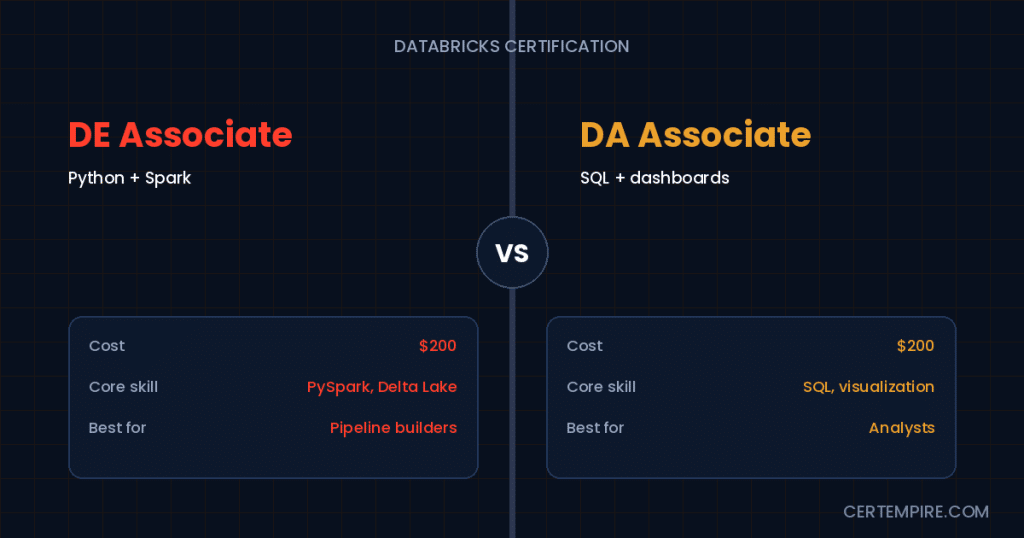
Data Engineer Associate and Data Analyst Associate cost the same $200, run the same 45 questions in 90 minutes, and share the same 70 percent passing score, but they test almost entirely different skill sets, one is Python and Spark-centric pipeline building, the other is SQL-centric analytics and dashboarding, and the honest answer to “which first” depends entirely on whether you write code that moves data or code that queries it. Official details live on Databricks’ certification page.
The direct answer: Take Data Analyst Associate if your background is SQL-heavy and you work primarily in dashboards, queries, and business intelligence, it’s widely described as the most approachable of Databricks’ 7 certifications. Take Data Engineer Associate if your work involves building and maintaining data pipelines using Spark SQL, Python, and Delta Lake. If you’re genuinely unsure which describes your actual job, Data Analyst Associate’s lower technical barrier makes it the safer starting point.
At a Glance
| Detail | Data Engineer Associate | Data Analyst Associate |
| Cost | $200 | $200 |
| Question count | 45 | 45 |
| Duration | 90 minutes | 90 minutes |
| Passing score | 70 percent | 70 percent |
| Core focus | ETL pipelines using Spark SQL and Python | Databricks SQL, dashboards, data visualization |
| Key topics | Lakehouse Platform, incremental processing, production pipelines, governance | SQL queries, data management, dashboarding, analytics applications |
| Coding depth | Python and Spark SQL required | Primarily SQL, no Python required |
| Widely described as | The most commonly held starting point | The most approachable of the 7 exams |
Important: Both exams touch Unity Catalog, but from different angles, Data Engineer Associate covers it as part of building and governing pipelines, while Data Analyst Associate covers it as part of accessing and querying data that’s already been organized. That overlap is real but shallow, it won’t substitute for the rest of either exam’s content.
What Data Engineer Associate Actually Covers
| Domain | Weight | Focus |
| Databricks Lakehouse Platform | 24 percent | Core platform architecture and concepts |
| ELT with Spark SQL and Python | 29 percent | Building pipelines that move between both languages |
| Incremental Data Processing | 22 percent | Batch and streaming data handling |
| Production Pipelines | 16 percent | Orchestration through Databricks Workflows |
| Data Governance | 9 percent | Permissions and access control basics |
What Data Analyst Associate Actually Covers
Data Analyst Associate centers on using Databricks SQL to complete introductory data analysis tasks: writing and optimizing SQL queries, managing data within Databricks SQL specifically, building dashboards and visualizations that translate raw query results into something a business stakeholder can actually use, and applying analytics thinking to common data challenges rather than pure syntax recall. Databricks doesn’t publish this exam’s domain weighting with the same granularity as Data Engineer Associate’s, but the content consistently centers on 3 broad areas: SQL proficiency, data management within the Databricks SQL environment, and the visualization and dashboarding layer that sits on top of both.
Note: Despite lacking Data Engineer Associate’s Python and Spark requirements, Data Analyst Associate is not a trivial exam. Its query-optimization and data-modeling questions assume real SQL depth, not just familiarity with basic SELECT statements, and candidates who underestimate it because it “sounds less technical” are sometimes surprised by how much genuine analytical reasoning it tests.
The Real Difference: Building Pipelines vs Querying Them
Data Engineer Associate assumes you’re comfortable writing Python and Spark SQL code and reasoning about Delta Lake’s transaction log behavior, incremental processing, and pipeline orchestration. Data Analyst Associate assumes you’re comfortable writing complex SQL and building dashboards that non-technical stakeholders will actually use, without needing to touch the pipeline infrastructure feeding that data in. A strong SQL analyst with no Python experience will struggle with Data Engineer Associate’s coding-heavy ELT domain specifically, and a strong Python developer with limited SQL depth can still find Data Analyst Associate’s query-optimization and dashboarding questions harder than expected.
| Your Background | Better Fit |
| SQL-heavy, limited or no Python experience | Data Analyst Associate |
| Comfortable with Python and Spark SQL together | Data Engineer Associate |
| Business intelligence and dashboarding work | Data Analyst Associate |
| Building and maintaining ETL pipelines | Data Engineer Associate |
| Genuinely unsure, early in a data career | Data Analyst Associate, the gentler starting point |
Who Should Take Each One
Business intelligence analysts and reporting specialists. If your daily work is writing SQL against a Databricks SQL warehouse and building dashboards stakeholders rely on, Data Analyst Associate validates exactly that work without requiring you to learn Python or pipeline orchestration you don’t actually use.
Aspiring or early-career data engineers. Data Engineer Associate is the more direct path if your goal is a data engineering role specifically, since it’s the more commonly held certification and the one most employers screening for Databricks-specific engineering skill expect to see.
Career changers moving from a general SQL or database background into Databricks specifically. Data Analyst Associate is the lower-friction entry point, letting you build Databricks-specific credibility before deciding whether to push further into the engineering side of the platform.
Team leads deciding which certification to recommend to junior staff. Match the recommendation to the actual role, not to which certification sounds more technical. A junior analyst pushed toward Data Engineer Associate before they’re ready often struggles unnecessarily with content that doesn’t match their daily work yet.
Which One Actually Leads Somewhere
Data Engineer Associate is the more commonly held Databricks certification overall and the one most study paths default to recommending first, largely because data engineering roles on Databricks specifically are more numerous than pure analyst roles built entirely around the platform. That doesn’t make Data Analyst Associate a lesser choice, it makes it a more specialized one, valuable specifically if your career path is genuinely analytics-focused rather than engineering-focused.
Preparation Time
| Exam | Typical Prep Time | Notes |
| Data Analyst Associate | 1 to 2 months | Even with limited hands-on experience, per multiple 2026 study guides |
| Data Engineer Associate | 4 to 8 weeks | Faster with existing Python or Spark background |
What This Difference Means for Pay
Databricks doesn’t publish separate salary data for Data Engineer Associate versus Data Analyst Associate holders specifically, and general data analyst compensation tends to run below data engineer compensation across the industry regardless of certification, reflecting the broader difference between analytics and engineering roles rather than anything specific to Databricks. Glassdoor’s 2026 figures put average Databricks Data Engineer pay at $133,130, a useful anchor even though it doesn’t isolate Associate-level holders specifically. If pay is a significant factor in your decision, weigh it against which role you’re actually qualified for and interested in, not the certification name alone.
Where This Fits in the Bigger Picture
If Data Engineer Associate turns out to be your path, the natural next question is how far to take it, covered in our Data Engineer Associate vs Professional comparison. If your work sits closer to general Spark development than Databricks-specific pipelines, see our Apache Spark Developer vs Data Engineer Associate guide. For the complete 7-exam roadmap, see our Databricks Certification Path guide.
Common Mistakes When Choosing Between These Two
Choosing Data Engineer Associate purely because it’s more commonly recommended, without checking whether your actual daily work is SQL-based or Python-based. The more popular choice isn’t automatically the right one for your specific role.
Assuming Data Analyst Associate is a lesser or beginner-only credential. It’s more approachable, not less valuable, for analytics-focused career paths specifically, and its query-optimization content genuinely tests analytical depth.
Underestimating Data Analyst Associate’s SQL depth because it sounds less technical than Data Engineer Associate. Query optimization and data modeling logic still require real preparation, not casual familiarity with basic queries.
Assuming the 2 exams’ shared Unity Catalog content means meaningful overlap in preparation. The overlap is real but narrow, covering access from 2 different angles, governance versus consumption, not a shortcut through either exam’s core material.
Recommending a certification to junior team members based on which sounds more prestigious rather than which matches their actual current role and skill set.
FAQS
Which Databricks certification should I take first?
Depends on your background. SQL-focused professionals should start with Data Analyst Associate. Python and Spark-comfortable candidates should start with Data Engineer Associate.
Is Data Analyst Associate easier than Data Engineer Associate?
It’s widely described as the most approachable of Databricks’ 7 certifications, largely because it doesn’t require Python or Spark coding depth, but it still demands real SQL proficiency and analytical reasoning.
Do these 2 exams overlap much?
Both touch Unity Catalog, but from different angles, pipeline governance versus data access, and the overlap doesn’t substitute for either exam’s core content.
Can I take both?
Yes, and professionals working across both analytics and engineering responsibilities sometimes do, though most candidates pick based on their actual role.
Which one is more commonly held?
Data Engineer Associate, reflecting that data engineering roles specifically built around Databricks are more numerous than pure analyst roles.
What format do both exams use?
Both run 45 questions in 90 minutes, using multiple choice and scenario-based questions with no drag-and-drop or hands-on lab components, consistent across every Databricks Associate-level exam.
Does Data Analyst Associate require any Python knowledge?
No, it centers entirely on SQL, data management within Databricks SQL, and dashboarding, without a Python or Spark coding requirement.
How long should I prepare for Data Analyst Associate?
Typically 1 to 2 months, even for candidates with limited hands-on Databricks experience, according to multiple 2026 study guides.