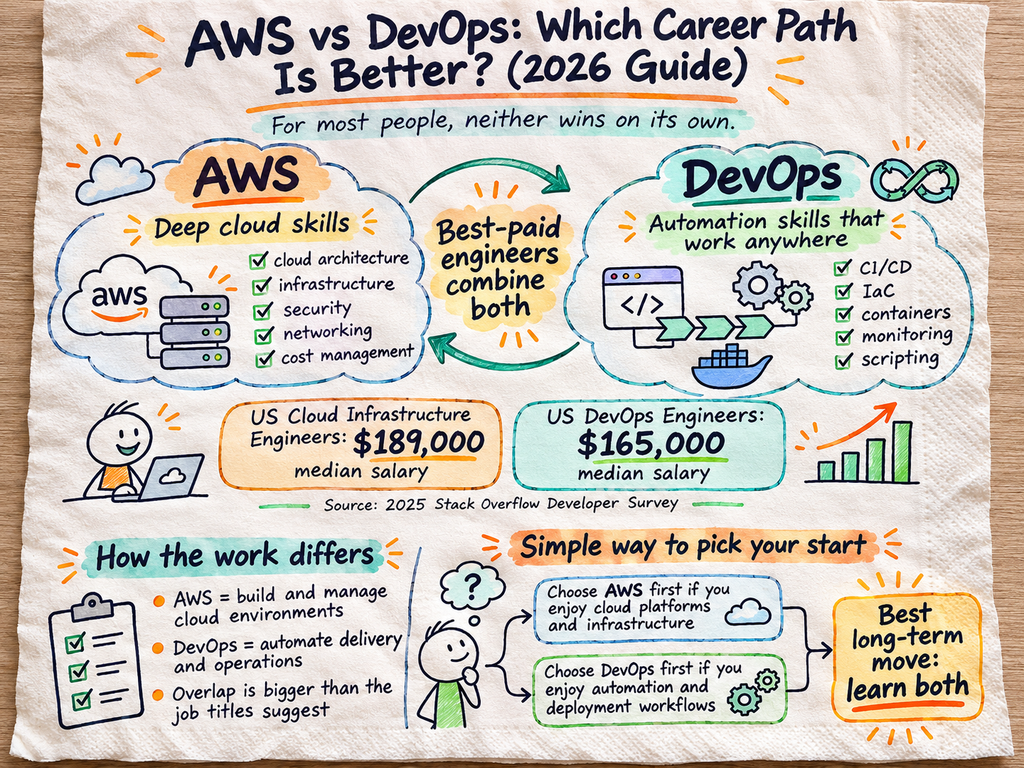
AWS vs DevOps: Which career path is better? For most people, neither wins on its own. AWS gives you deep cloud skills, DevOps gives you automation skills that work anywhere, and the best-paid engineers combine both.
That can sound vague, so this guide makes it concrete. In the 2025 Stack Overflow Developer Survey, US cloud infrastructure engineers reported a median salary of $189,000, and US DevOps engineers $165,000. Yet the two jobs overlap far more than their titles suggest.
Below, you will see what each path is, how the work differs, what the data says about pay, and a simple way to pick your start.
What AWS vs DevOps Really Means
AWS is a cloud platform. DevOps is a way of working. They are not rivals, so the real question is which one to learn first.
Amazon Web Services (AWS) is where companies rent servers, storage, databases and networks. Learning AWS means learning those services and how to design systems with them.
DevOps is different. AWS itself describes DevOps as a mix of cultural values, working practices and tools that help teams ship software faster. Its core practices include CI/CD (automated build and release), infrastructure as code, monitoring and logging, and close teamwork between developers and operations.
So why do people say “AWS DevOps”? Many teams practice DevOps on AWS, using services such as CodePipeline or CloudFormation. It is also the name of an AWS certification. It is not a single product.
When someone searches “AWS vs DevOps”, they usually mean one of three things:
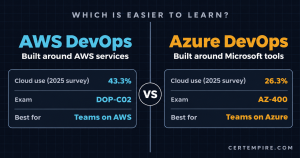
- Platform: “Should I build my DevOps skills on AWS or Azure?” See AWS DevOps vs Azure DevOps.
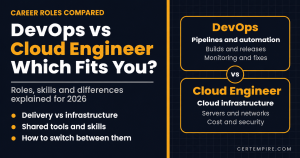
- Role: “Do I want to be a cloud engineer or a DevOps engineer?” See DevOps vs cloud engineer.
- Certification: “Is the AWS DevOps exam worth my time?” See is the AWS DevOps Professional worth it.
This guide covers the career question first.
AWS vs DevOps Side by Side
AWS goes deep on one platform, while DevOps goes wide across many tools. This table shows the gap at a glance.
| Factor | AWS path | DevOps path |
| Main focus | Designing and running cloud infrastructure on Amazon’s platform | Automating how software is built, tested, released and watched |
| First tasks | Set up servers, storage, networks and access rules | Build pipelines, write scripts, manage infrastructure as code |
| Core skills | Networking, IAM, compute, storage, cost control | Git, CI/CD, containers, Terraform, scripting |
| Portability | Tied to AWS, though cloud ideas carry over | Works on any cloud and on-premises |
| Entry point | Clear: cloud basics, then an associate-level exam | Wider: Linux, scripting and some coding come first |
| Common titles | Cloud engineer, solutions architect, cloud security engineer | DevOps engineer, SRE, platform engineer, DevSecOps engineer |
| Fits people who like | Systems, design and how the pieces connect | Automation, code and fixing slow processes |
Look at the “entry point” row. AWS has the friendlier front door for most beginners, because the learning order is clearer. DevOps asks for a broader base before the work feels natural.
Real learning roadmaps show why the entry point matters. One AWS Builder Center roadmap for beginners starts with Linux fundamentals, then adds Git and GitHub. So even on the friendlier AWS path, build the basics first.
Day-to-Day Work, Skills and Tools
On the AWS path you mostly build and secure the platform. On the DevOps path you mostly automate how code reaches it. Here is what that looks like in practice.
A typical week on the AWS path
- Plan networks (VPCs) and permissions (IAM) so teams can work safely.
- Pick compute and storage for new workloads, and watch the cost.
- Review security settings and fix gaps.
- Move or set up workloads in the cloud.
Common tools include EC2, S3, VPC, IAM and CloudWatch.
A typical week on the DevOps path
- Keep CI/CD pipelines running so code is tested and released automatically.
- Define servers and networks as code with tools such as Terraform or CloudFormation.
- Run containers, and tune alerts and dashboards.
- Follow up on incidents so the same failure does not repeat.
Common tools include Git, Docker, Kubernetes, Terraform and a CI/CD service.
One AWS Builder Center author lists the hands-on projects behind a move from Cloud Practitioner to the DevOps Professional exam. The platform half includes custom VPCs, IAM policies, EC2 servers and S3-hosted sites. The DevOps half adds CI/CD pipelines, Terraform, Docker, EKS and CloudWatch monitoring.
Where the two overlap
Both paths use infrastructure as code, monitoring and security checks. Many cloud engineers write pipelines, and many DevOps engineers manage networks and permissions. That is why job titles blur.
For a deeper look at the two jobs, read DevOps vs cloud engineer: roles, skills and differences.
AWS vs DevOps Career Roles, Pay and Demand
Both paths pay well, and the best survey data shows cloud infrastructure roles earning a bit more than DevOps roles. Still, no single number settles the choice.
Here are median yearly salaries from the 2025 Stack Overflow Developer Survey. It had 23,928 salary answers worldwide and 5,239 from the US.
| Role | Global median (USD) | US median (USD) |
| Cloud infrastructure engineer | $103,112.50 | $189,000 |
| Architect, software or solutions | $102,000 | $180,000 |
| DevOps engineer or professional | $87,011 | $165,000 |
Two cautions. The pay is self-reported, and the survey does not split roles by AWS or any other platform. Treat the table as a direction, not a promise.
What about job demand?
The US Bureau of Labor Statistics (BLS) does not list “DevOps engineer” or “cloud engineer” as separate jobs. Two nearby jobs give a hint:
- Computer network architects: median pay of $134,050 in May 2025, with 8% projected growth from 2025 to 2035. BLS says continued cloud growth will raise demand for these workers.
- Network and computer systems administrators: median pay of $99,130, with a projected 4% decline over the same period.
My reading: plain administration is shrinking while design and automation work grows. BLS does not say this outright, so treat it as interpretation.
Where each path can lead
- AWS path: cloud engineer, cloud security engineer, solutions architect.
- DevOps path: senior DevOps engineer, site reliability engineer (SRE), platform engineer, DevSecOps engineer.
Which Path Should You Choose? A Six-Question Check
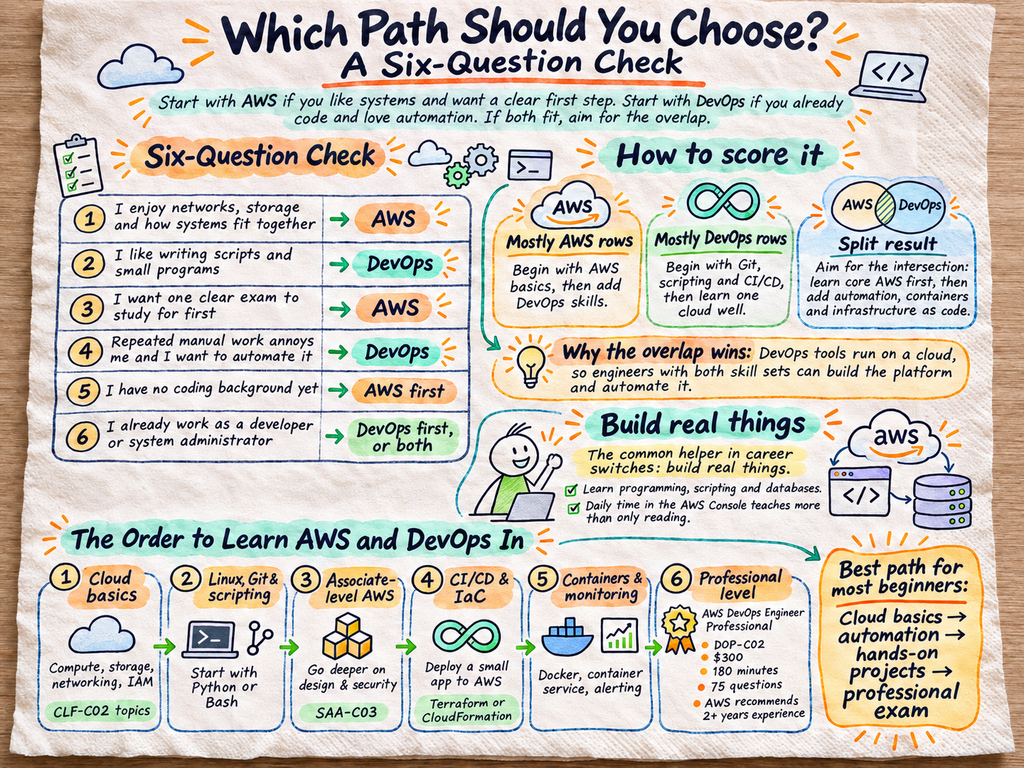
Start with AWS if you like systems and want a clear first step. Start with DevOps if you already code and love automation. If both fit, aim for the overlap.
Read each statement. Note which column it points to, then count.
| # | If this sounds like you | It points to |
| 1 | I enjoy networks, storage and how systems fit together | AWS |
| 2 | I like writing scripts and small programs | DevOps |
| 3 | I want one clear exam to study for first | AWS |
| 4 | Repeated manual work annoys me and I want to automate it | DevOps |
| 5 | I have no coding background yet | AWS first |
| 6 | I already work as a developer or system administrator | DevOps first, or both |
How to score it:
- Mostly AWS rows: begin with AWS basics, then add DevOps skills.
- Mostly DevOps rows: begin with Git, scripting and CI/CD, then learn one cloud well.
- A split result: aim for the intersection. Learn core AWS first, then layer on automation, containers and infrastructure as code.
Here is why the overlap often wins. DevOps tools run on a cloud, so someone with both skill sets can build the platform and automate it.
Switch stories share one helper: building real things. After a project ended, Andra Somesan moved from designing microwave transmission networks into DevOps, and told the story on AWS Builder Center. The advice was to learn programming, scripting and databases, and AWS came next through the console. Another AWS Builder Center author says daily time in the AWS Console, building and fixing things, taught more than hours of reading.
Still unsure about the platform itself? Our guide on AWS or Azure for DevOps compares the two on how easy each is to learn.
The Order to Learn AWS and DevOps In
Learn cloud basics first, then automation, then a professional-level exam once you have real hands-on time. This order works for most beginners. Your pace will vary.
- Cloud basics. Learn what compute, storage, networking and IAM mean on AWS. The CLF-C02 exam page is a useful checklist of topics.
- Linux, Git and one scripting language. These are the base of almost every DevOps job. Python or Bash is enough to start.
- Associate-level AWS. Go deeper on design and security. Our SAA-C03 exam page covers the Solutions Architect Associate topics.
- CI/CD and infrastructure as code. Build one pipeline that deploys a small app to AWS, with Terraform or CloudFormation. Keep it on GitHub as proof of skill.
- Containers and monitoring. Add Docker, a container service and basic alerting.
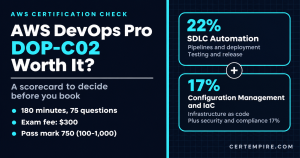
- Professional level. The AWS Certified DevOps Engineer Professional exam costs $300, runs 180 minutes and has 75 questions. AWS recommends two or more years of experience provisioning, operating and managing AWS environments. Our DOP-C02 exam page lists the topics.
Wondering if that last step pays off? Read AWS DevOps Engineer Professional (DOP-C02) before you book it.
You can also browse every exam in the Amazon AWS vendor section of our site.
Will AI Change Either Career Path?
AI is changing the work more than it is removing it. No one can promise how this plays out, but current research points the same way.
The 2025 DORA report from Google Cloud, based on nearly 5,000 technology professionals, found that 90% of respondents use AI at work. It also found that AI magnifies what a team already does. Strong teams gain, while weak processes get worse. The same report says 90% of organizations have adopted at least one internal platform.
A Perforce survey of 820 technology professionals adds a skills signal. About 87% expect AI to move engineers away from scripting and toward system design and directing outcomes.
What does that mean for you? Routine scripting is the part most likely to be automated. Design, security, reliability and judgment are harder to hand off. So learn the fundamentals of both paths, and use AI tools to move faster, not to skip understanding.
FAQs
Who earns more, DevOps or cloud engineer?
In the 2025 Stack Overflow survey, cloud infrastructure engineers earned more. Medians were $103,112.50 vs $87,011 worldwide, and $189,000 vs $165,000 in the US. The data is self-reported, so country, seniority and company size can matter more than the title.
Is DevOps a dead-end job?
No, but the title is changing. The 2025 DORA report found that 90% of organizations have adopted at least one internal platform, which keeps platform and reliability work in demand. DevOps careers can lead to SRE, platform engineering, DevSecOps or management. The risk is staying stuck on routine tasks that AI handles well.
Is AWS DevOps a good career?
Yes, if you enjoy both cloud systems and automation. It sits at the overlap of the two paths, which is where this guide suggests most beginners aim. Build core AWS skills first, then add pipelines and infrastructure as code.
AWS DevOps vs solutions architect salary: which is higher?
In the Stack Overflow data, US architects (software or solutions) reported $180,000 against $165,000 for DevOps engineers. Worldwide it was $102,000 against $87,011. The survey does not isolate AWS roles, so treat the gap as a rough guide.
Cloud architect vs DevOps: which should I pick?
Choose architecture if you like designing systems, and DevOps if you like automating them. BLS notes that computer network architects typically need five or more years of related experience, so DevOps or cloud engineering is often an easier first step toward architecture.
Is the AWS DevOps Professional exam harder than the Solutions Architect Professional?
We found no official difficulty ranking from AWS. The exams test different work: DOP-C02 targets people who automate and operate AWS applications, and AWS recommends two or more years of hands-on experience. Pick the one that matches your daily job. Our guide on DOP-C02 difficulty and value goes deeper.
Do I need an AWS DevOps certification to get a DevOps job?
No. AWS lists no formal prerequisites for DOP-C02 and recommends hands-on experience, so the exam is meant to confirm your skills, not replace them. A small pipeline project plus an associate-level cloud exam is a stronger starting point.
Conclusion: Pick Your Starting Point
The best AWS vs DevOps career path usually starts with AWS basics and grows into DevOps automation. AWS gives you a clear way in. DevOps gives you skills that travel across clouds. Together they open well-paid cloud, platform and architecture roles.
Your next step is small. Take the six-question check, then build one pipeline project on AWS. When you are ready to test what you know, try our free practice tests. You can also explore more guides on the Cert Empire blog or start from the Cert Empire home page.