TL;DR
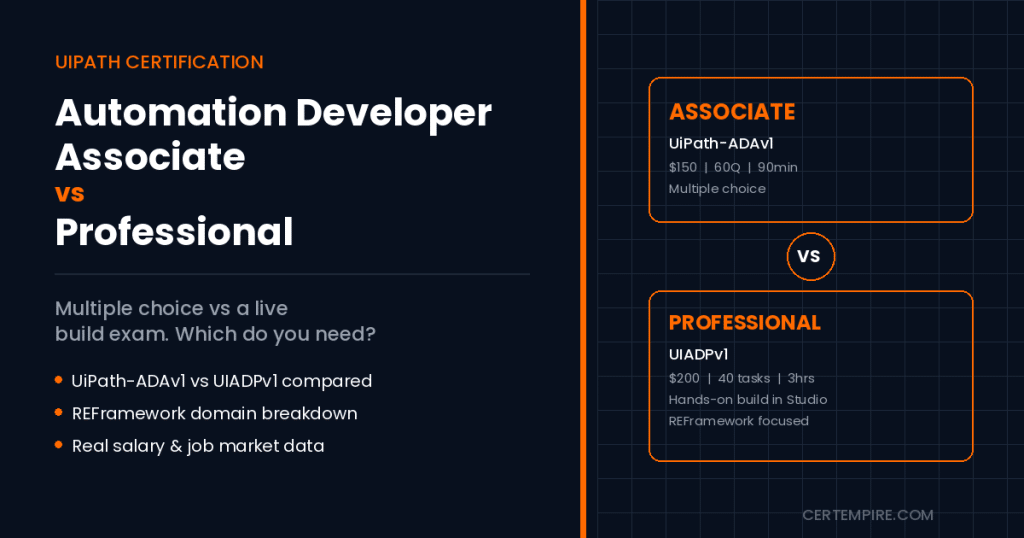
- Automation Developer Associate (UiPath-ADAv1): $150, 60 multiple-choice/multi-select questions, 90 minutes, 70% passing score. Tests whether you know UiPath Studio, variables, control flow, and basic Orchestrator concepts.
- Automation Developer Professional (UIADPv1): $200, only 40 questions but 3 hours, 70% passing score, and it is not multiple choice at all. It’s a hands-on, scenario-based practical exam where you actually build automations inside UiPath Studio.
- That format jump, from picking the right answer to building a working robot under time pressure, is the single biggest thing people underestimate about the Professional exam.
- UiPath recommends holding the Associate certification plus 6+ months of hands-on production automation experience before attempting Professional, though it is not a hard technical prerequisite.
- Job postings still frequently use UiPath’s older certification names (“Certified UiPath RPA Associate,” “UiPath Certified Advanced RPA Developer”) interchangeably with the current names, so don’t assume a listing requiring the old title is outdated or irrelevant to you.
- Both certifications are valid for 3 years. Associate is the right starting point for almost everyone; Professional is worth it once you’re actually building REFramework-based production automations, not before.
Quick Facts: Associate vs Professional
| Automation Developer Associate | Automation Developer Professional | |
| Exam code | UiPath-ADAv1 | UIADPv1 |
| Cost | $150 | $200 |
| Questions | 60 | 40 |
| Time limit | 90 minutes | 3 hours |
| Passing score | 70% | 70% |
| Format | Multiple-choice / multi-select | Hands-on practical build, inside UiPath Studio |
| Prerequisites | None formal | Associate cert + 6 months’ experience recommended (not enforced) |
| Validity | 3 years | 3 years |
| Languages | English, Japanese | English |
Sources: UiPath Automation Developer Associate quick facts, UiPath Automation Developer Professional (UIADP) exam details. For pricing across all 10 active UiPath certifications, see Cert Empire’s UiPath Certification Cost 2026 guide.
What Actually Happens When You Sit Each Exam
Most comparison articles list domains and move on. The more useful question is: what does the actual exam experience feel like? These two could not be more different.
Sitting the Associate exam feels like most professional IT certifications. You get 60 questions, some multiple-choice, some multi-select, covering seven knowledge areas: business knowledge around automation value, platform knowledge of UiPath products and Orchestrator fundamentals, the Studio interface itself, variables and arguments, data manipulation and control flow logic, Orchestrator and Integration Service concepts (queues, assets, connectors), and UI automation using the Object Repository. You read a scenario, pick the best answer, move on. Ninety minutes for 60 questions gives you roughly a minute and a half per question, which is comfortable if you’ve actually used Studio rather than just watched training videos.
Sitting the Professional exam is a different exercise entirely. There is no multiple-choice safety net. You are handed a scenario and have to build a working automation inside UiPath Studio itself, live, against the clock. Three hours for 40 “questions” sounds generous until you realize each one may actually be a multi-step build task, not a single click-and-answer item. The domain weighting tells you where the real difficulty lives: REFramework design alone (state machine architecture, configuration management, retry logic, exception handling) makes up 25% of the exam, with Orchestrator integration and UI automation/selectors each worth another 20%. Test automation, reusable libraries, and advanced platform features round out the rest. If you have not built a REFramework-based project from scratch under time pressure before, this exam will expose that gap immediately, in a way a multiple-choice exam never could.
Automation Developer Professional: Full Domain Breakdown
| Domain | Weight | What It Actually Tests |
| REFramework Design | 25% | State machine architecture, configuration management, retry logic, exception handling |
| Orchestrator Integration | 20% | Queues, assets, triggers, processes, releases |
| UI Automation & Selectors | 20% | Modern vs. Classic experience, Object Repository, Computer Vision |
| Test Automation | 15% | Data-driven tests, Mock activities, CI/CD integration |
| Libraries & Reusable Components | 10% | NuGet packaging, versioning, UI Descriptor Libraries |
| Advanced Platform Features | 10% | Action Center, UiPath Apps, Document Understanding |
Notice that REFramework Design and Orchestrator Integration together account for 45% of the exam. If your production experience so far has been building standalone workflows without ever wiring them into REFramework or Orchestrator queues, focus there before registering.
A Naming Note That Will Save You Confusion
UiPath has renamed its certification lineup more than once. The certification most people still call “RPA Associate” or “Advanced RPA Developer” in casual conversation, and in a lot of still-active job postings, is the predecessor to today’s Automation Developer Associate and Automation Developer Professional. A real job posting for a “UI Path Developer” role, for example, lists “Certified UiPath RPA Associate” as a requirement and “UiPath Certified Advanced RPA Developer” as preferred, using the older naming even in a live, current listing. If you see a posting or an old study guide referencing “UiPath-RPAv1” or “Advanced RPA Developer,” treat it as functionally equivalent to today’s Associate and Professional tracks respectively for the purposes of deciding which exam to study for, but confirm the current exam code on UiPath’s own certification page before registering, since exam content itself has been updated even where the practical skill level being tested hasn’t changed much.
Which One Should You Take?
Take Associate first if:
- You are new to RPA development or have under 6 months of hands-on UiPath experience.
- You want a credential that validates general platform literacy (Studio, variables, control flow, basic Orchestrator) before committing to deeper specialization.
- You’re using this certification to break into an RPA developer role rather than prove yourself in one you already hold.
Move to Professional once:
- You have real production experience building and deploying REFramework-based automations, not just tutorial projects.
- Your role already involves Orchestrator queue management, asset handling, or CI/CD-integrated testing.
- You want a credential that actually demonstrates you can build under pressure, not just recognize correct answers, since employers hiring for senior automation roles increasingly ask about this distinction directly.
Skip straight to Professional only if you already have substantial RPA development experience from another platform or an earlier UiPath role and are confident in REFramework and Orchestrator specifically. UiPath does not technically block you from registering for Professional without holding Associate first, but the domain weighting assumes Associate-level platform fluency as a baseline, so skipping it without equivalent experience is a real risk, not a shortcut.
This same “should I go straight to the advanced credential or build up to it” question comes up across other platforms too. See Cert Empire’s Databricks Data Engineer Associate vs Professional and Databricks Machine Learning Associate vs Professional for how the same logic plays out in a different certification ecosystem.
Career Impact and Salary Data
RPA and automation development salaries vary widely by market and seniority, and public trackers don’t cleanly separate Associate-certified from Professional-certified pay, so here is what the real job market data actually shows rather than a manufactured premium figure.
ZipRecruiter lists UiPath developer roles nationally in the $40 to $72 per hour range, and RPA-focused UiPath roles specifically in the $47 to $80 per hour range, both current as of September 2026 postings. Glassdoor’s aggregated data for “UiPath RPA Developer” and “RPA Developer UiPath” roles shows salary distributions consistent with that hourly range once annualized. Real postings vary by required certification level: junior and mid-level roles often list Associate-level certification (or its older “RPA Associate” name) as a baseline requirement, while senior and lead automation developer roles more frequently list the Professional-level credential, or the older “Advanced RPA Developer” title, as preferred or required, which tracks with the actual skill jump the Professional exam is built to validate.
The honest takeaway: certification alone does not set your rate in this field any more than it does elsewhere, but the Professional exam’s hands-on format means passing it is a more direct signal of actual build capability to an employer than a multiple-choice pass, which is likely part of why it shows up more often in senior-role requirements.
How to Prepare for Each Exam
- For Associate, build real projects in UiPath Studio before you study theory. The exam draws on practical familiarity with the interface and Orchestrator basics that flashcards alone won’t cover.
- For Professional, practice building a full REFramework project from a blank template under a timer. Since 25% of the exam is REFramework design alone, comfort with the template structure matters more than memorizing documentation.
- Get comfortable with both Modern and Classic UI automation experiences. The Professional exam’s UI Automation and Selectors domain explicitly tests both, plus Computer Vision, which candidates who only learned one experience often skip.
- Practice Orchestrator queue and asset management hands-on, not just conceptually, since Orchestrator Integration is worth 20% of the Professional exam and is almost entirely a practical skill.
- Use Cert Empire’s UiPath exam resources to check readiness: the UiPath vendor hub covers current exam question banks, and the Advanced RPA Developer exam questions resource is useful if your target role or study material still references that older exam name.
Common Mistakes People Make
- Studying for Professional the same way you studied for Associate. Multiple-choice prep (flashcards, question banks alone) does not build the hands-on speed the practical exam actually tests.
- Assuming Associate and Professional test the same skills at different difficulty levels. They don’t just scale up; Professional adds entirely new domains (REFramework, CI/CD testing, reusable libraries) that Associate never touches.
- Ignoring the older certification names in job postings. Dismissing a listing that says “RPA Associate” or “Advanced RPA Developer” as outdated can mean missing roles that are functionally asking for exactly the certification you hold under its current name.
- Registering for Professional without real REFramework production experience. UiPath doesn’t block this, but the 45% of the exam covering REFramework and Orchestrator will expose the gap immediately if your experience is tutorial-only.
Realistic Study Timeline
| Background | Associate Prep Time | Professional Prep Time |
| No prior RPA experience | 4-6 weeks, daily Studio practice | Not recommended yet; build 6+ months of production experience first |
| Some UiPath exposure (coursework, sandbox projects) | 2-3 weeks | 6-8 weeks, focused on REFramework builds |
| 6+ months production UiPath experience | 1-2 weeks (mostly a refresher) | 3-5 weeks, focused on timed practical drills |
These ranges assume genuine hands-on practice, not passive video-watching. Because the Professional exam is a live build exercise, reading documentation without opening Studio and actually building a REFramework project from scratch will not close the gap, no matter how many weeks you allot.
Is It Worth Getting Both?
For most working RPA developers, yes, eventually. Associate is inexpensive relative to the role it validates ($150) and low-risk to attempt early in a career. Professional carries more weight specifically because of its format: a hiring manager evaluating two candidates, one with a multiple-choice pass and one with a hands-on build pass, has a genuinely different signal to go on for the second candidate. If budget or time forces a choice right now, prioritize based on your actual daily work: Associate if you’re still building general platform fluency, Professional if REFramework and Orchestrator are already part of your job and you want the credential to catch up to your actual skill level.
For the full list of every current UiPath exam Cert Empire tracks, including the newer Agentic Automation and Specialized AI tracks outside the Automation Developer line, see the UiPath vendor hub or browse every certification path Cert Empire covers if you’re mapping UiPath against other automation or cloud platforms.
FAQS
Is UiPath Automation Developer Professional harder than Associate?
Yes, in format as much as content. Associate is multiple-choice testing platform knowledge; Professional is a hands-on practical build exam inside UiPath Studio, testing whether you can actually construct a working automation under time pressure.
Do I need Associate before I can take Professional?
Not as a technical requirement UiPath enforces, but it’s strongly recommended. UiPath’s own guidance suggests holding Associate plus 6+ months of hands-on production experience before attempting Professional.
How much does each UiPath certification cost?
Automation Developer Associate is $150. Automation Developer Professional is $200.
What format is the Professional exam?
A hands-on, scenario-based practical exam completed inside UiPath Studio, not multiple choice, with 40 tasks across a 3-hour window.
Are UiPath-RPAv1 and Automation Developer Associate the same certification?
They’re not identical exam codes, but they occupy the same role in UiPath’s certification lineup across different naming eras. If you see older material referencing “RPA Associate” or “UiPath-RPAv1,” treat it as the predecessor to today’s Automation Developer Associate, and confirm the current exam code before registering.
How long are these certifications valid?
Both Automation Developer Associate and Professional carry a 3-year validity period.
Which certification do employers actually ask for?
It varies by seniority. Junior and mid-level RPA developer postings tend to list Associate-level certification (or the older “RPA Associate” name), while senior and lead roles more often list Professional-level certification or the older “Advanced RPA Developer” title.
What are the main new domains on the Professional exam that Associate doesn’t cover?
REFramework design, test automation with CI/CD integration, reusable library packaging, and advanced platform features like Action Center and Document Understanding are all new territory not tested on Associate.
Can I skip Associate and go straight to Professional?
Technically yes, since UiPath doesn’t hard-block registration, but the Professional exam’s domain weighting assumes Associate-level platform fluency, so skipping it without equivalent real-world experience is a real risk.
Does passing the Professional exam guarantee a higher salary?
No single certification guarantees a pay jump. Real job market data shows UiPath developer pay in the $40 to $80 per hour range depending on role and seniority, with Professional-level (or equivalent older-name) certification appearing more often in senior-role requirements rather than commanding an automatic premium on its own.
Is the Associate exam available in multiple languages?
Yes, English and Japanese. The Professional exam is currently English only.
What happens if I fail the Professional exam?
UiPath allows retakes, though you’ll need to pay the exam fee again. Given the hands-on format, most failed attempts come from insufficient live-build practice rather than gaps in conceptual knowledge, so additional hands-on REFramework and Orchestrator practice matters more than re-reading documentation before a retake.