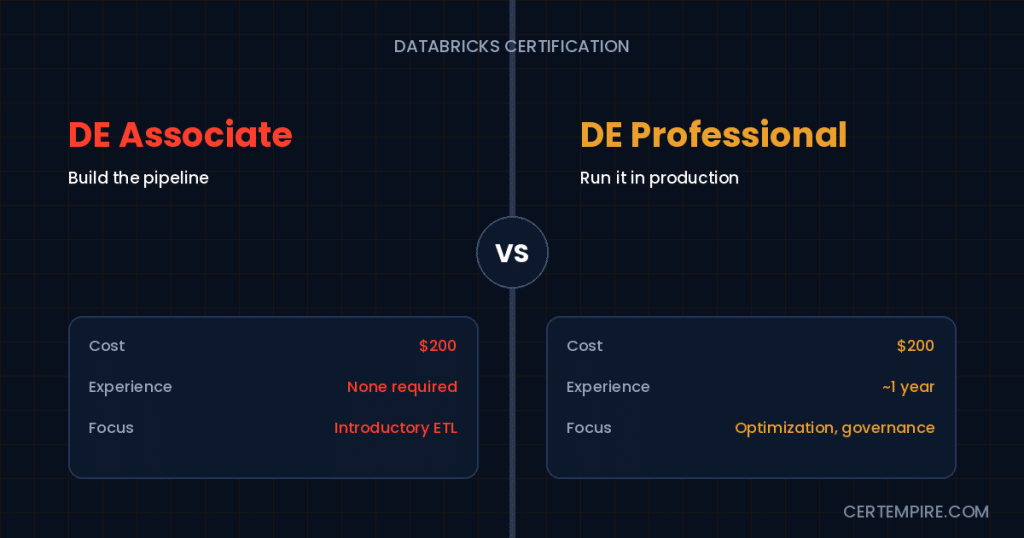
Data Engineer Associate and Data Engineer Professional cost the same $200, share the same 70 percent passing score, and both stay valid for 2 years, so the decision between them has nothing to do with price and everything to do with whether your daily work is building pipelines or operating them at production scale under real constraints. Official exam guides live on Databricks’ certification page.
The direct answer: Take Data Engineer Associate if you’re new to Databricks or your work is introductory ETL, core Spark SQL and Python, the Lakehouse Platform, and incremental data processing. Take Data Engineer Professional once you’re already doing advanced design work, optimization, governance, and production monitoring, and you have roughly a year of hands-on experience behind you. Most successful Professional candidates hold Associate first, though Databricks doesn’t formally require it.
Associate vs Professional at a Glance
| Detail | Data Engineer Associate | Data Engineer Professional |
| Cost | $200 | $200 |
| Question count | 45 | 59 to 60 |
| Duration | 90 minutes | 120 minutes |
| Passing score | 70 percent | 70 percent |
| Validity | 2 years | 2 years |
| Format | Multiple choice and scenario-based, no drag-and-drop or hands-on labs | Multiple choice and scenario-based, no drag-and-drop or hands-on labs |
| Experience assumed | None formally required | Roughly 1 year of hands-on production Databricks work |
| Prerequisite | None | None formally required, though Associate-level knowledge is assumed in practice |
Important: Every Databricks Associate exam runs 45 questions in 90 minutes, and every Professional exam runs 59 to 60 questions in 120 minutes, roughly 2 minutes per question either way. This format is identical across the entire 7-exam catalog, so once you know how one Associate exam is paced, you know how they all are.
What Data Engineer Associate Actually Tests
| Domain | Weight | What It Covers |
| Databricks Lakehouse Platform | 24 percent | Core platform concepts, clusters, notebooks, and how the Lakehouse architecture fits together |
| ELT with Spark SQL and Python | 29 percent | Building extract, load, transform pipelines using both Spark SQL and Python interchangeably |
| Incremental Data Processing | 22 percent | Batch and streaming data processing patterns, handling data that arrives continuously rather than all at once |
| Production Pipelines | 16 percent | Orchestrating and scheduling pipelines using Databricks Workflows |
| Data Governance | 9 percent | Permissions, security, and access control basics through Unity Catalog |
Key point: ELT with Spark SQL and Python is the single heaviest domain at 29 percent, and it specifically tests your ability to move between SQL and Python within the same pipeline, not just competence in one or the other. Candidates who are strong in Python but rusty on Spark SQL syntax, or vice versa, consistently lose points here even when their overall Databricks knowledge is solid.
What Data Engineer Professional Actually Tests
Professional builds on every Associate domain but shifts the questions from “can you build this” to “can you be trusted to run this in production.” That means deeper coverage of performance optimization, tuning Spark jobs and Delta Lake tables for cost and speed, security and governance at a more granular level than Associate’s introductory permissions coverage, monitoring and alerting for pipeline health, and CI/CD practices for deploying pipeline changes safely. Where Associate assumes you’re building your first few pipelines, Professional assumes you’ve already been burned by a production incident and know what questions to ask before deploying changes.
Note: Databricks doesn’t publish Professional’s exact domain weighting with the same granularity as Associate’s, but multiple 2026 study guides consistently describe it as scenario-heavy, presenting a described production situation and asking what the correct optimization, security, or deployment decision is, rather than testing isolated facts.
The Real Gap Between Them
Associate proves you can build a working pipeline. Professional proves you can be trusted to run that pipeline in production, where a bad configuration choice affects real data, real cost, and real uptime. This is the same kind of gap that separates foundational and advanced tiers across most serious technical certifications, the underlying platform knowledge doesn’t change dramatically, but the judgment required to apply it under real constraints does.
| If Your Work Involves | Take |
| Learning the platform, building your first ETL pipelines | Associate |
| Basic Delta Lake and Unity Catalog usage | Associate |
| Moving between Spark SQL and Python comfortably | Associate |
| Optimizing pipeline performance at scale | Professional |
| Implementing governance and security controls in production | Professional |
| Owning CI/CD for data pipelines | Professional |
| Diagnosing and resolving production pipeline incidents | Professional |
Who Should Take Associate, and Who Should Take Professional
Analysts and engineers new to Databricks entirely. Associate is built for exactly this profile, and its 24 percent weighting on core Lakehouse Platform concepts specifically means you don’t need prior Databricks exposure to start preparing, just general SQL and Python comfort.
Data engineers who’ve been running Databricks pipelines for less than a year. Associate remains the right target here too. The exam’s incremental data processing and production pipelines domains assume some hands-on exposure, but not the deep operational scar tissue Professional’s content assumes.
Senior data engineers responsible for pipeline reliability, cost, and security. Professional is built for this exact role, and its scenario-based format specifically tests the tradeoff reasoning this responsibility requires: is this slow job a partitioning problem or a shuffle problem, does this access request violate governance policy, is this the right moment to roll back a deployment.
Team leads evaluating candidates or planning team certification goals. Associate is a reasonable baseline expectation for anyone on a data engineering team. Professional is a meaningful signal specifically for whoever owns production reliability, and treating it as a universal team requirement usually isn’t necessary or realistic.
Preparation Time and What Actually Helps
| Exam | Typical Prep Time | What Helps Most |
| Data Engineer Associate | 4 to 8 weeks | Databricks Academy’s free self-paced courses, plus hands-on practice building pipelines in a free Community Edition workspace |
| Data Engineer Professional | 60 to 100 hours | Real production experience first, supplemented by Databricks Academy’s Professional-level courses and scenario-based practice questions |
Professional’s prep time isn’t dramatically longer in raw hours than Associate’s, but it demands hands-on production exposure that study materials alone can’t substitute for. Reading about CI/CD for data pipelines is meaningfully different from having actually built, broken, and fixed one.
What This Difference Means for Pay
Glassdoor’s 2026 figures put average Databricks Data Engineer pay at $133,130 a year, ranging from $104,368 to $171,580 for senior roles, but Databricks doesn’t independently publish a salary split specifically between Associate and Professional holders. The honest read: Professional-certified engineers land toward the higher end of that range specifically, since the role responsibilities Professional validates, production optimization, governance, CI/CD ownership, are what senior-tier data engineering roles actually pay for. Databricks’ own research states certified professionals broadly earn 15 to 30 percent more than non-certified peers, though that figure comes from the vendor rather than an independent survey, and should be read as a directional signal rather than a guaranteed number for your specific role or region.
Choosing Your Path, and What Comes Next
If you’re deciding between the data engineering track and Databricks’ analytics-focused entry point instead, see our Data Engineer Associate vs Data Analyst Associate comparison for that fork specifically. If your work is closer to general Spark development than Databricks-specific engineering, our Apache Spark Developer vs Data Engineer Associate guide covers that distinction. And if you’re on the machine learning side of Databricks rather than data engineering, the same Associate-to-Professional decision exists there too, covered in our Machine Learning Associate vs Professional comparison.
For the complete 7-exam catalog this pairing sits inside, see our Databricks Certification Path guide.
Common Mistakes When Choosing Between These Two
Assuming Professional is simply a harder version of the same content. It tests genuinely different judgment, production operations rather than pipeline construction, not just more difficult questions on the same material.
Attempting Professional without real production experience because the exam fee is identical to Associate. The fee doesn’t reflect the experience gap the content assumes, and candidates without that background consistently report the scenario questions moving faster than expected.
Skipping Associate entirely when you’re new to Databricks, on the assumption that general data engineering experience elsewhere transfers directly. Databricks-specific tools, Delta Lake’s transaction log behavior, Unity Catalog’s governance model, Workflows orchestration, still need dedicated study even for experienced engineers coming from other platforms.
Underestimating the ELT with Spark SQL and Python domain on Associate. At 29 percent, it’s the heaviest single domain, and candidates who are strong in only one of the two languages consistently underperform here.
Treating Professional’s lack of a published domain breakdown as a reason to skip structured study. The absence of exact percentages doesn’t mean the exam is unstructured, it means you should lean more heavily on scenario-based practice questions to understand the pattern of judgment being tested.
FAQS
Do I need to be a Data Engineer Associate before taking Professional?
Not formally, but Professional’s content assumes Associate-level fundamentals, and most successful candidates hold Associate first.
What’s the real difference between the 2 exams?
Associate tests introductory ETL and platform fundamentals across 5 weighted domains. Professional tests advanced production patterns: performance optimization, governance, security, and CI/CD, assuming roughly a year of hands-on experience, through scenario-based questions rather than a published fixed domain breakdown.
How many questions are on each exam?
Associate runs 45 questions in 90 minutes. Professional runs 59 to 60 questions in 120 minutes. Both work out to roughly 2 minutes per question.
How much does each exam cost?
Both cost $200, with identical passing scores and validity periods.
Which domain carries the most weight on Data Engineer Associate?
ELT with Spark SQL and Python, at 29 percent, followed by the Databricks Lakehouse Platform domain at 24 percent.
How long should I study for Data Engineer Professional?
Roughly 60 to 100 hours if you already have close to a year of hands-on production Databricks experience. Without that experience, expect meaningfully longer, since study materials alone don’t fully substitute for real operational exposure.
Is Data Engineer Associate enough for most data engineering roles?
For entry-level and early-career roles, yes. Professional becomes relevant once your responsibilities shift toward owning production reliability and performance specifically.
Does Data Engineer Professional have a published list of exam domains like Associate does?
Not with the same granularity. Databricks describes Professional’s content areas, advanced design, optimization, governance, monitoring, deployment, but multiple 2026 study guides note it’s tested through scenario-based questions rather than a fixed, published percentage breakdown.
What format do these exams use?
Both are multiple choice and scenario-based. Neither includes drag-and-drop questions or hands-on lab components, a format that’s consistent across all 7 Databricks certifications.
Do certified Data Engineer Professional holders actually earn more?
Glassdoor’s 2026 data shows Databricks Data Engineers averaging $133,130, with senior roles reaching up to $171,580. Databricks doesn’t publish a certification-specific split, but Professional-level responsibilities generally align with the higher end of that range.