
Oracle 1Z0-1085-26 Real Exam Dumps [September 2026 Update]
Our Oracle 1Z0-1085-26 exam dumps provide the most recent and reliable practice material for the Oracle Cloud Infrastructure Foundations Associate certification. Each dump includes verified answers, clear explanations, and useful references to support your study. With free sample questions and Cert Empire’s interactive exam simulator, you can prepare efficiently and approach your 1Z0-1085-26 exam with confidence.
What Users Are Saying:
Half of this exam is Core OCI Services – and that single fact should determine how candidates allocate their preparation time. The four domains carry weights of 50%, 25%, 15%, and 10%. Candidates who spread their study time evenly across all four domains are functionally spending 25% of their effort on the domain that accounts for 50% of questions, and 25% on Governance and Administration that accounts for only 10%. The math matters: answering every Governance question correctly (10%) and every Security question correctly (25%) still leaves 65% of points contingent on Core OCI Services performance. Core OCI Services covers compute (OCI Compute instance types, shapes, boot volumes, images, autoscaling), networking (VCN, subnets, security lists, network security groups, internet gateway, NAT gateway, service gateway, load balancer, FastConnect, VPN), and storage (block volume, object storage storage tiers, file storage, archive storage) – and the exam tests each at the configuration decision level, not just the definition level. Knowing that object storage exists is not sufficient; knowing that Oracle’s standard object storage tier, infrequent access tier, and archive tier have different retrieval time and cost trade-offs, and which tier is correct for a described data access pattern, is what the exam tests. Investing study time proportional to domain weight is the single most impactful preparation decision for 1Z0-1085-26.
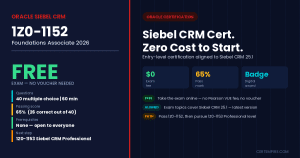
The Oracle 1Z0-1085-26 (Oracle Cloud Infrastructure 2026 Foundations Associate) is a FREE Oracle certification validating foundational knowledge of OCI services, architecture, security, and governance. Released June 2026, replacing the retired 1Z0-1085-25. No prerequisites, no hands-on experience required – the exam is entirely conceptual. 40 questions, 60 minutes, 65% passing.
Cert Empire’s 1Z0-1085-26 exam questions are weighted 50% to Core OCI Services – matching the real exam’s domain distribution.
Exam Snapshot
| Field | Details |
| Exam Code | 1Z0-1085-26 |
| Exam Name | Oracle Cloud Infrastructure 2026 Foundations Associate |
| Vendor | Oracle |
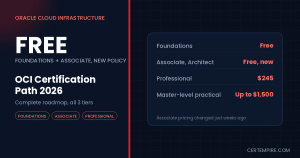
| Cost | FREE (no registration fee per current Oracle University pricing) |
| Number of Questions | 40 |
| Duration | 60 minutes |
| Passing Score | 65% (~26 of 40 correct) |
| Prerequisites | None |
| Replaces | 1Z0-1085-25 (retired May 29, 2026) |
| Delivery | Online (Oracle certification platform) |
| Target Audience | Cloud beginners, IT professionals, business users, students starting their OCI certification journey |
Domain Weights – The Preparation Allocation Guide
| Domain | Weight | Study Allocation |
| Core OCI Services (Compute, Networking, Storage) | 50% | Half of all study time |
| Security Services (IAM, Shared Model, Security Tools) | 25% | One-quarter of study time |
| Getting Started with OCI (Cloud Concepts, Infrastructure) | 15% | Just over one-eighth |
| Governance and Administration (Pricing, Cost Tools) | 10% | One-tenth |
Domain 1: Getting Started with OCI (15%)
Cloud Concepts and OCI Positioning
Cloud computing service models: The exam tests IaaS (Oracle provides virtualized compute, network, and storage; the customer manages OS, middleware, and applications), PaaS (Oracle provides a managed runtime platform; the customer manages applications and data), and SaaS (Oracle provides complete applications; the customer manages only configuration and user data). OCI primarily provides IaaS and PaaS services.
OCI Distributed Cloud: OCI’s distributed cloud delivers consistent Oracle Cloud services across multiple deployment models – not just public cloud regions. The exam tests the four models:
- Public cloud regions: Oracle-owned and -operated data centers accessible from the public internet.
- Dedicated regions (Alloy): A complete OCI region deployed in a customer-owned or partner-owned data center for customers requiring dedicated infrastructure.
- OCI Roving Edge: Hardened portable Oracle Cloud hardware for locations without reliable internet connectivity (military, remote operations).
- Hybrid cloud: Integration between OCI public cloud and on-premises infrastructure through FastConnect or VPN.
The exam tests what distinguishes OCI’s distributed cloud from standard multi-region availability – it is about deployment model variety, not just geographic distribution.
OCI Global Infrastructure
Regions and Availability Domains (ADs): A Region is a geographic cluster of Oracle data centers. Each region contains one or more Availability Domains – independent data centers within the region with separate power, cooling, and network infrastructure. ADs within a region are connected through low-latency, high-bandwidth network but are physically isolated so a failure in one AD does not affect others. The exam tests why deploying resources across multiple ADs within a region provides resilience against data center-level failures.
Fault Domains: Within each Availability Domain, Fault Domains provide further isolation against hardware failures (server rack failures, power delivery failures). Each AD contains three Fault Domains. Resources distributed across Fault Domains are isolated from each other’s physical hardware. The exam tests the Fault Domain as the isolation unit within an AD, just as the AD is the isolation unit within a region.
Compartments: Compartments are logical containers for organizing and isolating OCI resources within a tenancy. A tenancy begins with a root compartment. Child compartments can be created under the root for organizational purposes (by project, environment, team, or cost center). IAM policies are applied at the compartment level. The exam tests how compartments enable access control (policies restricting specific users to specific compartments) and billing isolation (cost tracking per compartment).
Domain 2: Core OCI Services (50%) – Half the Exam
Compute Services
OCI Compute instance shapes: The exam tests shape categories:
- Standard shapes (E-series): AMD EPYC processors, balanced price-performance for general workloads.
- DenseIO shapes: NVMe SSDs locally attached to the compute instance for high-IOPS workloads requiring the lowest possible storage latency (not over the network).
- GPU shapes: NVIDIA GPU acceleration for machine learning training, inference, and graphics rendering.
- HPC shapes: High-performance computing with RDMA networking for scientific simulation and distributed computing.
- Flexible shapes: Candidate selects the exact number of OCPUs and GB of memory rather than choosing from predefined combinations.
Bare Metal vs. Virtual Machine: A Bare Metal (BM) instance gives the customer direct access to the physical server hardware with no hypervisor overhead. A Virtual Machine (VM) instance runs on Oracle-managed hypervisor. The exam tests when bare metal is appropriate (workloads requiring maximum performance, specific hardware security requirements, applications that run poorly in virtualized environments) versus VMs (most standard workloads, faster provisioning, easier resizing).
Images for compute provisioning: Three image types the exam tests: Platform images (Oracle-provided OS images maintained by Oracle), custom images (images the customer creates from an existing instance – capturing current configuration for rapid standardized deployment), and marketplace images (pre-configured application environments from Oracle and third-party vendors). The exam also tests boot volume characteristics: the boot volume is a block volume that persists independently of the compute instance – terminating the instance does not delete the boot volume unless explicitly chosen.
Autoscaling: Autoscaling adjusts the number of compute instances in an instance pool based on defined policies. Metric-based autoscaling scales in or out based on OCI Monitoring metrics (CPU utilization, memory). Schedule-based autoscaling scales at specific calendar times (scale out at 8 AM weekdays, scale in at 8 PM). The exam tests autoscaling policy configuration and the interaction with load balancers (as instances are added or removed, the load balancer’s backend set is updated automatically).
Networking Services
Virtual Cloud Network (VCN): The VCN is OCI’s software-defined private network within a region. Each VCN has a CIDR block defining its private IP address range. The exam tests VCN creation, CIDR block selection (must not overlap with any network the VCN will connect to via peering or VPN), and what a VCN provides (network isolation – resources in a VCN cannot communicate with resources outside it without explicit configuration).
Subnets: Subnets divide a VCN into smaller address ranges. Subnets are either regional (span all ADs in the region – recommended) or AD-specific. Each subnet is either public (resources can have public IPs and be reachable from the internet via the internet gateway) or private (resources have only private IPs and cannot be directly reached from the internet). The exam tests what makes a subnet public vs. private (the subnet’s type – not whether resources in it happen to have public IPs assigned).
Security Lists and Network Security Groups (NSGs): These are the two stateful firewall mechanisms for controlling VCN traffic.
- Security Lists: Applied to subnets. Every resource in the subnet is subject to the subnet’s security list rules. Rules control ingress (inbound) and egress (outbound) traffic by protocol, port, and source/destination CIDR.
- NSGs: Applied to individual resources (compute instances, load balancers, database systems). More granular than security lists – a resource can be in multiple NSGs. NSG rules can reference other NSGs as the source/destination (rather than just CIDRs), enabling cleaner micro-segmentation.
The exam tests the functional difference: security lists operate at the subnet level; NSGs operate at the individual resource level.
Internet Gateway, NAT Gateway, Service Gateway:
- Internet Gateway: Allows public subnet resources to initiate and receive connections with the public internet. Requires the subnet to be public and the resource to have a public IP.
- NAT Gateway: Allows private subnet resources to initiate outbound connections to the internet (e.g., OS updates, external API calls) without exposing them to inbound connections. Resources retain only private IPs.
- Service Gateway: Allows private subnet resources to access Oracle Cloud services (Object Storage, Autonomous Database) without traversing the public internet – traffic stays on Oracle’s backbone network.
The exam tests which gateway is appropriate for which connectivity requirement: a private server needs to download OS patches from the internet (NAT Gateway), a private server needs to access OCI Object Storage without internet exposure (Service Gateway), a web server needs to serve public traffic (Internet Gateway).
Load Balancer: Distributes incoming traffic across multiple compute instances for high availability and horizontal scaling. The exam tests load balancer types:
- Flexible Load Balancer: HTTP/HTTPS and TCP load balancing, Layer 7 content-based routing, WebSocket support.
- Network Load Balancer: Ultra-low latency, Layer 4 (TCP/UDP), handles millions of connections per second.
The exam tests listener configuration (what port the load balancer listens on), backend set (the group of compute instances receiving traffic), and health checks (how the load balancer determines which backends are healthy).
FastConnect and VPN Connect: Enterprise connectivity options for hybrid cloud.
- FastConnect: A dedicated physical circuit between the customer’s data center and OCI, providing predictable bandwidth and low latency through a third-party provider.
- VPN Connect: An IPsec-encrypted VPN tunnel over the public internet – lower cost, higher latency than FastConnect, bandwidth limited by internet quality.
The exam tests when each is appropriate: latency-sensitive enterprise applications require FastConnect; development environments or backup connectivity can use VPN Connect.
Storage Services
OCI Block Volume: Persistent, high-performance block storage for compute instances. Attached to a single compute instance at a time and accessed like a local disk. The exam tests block volume performance tiers (Lower Cost, Balanced, Higher Performance, Ultra High Performance – higher tiers provide higher IOPS per GB at higher cost), block volume backup to Object Storage, and cross-region replication for DR.
OCI Object Storage: Scalable, unstructured data storage accessed via REST API (HTTP/HTTPS). Not mounted as a file system – accessed programmatically using the OCI SDK, CLI, or S3-compatible API. The exam tests the three storage tiers:
- Standard tier: Frequently accessed data, highest throughput, immediate retrieval, highest cost per GB.
- Infrequent Access tier: Data accessed less than once per month, lower cost per GB, small retrieval fee per request.
- Archive tier: Long-term archive for data rarely or never accessed, lowest cost per GB, retrieval takes hours (objects must be restored before download).
The exam presents a data access pattern and tests which tier is correct: active application data (Standard), monthly compliance reports (Infrequent Access), seven-year regulatory archives (Archive).
OCI File Storage: A shared, hierarchical file system accessed via NFS protocol from multiple compute instances simultaneously. Appropriate when multiple servers need concurrent access to the same file data – shared application code, shared media assets, home directories for multi-user systems. The exam tests File Storage vs. Block Volume: Block Volume attaches to one instance; File Storage mounts to many instances simultaneously.
OCI Archive Storage: The exam tests Archive as the Object Storage tier for long-term archives – clarifying that Archive is a property of Object Storage, not a separate independent service. Archive objects must be restored before download; restoration time is measured in hours.
Domain 3: Security Services (25%)
OCI Shared Security Model
The exam tests the shared responsibility boundary between Oracle and the customer. Oracle is responsible for: physical data center security, hypervisor and hardware security, Oracle Cloud network infrastructure security, and OCI service security (patching the managed database engine, for example). The customer is responsible for: what runs inside their VCN (firewall rules, OS patches on IaaS VMs, application security), IAM configuration (who has access to what), data encryption choices, and data classification.
A common exam question pattern: which of these is Oracle’s responsibility vs. the customer’s? Patching the operating system of a compute VM is the customer’s responsibility. Patching the underlying hypervisor is Oracle’s responsibility.
Identity and Access Management (IAM)
IAM components the exam tests:
- Tenancy: The root container for all OCI resources for an organization – the top of the resource hierarchy.
- Users: Individual human identities (or service accounts) that authenticate to OCI.
- Groups: Collections of users who share common access requirements. IAM policies grant permissions to groups, not individual users.
- Policies: Documents that specify who can do what on which resources in which compartment. Policy syntax: Allow group <GroupName> to <verb> <resource-type> in <location>.
- Dynamic Groups: Rules-based groups that match compute instances, functions, or other OCI resources (rather than users) – allowing OCI resources themselves to make authenticated API calls to other OCI services.
Policy verbs the exam tests: inspect (list resources, no read of sensitive details), read (inspect plus read resource content), use (read plus perform most operations on existing resources), manage (all operations including create and delete).
Identity Domains: The current IAM architecture uses Identity Domains as the container for users, groups, and authentication settings. The exam tests Identity Domain as the modern IAM concept that replaced the older user management approach.
OCI Security Services
OCI Cloud Guard: Continuously monitors the tenancy for security configuration problems (a public Object Storage bucket, an overly permissive IAM policy, a compute instance with a known vulnerability) and automatically detects security posture problems. Cloud Guard detectors identify problems; responders automatically remediate them. The exam tests Cloud Guard as the posture management service.
OCI Security Zones: Enforces security guardrails at the compartment level. A Security Zone is a compartment with policies that cannot be violated – for example, you cannot create a public subnet in a Security Zone compartment, or create a compute instance without an approved image. The exam tests Security Zones as the mechanism for preventing insecure configurations from being deployed at all (unlike Cloud Guard, which detects and fixes problems after they occur).
OCI Vault: A managed service for storing and managing secrets (API keys, passwords, database connection strings) and cryptographic keys. Applications retrieve secrets from Vault at runtime rather than storing them in code or configuration files. The exam tests OCI Vault as the secure secret management solution – specifically that secrets must not be hardcoded in application code.
Domain 4: Governance and Administration (10%)
OCI Pricing and Cost Management
OCI Pricing models:
- Pay-as-you-go (PAYG): Pay for resources consumed with no upfront commitment. Highest per-unit price, maximum flexibility.
- Monthly Flex: Commit to a monthly spend level (minimum $1,000/month) for a discount over PAYG rates.
- Annual Universal Credits: Commit to a one-year or multi-year spend for deeper discounts.
- BYOL (Bring Your Own License): Existing Oracle software licenses can be applied to OCI resources, reducing software costs.
The exam tests which model applies to which described customer situation.
OCI Cost Management tools:
- Cost Analysis: Reports showing actual OCI spending broken down by service, compartment, tag, or time period. Used for analyzing past spending.
- Budgets: Configurable spending alerts that notify when actual or projected spending exceeds a defined threshold.
- OCI Cost Estimator: A planning tool that estimates the cost of a proposed OCI configuration before committing to resources.
OCI Support tiers: Basic (included at no cost, documentation and community access only), Developer (technical support for developers), Standard (production-level support with faster response times), Premier (highest priority support with dedicated resources). The exam tests which support tier is appropriate for production environments versus development or testing.
5 Study Tips for Oracle 1Z0-1085-26
- Tip 1: Allocate your study time proportional to domain weights: spend half your total study time on Core OCI Services. Compute, networking (VCN, subnets, gateways, security lists vs. NSGs, load balancer), and storage (block, object, file, and archive tier distinctions) together deserve as much study time as the other three domains combined.
- Tip 2: Study the three OCI storage types with use-case precision: Block Volume for per-instance block storage, Object Storage for unstructured data accessed via API, File Storage for shared file system access by multiple instances. Know the three object storage tiers (Standard, Infrequent Access, Archive) and when each is appropriate.
- Tip 3: Study the three VCN gateways (Internet Gateway, NAT Gateway, Service Gateway) and when each is required. These questions appear consistently across OCI Foundations exam sittings.
- Tip 4: Study the IAM policy syntax (Allow group X to verb resource-type in location) and the four verbs (inspect, read, use, manage) in order of increasing privilege.
- Tip 5: Practice with Cert Empire’s 1Z0-1085-26 exam questions with Core OCI Services at 50% of the question bank – matching the real exam’s domain distribution.
Best Study Resources
- Cert Empire 1Z0-1085-26 exam questions PDF and practice simulator (June 2026 edition – aligned to the current exam replacing 1Z0-1085-25).
- Oracle MyLearn: Oracle Cloud Infrastructure 2026 Foundations course (free, includes exam access).
- AGuideToCloud.com OCI Foundations 2026 study guide (aguidetocloud.com/cert-tracker/oci-foundations/) – confirmed domain weights and 250 practice questions.
- OpenExamPrep.com – 200 free OCI Foundations practice questions with explanations.
- SkillCertPro OCI Foundations Associate practice exams.
Career Opportunities After 1Z0-1085-26
- Cloud Associate (OCI)
- Junior Cloud Engineer
- Pre-Sales Cloud Consultant
- IT Operations Staff (Cloud Transition)
- Cloud Architecture Student / Certification Track Entry
The OCI Foundations Associate is the gateway credential for all advanced OCI certification tracks – Architect Associate, Developer Professional, Security Professional, Networking Professional. Earning it while it is free establishes OCI foundational literacy and activates the Oracle certification track.
Why Candidates Choose Cert Empire for Oracle 1Z0-1085-26 Preparation
✔ Domain-weight-aligned question bank. Our 1Z0-1085-26 question bank allocates 50% of questions to Core OCI Services, 25% to Security Services, 15% to Getting Started, and 10% to Governance – matching the official domain weights exactly.
✔ VCN gateway selection scenario questions. We test Internet Gateway vs. NAT Gateway vs. Service Gateway selection with described network requirement scenarios – the consistent source of exam difficulty for networking-unfamiliar candidates.
✔ Object storage tier selection questions. Our questions present data access patterns and test which storage tier (Standard, Infrequent Access, Archive) is most cost-appropriate.
✔ IAM policy component questions. We test the four IAM verbs, group vs. dynamic group distinctions, and compartment-level policy scoping.
✔ Backed by a full money-back guarantee. If our exam questions do not help you pass, we refund your purchase.
FAQ’s
What is Oracle 1Z0-1085-26?
1Z0-1085-26 is the Oracle Cloud Infrastructure 2026 Foundations Associate certification exam, released June 2026 and replacing the retired 1Z0-1085-25. It validates foundational knowledge of OCI services, architecture, security, and governance at a conceptual level.
Is the 1Z0-1085-26 exam free?
Yes, per current Oracle University pricing the OCI Foundations Associate exam is available at no registration fee. Candidates can access the exam through Oracle MyLearn after completing the OCI Foundations learning path.
What are the four domains and their weights?
Core OCI Services (50%), Security Services (25%), Getting Started with OCI (15%), and Governance and Administration (10%).
Does this exam require hands-on OCI experience?
No. The exam is entirely conceptual – it validates knowledge of what OCI services are and how they work without requiring candidates to have performed hands-on configuration. This makes it accessible to business users, students, and IT professionals new to OCI.
How long is the OCI Foundations certification valid?
Oracle Cloud Infrastructure certifications are valid for 24 months from the date earned.
Related Certifications Worth Exploring
Oracle 1Z0-1085-26 certified professionals advancing to the next level of OCI expertise will find our Oracle Cloud Infrastructure 2026 Cloud Ops Professional (1Z0-1067-26) exam questions page covers enterprise OCI operations, automation, monitoring, security, networking, and infrastructure management skills that build directly on the foundational cloud knowledge validated by 1Z0-1085-26. For those pursuing the architect track, our Oracle Cloud Infrastructure Architect Associate exam questions page covers the solutions architecture credential that follows OCI Foundations.
Related Posts
-

-
-
-
-
-




Reviews
There are no reviews yet.